No Picture
News Briefs

Jesuit superior general: Satan is real, and wants us to reject God

December 6, 2019 CNA Daily News 2

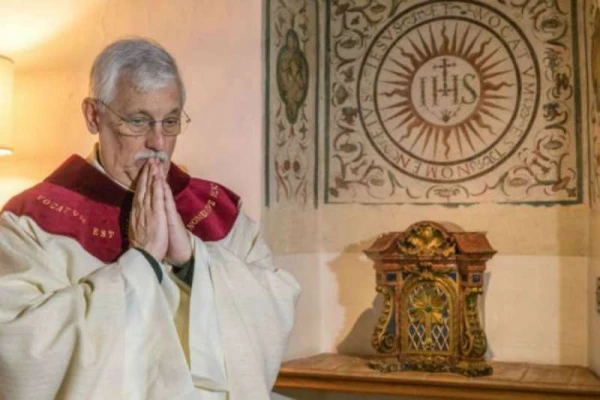
Vatican City, Dec 6, 2019 / 12:12 pm (CNA).- The superior general of the Jesuit order told reporters Tuesday that the devil is real, after making headlines in August by stating that Satan is a symbol, not a person.

Satan “is the one who stands between God’s plan and his work of salvation accomplished in Christ, because he has made this irreversible and free decision, and he wants to drag others to reject the merciful God, who prefers to give his life to save instead of to condemn,” Fr. Arturo Sosa, SJ, said in a Dec. 2 meeting with journalists, according to a report from Vida Nueva.

Sosa added that “the power of the devil…obviously still exists as a force that tries to ruin our efforts.”

Sosa’s comments came amid remarks he offered on the six Jesuits and two employees killed in November 1989 by Salvadoran soldiers at the University of Central America in San Salvador.

On Aug 21, Sosa told an Italian magazine that the devil “exists as the personification of evil in different structures, but not in persons, because is not a person, is a way of acting evil. He is not a person like a human person. It is a way of evil to be present in human life.”

“Good and evil are in a permanent war in the human conscience and we have ways to point them out. We recognize God as good, fully good. Symbols are part of reality, and the devil exists as a symbolic reality, not as a personal reality,” he added in August.

The Catechism of the Catholic teaches that “Satan was at first a good angel, made by God: ‘The devil and the other demons were indeed created naturally good by God, but they became evil by their own doing.’”

Angels, the Catechism says, are “spiritual, non-corporeal beings.”

Sosa, 71, was elected the Jesuits’ superior general in 2016. A Venezuelan, he has a pontifical licentiate in philosophy and a doctorate in political science. He served as a Jesuit provincial superior in Venezuela from 1996 to 2004, and in 2014 began an administrative role at the general curia of the Jesuits in Rome.

Sosa has offered controversial comments about Satan in the past. In 2017, he told El Mundo that “we have formed symbolic figures such as the Devil to express evil.”

After his 2017 remark generated controversy, a spokesman for Sosa told the Catholic Herald that “like all Catholics, Father Sosa professes and teaches what the Church professes and teaches. He does not hold a set of beliefs separate from what is contained in the doctrine of the Catholic Church.”


[…]

No Picture
News Briefs

Pope Francis: Don’t forget the real meaning of Christmas

December 5, 2019 CNA Daily News 1

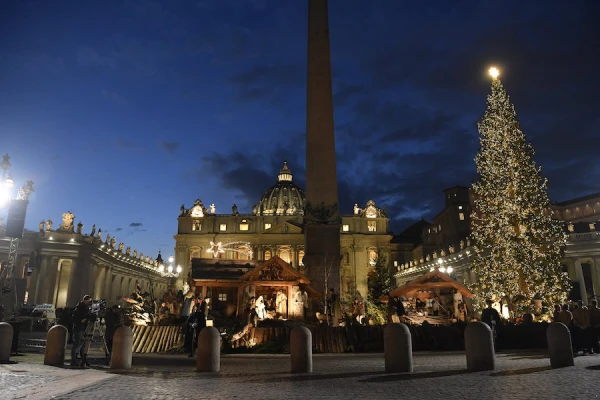
Vatican City, Dec 5, 2019 / 10:40 am (CNA).- Ahead of the Vatican Christmas tree lighting Dec. 5, Pope Francis expressed hope that the nativity scene in St. Peter’s Square will serve as a reminder of what Christmas is truly about.

A nativity scene “is a genuine way of communicating the Gospel, in a world that sometimes seems to be afraid of remembering what Christmas really is, and blots out the Christian signs to only keep those of a banal, commercial imagination,” Pope Francis told an Italian delegation at the Vatican for the Christmas tree lighting ceremony Dec. 5.

This year’s Vatican Christmas tree comes from the northern Italian region of Vicenza, which was greatly damaged by storms in October 2018. The red spruce in St. Peter’s Square is a little over 85 feet tall.

The Christmas tree lighting ceremony also revealed a life-size nativity scene carved out of wood with tree trunks from Vicenza placed in the background in memory of the storm.

“The wooden trunks, coming from the areas hit by the storms, which form the backdrop to the landscape, underline the precariousness in which the Holy Family was found on that night in Bethlehem,” Pope Francis said.

Pope Francis met with delegations from the Italian diocese of Trento, Padua and Vittorio Venetoin at the Vatican’s apostolic palace Dec. 5 before the Christmas tree and nativity scene were presented.

“Today’s meeting offers me the opportunity to renew my encouragement to your people, who last year suffered a devastating natural disaster, with the demolition of entire wooded areas,” Pope Francis told the delegation.

“I was pleased to learn that, replacing the plants removed, 40 fir trees will be replanted to replenish the woods severely damaged by the storm of 2018,” he said.

The Vatican Christmas tree is illuminated by energy-saving Christmas lights from the German multinational OSRAM, to reduce the environmental impact of the display.

Cardinal Giuseppe Bertello and Bishop Fernando Vérgez Alzaga chaired the Vatican Christmas lighting ceremony. The nativity scene and Christmas tree will remain on display in St. Peter’s Square until January 12, 2020, the feast of Christ’s Baptism.

Pope Francis began Advent with a trip to the Italian town of Greccio, where St. Francis of Assisi created the first nativity scene in 1223. In Greccio, Pope Francis signed the apostolic letter, Admirabile signum, on the meaning and importance of nativity scenes.

“All those present experienced a new and indescribable joy in the presence of the Christmas scene. The priest then solemnly celebrated the Eucharist over the manger, showing the bond between the Incarnation of the Son of God and the Eucharist,” Pope Francis wrote in the letter describing the St. Francis’ first nativity.

“As we contemplate the Christmas story, we are invited to set out on a spiritual journey, drawn by the humility of the God who became man in order to encounter every man and woman. We come to realize that so great is his love for us that he became one of us, so that we in turn might become one with him,” Pope Francis said.

[…]

No Picture
News Briefs

‘The key is not to fight, but just to bear witness’: How to preach Advent

December 5, 2019 CNA Daily News 0

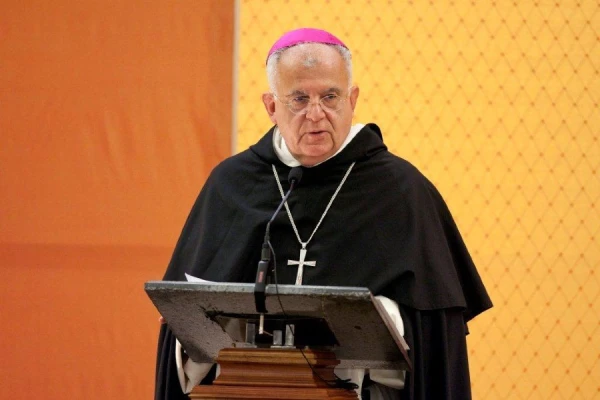
Washington D.C., Dec 5, 2019 / 08:35 am (CNA).- The season of Advent, and the entire cycle of the liturgical year, is vital to remaining rooted in the true mission of the Church, Archbishop Joseph Augustine Di Noia, O.P., adjunct secretary of the Congregation for the Doctrine of the Faith, told CNA. 

Di Noia spoke to CNA Dec. 4 about his newly-released book, “Grace in Season: The Riches of the Gospel in Seventy Sermons” which was published Nov. 15 by Cluny Media. 

“The theme of the book is that the preacher should realize that the liturgical year is a unit that is repeated every single year, and it starts with Advent and finishes with Pentecost,” said Di Noia. The book, a collection of Di Noia’s own sermons, is organized by the liturgical seasons. 

The combined readings–the prayers, the preface, and everything said at Mass– form “a story that you fit into. The liturgy is the key, the entree to it,” he said. By repeating this liturgy in the liturgical year, “we become like Him,” said Di Noia. “That’s the unspoken premise of the book.” 

The liturgical year, he said, is support for the faith similar to a sacramental, and is the “fundamental pattern of Christian spirituality” that is configured to Christ. Preachers, he said, should look to the lectionary and the Sunday readings first and foremost when deciding what they will preach to their homilies. 

“And each season,” he said, “has a particular grace. So Advent is the grace to realize the complete gratuity of grace.”

In the middle of a secularized holiday season, the archbishop said it was important to remain rooted in the true meaning of the time. In the present culture, where the true meaning of Advent as a season of somber preparation is largely discarded, Di Noia said that the best approach to respecting the liturgical season is by hunkering down and living a Christian life in spite of everything. 

“We can’t change the culture,” said Di Noia. “You just have to maintain [a devotion to Advent]. It’s an effort and it requires a certain amount of discipline to concentrate on Advent.” 

“People say, ‘Let’s put Christ back into Christmas.’ I say ‘who took him out?’ Who could take him out?”

Reflecting on the Advent practice of looking towards the second coming of Christ, Di Noia said that it is key to remember why exactly it was that Christ came to earth. 

“Christ did not come for the resolution to [societal] problems,” said Di Noia. “He came to confront the sin in the human heart, directly. He didn’t try to do something superficially.”

Had Christ been born as the son of someone prominent, such as an emperor, that would have undermined his purpose and  “would have confirmed us in our belief that we can deal with sin […] and that there are human ways we can dissolve it.” 

“In the end, without the passion, death, and resurrection of Christ, sin is intractable. It cannot be cured,” he said. 

In his current role at the Congregation for the Doctrine of the Faith, the Vatican department charged with guarding Church discipline in faith and morals, Di Noia is not ordinarily permitted to speak publicly on the nature of his work. But, he told CNA, his day job has not stopped him living out the Dominican charism of teaching and preaching.

The collection of sermons, said Di Noia, “is a way of evangelizing” which was suggested to him by a fellow Dominican friar in Rome.  

The majority of the 70 homilies picked for the book date from after his consecration as a bishop in 2009. Prior to this time, he said he did not typically write down sermons, and instead preferred to form a general idea and preach spontaneously from there. Once he began writing down sermons, he realized he could better craft his preaching and include quotes from the Church Fathers. 

“I’m preaching all the time,” he said, noting that he frequently lectures as well. His work in the CDF he categorized as “pastoral,” while noting the tragic reality that the CDF is now mostly known for dealing with cases of sexual abuse by clerics.

Di Noia is acutely aware of how the abuse crisis has shaken the Church and the faithful, and in particular how it has changed the wider perception of the Church and of Catholics in society. For struggling Catholics, Di Noia offered a reflection on how Christ himself was treated leading up to his crucifixion.

“The profound significance of what the Church experiences in the world is that the suffering is the power of Christ,” he said. Di Noia pointed to a passage from the Gospel of John, where it states “He came to his own and his own received him not.” 

“So that, in other words, the expectation that the message is not going to be palatable is the default position,” he said with a laugh. 

“They key is not to fight, but just to bear witness. It’s very difficult,” he said. 

[…]

No Picture
News Briefs

Release of new curial constitution delayed again

December 4, 2019 CNA Daily News 1

Vatican City, Dec 4, 2019 / 09:30 am (CNA).- The publication date of the new constitution governing the Roman Curia has been delayed again as Pope Francis’ council of cardinals continues to evaluate suggestions to the draft that was given to bishops’ conferences in May.

The now six-member advisory council met at the Vatican Dec. 2-4.

According to a brief Vatican press release Dec. 4, the group of cardinals had continued to receive suggestions on the text of the new apostolic constitution, provisionally titled Praedicate evangelium, until a few days before the start of the latest round of meetings.

The council of cardinals will continue its “reading and evaluation” of the draft at its next meeting, which will take place in February 2020, the Holy See press office stated.

Praedicate evangelium will replace Pastor bonus, the current apostolic constitution on the Roman Curia promulgated by Pope John Paul II on June 28, 1988, and subsequently modified by both popes Benedict and Francis.

The new document is expected to place renewed emphasis on evangelization as the structural priority of the Church’s mission, with some predicting the merger of the Vatican’s Congregation for the Evangelization of Peoples and the Pontifical Council for the Promotion of the New Evangelization into a single larger department.

In June, the secretary of the council, Bishop Marcello Semeraro, said there was a possibility Pope Francis would see a final draft of the document in September, but in September cardinals were still working on incorporating the suggestions submitted by bishops’ conferences and others during the summer.

The new constitution has been the advisory group’s key reform project since its establishment in 2013, one month after Pope Francis’ election.

According to the press release, this week’s meetings focused on two aspects of the draft text: the relationship between the Roman Curia and bishops’ conferences, and the presence of lay men and women in decision-making roles in curial and other Church offices.

The “theological-pastoral bases of these aspects” was also studied.

The Council of Cardinal Advisors is often referred to informally as the “C9,” although there have been only six members for nearly the past year.

The current members – Cardinals Pietro Parolin, Oscar Rodriguez Maradiaga, Reinhard Marx, Sean O’Malley, Giuseppe Bertello, and Oswald Gracias – were all present for the latest gathering, the group’s 32nd round of meetings.

Pope Francis also attended sessions, when not in other audiences and appointments. Bishop Marcello Semeraro, the secretary of the council, was also present at the meetings this week.

Besides discussing the curial constitution, the council heard a report from Cardinal Michael Czerny on October’s Synod of Bishops on the Amazon and some considerations from Cardinal O’Malley on the work of the post-synodal apostolic exhortation.

They also heard from Cardinal Marx on the Church in Germany’s “synodal path” and the topics on which it will focus.

[…]

No Picture
News Briefs

Pray that bishops, priests will manifest Christ’s love, Pope Francis urges

December 4, 2019 CNA Daily News 1

Vatican City, Dec 4, 2019 / 06:17 am (CNA).- Bishops and priests have a duty to guard and protect the Catholics entrusted to their care; and they need the faithful’s prayers for this task, Pope Francis said at the general audience Wednesday.

“Let us ask the Lord to renew in us love for the Church and for the deposit of the faith that it preserves, and to make us all co-responsible in the custody of the flock, supporting the pastors in prayer so that they manifest the firmness and tenderness of the Divine Shepherd,” he said Dec. 4.

He emphasized that “bishops must be very close to their people to guard them, to defend them; not detached from the people.”

Reflecting on the Acts of the Apostles, he explained that in chapter 20 Paul is saying farewell at the end of his apostolic ministry in Ephesus, giving a sort of “spiritual testament” to those who will lead the community after his departure and who will probably never see him again.

Pope Francis recommended everyone read chapter 20 of the Acts of the Apostles to learn how to say goodbye, calling it one of the “most beautiful” passages in Acts.

In this passage, Paul also exhorts the leaders of the community. “And what does he say to them?” the pope said. “‘Watch over yourself and the whole flock.’ This is the work of the shepherd: waking, watching over himself and the flock.”

“The priests must watch, the bishops, the pope must watch,” he continued. “Keep vigil to guard the flock, and also to watch over oneself, examine one’s conscience and see how this duty to watch is carried out.”

He quoted Acts 20:28, which says, “Watch over yourselves and over the whole flock, in the midst of which the Holy Spirit has constituted you as guardians to be shepherds of the Church of God, which was acquired with the blood of his own Son.”

The pope again recommended that people “not forget today to take a Bible and read the 20th chapter, verses 17 onward, of the Book of the Acts of the Apostles. It is a jewel and good for everyone.”

Pope Francis also spoke against belief in magic, fortune telling, or tarot cards.

“Even today in the big cities, practicing Christians do these things,” he said. “Please: magic is not Christian!”

“These things that are done to guess the future or guess many things or change life situations are not Christian. The grace of Christ brings you everything: pray and entrust yourself to the Lord,” he urged.


[…]