No Picture
News Briefs

Scholar hopes Vatican archives will give ‘fuller, transparent’ picture of Pius XII

March 15, 2020 CNA Daily News 1

Washington D.C., Mar 15, 2020 / 12:00 pm (CNA).- A researcher from the United States Holocaust Memorial Museum told CNA that she hopes the recent opening of the Pius XII archives in the Vatican will give historians a fuller, more transparent image of the wartime pope. 

Dr. Suzanne Brown-Fleming, the museum’s director of international academic programs, has been unable to travel to Rome to view the archives due to the COVID-19 outbreak, but told CNA that she hopes to make the trip in April. 

Brown-Fleming spoke to CNA Thursday about what she expects to find in the archives. 

The Vatican officially opened the archives, which cover Venerable Pius XII’s entire pontificate — March 1939 through October 1958 — on March 2. It is the first time scholars have been granted access to the  approximately 16 million documents they contain. 

Pius XII remains a disputed figure, with some historians criticising him for not making a more explicit denunciation of Hitler and the Nazis, and others pointing to Mit brennender Sorge, his 1937 encyclical to the Church in Germany, and the limits imposed on him by the Lateran Treaty.

After examining the documents in the archives, Brown-Fleming said that historians will “definitely have a more fair reading of [Pius XII].”

“I think that on both sides of the argument there has been picking and choosing as to ‘let’s show this document and interpret it this way and ignore these five documents,’ and his critics have done the same,” she said. “So I’m not sure either side has been completely fair, because there’s been no access to the full documentation.” 

Brown-Fleming thinks that the public opinion will likely end up “somewhere between the two polar opposites that we’re seeing now,” but that this will not happen until the archives have been fully studied. 

“But it will be a fair and transparent reading,” she said. 

Pius XII died in 1958, his cause for canonization was opened in November 1965, by Pope (now Saint) Paul VI during the final session of the Second Vatican Council. On December 19, 2009, Pope Benedict XVI declared him “Venerable,” meaning the Church has determined that he led a life of heroic virtue.

A practicing Catholic, Brown-Fleming told CNA that she hopes she is able to find documentary proof that the Church and individual Catholics in Europe invoked the tenets of their faith and tried to save their Jewish neighbors. 

“Did they respond in a uniform ‘love thy neighbor’ way, or did they parse in their minds? I think it’s going to be very interesting to know,” she said. 

A big question, and one that Brown-Fleming hopes will be answered by the archives, concerns Pius XII’s actions in September 1943, when Rome’s Jewish population was rounded up and deported. 

“There’s a big question around whether Pius XII gave orders to have Roman Jews hidden. Many Jews were hidden including on Vatican grounds,” she said. “Did he order that? Did he know about it and say, okay, ‘this is not a good idea because it puts Vatican property in danger’? Did he say, ‘yes, please do this and save who you can’?” 

“We know that Jews were rescued by Catholic families in Italy and in France,” said Brown-Fleming. She told CNA that she was hopeful her time in the archives will reveal the motivations behind why these families chose to risk their lives to save people: “Was it because of messaging from the pope or was it spontaneous?”

Another question Brown-Fleming wants the archives to answer is what Pius XII knew in the post-war era, when a Vatican “ratline” enabled many former Nazis to escape to South America.

“In the Cold War period, many Nazis escaped to South America with the help of the Vatican–lower level officials,” she said. “But how much did the Pope know about this? That’s a very big question.” She is also hoping to find information about Pius XII’s personal attitude towards the Jewish people, which is “something that’s very hard to discern in public messaging.” 

Once she is granted permission to travel to Italy and examine the archives, Brown-Fleming intends on starting her research in the Vatican Apostolic Archive. She explained that there are four reading rooms in the archive, and that the first room is dedicated to indices. She says the plan is to look for certain keywords in the indices.

Once those keywords are found, Brown-Fleming will request the entire folder. She hopes that, similar to the 2003 opening of Pius XI’s archives, the United States Holocaust Museum would be given permission to reproduce the some of the contents of the archives and keep them in Washington.

Regardless of what is found, Brown-Fleming said she is glad that there will finally be answers about the legacy of Pius XII, and she is confident that whatever is uncovered will be a positive move for the Church.

The archives will “kind of settle those questions” regarding Pius XII and the actions of the Church during World War II, “even if the answers aren’t always good. And I don’t think they always will be, because we’re talking about human beings and even a pope makes mistakes.” 

“We’re going to find a mixed record, but at least we know what it is,” she said. “And then once we know what it is, we can really wrestle with that.”

[…]

No Picture
News Briefs

Rome’s churches closed, then opened again. What happened?

March 13, 2020 CNA Daily News 2

Vatican City, Mar 13, 2020 / 01:47 pm (CNA).- Less than one day after the Diocese of Rome closed all Roman churches to the public, the cardinal who oversees the diocese reversed himself, saying he would leave that decision to parish pastors.

Both announcements came amid deliberations between Pope Francis and Cardinal Angelo De Donatis, the vicar general of Rome, who oversees the day-to-day operations of a diocese whose bishop is Pope Francis.

De Donatis published a letter March 13 explaining that he consulted with Pope Francis before closing the churches for private prayer March 12, and before opening them again March 13.

“After consulting our bishop, Pope Francis, we published yesterday, March 12, the decree that establishes the closure of our churches for three weeks,” Cardinal Angelo De Donatis wrote in a letter to the Diocese of Rome.

“A further conversation with Pope Francis, this morning, however, prompted us to consider another need: that because of the closure of our churches, other ‘least ones’ find a different kind of reason for uncertainty and confusion. The risk is for people to feel even more isolated,” he explained.

Before the initial decision’s reversal, Pope Francis had spoken out against “drastic measures” in response to the coronavirus in his morning homily televised throughout Italy and livestreamed online.

“Let’s pray for this, that the Holy Spirit may give to pastors the ability for pastoral discernment so that they might provide measures which do not leave the holy, faithful people of God alone, and so that the people of God will feel accompanied by their pastors, comforted by the Word of God, by the sacraments, and by prayer,” Pope Francis said March 13.

Pope Francis had prayed for authorities who “must decide … on measures that people do not like” in his homily the day prior.

In defiance of the initial church closure decree, the cardinal in charge of the pope’s charity office, Cardinal Konrad Krajewski, opened Friday his titular church, St. Mary Immaculate all’Esquilino, a church located in an ethnically-diverse, and poor, area of Rome.

“In full compliance with safety standards, it is my right to ensure an open church for the poor. At 8:00 this morning, I came here and opened the door wide. In this way the poor will be able to adore the Blessed Sacrament which is the consolation for all in this moment of grave difficulty,” Krajewski said, according to Vatican News.

The diocesan reversal came shortly after.

The revised decree clarifies that “non-parish churches” and other religious buildings will remain closed, while parishes and missionary churches dedicated to care for others can be reopened. The properties of religious communities and monasteries are only accessible to the members of their communities.

The decree “is therefore modified, placing the ultimate responsibility of entering the places of worship in the hands of priests and all the faithful, so as not to expose the population to any danger of contagion and at the same time avoid the sign of a physical prohibition on access to a place of worship by closing it, which could create disorientation and a greater sense of insecurity,” Cardinal De Donatis wrote.

“Every ecclesial precautionary measure must take into account not only the common good of civil society, but also of that unique and precious good which is faith, especially that of the least ones,” he said.

The vicar general exhorted Catholics to follow the Italian government’s quarantine measures until April 3, and to stay at home.

“Coronavirus infection is spreading exponentially. In a few days the number of infected doubles, and at this rate it is not difficult to predict that in two months it will reach the order of tens of thousands of people only in Italy,” De Donatis wrote in his letter.

“There is a clear risk of collapse of healthcare facilities, in which there are already many on ventilators, above all because of the disproportion between the available intensive care resources and the growing number of patients. A large number of people could die, especially the elderly and vulnerable people,” the vicar of Rome said.

There are 242 confirmed cases of COVID-19 currently in Lazio, the region surrounding Rome, as of March 13, according to the Italian Ministry of Health.

Coronavirus cases in Italy have grown quickly in recent weeks surpassing 17,500 documented cases. More than 1,250 people have died from COVID-19 in the country since Feb. 22.

A nationwide quarantine has been declared in Italy through April 3 in order to slow the spread of the coronavirus pandemic.

The quarantine restricts movement within Italy and requires people to stay in their homes except for cases of absolute necessity, which may include going to work, to the pharmacy or hospital, or to the supermarket.

On March 11, Italy’s Prime Minister Giuseppe Conte tightened the restrictions of a nationwide lockdown to include the closure of all restaurants, bars, and non-commercial businesses other than supermarkets.

In all cases, a distance of one meter must be maintained between people in public. Not following these regulations is punishable by fine or arrest.

The previous Diocese of Rome decree suspending all public Masses in the diocese until April 3 still stands, however now Catholics will once again have access to some parishes for private prayer.

“The spiritual need of the people of God to gather to celebrate the Eucharist becomes for us Christians the object of a painful renunciation. There is first the spiritual need for the charity of caring for our brothers. Unfortunately, going to church is no different than going to other places: it is at risk of contagion,” De Donatis wrote.


[…]

No Picture
News Briefs

Vatican offices to remain open amid coronavirus lockdown

March 12, 2020 CNA Daily News 0

Vatican City, Mar 12, 2020 / 07:03 am (CNA).- Amid the coronavirus pandemic, Vatican City State offices and dicasteries of the Holy See will remain open and working, with additional precautions and the possibility to work from home in some cases, the Vatican said Thursday.

A March 12 statement said “it has been established that the dicasteries and entities of the Holy See and of the Vatican City State remain open to ensure essential services to the Universal Church.”

With the permission of their superior, certain employees may work remotely. Those whose work regards materials or information protected by the pontifical secret may not work from home, according to provisions distributed by the Secretariat of State, which is coordinating the Vatican’s measures during the coronavirus pandemic.

The decision to continue work was made during a special March 12 meeting of the heads of dicasteries, chaired by Secretary of State Cardinal Pietro Parolin.

The Secretariat of State’s provisions asked that offices adopt flexible hours and have employees and officials work varying shifts to avoid having many people present in the office at the same time.

“The activities of the dicasteries, of the entities of the Holy See or connected to it and of the Governorate of the Vatican City State must continue to be guaranteed,” the document states, with consideration for what are the most essential services.

The temporary provisions are in effect from March 11.

Pope Francis had a normal schedule of several one-on-one meetings in the morning March 12, including with Fr. Roberto Dotta, the abbot of the Papal Basilica of St. Paul Outside the Walls, and Cardinal Stanislaw Rylko, the archpriest of the Papal Basilica of St. Mary Major.

He also met with Cardinal Giovanni Battista Re, deacon of the College of Cardinals, Archbishop Giacomo Morandi, secretary of the Congregation for the Doctrine of the Faith, and Cardinal Francesco Coccopalmerio, president emeritus of the Pontifical Council for Legislative Texts.

The ambassador of Japan to the Holy See, Yoshio Matthew Nakamura, also had a courtesy visit with Pope Francis March 12.

Several Vatican officials told CNA earlier this week that work inside Vatican offices continues despite the coronavirus pandemic.

Employees and officials have been asked to remain one meter away from each other at all times, to restrict visits from guests, and to not gather for meetings or around the coffee machine, one official said.

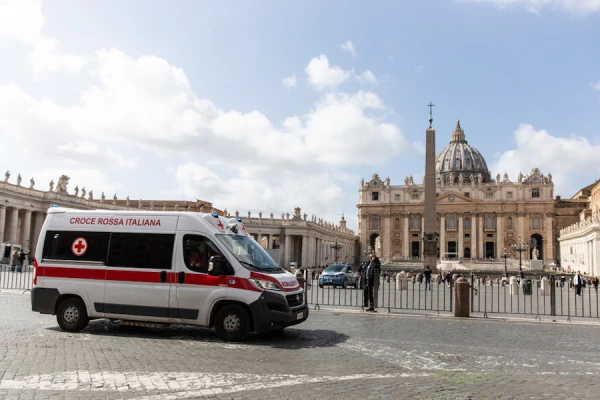
Italian police closed the border with the Vatican at St. Peter’s Square March 10. St. Peter’s Basilica was also closed to tourists.

The Italian government has put Italy on a nationwide lockdown through April 3 to help contain the spread of the coronavirus, which has caused the death of more than 800 people in the country.

The quarantine prevents movement within the country and limits other travel. People are required to stay at home except to go to work, the supermarket, or the pharmacy.


[…]

No Picture
News Briefs

‘Prayer is our strength’: Cardinal Turkson’s message during coronavirus pandemic

March 11, 2020 CNA Daily News 1

Vatican City, Mar 11, 2020 / 11:19 am (CNA).- Cardinal Peter Turkson sent a message Wednesday encouraging Catholics to see the sacrifices required to slow the spread of coronavirus as a chance to deepen their relationships with God and their neighbors.

“Prayer is our strength, prayer is our resource. Here then is the favorable moment to rediscover the fatherhood of God and our being children,” Turkson said in the March 11 message.

He encouraged “the most tested communities” to not experience “everything as a privation.”

For those who cannot gather for the celebration of Mass, he said, “we are called to an even more deeply rooted journey on what sustains the spiritual life: prayer, fasting, and charity.”

“If we cannot meet in our assemblies to live our faith together, as we usually do, God offers us the opportunity to enrich ourselves, to discover new paradigms, and to find personal relationships with Him again,” he said.

The prefect of the Dicastery for Promoting Integral Human Development, Turkson addressed his letter to health workers, chaplains, the sick and their families, volunteers, civil authorities, bishops in charge of pastoral work in healthcare, the heads of bishops’ conferences, and all people of good will.

His message was sent as countries around the world increase measures to fight the spread of coronavirus.

In Italy, public Masses were canceled starting March 8. Most dioceses in Japan have also suspended public Masses.

Worldwide, there are 109,577 confirmed cases of coronavirus, and 3,809 deaths.

The new strain of coronavirus causes a respiratory disease, COVID-19, and has a fatality rate of roughly 3%. The vast majority of cases and deaths have been in China.

In his message, the cardinal reminded Catholics of Christ’s words in Matthew’s Gospel: “when you pray, go to your inner room, close the door, and pray to your Father in secret. And your Father who sees in secret will repay you.”

He also recalled the many times Pope Francis has encouraged Catholics to keep the Bible nearby and to pray with scripture.

“The effort made to contain the spread of Coronavirus is accompanied by the commitment of each individual faithful for the greater good: the reconquest of life, the defeat of fear, the triumph of hope,” he said.

The cardinal noted the importance of solidarity during this time and asked people to think of their “neighbor, office colleague, school friend, but above all the doctors and nurses who risk contamination and infection to save the infected.”

Turkson asked political and economic authorities to not neglect social justice amid the new economic crisis caused by the virus and to continue to look for ways to support health workers all over the world, especially in the places in most difficulty.

“So let us pray to God the Father to increase our faith, help the sick in healing and support health workers in their mission,” the cardinal said.

“We ask the Holy Spirit to illuminate the efforts of scientists, health workers and governments, and we entrust all the populations affected by the contagion to the intercession of the Virgin Mary, Mother of humanity.”

[…]