No Picture
News Briefs

CDF: Belgian Brothers of Charity hospitals must drop Catholic identity over euthanasia

May 4, 2020 CNA Daily News 0

CNA Staff, May 4, 2020 / 12:01 pm (CNA).- The Congregation for the Doctrine of the Faith has ordered 15 psychiatric hospitals in Belgium which belong to the Brothers of Charity to cease identifying as Catholic institutions after they allowed the euthanization of patients in 2017.

The hospitals are managed by a civil non-profit corporation with the same name as the Brothers of Charity religious congregation which owns them.

The CDF decision was communicated in a letter dated March 30, stating that “with deep sadness” the “psychiatric hospitals managed by the Provincialate of the Brothers of Charity association in Belgium will no longer be able to consider themselves Catholic institutions.”

In a statement responding to the CDF’s decision, the superior general of the Brothers of Charity, Br. René Stockman, said that “with a heavy heart” the religious congregation “must let go of its psychiatric centers in Belgium.”

Br. Stockman pointed out that it is “painful” that the psychiatric centers of the Brothers of Charity in Belgium have lost their Catholic status, considering also that the brothers “were among the pioneers in the field of mental health care in Belgium.”

At the same time, Stockman said he recognizes that “the congregation [the Brothers of Charity] has no choice but to remain faithful to the charism of charity, which cannot be reconciled with the practice of euthanasia on psychiatric patients.”

The decision by the Vatican’s doctrinal office ends three years of disputes between the Brothers of Charity and the corporation which manages their hospitals in Belgium.

In 2017, the board decided to allow euthanasia to be carried out in its hospitals in Belgium, where the euthanasia law is among the most broad.

At the time of the decision, the board of the corporation was composed of 15 members, with only three of them religious brothers of the congregation. The chairman is former Belgian prime minister Hermann van Rompuy.

Two of the three religious brothers among the board members, Luc Lemmens, 61, and Veron Raes, 57, supported the euthanasia decision. Their terms on the board ended at the end of September 2018 and were not renewed.

The religious congregation, especially Stockman, protested the decision, reiterating the Brothers of Charity’s rejection of euthanasia in their hospitals.

The brothers appealed to the Vatican, which asked the psychiatric hospitals to change their protocol allowing euthanasia as “a medical act” under certain conditions.

The hospital management responded with a long statement in September 2017, in which it contested a lack of dialogue and maintained the hospital was “perfectly consistent” with Christian doctrine.

The CDF’s direction that the hospitals must no longer identify as Catholic was communicated in a letter signed by CDF prefect Cardinal Luis Francisco Ladaria Ferrer and secretary Archbishop Giacomo Morandi.

The letter retraced the developments of the story, recalling that the document allowing euthanasia in the brothers’ hospitals “refers neither to God, nor to Holy Scripture, nor to the Christian vision of Man.”

According to the letter, the CDF had spoken with the Brothers of Charity and had also informed Pope Francis of the gravity of the situation.

Other audiences had also taken place beginning June 2017, including with the Congregation for Institutes of Consecrated Life and Societies of Apostolic Life, the Secretariat of State, the representatives of the Brothers of Charity and the managing corporation, as well as representatives of the Belgian bishops’ conference.

The Holy See also sent Bishop Jan Hendriks, auxiliary of Amsterdam, as an apostolic visitor, but he did not register any steps forward nor a desire to find “a viable solution that avoids any form of responsibility of the institution for euthanasia.”

The request of the CDF to the Brothers of Charity and to the managing corporation was clear: “affirm in writing and in an unequivocal way their adherence to the principles of the sacredness of human life and the unacceptability of euthanasia, and, as a consequence, the absolute refusal to carry it out in the institutions they depend on.”

The corporation “did not give assurance on these points.”

The CDF therefore reiterated that “euthanasia remains an inadmissible act, even in extreme cases,” and strengthened the statement by citing St. John Paul II’s 1995 encyclical Evangelium vitae, and a Jan. 30 speech by Pope Francis to the CDF.

The CDF stressed that “Catholic teaching affirms the sacred value of human life,” the “importance of caring for and accompanying the sick and disabled,” as well as “the Christian value of suffering, the moral unacceptability of euthanasia” and “the impossibility of introducing this practice in Catholic hospitals, not even in extreme cases, as well as of collaborating in this regard with civil institutions.”

The Brothers of Charity is a religious congregation of lay brothers founded in 1807 in Belgium, whose specialization is care for the sick and those with psychiatric diseases.

At the congregation’s July 2018 general chapter the group stressed that the Brothers of Charity “believes in sacredness and absolute respect for every human life, from conception to natural death. The general chapter requires that each brother, associate member and others associated with the mission of the congregation adhere to the doctrine of the Catholic Church on ethical issues.”

[…]

No Picture
News Briefs

Pope Francis asks for prayer for vocations to the priesthood on Good Shepherd Sunday

May 3, 2020 CNA Daily News 1

Vatican City, May 3, 2020 / 06:30 am (CNA).- Pope Francis called on all Catholics to pray for vocations to the priesthood and consecrated life on Good Shepherd Sunday, the World Day of Prayer for Vocations.

“Priesthood and consecrated life require courage and perseverance, and without prayer one does not follow this path. I invite everyone to ask the Lord for the gift of good workers for his kingdom who have their hearts and hands open to his love,” Pope Francis said on May 3.

In his Regina Caeli address, the pope said that the World Day of Prayer of Vocations is a reminder of Jesus’ words in the Gospel of Matthew: “The harvest is abundant but the laborers are few, so ask the master of the harvest to send out laborers for his harvest.”

Christ, the Good Shepherd, calls his sheep by name and the sheep listen to his voice, the pope said.

“Christian existence is always a response to the call of God, in any state of life,” he said.

Speaking from the library of the Vatican’s Apostolic Palace, Pope Francis offered advice for discerning the Lord’s voice from other voices of temptation or distraction.

He said that the voice of the evil one “seduces, assails, forces” with “tempting but passing emotions”.

“At first it flatters, makes us believe that we are omnipotent, but then it leaves us with emptiness inside and accuses us: ‘You are worth nothing,’” he said. “The voice of God, on the other hand, corrects us with much patience, but always encourages us, consoles us. It always nourishes hope.”

“The voice of God never binds: God proposes himself, he does not impose himself,” he said.

Pope Francis explained that the voice of temptation “always revolves around the self,” whereas the voice of God invites all to go “beyond ourselves to find true goodness and peace.”

“Dear brothers and sisters, in this time many thoughts and concerns lead us to turn in on ourselves. We pay attention to the voices that reach our heart. Let’s ask where they come from,” Pope Francis said.

Pope Francis said that May is “the Marian month par excellence” and encouraged people to place all of their concerns, expectations, and plans for the future “in the heart of the Holy Virgin.”

In his message for the 2020 World Day of Vocations, Pope Francis pointed to Mary’s courageous “yes” to God at the Annunciation as a model to follow:

“Cultivate the interior disposition of the Blessed Virgin Mary. Grateful that Lord gazed upon her, faithful amid fear and turmoil, she courageously embraced her vocation and made of her life an eternal song of praise to the Lord.”

“Every vocation is born of that gaze of love with which the Lord came to meet us,” he said. “We will succeed in discovering and embracing our vocation once we open our hearts in gratitude and perceive the passage of God in our lives.”

The pope stressed that vocational discernment is not simply “a decision we make as isolated individuals.”

“Vocation, more than our own choice, is a response to the Lord’s unmerited call,” he said.

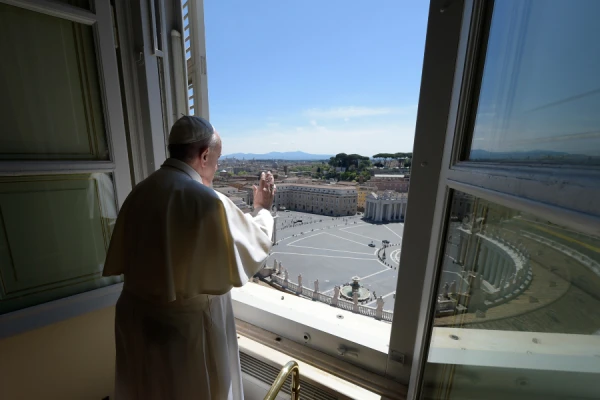
Due to the coronavirus pandemic, Pope Francis led the traditional Marian Regina Caeli prayer via video livestream on May 3. The pope then appeared in the window of the Apostolic Palace above an empty St. Peter’s Square to offer a blessing for the city of Rome and the world.

“We ask for the grace to recognize and follow the voice of the Good Shepherd, who brings us out of the enclosure of selfishness and leads us to the pastures of true freedom. Our Lady, Mother of the Good Council, guide and accompany our discernment,” Pope Francis said.

[…]

No Picture
News Briefs

Scholars dispute charge of Pius XII Holocaust cover-up

May 1, 2020 CNA Daily News 3

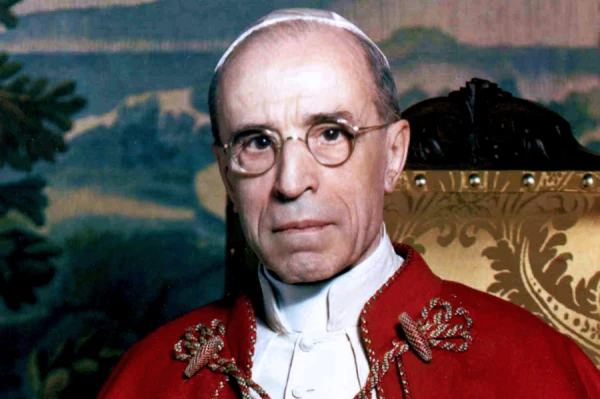
Denver Newsroom, May 1, 2020 / 12:15 pm (CNA).- Scholars say charges that Pope Pius XII covered-up the Vatican’s knowledge of the Holocaust are based on exaggerated claims and do not represent the truth.

Fr. Hubert Wolf, a professor of history at the University of Munster, claimed last month that in the Vatican’s recently opened archives on Pope Pius XII, he had found an anti-Semitic memo which suggested that Pope Pius XII knew about the Holocaust in Europe before the U.S. government did, but made efforts to conceal his knowledge.

But Ronald Rychlak, a professor at the University of Mississippi’s law school and the author of “Hitler, the War, and the Pope” told CNA that Wolf’s argument doesn’t stand up to historical scrutiny.

What Pope Pius XII knew and did during World War II has been a source of controversy for years. That controversy was reignited in early March, when the Vatican opened to researchers its archives on Pius XII. Wolf was among the researchers. But a week after the archives were opened, the coronavirus lockdown in Italy forced researchers to pause their work.

Undeterred, Wolf told German and American media this month that he had found a key document which, he said, could prove that Pius XII lied to the U.S. government by claiming in 1942 that he could not verify intelligence reports, which came from the Jewish Agency for Palestine in Geneva, about death camps for the mass murder of Jews in Poland and Ukraine.

When the U.S. entered World War II in 1942, it did not yet have knowledge of the scale of atrocities committed against Jewish people across Europe, especially the mass murder of Jews in Eastern Europe. It had received reports of those atrocities, however, and was making efforts to verify them.

In 1942, the Vatican, too, had received reports, mostly from Church leaders, about the mass murder of Jews by Nazi forces.

Nevertheless, in September 1942, when a U.S. official asked the Vatican to verify a report from the Jewish Agency for Palestine, Vatican officials said they could not independently confirm the information it contained regarding the existence of death camps, but that the Vatican did know, and had received reports, about atrocities committed by Nazi forces, adding that “the Holy See is taking advantage of every opportunity offered in order to mitigate the suffering.”

Rychlak told CNA that the Holy See’s concern to be judicious about verifying any report “can logically be traced to WWI, when false stories of atrocities were often circulated,”

But after examining the Pius XII archives for a week in March, Wolf pointed journalists this month to a 1942 memo from a staffer in the Vatican’s Secretary of State, Msgr. Angelo Dell’Acqua, who later became a cardinal. The memo, which has not been released to the public, apparently cautioned against verifying the report from the Jewish Agency for Palestine.

Wolf told journalists that the memo warned against believing the report because Jews “easily exaggerate.”

“This is a key document that has been kept hidden from us because it is clearly anti-Semitic and provides background information on why Pius XII did not speak out against the Holocaust,” Wolf told a Munster Catholic newspaper.

German journalist Michael Hesemann was also among the researchers who examined Pius XII’s archives in March. In a statement sent to CNA, he said that Wolf has made his claim about Pius XII without understanding the meaning of the memo he found, or its significance.

He added that the memo “warns not to draw premature conclusions on the new information, [stating]: ‘It is necessary to assure that they are true, since exaggerations happen easily, also among Jews.’ With other words: Trust but verify!”

“For Wolf, this is evidence for the Vatican’s anti-Semitism during the pontificate of Pius XII. For him, it means, and this is how he paraphrases it in several interviews with German media: ‘All Jews are liars,” Hesemann said.

“But it means nothing like that, Hesemann said, explaining that the memo was intended to urge caution against any exaggeration.

“And indeed the Jewish Agency’s report contained several rumors which were not true at all, as we know today. It claimed that ‘in all Eastern Poland and the occupied Russian territories, not a single Jew is alive anymore.’ We know that thousands survived in the underground or became partisans.”

“No government in the world would act on a single report, but waits for an independent verification – that’s why President Roosevelt asked the Vatican, in the first place,” Hesemann added.

In either case, Hesemann said, the memo “did not influence papal policy, which remained the same before and after, nor does it contain any new information. It is one man’s reminder to trust and to verify and nothing more.”

The memo is not included in an 11-volume cache of Vatican documents from the Second World War. To Wolf, this is a reason to be skeptical about the volumes, according to the Washington Post.

But to Hesemann, the memo was not included “not because of a Vatican cover-up, but because it’s irrelevant.”

Hesemann cautioned that Wolf, who has “promoted conspiracy theories” about Pius XII in the past “draws premature conclusions, blames the Vatican of a cover-up and creates sensationalist headlines,” to further “his own agenda,” namely, “stop the ongoing beatification process of Pius XII – at least until he and his team have evaluated the last of the pages Pope Francis made available for historical research.”

Rylchak pointed out evidence, presented in his book, of Pius XII’s concern to oppose the Nazis, which he says was well-recognized by journalists and bishops during the Second World War. He also pointed out that Pius XII, through “ a long series of communications with the American bishops,” encouraged opposition to Nazi ideology.

“Despite all of this, Wolf would have us believe that Pius did not make his opinion known due to a cover note from a low-level assistant,” Rylchak said, calling the assertion “ridiculous.”


[…]

No Picture
News Briefs

Pope Francis raises Cardinal Tagle to new rank

May 1, 2020 CNA Daily News 3

Vatican City, May 1, 2020 / 10:30 am (CNA).- Pope Francis has raised Cardinal Luis Antonio Tagle to the rank of cardinal bishop in a new sign of his esteem for the former Archbishop of Manila.

The Holy See press office said May 1 that the pope had des… […]