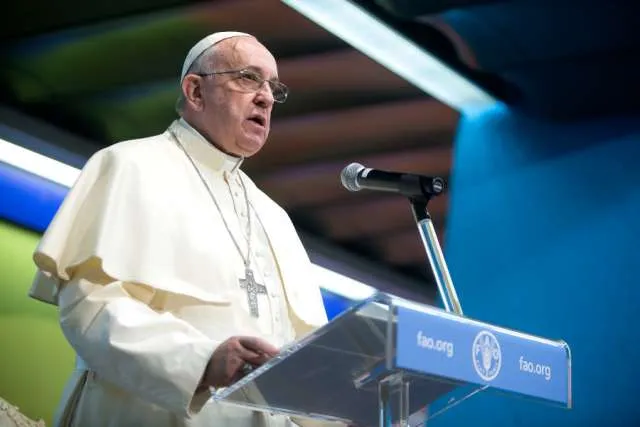
 Pope Francis addresses the United Nations’ Food and Agriculture Organization (FAO) at their headquarters in Rome on Nov. 20, 2014. / FAO Giulio Napolitano.
Vatican City, Jun 14, 2021 / 08:00 am (CNA).
Pope Francis said Monday that the world must do more to help small food producers.
In a message to the Food and Agriculture Organization of the United Nations, the pope said that the coronavirus crisis should spur efforts to create a global food system capable of withstanding future shocks.
“I appreciate and encourage the efforts of the international community to enable each country to implement the necessary mechanisms to achieve food autonomy, whether through new models of development and consumption or through forms of community organization that preserve local ecosystems and biodiversity,” the pope wrote in Spanish.
“It could be of great benefit to draw on the potential of innovation to support small producers and help them improve their capacities and resilience. In this regard, your work is of particular importance in the current time of crisis.”
The pope’s message was addressed to Michał Kurtyka, Poland’s climate minister and president of the 42nd Session of the FAO Conference, taking place in Rome on June 14-18.
The FAO, founded in 1945, has more than 194 member states and works in over 130 countries.
In addition to the papal message, the conference’s first day featured an address by the Italian President Sergio Mattarella and opening remarks by the FAO’s Chinese Director-General Qu Dongyu, who described the pandemic as “a powerful wake-up call on the fragility and shortcomings of our agrifood systems.”
In his message, the pope noted that in 2020 the number of people at risk of acute food insecurity and in need of immediate subsistence support reached its highest level in five years.
“This situation could worsen in the future. Conflicts, extreme weather events, economic crises, together with the current health crisis, are a source of famine and hunger for millions of people,” he wrote.
“Therefore, in order to address these growing vulnerabilities, it is essential to adopt policies capable of tackling the structural causes that give rise to them.”
The pope continued: “To provide a solution to these needs, it is important, above all, to ensure that food systems are resilient, inclusive, sustainable, and able to provide healthy and affordable diets for all.”
“In this perspective, the development of a circular economy, which guarantees resources for all, including future generations, and promotes the use of renewable energies, is beneficial.”
“The fundamental factor for recovering from the crisis that is striking us is an economy tailored to man, not subject only to profit, but anchored in the common good, friendly to ethics and respectful of the environment.”
The FAO’s 2020 State of Food Security and Nutrition in the World report predicted that the COVID-19 pandemic would cause 130 million more people worldwide to suffer chronic hunger by the end of last year.
The pope said: “The reconstruction of post-pandemic economies offers us the opportunity to reverse the course followed so far and invest in a global food system capable of withstanding future crises.”
“This includes the promotion of sustainable and diversified agriculture that takes into account the valuable role of family farming and rural communities.”
“Indeed, it is paradoxical to note that it is precisely those who produce food that suffer from the lack or scarcity of food. Three-quarters of the world’s poor live in rural areas and depend primarily on agriculture for their livelihoods.”
“However, due to lack of access to markets, land ownership, financial resources, infrastructure and technologies, these brothers and sisters of ours are the most vulnerable to food insecurity.”
Concluding his message, the pope said that it was not enough merely to outline programs.
“Tangible gestures are needed that have as their point of reference the common belonging to the human family and the fostering of fraternity,” he wrote, assuring the conference of the Catholic Church’s support for its work.

[…]




