Pope Francis prays with journalists on a papal flight August 14, 2014. / Alan Holdren/CNA
Rome Newsroom, Sep 21, 2022 / 07:04 am (CNA).
Pope Francis has called on Christians to support communities in the Dominican Republic and Puerto Rico devas… […]
General audience with Pope Francis on St. Peter’s Square, Vatican, Sept. 21, 2022 / Pablo Esparza / CNA
Rome Newsroom, Sep 21, 2022 / 04:05 am (CNA).
Reflecting on his recent trip to Kazakhstan, Pope Francis on Wednesday said that offering Mass for the feast of the Holy Cross surrounded by the capital city of Nur-Sultan’s “ultra-modern architecture” led him to think about the meaning of the cross today.
“In a world in which progress and regression are intertwined, the cross of Christ remains the anchor of salvation,” Pope Francis said in St. Peter’s Square on Sept. 21.
Speaking at his Wednesday general audience, the pope underlined that the cross is “a sign of hope that does not disappoint because it is founded on the love of God, merciful and faithful.”
Pope Francis said his Sept. 13–15 visit to the Central Asian country reminded him of Kazakhstan’s many martyrs who “suffered so much for the faith during the long period of persecution: murdered, tortured, imprisoned for the faith.”
“And credit … must be given to the Kazakh government, which, having freed itself from the yoke of the atheistic regime, now proposes a path of civilization clearly condemning fundamentalism and extremism,” he said.
The primary purpose of the pope’s trip to Kazakhstan was to take part in an interreligious conference, the Seventh Congress of the Leaders of World and Traditional Religions.
On the final day of the congress, delegates representing the world’s major religions voted to adopt a declaration calling religious pluralism an expression “of the wisdom of God’s will in creation.”
Pope Francis said that the congress aimed to put “religions at the center of efforts to build a world where we listen to each other and respect each other in diversity.”
“And this is not relativism,” he added. “It is listening and respecting.”
Throughout his trip last week, the pope repeatedly appealed for dialogue and peace in the “senseless and tragic war” in Ukraine. At the end of his general audience, the pope repeated his appeal, expressing solidarity with the “noble and martyred” Ukrainian people.
The pope said this envoy in Ukraine, Cardinal Konrad Krajewski, called him yesterday and described “the pain of the people, the savage actions, the monstrosities, and the tortured corpses that had been found.”
He was likely referring to Krajewski’s recent visit to a mass grave in Izium, Ukraine, where 146 bodies, mostly civilians, have been exhumed so far.
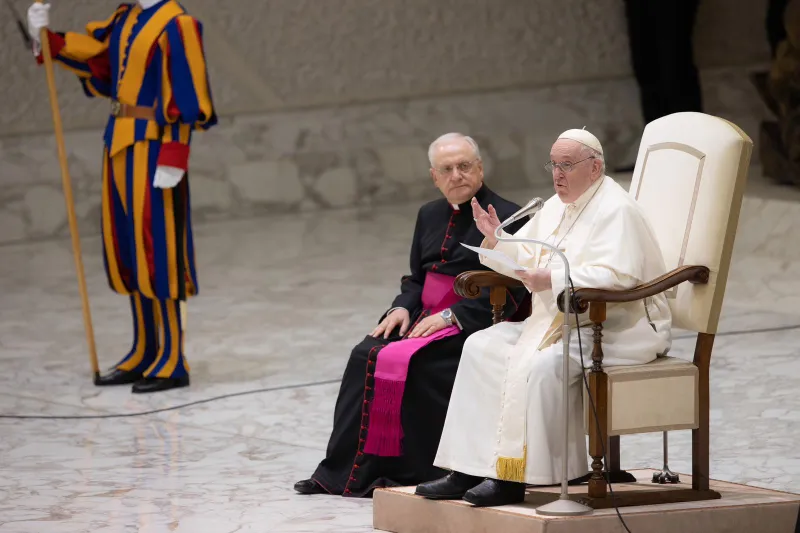
Pope Francis praying at the general audience, Sept. 21, 2022. Pablo Esparza / CNA
Pope Francis also highlighted World Alzheimer’s Day, noting that the disease “affects so many people who, because of this condition, are often placed on the margins of society.”
“We pray for Alzheimer’s patients, their families and their loving caregivers, that they will be increasingly supported and helped,” he said.
Pope Francis and Xi Jinping / Mazur/catholicnews.org.uk/360b/shutterstock
Rome Newsroom, Sep 19, 2022 / 08:33 am (CNA).
While a trial against Cardinal Joseph Zen is getting underway in China, the Holy See continues to work towards the renewal o… […]
Jacob Matham’s portrait of Leo XI, who reigned April 1-27, 1605. / public domain
Denver Newsroom, Sep 18, 2022 / 14:00 pm (CNA).
Blessed John Paul I did not serve as Roman Pontiff for long, but 10 other popes had shorter pontificates than he did. Their stories are a microcosm of the history of the papacy. Some were friends of saints and worked for the good of the Church, while the qualifications of others might be a bit questionable. Through all these more or less flawed men who sat in the Chair of Peter, the Catholic Church teaches that the connection to St. Peter and his profession of faith in Christ endures.
Urban VII was pope for 13 days, Sept. 15–27, 1590.
He was born Giambattista Castagna at Rome, the home city of his mother. His father was of Genoan nobility. His uncle was a cardinal, whom he served at points during his long career in the Church. He held doctorates in civil and canon law.
Castagna worked in government and diplomacy on behalf of the papacy, which at the time held civil power over parts of Italy. He led several commissions during the Council of Trent and helped organize the military alliance against the Ottoman Empire, according to the New Catholic Encyclopedia. He was appointed archbishop in 1553 and became a cardinal in 1583.
He had a reputation for genuine piety, intelligence, and ability to govern.
Jacopino del Conte’s portrait (c. 1590) of Urban VII. public domain
After his election as pope, he made sure to address the needs of the poor in Rome. His initial plans included expanded public works to employ the poor.
As God’s providence allowed, he did not have time to do much more than plan. He died of malaria at the age of 69. In his will, he left his personal fortune to support poor girls.
Celestine IV reigned for 15 days, Oct. 25–Nov. 10, 1241.
The future pope was born Goffredo da Castiglione in Milan. He spent time with the Cistercian religious order and was a cardinal bishop of Sabina. He was a nephew of Pope Urban III. He was already in poor health when he was elected, at a time when the papacy was a center of political conflict between backers and opponents of Holy Roman Emperor Frederick II.
Boniface VI reigned for 16 days, April 11–26, 896.
He was born in Rome. Not much is known about this pope, though records indicate that during his life he was canonically deprived of holy orders on two occasions: the first time as a subdeacon, and the second as a priest. His irregular past caused controversy over his election, the New Catholic Encyclopedia says.
Theodore II reigned for 20 days in December 897.
Another little-known pope, it is said that his clergy loved him, that he loved peace, and that he lived a life of chastity and charity to the poor. He came to power soon after a low point of the papacy. Pope Theodore annulled the acts of the “Cadaver Synod,” which had put on trial the corpse of his predecessor, Pope Formosus. He recovered the dead Roman Pontiff’s body from the River Tiber and gave it a proper burial. He also reinstated clergy who had been forced to resign.
Sisinnius was pope for 21 days, Jan. 15–Feb. 4, 708.
This pope was born in Syria. His health troubles included disabling arthritis, and he was unable to feed himself. The papacy was responsible for the military defense of Rome at this time, with Lombards invading from the north of Italy and Muslim armies advancing from the south. Sisinnius ordered the walls of Rome to be reinforced as his first act, the New Catholic Encyclopedia says. Before he died, Pope Sisinnius ordained one priest and consecrated a bishop for Corsica.
Marcellus II was pope for about 22 days in April and May, 1555.
He was born Marcello Cervini, at Montefano in Tuscany. Like the sainted Pope Marcellus of the fourth century, he kept his baptismal name as his papal name.
His father worked under several pontificates as a scribe and secretary.
Before Cervini was elected pope he served various roles as a secretary to popes and cardinals, including work to correct the Julian calendar. He was actively engaged with the “New Learning” of Renaissance humanism. He served as protector of the Vatican Library and helped improve and expand its collection. Cervini served the Vatican at the time of its response to the Protestant Reformation. He was a president at the Council of Trent, which continued through his short pontificate.
He gained a reputation as a Church reformer and had hoped to pursue this path during his papacy. He was not consecrated a bishop until the day after he was elected pope.
Pope Marcellus reputedly became sick from overwork during the celebrations of Holy Week and Easter, and the illness turned fatal.
The Missa Papae Marcelli of Giovanni Pierluigi da Palestrina was composed in his honor.
Damasus II reigned for 24 days in July and August, 1048.
This pontiff was named Poppo. He was born in Bavaria and was of German extraction. He served as Bishop of Brixen in Tyrol, in what is now western Austria.
Popes at the time could be nominated in an unusual manner. Pope Damasus II was named by Holy Roman Emperor Henry III. The pope, however, soon died of malaria.
Pius III was pope for 27 calendar days, Sept. 22–Oct. 18, 1503.
He was born Francesco Todeschini in Siena. He was the nephew of Pope Pius II, a famous Renaissance-era pope. His uncle took him into his household and became his patron, allowing the young man to add the pontiff’s family name Piccolomini to his own last name.
Francesco studied canon law. His uncle named him to become administrator of the Archdiocese of Siena and later made him a cardinal-deacon.
The future Roman Pontiff had a reputation of living an upright life as a cultured, gentle man, the New Catholic Encyclopedia reports. He took part in several conclaves of his time, including that which elected Alexander VI.
His service to the papacy included several diplomatic appointments to Germany, France, and Perugia.
Francesco’s own papal election took place amid ruling Italian families’ disputes over control of Rome and included an unsuccessful power play by the Borgia family.
Pius III was known to be in poor health. At the time of the papal coronation he was already suffering from a diseased leg, which developed into a septic ulcer. He died at the age of 64.
Leo XI was pope for 27 days, from April 1–27, 1605.
The Florentine-born Alessandro de Medici was a member of the famous Medici family. He was grand-nephew to Pope Leo X. He sought to become a priest from an early age, but because his mother objected he was not ordained until after she died, according to the New Catholic Encyclopedia. He served as an ambassador to Rome on behalf of Tuscany, before he began to advance in the Church. He would eventually become a bishop, then archbishop of Florence, before being named a cardinal.
He served as a papal legate to France and was head of the Congregation of Bishops.
Among his great friends was St. Philip Neri, founder of the Oratorians.
He was elected pope at the age of 69 and became sick almost immediately.
Benedict V served as pope for 33 days, May 22–June 23, 964.
He was born in Rome and had a reputation for great learning.
He reigned at a time of great turmoil in the Church. Holy Roman Emperor Otto I had interfered with the pontificates of his predecessors. The emperor had forcibly deposed a pope and installed his own nominee on the See of Peter. There were rival claimants to the papacy under Benedict V and Otto again interfered, laying siege to Rome and taking the pope away from Rome by force. Benedict either renounced the papacy or was forcibly deposed. He lived in exile in Hamburg for another year.
John Paul I served as Roman Pontiff from Aug. 26–Sept. 28, 1978, 33 calendar days.
His beatification on Sept. 4 renewed attention to his life. He had a reputation for humility and for teaching the faith in an understandable way.
The future John Paul I took part in the Second Vatican Council and was named patriarch of Venice.
As a cardinal, Luciani published a collection of “open letters” to historic figures, saints, famous writers, and fictional characters. The book, “Illustrissimi,” included letters to Jesus, King David, Mark Twain, Charles Dickens, and Christopher Marlowe, as well as Pinocchio and Figaro, the barber of Seville.
He was the first pope to have two names. He took his papal name from his immediate predecessors, Sts. John XXIII and Paul VI.
Pope Francis delivers the Angelus address on Aug. 21, 2022. / Vatican Media.
Vatican City, Sep 18, 2022 / 04:35 am (CNA).
Pope Francis said Sunday that Christians should not become discouraged or remain indifferent to stories of corruption, but… […]
The logo of the 2025 Jubilee. The Vatican’s Dicastery for Evangelization is organizing the Catholic Church’s next Holy Year around the theme “Pilgrims of Hope.” / Daniel Ibanez/CNA
Vatican City, Sep 17, 2022 / 05:12 am (CNA).
The Vatican will hold a contest to choose the original musical composition for the official hymn of the Catholic Church’s 2025 Jubilee Year.
The Dicastery for Evangelization announced the sacred music writing competition Sept. 17. The contest will open for submissions early next year.
Entries, the dicastery said, should set to music a text in Italian by the theologian Monsignor Pierangelo Sequeri. After the winning music is chosen next year, the evangelization office will translate the text into other major languages.
The text is titled “Pilgrims of Hope,” after the theme of the 2025 Jubilee. The refrain, translated into English by CNA, is: “Living flame of my hope, May this song reach up to Thee! Eternal womb of infinite life, On my way I trust in Thee.”
According to the regulations set out by the Vatican, the musical composition should include a score for voice and organ, and be able to be sung both by church congregations and by four-part church choirs.
The competition will be open for submissions from Jan. 16 to March 25, 2023, and the winner will be chosen by a judging committee in collaboration with the Pontifical Institute of Sacred Music. Full regulations can be found on the webpage of the 2025 Jubilee.
The logo for the 2025 Jubilee Year was also chosen after a worldwide competition, and unveiled in June.
A Jubilee is a special Holy Year of grace and pilgrimage in the Catholic Church. An ordinary Jubilee typically takes place every 25 years, though a pope may call for additional Jubilees, as Pope Francis did with the Extraordinary Jubilee of Mercy from 2015-2016.
The last ordinary Jubilee was the Great Jubilee of 2000, which was held under Saint Pope John Paul II and had the theme “Christ Yesterday, Today, Forever.”
In its announcement of the hymn-writing competition Saturday, the Dicastery for Evangelization said that “the Sacred Scriptures are steeped in song, and the Psalms are a striking example: the prayers of the people of Israel were written to be sung, and it was in song that the most human events were presented before the Lord.”
“The tradition of the Church has continued this, making music and song one of the lungs of its liturgy,” the dicastery said.
The evangelization office, which is responsible for organizing the Jubilee, said “many themes of the Holy Year are woven into the text” of the hymn prepared by Monsignor Pierangelo Sequeri, who is the former dean of the John Paul II Pontifical Theological Institute for the Sciences of Marriage and the Family in Rome.
“The motto, ‘Pilgrims of Hope,’” it said, “is best echoed biblically in some pages from the prophet Isaiah (Isaiah 9 and Isaiah 60). The themes of creation, fraternity, God’s tenderness and hope in our destination resonate in a language, which although not ‘technically’ theological, is in substance and in the allusions, so that it rings eloquently in the ears of our time.”
The full lyrics of what will become the official hymn of the 2025 Jubilee can be found below. It has been translated into English from the Italian original by CNA.
Pilgrims of Hope
Living flame of my hope may this song reach up to Thee! Eternal womb of infinite life on the way I trust in Thee.
Every tongue, people and nation finds light in your Word. Sons and daughters scattered and fragile are embraced in your beloved Son.
Living flame of my hope may this song reach up to Thee! Eternal womb of infinite life on the way I trust in Thee.
God watches us, tender and patient: the dawn of a new future rises. New Heavens Earth made new: the Spirit of Life moves walls.
Living flame of my hope may this song reach up to Thee! Eternal womb of infinite life on the way I trust in Thee.
Lift up your eyes, move with the wind, speed up your step: God comes, in time. See the Son who became Man: thousands upon thousands find the way.
Living flame of my hope may this song reach up to Thee! Eternal womb of infinite life on the way I trust in Thee.
Discussing on the flight from Kazakhstan to Italy on Thursday, Sept. 15, 2022, the moral degradation of the West, particularly in relation to the advance of legal euthanasia, Pope Francis said the region has taken the wrong path, and that killin… […]