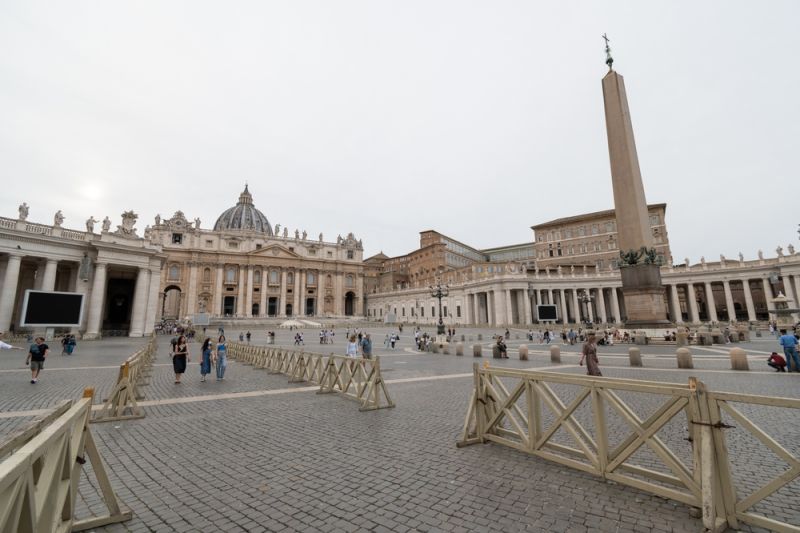
 St. Peter’s Square in Vatican City. / Credit: Alexander_Peterson/Shutterstock
Rome Newsroom, Jun 5, 2023 / 12:20 pm (CNA).
Nobel laureates, Grammy-winner Andrea Bocelli, and several former heads of state will join Pope Francis in St. Peter’s Square on Saturday night for the World Meeting on Human Fraternity.
The June 10 event, called “#Not Alone,” will culminate with Pope Francis signing a document calling for a commitment to human fraternity drafted by a dozen Nobel Peace Prize winners together with representatives of former Nobel Prize-winning organizations.
Young people representing different countries will also form “a symbolic embrace” by joining hands in a ring around St. Peter’s Square, according to the Fratelli Tutti Foundation, the sponsor of the event.
Cardinal Mauro Gambetti, the archpriest of St. Peter’s Basilica, described the upcoming meeting as “a great day of celebration and unity inspired by Pope Francis’ encyclical Fratelli Tutti, transcending a vision that restricts social friendship to ethnic or blood ties.”
Speaking at a Vatican press conference promoting the event, Jesuit Father Francesco Occhetta, the head of the Fratelli Tutti Foundation, noted that participants in the event “will be given as a gift a piece of organic soil and seeds to plant and germinate as a symbol of the commitment to guard fraternity.”
Nobel laureates who have confirmed their participation in the World Meeting on Human Fraternity include Iraqi human rights advocate Nadia Murad, Congolese gynecologist Denis Mukwege, and Yemeni Arab Spring leader Tawakkol Karman.
The former presidents of Colombia, Costa Rica, Poland, and Democratic Republic of East Timor — all peace prize winners — will also participate, as well as representatives of several U.N. organizations that have been past recipients.
The World Meeting on Human Fraternity will begin with private meetings of five working groups representing Nobel laureates, the poor, environmentalists, students, and associations.
At 4 p.m. local time, Italian TV presenter Carlo Conti, the former host of Italy’s national Eurovision competition, will kick off an Italian television broadcast of the World Meeting on Human Fraternity event in St. Peter’s Square with performances by Bocelli and other Italian musical artists.
Pope Francis will join the event two hours later to listen to what emerged in the working group discussions, sign the human fraternity document, and join the symbolic embrace. Later, circus performers and street artists will take to the stage in St. Peter’s Square to perform until 10 p.m.
Town squares in Buenos Aires, Argentina; Jerusalem; Nagasaki, Japan; Brazzaville, Republic of Congo; and four other locations in the world will connect live to St. Peter’s Square for the event.
The following is a list of Nobel laureates and Nobel laureate representatives who will participate in the World Meeting on Human Fraternity, according to the Vatican:
Juan Manuel Santos, president of the Republic of Colombia from 2010 to 2018 (Colombia): Nobel Peace Prize in 2016 for his resolute commitment to ending the civil war that has affected his country for 50 years.
Oscar Arias Sánchez, president of the Republic of Costa Rica from 1986 to 1990 and from 2006 to 2010 (Costa Rica): Nobel Peace Prize winner in 1987 for his efforts in promoting peace and stability in Central America, in particular for his efforts to end conflicts in the region and promote dialogue and cooperation between countries.
Lech Wałęsa, president of the Republic of Poland from 1990 to 1995 (Poland): Nobel Peace Prize in 1983 for his nonviolent struggle for human rights and free trade unions in Poland. As leader of the Solidarność trade union, he played a key role in the rights of workers and in the promotion of democracy in his country.
José Ramos-Horta, president of the Democratic Republic of East Timor (East Timor): Nobel Peace Prize winner in 1996 for his work in favor of a just and peaceful solution to the conflict in East Timor.
Jody Williams, founder of the International Campaign to Ban Landmines (ICBL) and president of the Nobel Women’s Initiative (United States): Nobel Peace Prize winner in 1997 for work on banning and clearing landmines.
Shirin Ebadi, president of the Defenders for Human Rights Centre (Iran): Nobel Peace Prize in 2003 for her commitment to the defense of democracy, human rights, and especially women and children in Iran.
Muhammad Yunus, founder of Grameen Bank (Bengals): Nobel Peace Prize in 2006 for his work in promoting economic and social development through the concept of microcredit. Through the Grameen Bank, he provided affordable finance to the poor and helped improve their living conditions.
Leymah Roberta Gbowee, president of Gbowee Peace Foundation Africa (Liberia): Nobel Peace Prize winner in 2011. As a leader of the Liberian women’s movement, she played a vital role in ending the civil war and promoting reconciliation in her country.
Tawakkol Karman, leader of the Arab Spring (Yemen): Nobel Peace Prize in 2011. As a journalist and activist, he defended human rights, democracy, and freedom of expression in his country.
Denis Mukwege, gynecologist (Democratic Republic of Congo): Nobel Peace Prize winner in 2018 for providing medical care and support to women victims of sexual violence in times of war and armed conflict.
Nadia Murad Basee Taha, president and co-founder of Nadia’s Initiative (Iraq): Nobel Peace Prize winner in 2018 for her efforts to end the use of sexual violence as a weapon of war and armed conflict.
Giorgio Parisi, vice president of the Accademia Nazionale dei Lincei (Italy): Nobel Prize in Physics in 2021 for the discovery of the interaction between disorder and fluctuations in physical systems, from the atomic to the planetary scale.
Maria Angelita Ressa, president of Rappler Inc. (Philippines): Nobel Peace Prize in 2021 for efforts to safeguard freedom of expression.
International Peace Bureau (IPB): Organization Nobel Peace Prize in 1910 for liaising between the peace societies of various countries and helping them organize world meetings of the international peace movement. Represented by Philip James Jennings, president.
American Friends Service Committee (AFSC): Organization Nobel Peace Prize winner in 1947 for its pioneering work in the international peace movement and compassionate effort to alleviate human suffering, thereby promoting brotherhood among nations. Represented by Hector Manuel Cortez, deputy secretary general.
United Nations High Commissioner for Refugees (UNHCR): Nobel Peace Prize was awarded to the organization in 1954 and 1981 for its commitment to heal the wounds of war by providing aid and protection to refugees from all over the world and for the promotion of the fundamental rights of refugees. Represented by Filippo Grandi, high commissioner.
United Nations International Children’s Emergency Fund (UNICEF): Organization Nobel Peace Prize winner in 1965 for its commitment to strengthening solidarity between nations and narrowing the gap between rich and poor states. The organization is dedicated to promoting and advocating for the rights of children, working to improve their health, education, and well-being around the world. Represented by Bo Viktor Nylund, special representative.
International Labour Organization (ILO): Nobel Peace Prize Organization in 1969 for having created international legislation that ensures certain standards for working conditions in each country. Represented by Gianni Rosas, ILO office director for Italy and San Marino.
International Physicians for the Prevention of Nuclear War (IPPNW): 1985 Nobel Peace Prize-winning organization to disseminate authoritative information and create awareness of the catastrophic consequences of a nuclear war. Represented by Kati Riitta Maria Juva, co-president, and Onazi David, co-chair.
Peace Operations, United Nations Peacekeeping Forces: Nobel Peace Prize Organization in 1988. Its mission is to prevent armed clashes and create the conditions for negotiations between countries in conflict. Represented by Aroldo Lazaro Saenz.
Pugwash Conferences on Science and World Affairs: Organization awarded the Nobel Peace Prize in 1995 for its efforts to diminish the role of nuclear weapons in international politics and, in the long term, for the elimination of nuclear weapons. Represented by Paolo Cotta Ramusino, general secretary.
International Campaign to Ban Landmines (ICBL): Organization awarded the Nobel Peace Prize in 1997 for its work in banning and clearing landmines. Represented by Tun Channareth, ICBL world ambassador, and Denise Coghlan, RSM, member of the board of directors.
International Atomic Energy Agency (IAEA): Organization awarded the Nobel Peace Prize in 2005 for its efforts to prevent the use of nuclear energy for military purposes and to ensure that nuclear energy for peaceful purposes is used as safely as possible. Represented by Jacek Andrzej Bylica, IAEA chief of staff.
Intergovernmental Panel on Climate Change (IPCC): Organization awarded the Nobel Peace Prize in 2007 for its efforts to build and disseminate greater knowledge of man-made climate change and to lay the foundations for the measures necessary to counter them. Represented by Hoesung Lee, president.
Organisation for the Prohibition of Chemical Weapons (OPCW): Organization Nobel Peace Prize winner in 2013 for efforts to eliminate chemical weapons. Represented by Odette Melon, vice general manager.
International Campaign to Abolish Nuclear Weapons (ICAN): Nobel Peace Prize-winning organization for its work to draw attention to the catastrophic humanitarian consequences of any use of nuclear weapons and its pioneering efforts to achieve a treaty-based prohibition of such weapons. Represented by Daniel Högsta, interim executive director.
Center for Civil Liberties: Nobel Peace Prize Organization in 2022. It has been promoting the right of expression and fundamental rights of citizens for many years. It worked hard to document war crimes, violence, and abuses of power. With its work, it demonstrates the importance of civil society for peace and democracy. Represented by Oleksandra Matvijchuk.
United Nations: Nobel Peace Prize Organization in 2001 for its work for a more inclusive and peaceful world. Represented by Miguel Angel Moratinos, undersecretary-general of the United Nations, who contributed to the creation and launch of the United Nations Alliance of Civilizations (UNAOC) in 2005 and since 2019 has held the position of high representative of the UNAOC.
Oley Back Road, representing Ellen Johnson Sirleaf: Nobel Peace Prize winner in 2011 for her nonviolent fight for women’s safety and their right to full participation in peacebuilding.
[…]



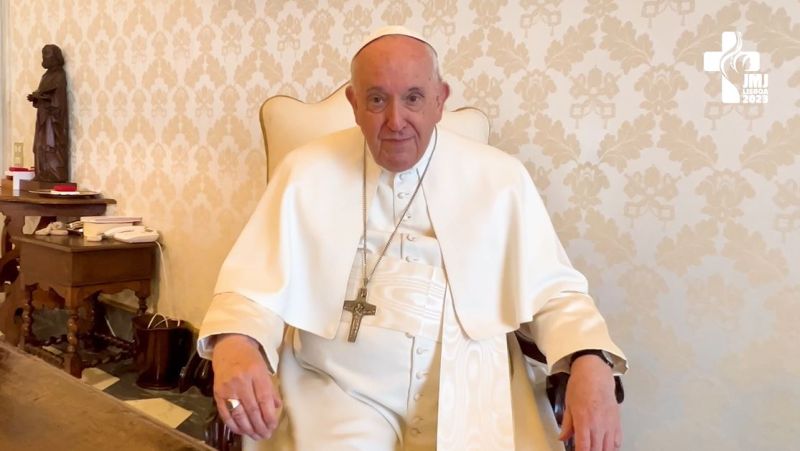 A screenshot from Pope Francis’ May 4 video message to young people attending World Youth Day 2023 in Lisbon, Portugal. / Vatican Media