Archbishop Jose Gomez of Los Angeles, California. / Daniel Ibanez/CNA.
Baltimore, Md., Nov 16, 2022 / 12:45 pm (CNA).
Editor’s note: Archbishop José H. Gomez of Los Angeles, the outgoing president of the United States Conference of Catholic Bis… […]
Bishops Kevin Rhoades of Fort Wayne-Sound Bend (left), Michael Burbidge of Arlington (center), and Paul Coakley of Oklahoma City (right) / Credit: Shannon Mullen/CNA, Kate Veik/CNA, and Archdiocese of Oklahoma City
Archbishop Timothy Broglio, the newly elected president of the United States Conference of Catholic Bishops, meets with reporters in Baltimore on Nov. 15, 2022. / Joe Bukuras/CNA
Baltimore, Md., Nov 15, 2022 / 17:50 pm (CNA).
In his first press… […]
The March for Life in Washington, D.C., January 22, 2016. / Jeff Bruno.
Baltimore, Md., Nov 15, 2022 / 17:04 pm (CNA).
Following the overturning of Roe v. Wade, the chair of the U.S. Catholic bishops’ Committee on Pro-Life Activities is encoura… […]
Archbishop Christophe Pierre, the papal nuncio to the United States, addresses the U.S. bishops and their annual fall assembly on Nov. 15, 2022, in Baltimore. / Screenshot from USCCB video
Archbishop José H. Gomez of Los Angeles, the outgoing president of the United States Conference of Catholic Bishops, speaking on Nov. 15, 2022, at the conference’s fall assembly in Baltimore. / Katie Yoder/CNA
Archbishop William E. Lori was elected vice president of the United States Conference of Catholic Bishops on Nov. 15, 2022, in Baltimore. / Katie Yoder/CNA
Baltimore, Md., Nov 15, 2022 / 13:13 pm (CNA).
Archbishop William E. Lori of Baltimore, … […]
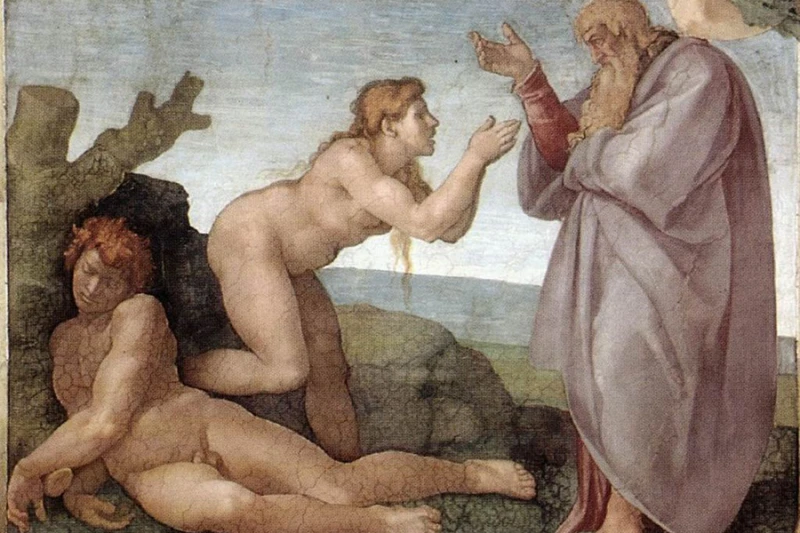
Michelangelo’s The Creation of Eve, from the Sistine Chapel ceiling, c. 1510. / null
Denver, Colo., Nov 15, 2022 / 09:00 am (CNA).
Michelangelo’s artistic masterpiece in the Sistine Chapel broke new ground in portraying the dynamic creative acts of God, but his work also depicts the combined importance of men and women through all of sacred history, art historian Elizabeth Lev has said.
“The spirit of artistic adventure led the artist to experiment with a completely new vision of creation,” Lev said Nov. 12. “He took a book that had been painted, sculpted, mosaiced, and illuminated over and over again in the history of art and created something completely new.”
She spoke at the closing keynote Saturday evening at the fall conference of the University of Notre Dame’s de Nicola Center for Ethics and Culture. Lev teaches at the Rome campus of Duquesne University and the Pontifical University of St. Thomas Aquinas. Her speech, “Creation, Complementarity, & St. John Paul II in Michelangelo’s Sistine Ceiling,” focused on one of the key artistic treasures of Vatican City.
The 16th-century Florentine artist Michelangelo was commissioned by Pope Julius II to paint the Sistine Chapel’s ceiling and the upper section of its walls. This was the artist’s focus from 1508 to 1512. He later finished the Last Judgment above the chapel altar from 1535 to 1541.
The ceiling frescoes show the creation of the heavens and the earth, the creation of Adam and Eve, their expulsion from the Garden of Eden, the great flood, and the rebirth of humankind through Noah.
Lev cited St. John Paul II’s description of Michelangelo’s work in his poem “Meditations on the Book of Genesis at the Threshold of the Sistine Chapel.”
“It is the book of the origins — Genesis,” the pope said. “Here, in this chapel, Michelangelo penned it, not with words, but with the richness of piled-up colors. We enter in order to read it again, going from wonder to wonder.”
Lev reflected on the first three panels depicting the creation of the world. These show “the mighty dynamic figure of God the Father at work.”
“It’s not what God creates, it’s that God creates,” she said. Michelangelo broke ground in portraying God as “physically engaged in creation.” For Lev, this offers “a preview of the Incarnation.”
Turning to Michelangelo’s famous depiction of the Creation of Adam, Lev noted that the artist depicts “just God and the creature formed in his likeness.” Adam is shown as “somewhat listless” in contrast with God’s energy. Adam is “sentient and awake but he has no will or strength or purpose to rise,” she said. “He looks completely passive and dependent despite that incredibly beautiful form.”
“It’s God who reaches towards man,” she continued. For Lev, the outstretched finger of God makes the viewer “almost lean forward in his seat waiting for that final Act of Creation, the divine spark, the Breath of Life that will release that latent energy and allow Adam to take his place as the greatest of creations.”
“This is the joy in humanity that permeates the Renaissance,” Lev said.
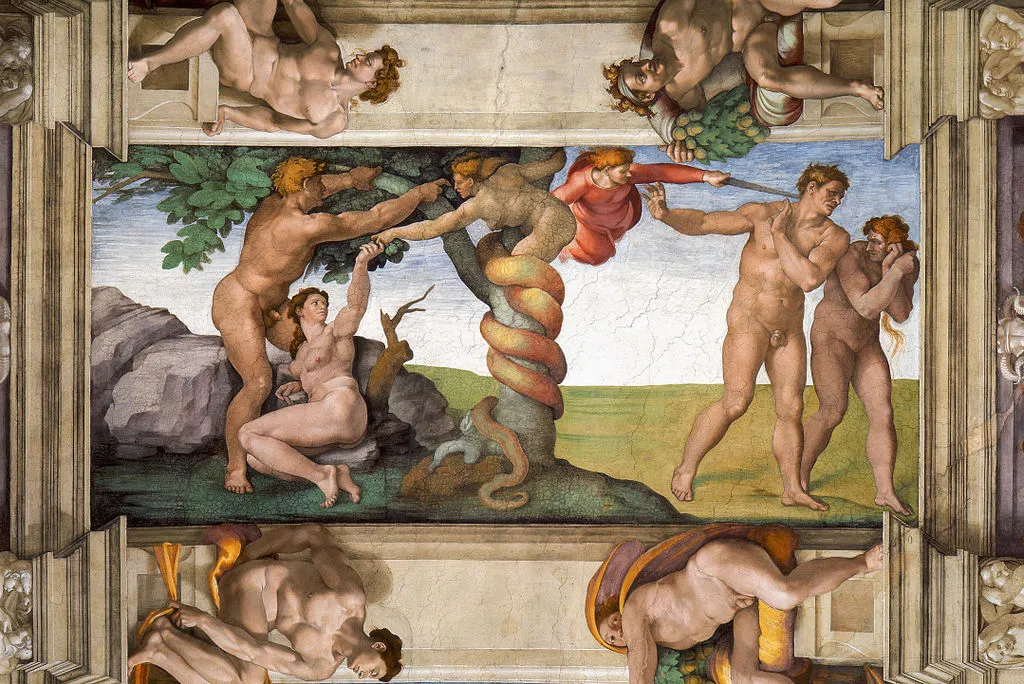
Michelangelo’s The Fall and Expulsion from Paradise from the Vatican’s Sistine Chapel (1508-12).
There is academic debate over a female figure shown in the Creation of Adam. As God the Father stretches out one arm to Adam, his other arm curls around a female figure. Some have identified this figure as Wisdom, some as Mary.
Lev suggested it is best to identify this figure as Eve, both because the figure provides visual balance to Adam and because her gaze “connects her more intimately with Adam.”
The creation of Eve from Adam, depicted next on the chapel ceiling, shows Eve emerging from Adam’s side with her hands clasped in prayer, an image of the Church and the personification of Mary, the “Second Eve.”
Lev cited St. John Paul II’s 1999 homily inaugurating the newly restored Sistine Chapel, after centuries of grime and soot were removed. The pope called the chapel the “sanctuary of the theology of the human body,” alluding to his catecheses offered from 1979 to 1984. The pope suggested that Michelangelo allowed himself to be guided by the Book of Genesis’ depiction of mankind in Eden: “the man and his wife were both naked and they felt no shame.”
Before the fall, Lev commented, Michelangelo depicted Adam and Eve in the state of grace as “two of his most beautiful figures.”
“They are filled with dynamism. They’re buoyant. They’re luminous,” Lev said, adding that their bodies “suggest immortality.” After the fall, however, both of their bodies “lose their luminosity” and appear heavier, like a burden. Adam’s shoulder seems to force Eve into the background, “subjugating her.”
For Lev, the artistic depiction of the genealogy of Jesus Christ also deserves attention. The portrayal of the ancestors of Jesus Christ shows “a genealogy of men and women struggling from generation to generation.” These figures seem “more approachable” and “much more similar to candid family photographs.” Even though 22 women in Jesus’ genealogy are not named, Michelangelo pairs them with their husbands.
Lev noted that Michelangelo broke with artistic convention both by including mothers and by showing them as busy, everyday women “tending to toddlers, toilettes, and tasks.” His style of painting them with “incredible immediacy” adds observations of human nature: Eleazar’s wife holds the purse strings and the key to the house, and her husband looks “startled” as she surveys their son. Other depictions are “tender and intimate,” like the portrayal of the wife of Manasseh, who cradles a swaddled son while rocking an infant’s cradle.
Here, Lev drew on John Paul II’s 1995 “Letter to Women.” He wrote that womanhood and manhood are complementary at the physical, psychological, and even ontological level.
“It is only through the duality of the masculine and the feminine that the human finds full recognition,” the pope said. “To this unity of the two, God has entrusted not only the work of procreation and family life but the creation of history itself.”
Lev noted that the passing of generations “necessarily emphasizes the begetting of children.” This means that the complementarity of the sexes is essential for a population to form and for creation to continue.
In Michelangelo’s portrayal of the Last Judgment, the artist still looks back to creation but also breaks new ground. He placed Mary next to Christ, as “a foil to Christ’s sternness.”
“She is the picture of mercy gazing down towards the elect, placed by the wound in Christ’s side whence the Church sprang,” Lev said. “Mary is transfigured into the Bride of Christ, for whom he gave his life and to whom he cannot say no. She is the conduit to Christ, as Eve was the link between God and man in the creation of woman.”
For Lev, the Sistine Chapel shows the “incredible gift of creation” from the beginning of the world down through the generations, “through which all of us today are a part of that continuation of creation.”
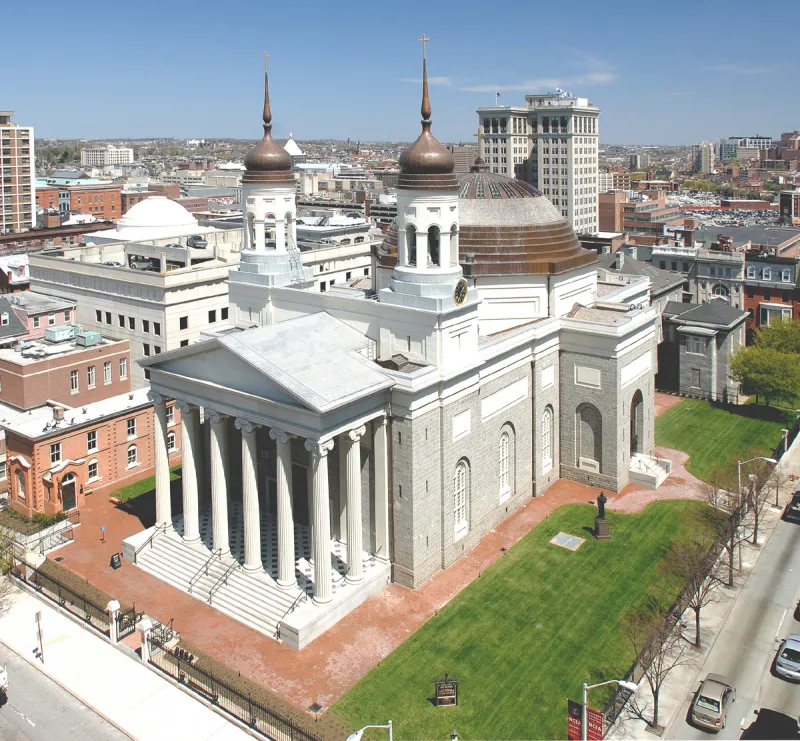
A view of Baltimore’s Basilica nestled amid the city’s famed row houses / Public domain
St. Louis, Mo., Nov 15, 2022 / 06:00 am (CNA).
The bishops of the United States are meeting this week for their fall assembly in Baltimore. They’re gathering to elect a new president and discuss issues facing the Church such as the Ukraine war and the Synod on Synodality, among other things.
In the early days of the United States Conference of Catholic Bishops (USCCB) in the early 2000s, the bishops held their fall meeting in Washington D.C. — a location that makes a lot of sense, given Washington’s status as the nation’s capital, as well as the city where the USCCB is headquartered.
But since 2006, the bishops’ fall assembly has been held in nearby Baltimore.
But what’s so special about Baltimore? For American Catholics, quite a lot.
For starters, Baltimore was the first diocese in the United States, having been established as such in 1789 and elevated to an archdiocese in 1808. Before its establishment, Catholics in the young United States were under the jurisdiction of the Apostolic Vicariate of the London District in England.
Maryland, at the time, was the most Catholic of the 13 colonies, having been founded by Catholic colonists wishing to create a society where they could practice their faith. The territory of the Diocese of Baltimore originally included the entire fledgling country.
John Carroll was chosen as Baltimore’s first bishop, and thus the de facto leader of Catholics in the U.S. A cousin of Charles Carroll — the sole Catholic signer of the Declaration of Independence — Carroll’s tenure as bishop led to many Catholic firsts. In 1791 he founded the first seminary in the country, and he ordained the first priest in the U.S. in 1793. Carroll laid the cornerstone for the Basilica of the National Shrine of the Assumption of the Blessed Virgin Mary, Baltimore’s present co-cathedral, in 1806. In 1809, the future St. Elizabeth Ann Seton arrived in Baltimore and started the country’s Catholic school system.
Though several other dioceses in important cities such as New York, Boston, and Bardstown (now Louisville) would be established after 1808, Baltimore would remain the only archdiocese in the country until 1846. The Archdiocese of Washington was not created until the 20th century.
In 1858, the Vatican issued a decree granting the right of precedence in the United States to the Archbishop of Baltimore. This means that the Archbishop of Baltimore takes precedence over all other American archbishops — cardinals excluded — in councils, gatherings, and meetings of the hierarchy regardless of seniority, the archdiocese explains.
In addition to being “first,” Baltimore has historically played an important role in hosting councils and meetings in the U.S. According to the archdiocese, the first Baltimore synod was held in 1791 when 22 priests met with Bishop Carroll to draw up guidelines for the practice of the faith by the clergy and laity, and later synods took on a national character since the diocese was the only one in the country. Most notably, plenary councils of all the country’s bishops were held in Baltimore in 1852, 1866, and 1884. One enduring effect of the last plenary council was setting in motion the process to create the Baltimore Catechism, which was the primary teaching document in U.S. Catholic schools for nearly a century.
According to the archdiocese, Baltimore today “enjoys a position of importance in the American Church as a leading center of ecumenical, social and civic progress, along with being one of the prime locations for priestly formation in the United States.”
Given all this history in Baltimore, it’s not too surprising that the bishops’ annual fall assembly was moved to Baltimore in 2006.