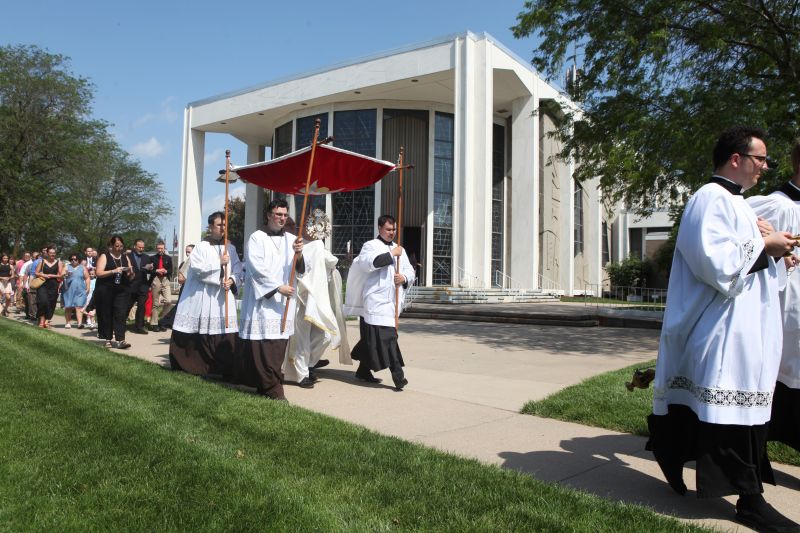
 The Ryken Center at St. John’s High School in Shrewsbury, Massachusetts / John Phelan|Wikipedia|CC BY-SA 3.0
Boston, Mass., Aug 18, 2023 / 13:36 pm (CNA).
Members of religious orders affiliated with two Catholic high schools in Massachusetts have told Worcester Bishop Robert McManus that they will not be implementing the diocese’s new policy concerning gender ideology and sexual confusion because, they said, policies are already in place.
Xaverian Brother Daniel Skala, representing St. John’s High School, and Sister Patty Chappell of the Sisters of Notre Dame de Namur, representing Notre Dame Academy, wrote a joint letter to McManus Aug. 11 saying that the boards of trustees of their religious orders decided to forgo implementing the bishop’s policy, according to the Patch.
The new diocesan policy was approved in June and “sent to all Catholic schools to incorporate into school handbooks beginning this fall,” an Aug. 15 statement from the diocese said.
“Students may not advocate, celebrate, or express same-sex attraction in such a way as to cause confusion or distraction in the context of Catholic school classes, activities, or events,” the guidance says.
The policy also addresses gender dysphoria and states that students should be treated in accordance with their biological sex.
“School practice shall consider the gender of all students as being consistent with their biological sex, including, but not limited to, the following: participation in school athletics; school-sponsored dances; dress and uniform policies; the use of changing facilities, showers, locker rooms, and bathrooms (with rare exceptions only on a limited, case-by-case basis, to be determined by the principal of the school); titles, names, and pronouns; and official school documents,” reads the memo sent by the bishop.
In their letter to McManus, the two religious said the schools would not adopt the bishop’s guidance but would instead continue to follow “established practices.”
“We feel confident that our schools are responding to the issues raised in your memo in a manner that respects the dignity of all persons, aligns to the mission and charism of our sponsoring orders, and protects and affirms our identity as Catholic schools,” the letter said.
“We support our respective boards’ recent determination to uphold their established practices, guided by the principles of our Church and religious orders, instead of incorporating the [new policies] into their handbooks,” the letter said.
CNA reached out to both orders inquiring about the policies that are already in place.
Susan Dennin, a spokeswoman for the Sisters of Notre Dame de Namur U.S. East-West Province, told CNA Friday that Notre Dame Academy has “consistently followed both the legal guidance and recommendations of the National Catholic Educational Association that schools should not have a policy on transgender students.”
“NDA Worcester has approached these sensitive and complex circumstances in a pastoral manner that respects the dignity of all persons while also affirming the school’s Catholic identity,” she said.
“While supporting students and families, NDA Worcester maintains communication with province leadership in discerning mission appropriate responses to any unique family or student inquiries,” Dennin said.
CNA contacted the National Catholic Educational Association inquiring about any guidance it has given that schools should not have a policy on transgender students, but did not get a response by time of publication.
On the organization’s website there is a reference sheet which offers schools resources regarding Catholic social teaching and gender identity.
A spokesman for the Xaverian Brothers did not respond.
Ray Delisle, a spokesperson for the Worcester Diocese, said Friday: “First, I must make note that Bishop McManus has been away on the regional bishops’ retreat this week and I believe their letter arrived early this week.”
“That being said, policies take time to be implemented. Even though it was sent to all 21 schools in our diocese, including diocesan, parochial, and private Catholic schools, some schools may have had a policy in place,” he added.
“We will have to wait and see how it goes. Given all these factors, there is no response or comment to their letter at this time.”
The Worcester Diocese’s policy refers to Pope Francis’ frequent statements about the dangers of “gender ideology” and counsels schools to accompany those suffering from confusion related to their sexuality.
The policy says that “Pope Francis has repeatedly stressed the importance of a proper understanding of our sexuality, warning of the challenge posed by ‘the various forms of an ideology of gender that denies the difference and reciprocity in nature of a man and a woman and envisages a society without sexual differences.’”
“We must not demean or deny the sincerity and struggle of those who experience same-sex attraction or who feel their true gender identity is different from their biological sex. Rather, we seek to accompany them on their journey of life, offering them the light of the Gospel as they try to find their way forward,” the policy says.
Just over a year ago, McManus revoked the Catholic status of a Jesuit-run school in Worcester for defying his order to stop flying flags supporting LGBT pride and the Black Lives Matter movement.
In March Pope Francis called gender ideology “one of the most dangerous ideological colonizations.”
McManus is the latest of several other bishops to issue pastoral policies in schools in an attempt to address the issue of gender ideology, which the U.S. bishops in a 2017 ecumenical letter have called harmful to people and societies “by sowing confusion and self-doubt.”
This article has been updated.
[…]