“Let this cross guide you as it once guided Constantine,” said Archbishop Elpidophoros of the Greek Orthodox Archdiocese of America upon presenting President Trump with a holy cross at the White House on March 24, 2025. / Credit: Courtesy of the… […]
Rep. Chris Smith, R-New Jersey, co-chair of the Congressional Pro-Life Caucus, speaks during a presentation of the Let Pregnancy Centers Serve Act, which protects pregnancy care facilities, at a March 24, 2025, press conference in the U.S. Capit… […]
A Chase bank building in Wilmington, Delaware. / Credit: Harrison Keely, CC BY 4.0, via Wikimedia Commons
CNA Staff, Mar 25, 2025 / 06:00 am (CNA).
Legislators in several states are moving to address the practice of “debanking” as part of an effort to stop what some critics say are anti-conservative measures employed by major U.S. financial institutions.
The Cambridge Dictionary defines debanking as “the act by a bank of closing someone’s account because they are regarded as a risk legally, financially, or to the bank’s reputation.” Critics have claimed that the practice is used by banks to antagonize certain groups, including conservatives and other political activists.
For example, the Trump Organization filed a lawsuit earlier this month against one of the largest banks in the United States. President Donald Trump claims he was a victim of debanking after Capital One allegedly closed hundreds of his organization’s accounts soon after his supporters’ Jan. 6, 2021, storming of the U.S. Capitol.
In her recently-released memoir, Melania Trump alleged that she and her son, Barron, were also debanked.
The Ruth Institute, a global coalition designed to equip Christians to defend the family, alleged it was debanked in 2017. Just two years ago, a Memphis-based Christian charity called the Indigenous Advance Ministries also claimed that it had been debanked by Bank of America.
In another high-profile case, in 2022 former U.S. senator and ambassador Sam Brownback announced that his nonprofit group the National Committee for Religious Freedom had been debanked.
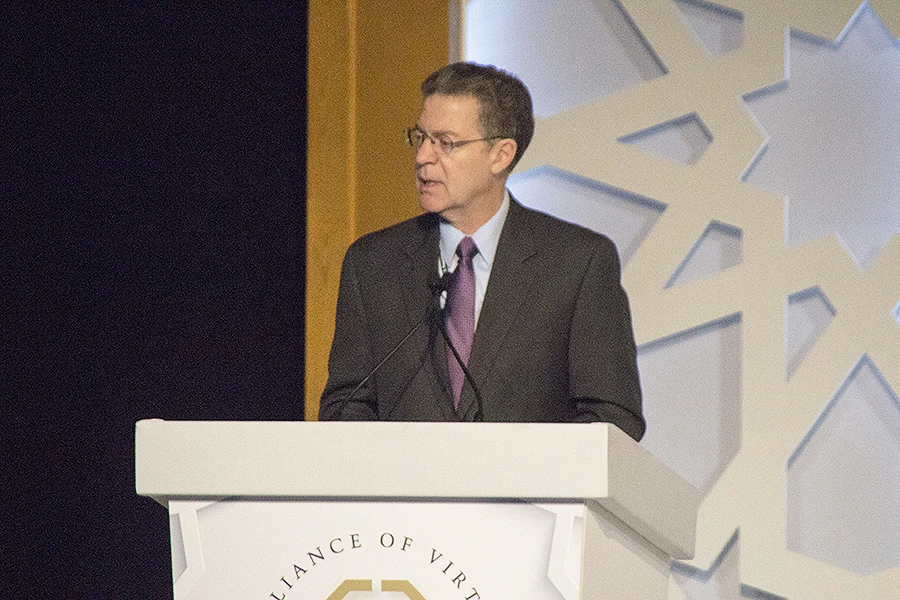
Ambassador Sam Brownback speaks on Feb. 6, 2018. Credit: Jonah McKeown/ CNA
Over the past decade, other high-ranking individuals and grassroots organizations have reportedly faced debanking, including Nigel Farage, who led the Brexit effort in the United Kingdom; evangelist and motivational speaker Nick Vujicic; Moms for Liberty, a parental rights advocacy group; Christian author and preacher Lance Wallnau; and Timothy Two Project International, a Christian ministry.
U.S. bishops ‘monitoring’ debanking; legislators move to address
While it’s unclear to what extent debanking has affected U.S. Catholics, the U.S. Conference of Catholic Bishops acknowledged the phenomenon in its 2025 religious liberty report.
“In recent years, individuals have raised concerns that banks are discriminating on the basis of political and religious viewpoints,” the report read.
“In response to incidents like these, some states have begun passing laws intended to prevent politically motivated debanking,” the bishops noted. “However, the U.S. government argues that these laws hamstring banks, who need to be able to account for potential customers’ exposure to foreign actors. The lack of transparency, though, makes it difficult to ascertain why someone like Ambassador Brownback would be debanked.”
According to the report, the USCCB is “monitoring this issue but has not taken a position on it.”
Taking action against debanking
Some lawmakers are moving to address the controversy via legislation.
An anti-debanking bill in Idaho was sent to the state governor for signature last week.
The Transparency in Financial Services Act would prohibit “large financial institutions from discriminating against customers based on their political or religious views” and would give customers the right to request the reason for denial from an institution.
Montana’s Republican-sponsored Equality in Financial Services Act and South Carolina’s anti-debanking bill — similar to Idaho’s bill — have made some progress in the state Legislature, while Georgia’s Freedom of Speech and Belief Act failed to pass at the beginning of March.
Some see changes in bank policy, or even legal changes, as potential solutions to debanking.
Alliance Defending Freedom (ADF) — a legal group committed to protecting religious freedom and freedom of speech — worked with Indigenous Advance Ministries to file a consumer complaint following its alleged debanking in 2022.
“No American should ever fear losing access to their bank account due to their religious or political beliefs,” Lathan Watts, ADF’s vice president of public affairs, told CNA.
In its 2023 Viewpoint Diversity Score Index, ADF found that 7 out of 10 of the largest commercial banks — including Chase — have “hate speech” or “reputational risk” policies that contribute to debanking.
JPMorgan Chase, a top American bank, recently adjusted its policy, agreeing to protect clients against political and religious debanking in its code of conduct after 19 attorneys general petitioned the bank to cease its debanking practices in 2023.
“Chase’s policy change is a significant step by our nation’s largest bank to uphold financial access for all Americans,” Watts said. “This change provides necessary protections for customers like Ambassador Brownback, whose account at the National Committee for Religious Freedom was unexpectedly canceled in 2022.”
Watts shared his hope that other banks will take similar measures.
“Alliance Defending Freedom actively engaged with Chase in these negotiations, and we are hopeful that other banks will follow suit in safeguarding fundamental financial freedoms,” Watts said.
Jennifer Roback Morse, the founder and president of the Ruth Institute — an organization dedicated to combating the effects of the sexual revolution — recalled her own experience allegedly being debanked.
“In 2017, the Ruth Institute was one of the first organizations to be attacked in the banking arena,” Morse told CNA. “In our case, our credit card processor cut us off with no notification, or explanation, except to say that we ‘violated its standards.’”
Ruth Institute President Jennifer Roback Morse speaks on “The World Over with Raymond Arroyo” on June 13, 2019. Credit: “The World Over with Raymond Arroyo/EWTN News screenshot
While there was no clear explanation, Morse believes it was due to a leftist law center labeling the organization as a hate group.
“We surmised this was because we were listed on the Southern Poverty Law Center’s ‘Hate Map’ for our opposition to the redefinition of marriage and other LGBT-issues,” Morse said. “Thankfully, we were able to secure another credit card processor fairly quickly.”
Morse told CNA that banking “is a highly regulated, semi-monopolistic industry, comparable in some respects to public utilities such as electricity and water.”
“I am in favor of banks being legally required to be transparent and even-handed in their standards,” she said.
“Alternatively, if banks are permitted to engage in viewpoint discrimination,” she argued, “I would urge that bakers, florists, therapists, and other professionals also be permitted to refuse service to potential customers for any reason they choose.”
“A disappointed customer can find an alternative photographer a lot easier than they can find an alternative bank,” Morse noted. “And it is a lot easier to participate in the business world without a photographer or florist than to survive without banking services.”
‘A balanced approach’
While conservative legislators are pushing these anti-debanking bills, support for this legislation is not entirely united within the conservative movement.
A recent poll found that while a majority of conservatives are concerned about debanking, nearly three-quarters of conservatives expressed support for banks having the right to choose their own clients.
The poll by the Tyson Group found that conservatives “do not support broad government intervention that prevents financial institutions from making risk-based assessments when determining their customers.”
“When informed that legislation could force businesses to provide services to customers at odds with their values and the conservative movement, many expressed hesitations,” the study noted.
“As conservatives push for greater accountability from regulators, they also seek a balanced approach to debanking that avoids unintended consequences and protects the rights of both consumers and businesses.”
Some opponents of anti-debanking laws maintain that restrictions against debanking could have unintended consequences.
In South Carolina, for example, an anti-debanking bill under consideration, the Equality in Financial Services Act, would prevent financial institutions from discriminating when providing financial services.
But a Republican executive committeeman from Richland, South Carolina, is concerned that such an anti-debanking law could require pro-life banks to work with abortionists.
“Stopping abortion and protecting children requires winning hearts and minds but also cutting off the financial pipeline that enables these activities,” Eaddy Roe Willard, Richland GOP executive committeeman, told CNA. “Misguided legislation at the state level will only make it harder to do that.”
Cardinal Robert McElroy speaks at the conference “Catholic Social Teaching and Work with Migrants and Refugees at a Time of Uncertainty” on March 24, 2025, in Washington, D.C. / Credit: Madalaine Elhabbal/CNA
CNA Staff, Mar 24, 2025 / 17:50 pm (CNA).
Following an investigation into a possible Eucharistic miracle at a local parish, the Archdiocese of Indianapolis announced Monday that scientific a… […]
CNA Staff, Mar 24, 2025 / 17:15 pm (CNA).
Editor’s note: This story contains graphic descriptions of an abortion procedure.A woman is suing an abortionist for allegedly leaving more than half of her unbo… […]
St. Mary’s School in Fredericksburg, Texas. / Credit: Michael Barera, CC BY-SA 4.0, via Wikimedia Commons
Seattle, Wash., Mar 24, 2025 / 15:40 pm (CNA).
A $1 billion “school choice” proposal moving through the Texas Legislature could dramatically expand private education and home schooling in the country’s second most populous state, winning praise from Catholic leaders while raising concerns among some public school advocates.
The legislation would create education savings accounts (ESAs) of about $10,893 per student — calculated as roughly 85% of what public schools receive per pupil — and allow home schooling families to collect $2,000 per child. Crucially, the bill does not include any income cap, prompting debate over whether higher-earning parents should also benefit from state funds.
If passed, the bill could trigger an influx of students to Catholic schools, the largest private school network in Texas. According to Helen Osman, communications consultant for the Texas Catholic Conference, there are 240 Catholic schools in the state educating approximately 62,000 students, but they have room for 25,000 more.
“This legislation would give more families access to Catholic education, allowing parents to exercise their fundamental right and responsibility to find the best education for their children,” Osman told CNA.
In recent guidance, the state’s bishops said the bill meets key criteria they support, such as accreditation-based accountability, strong religious liberty protections, and a focus on aiding low-income families.
Despite that endorsement, critics worry about the bill’s impact on public schools, which rely heavily on attendance-based state funding. If families move their children to private or home-based education, fewer dollars remain for the 5.5 million students in the public system.
Lawmakers on the left argue that wealthier Texans stand to benefit disproportionately, while supporters insist that today’s inflationary climate affects a wide range of households.
Home-schoolers could also benefit
Home-schoolers who opt in to the program would receive $2,000 per student. Anita Scott, education policy director for the Texas Home School Coalition, told CNA in an interview that parents appreciate the financial relief.
When asked about those home schooling families wary of a potential increase of state oversight, she said they’ve “been invited to the table to make sure the bill is functional for home-schoolers.”
“If parents are still uncomfortable, they can opt out. Families want to be in charge of what’s placed in front of their children. They deserve that freedom, whether or not they take state funds,” Scott said.
Meanwhile, conservative advocates, including Mandy Drogin of Next Generation Texas, say these education savings accounts would not siphon money from public school coffers.
Mandy Drogin directs the Texas Public Policy Foundation’s “Next Generation Texas” campaign. Credit: Courtesy of Texas Public Policy Foundation/screenshot
“So first off, the money for the education savings account does not come from any education-related funding,” Drogin said. “It’s from state revenue funds, especially the surplus, and does not in any way remove or defund the public schools.” Proponents also argue the competition will elevate academic quality for all students.
The House plan differs from the Senate bill, which establishes a flat voucher amount rather than pegging it to public school funding. Both proposals prioritize children with disabilities and expand home-based education support, but lawmakers must reconcile those differences if they intend to finalize a single policy.
Gov. Greg Abbott, who has made “school choice” a central priority this session, predicts a final compromise before the legislative term ends in June.
Nationally, Catholic leaders are also backing the Educational Choices for Children Act (ECCA), a federal bill offering $10 billion in tax credits to donors who fund K–12 scholarships. They view it as another avenue to help low- and middle-income families afford private education, especially in states restricted by “anti-Catholic” Blaine amendments.
Two years ago, voucher bills floundered in the Texas House. This year, more lawmakers appear open to ESAs, thanks to retirements and electoral changes that have brought additional supporters into the chamber. Many see this shift as pivotal in moving the House bill forward.
Gov. Abbott of Texas signed a law banning transgender procedures for children. Credit: Carrington Tatum/Shutterstock
Observers note that negotiations are likely to produce amendments, especially regarding details such as special education funding or income-based priorities.
Should legislators vote it into law, the program would become one of the country’s most expansive voucher-style initiatives, lauded by supporters as a boon for educational freedom and criticized by opponents as a drain on local school budgets.
With the political momentum behind school choice stronger than it has been in years, the debate over whether affluent Texans should tap taxpayer-funded ESAs remains a key sticking point — and one that could shape the future of education in Texas for years to come.
Washington, D.C. Newsroom, Mar 24, 2025 / 08:00 am (CNA).
Three U.S. representatives have introduced a bill that supports American taxpayers who choose to participate in health sharing, a care option favore… […]
U.S. Secretary of Transportation Sean Duffy in a March 20, 2025, interview on “The World Over with Raymond Arroyo” shares how his family and Catholic faith have sustained him during his extraordinarily intense first months as U.S. Secretary of T… […]
Genuflection before the Blessed Sacrament. / Credit: ACI Prensa
ACI Prensa Staff, Mar 22, 2025 / 09:00 am (CNA).
Cardinal Timothy Dolan, the archbishop of New York, explained one of the expressions of reverence Catholics make in church — genufl… […]