The Dispatch

By the numbers: How the Catholic Church has changed during Pope Francis’ pontificate

March 13, 2023 Catholic News Agency 15
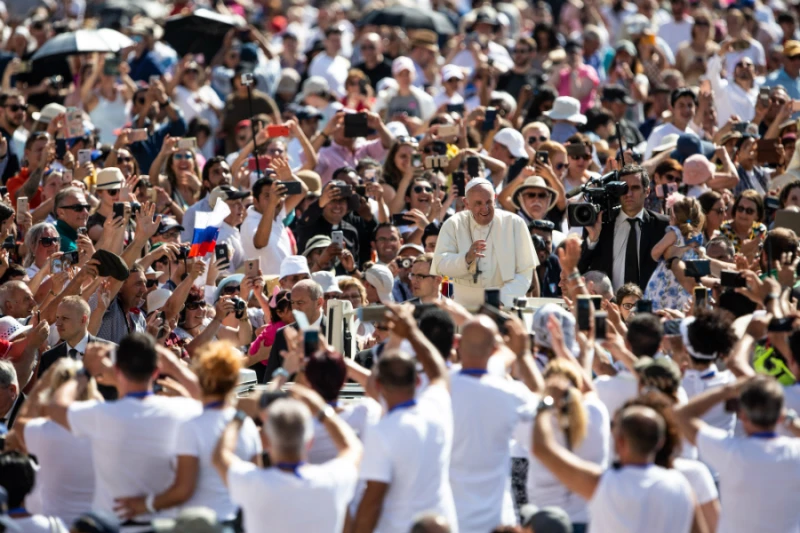
Pope Francis at his weekly Wednesday audience in St. Peter’s Square June 26, 2019. / Daniel Ibanez/CNA.

St. Louis, Mo., Mar 13, 2023 / 03:00 am (CNA).

Pope Francis was elected to the papacy 10 years ago, on March 13, 2013. How has the worldwide Catholic Church changed since then?

Statistically speaking, the Church has grown, keeping pace with and even exceeding overall world population growth. The total number of Catholics worldwide grew from ​​1.253 billion in 2013 to 1.378 billion in 2021, an increase of nearly 10%. During the same period, the world’s population as a whole grew by 9.1%, according to the World Bank.

Despite this increase, the Church performed 2 million fewer baptisms in 2020 than in 2013. The number of marriages declined by 702,246, or nearly a third. Confirmations and first Communions also dropped by 12% and 13%, respectively, despite relatively stable levels of Mass attendance in the world’s 13 most Catholic countries.

A Catholic researcher told CNA this week that the biggest likely reason for this drop in participation in the sacraments is not hard to guess — three of the 10 years of Francis’ pontificate have been marked by the worldwide effects of a pandemic. But that’s not the only reason, he says.

“I don’t know if the Catholic world has changed as much as just the world [in general] has changed,” Mark Gray, senior researcher with the Center for Applied Research in the Apostolate (CARA) at Georgetown University, told CNA.

“The Church and Pope Francis and bishops have had to try to navigate their way through some really challenging demographic changes as well as the pandemic. And the Catholic Church has come out of these better than many other Christian denominations. So there’s good news there, but there’s still a lot to weather. There’s a headwind, I would say, against the Church.”

The drop in participation in the sacraments worldwide is not due only to the pandemic, he cautioned, but rather is part of a much larger demographic trend worldwide of declining births. According to the World Bank’s world development indicators, life expectancies at birth have been increasing globally from 51 years in 1960 to 72 years in 2020. At the same time, Gray wrote, the birth rate per 1,000 people has fallen from 32 in 1960 to 17 in 2020.

“The number of births is expected to decline annually into the foreseeable future, eventually being outnumbered by deaths in 2085, according to U.N. projections,” Gray wrote in a March 9 blog post.

“The population will grow in the decades ahead as life expectancies continue to increase but at the same time births will decline and that will result in fewer baptisms, fewer first Communions, fewer students, and yes even fewer marriages annually just by the numbers of the demographic shift we are experiencing.”

Gray wrote that the full effects of the COVID-19 pandemic lockdowns, which prevented Catholics around the world from accessing the sacraments for a time, will likely take years to fully quantify. He also cautioned that two of the most authoritative sources for the number of Catholics have significant lags in their data. The most recent full dataset contained in the current edition of the Vatican’s Annuarium Statisticum Ecclesiae is for 2020, though the Vatican’s newspaper published a summary of the 2021 statistics earlier this month. The Official Catholic Directory, which covers the United States, goes up to 2021.

“Any impact, positive or negative, Pope Francis may have had will be overshadowed by the effects of the COVID-19 pandemic when our most current data represents 2020 and 2021,” Gray wrote.

“We know looking at Church data for these years we are going to see lower levels of Mass attendance and sacramental practice with the impact of lockdowns, restrictions, and hesitancy for people to gather in crowds in enclosed spaces during those two years.”

Other statistical indicators present a mixed picture of the Church’s growth in some areas and recession in others. For example, the total number of students in Catholic schools is up by 7.3% since 2013.

“One of the really bright signs for the Church is growth in Catholic education globally; more of the world’s youth are being educated in Catholic schools than they have in years and decades past,” Gray noted to CNA.

The number of diocesan priests worldwide appears to be virtually unchanged in the decade of Pope Francis’ pontificate, while the number of religious priests dipped only slightly. The number of religious sisters worldwide suffered a larger drop of nearly 11%.

According to the Vatican, however, the number of seminarians worldwide has been decreasing since 2013. The 2021 report shows the number of seminarians across the globe decreased by 1.8% since 2020. The sharpest declines were in North America and Europe, where the number of seminarians decreased by 5.8% on both continents.

Despite overall growth in the number of Catholics worldwide, that growth has not been evenly distributed. Overall, Africa has a higher baptism rate than Europe and a far higher rate of Mass attendance in countries with large Catholic populations. Another recent analysis by CARA found that Nigeria, Kenya, and Lebanon have the highest proportion of Catholics who attend Mass weekly or more, with Nigeria as the clear leader. Ninety-four percent of Catholics in Nigeria say they attend Mass at least weekly. In Kenya, the figure was 73%, and in Lebanon it was 69%. In comparison, countries like Germany, France, Switzerland, and the Netherlands are all under 15%.

In addition, Africa bucks the trend of declining vocations by showing an increase in seminarians and religious brothers, according to the 2021 Vatican statistics. Africa also saw the only increase in seminarians and religious brothers across the globe from 2020-2021, at 0.6%. The number of religious brothers in Africa increased by 2.2% during the same time frame.

Pope Francis has made pastoral attention to Africa a priority of late, making a visit to the heavily Catholic Democratic Republic of Congo and South Sudan last month to an enthusiastic welcome.

Focusing on the United States — where a mere 5% of the world’s Catholics live — the picture is a bit less optimistic. In contrast to the stable numbers of the world as a whole, the number of diocesan priests in the U.S. dropped 8% from 2013 to 2021. There are 27% fewer sisters, 19% fewer brothers, and 15% fewer religious priests compared with a decade ago, though the number of permanent deacons has increased slightly, by 3%. Gray said the United States disproportionately relies on immigrant priests to address its own shortages.

Additionally, according to the General Social Survey, weekly Mass attendance among Catholics in the U.S. declined from 25% in 2012 to 17% in 2020-2021. The drop in sacramental participation in the U.S. — baptisms, marriages, etc. — mirrors the global trends.

As well, “since 2013, we’ve lost more than 1,000 parishes through reorganizations and closures,” Gray noted.

“Daily prayer declined from 59% to 51% from 2012 to 2020-2021. Unlike Mass attendance, one can pray at home and this should not have been affected by the pandemic. If anything, one might think Catholics would be praying more often during that time.”

Gray again cautioned that there are much larger demographic and social changes going on in the U.S. — and in the world at large — than can be attributed solely to Pope Francis’ leadership.

“No one should be giving Pope Francis a 10-year report card based on the most current data available,” he concluded.

“And when more comparable post-COVID-19 data are available, any ‘grades’ given for changes in the number of sacraments celebrated should be considered within the context of what is happening demographically across the globe.”

Speaking with CNA, he added: “It’s hard to make this comparison [between 2013 and 2023] because we have these lags in the data … We’ll know more in a couple of years when the data catches up with us.”

[…]

No Picture
News Briefs

Pope Francis: Gender ideology is ‘one of the most dangerous ideological colonizations’ today

March 11, 2023 Catholic News Agency 4
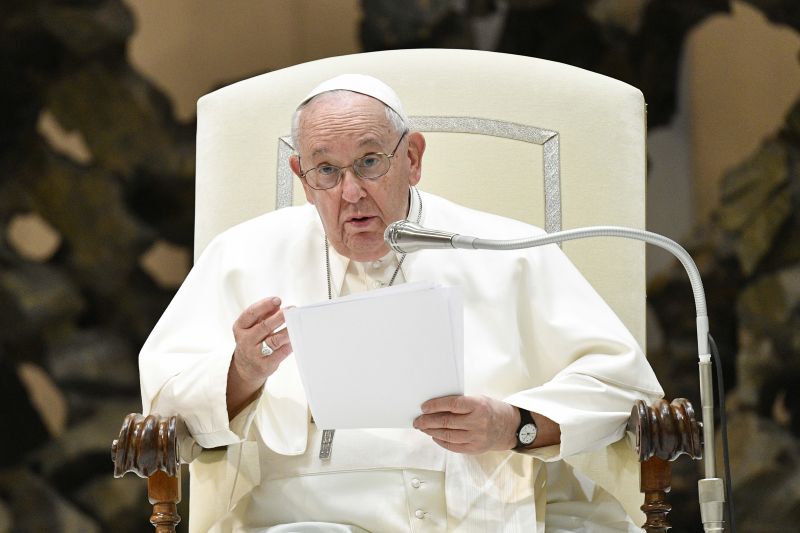
Pope Francis speaks at the general audience in Vatican City’s Paul VI Hall on Feb. 22, 2023. / Vatican Media

Rome Newsroom, Mar 11, 2023 / 05:20 am (CNA).

Pope Francis has said that gender ideology is “one of the most dangerous ideological colonizations” today.

In an interview with journalist Elisabetta Piqué for the Argentine daily newspaper La Nación, Pope Francis explained the reasoning behind his strong statement.

“Gender ideology, today, is one of the most dangerous ideological colonizations,” Francis said in the interview published on the evening of March 10.

“Why is it dangerous? Because it blurs differences and the value of men and women,” he added.

“All humanity is the tension of differences. It is to grow through the tension of differences. The question of gender is diluting the differences and making the world the same, all dull, all alike, and that is contrary to the human vocation.”

Pope Francis has frequently used the term “ideological colonization” throughout the 10 years of his pontificate, particularly to describe instances when aid money for developing countries has been tied to contraceptives, abortion, sterilization, and gender ideologies.

In a conversation with Polish bishops in 2016, Pope Francis said: “Today children — children — are taught in school that everyone can choose his or her sex. Why are they teaching this? Because the books are provided by the people and institutions that give you money. These forms of ideological colonization are also supported by influential countries. And this is terrible!”

The pope told Piqué that he was not currently writing a new encyclical and denied that he had been asked to write a document on the subject of gender.

While he is not writing something on gender ideology, the pope said that he talks about the subject “because some people are a bit naive and believe that it is the way to progress.”

He said that they “do not distinguish what is respect for sexual diversity or diverse sexual preferences from what is already an anthropology of gender, which is extremely dangerous because it eliminates differences, and that erases humanity, the richness of humanity, both personal, cultural, and social, the diversities and the tensions between differences.”

The pope noted that he always distinguishes “between what pastoral care is for people who have a different sexual orientation and what gender ideology is.”

“They are two different things,” he added.

When Piqué asked Pope Francis if he knew that in Argentina people are asked to indicate on official forms if they are male, female, or non-binary sex, the pope said that it reminded him of the “futuristic” novel, “Lord of the World,” written by Monsignor Robert Hugh Benson in 1907.

He said that the book presents the idea of “a future in which differences are disappearing and everything is the same, everything is uniform, a single leader of the whole world.”

In the interview with La Nación — the third papal interview published on March 10 — Pope Francis also reflected on the 10 years of his pontificate, his concern for the war in Ukraine, and why he has not traveled to his native Argentina.

Days ahead of the 10th anniversary of his pontificate on March 13, the pope said that he was especially happy about the legacy of his “pastoral line of forgiveness and understanding of the people, to make room in the Church for everyone.”

Asked to identify any mistakes he might have made in the past 10 years, the pope regretted times when he had lost his patience.

“More than once. It did not appear in the newspapers, but more than once,” he added with a laugh.

[…]

No Picture
News Briefs

‘I regret to inform you’: Pope Francis rebuffs Cardinal Becciu in letters read during ongoing finance trial

March 10, 2023 Catholic News Agency 2
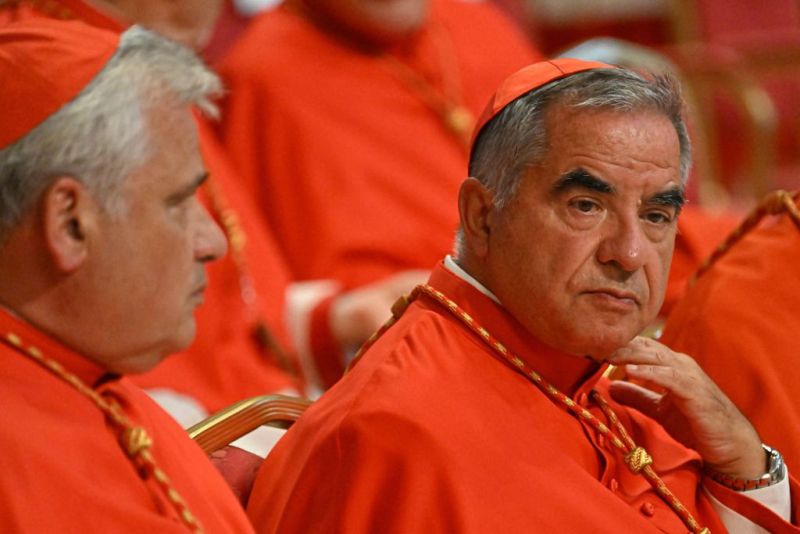
Italian Cardinal Giovanni Angelo Becciu (right) waits prior to the start of a consistory during which 20 new cardinals are to be created by the Pope, on Aug. 27, 2022 at St. Peter’s Basilica in the Vatican. ( / Photo by ALBERTO PIZZOLI/AFP via Getty Images

Rome Newsroom, Mar 10, 2023 / 14:15 pm (CNA).

Prior to the start of his trial on financial malfeasance charges, Cardinal Angelo Becciu tried to get Pope Francis to confirm that he had authorized the financial transactions that led to Becciu’s prosecution.

The pope refused.

“I regret to inform you that I cannot comply with your request,” the pope wrote back.

The correspondence between the two, which took place in July 2021, was read and displayed in a Vatican court March 9 — an unexpected turn of events coming during the 50th hearing of the trial.

Promoter of Justice Alessandro Diddi obtained the three letters directly from the “sovereign authority,” that is, Pope Francis himself.

In one letter, dated July 20, 2021, Becciu asked the pope to confirm that he had given the go-ahead for an investment by the Secretariat of State in a luxury property in London in 2013. Not only that, Becciu also asked the pope to acknowledge that he had personally approved the hiring of an intermediary, Cecilia Marogna, to help secure the release of Sister Cecilia Narvaez, the Colombian nun kidnapped in Mali in 2017 and freed in 2021.

In a style that seems more legalistic than Pope Francis’ usual writing, the pope wrote back on July 21 to say that Becciu’s letter surprised him. Instead of granting the confirmation that Becciu sought, the pope emphasized that the proposal for the purchase of the property in London “immediately seemed strange to me.” For that reason, he wrote, “I suggested that a prior consultation be carried out with the secretary of state, Cardinal Pietro Parolin, and with Father Juan Antonio Guerrero Alves, prefect of the SPE, for the insights of their respective competences.”

The phone call and new letter

On July 24, Cardinal Becciu telephoned Pope Francis and secretly recorded their conversation. In the phone call, Becciu complained that the pope’s letter of July 21 was like a verdict issued against him. He asked for it to be annulled, telling the pope that the tone of his letter was “entirely juridical” rather than that of a spiritual father.

Becciu asked the pope if he remembered that he gave him “the authorization to free the nun” and then told the pope that it would be enough for him if the pope said he authorized him to carry out particular operations. The pope responded by asking to send in writing “explanations and what he would like me to write.”

Becciu wrote to the pope again on July 24. In that letter, he thanked the pope for the phone call and said he he heard Francis “like a true father willing to listen to the pain of a son.”

Enclosed with the letter were two declarations that he asked the pope to sign, one regarding the London property deal and the other concerning the nun’s release.

Concerning the London property, Becciu appealed to the pope to affirm that he had considered “the proposal interesting.”

On July 26, Pope Francis responded again. He wrote that he had not clarified his “negative position” on the declarations that the cardinal wanted him to sign.

“Evidently and surprisingly, you misunderstood me,” Francis wrote.

“I regret to inform you,” he added, “that I cannot comply with your request to formally declare ‘nothing’ and therefore to ‘disregard’ the letter I had written to you.”

[…]

No Picture
News Briefs

Pope Francis says imprisonment of Nicaraguan bishop reminds him of Hitler’s dictatorship

March 10, 2023 Catholic News Agency 0
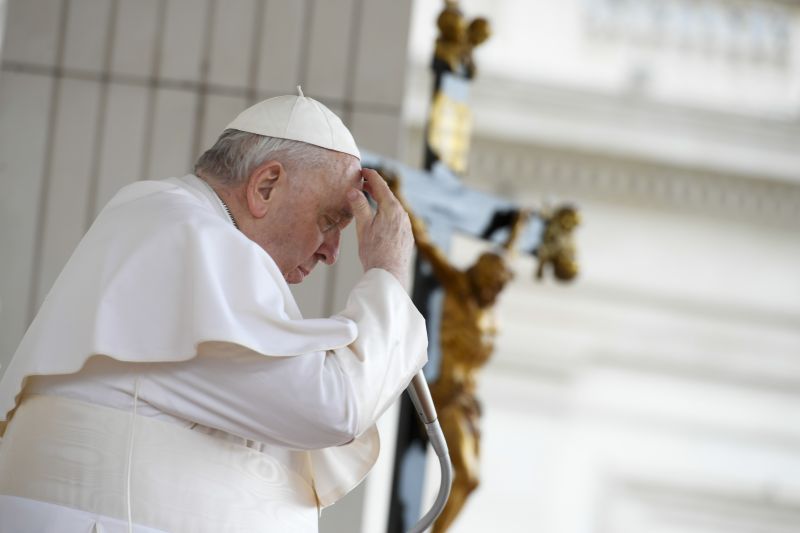
Pope Francis prays in St. Peter’s Square on March 8, 2023. / Vatican Media

Rome Newsroom, Mar 10, 2023 / 08:00 am (CNA).

Pope Francis called Nicaragua’s Daniel Ortega “unstable” and likened Nicaragua’s Sandinista government to Nazi Germany in an interview published Friday.

Speaking about Nicaragua’s Bishop Rolando Álvarez, who was sentenced to 26 years in prison by Ortega’s dictatorship last month, Pope Francis said: “It is something out of line with reality; it is as if we were bringing back the communist dictatorship of 1917 or the Hitler dictatorship of 1935.”

“They are a type of vulgar dictatorships,” he added, also using the Argentine word “guarangas,” meaning “rude.”

Pope Francis said: “With much respect, I have no choice but to think that the person who leads [Daniel Ortega] is unstable,” according to a transcript published on March 10 by the Spanish-language news outlet Infobae.

“Here we have a bishop in prison, a very serious man, very capable. He wanted to give witness and did not accept exile,” he said, speaking of Álvarez, whose imprisonment deeply grieved the pope.

The pope’s comment echoes those made recently by the chair of the U.N.’s Human Rights Group on Nicaragua, Jan Michael Simon.

“The use of the justice system against political opponents, as in Nicaragua, is exactly what the Nazi regime did,” Simon said.

‘Russian empire’ and the Ukraine war

Two news outlets published interviews with Pope Francis on March 10, days before the 10th anniversary of his pontificate.

In an interview with the Swiss public broadcaster RSI, Pope Francis spoke about what he would say if he had a chance to meet again with Russian President Vladamir Putin one year after the full-scale Russian invasion of Ukraine.

“I would speak to him as clearly as I speak in public. He is an educated man,” the pope said.

“The second day of the war I was at the Russian embassy to the Holy See to say that I was willing to go to Moscow as long as Putin would leave me a window to negotiate. Lavrov wrote to me saying thank you but it’s not the time. Putin knows I’m available.”

“But there are imperial interests there, not only of the Russian empire, but of the empires elsewhere. It is typical of the empire to put nations in second place,” Pope Francis said.

Benedict’s funeral

When asked why the funeral for Pope Emeritus Benedict XVI was sober, Pope Francis revealed that the funeral for the pope emeritus was challenging for masters of the apostolic ceremonies.

“The masters of ceremonies ‘broke their heads’ carrying out the funeral of a non-reigning pope. It was difficult to make a distinction,” he said.

“Now I have told them to study the ceremony for the funerals of future popes, of all popes. They are studying and also simplifying things a bit, removing the things that, liturgically, are not correct.”

Possibility of Pope Francis’ retirement

As he approaches the 10th anniversary of his pontificate, Pope Francis has said that he is not currently contemplating his retirement but discussed the circumstances that could potentially lead him to resign.

He said: “A tiredness that does not make you see things clearly. A lack of clarity, of knowing how to evaluate situations. A physical problem, too, perhaps,” could lead to his retirement.

“I always ask about this and listen to advice. ‘How are things going? Do you think I should…’ I ask those who know me and even some intelligent cardinals. And they tell me the truth: carry on, it is fine. But please: give me a shout in time,” he added.

RSI has only published an abridged transcript of its interview with the pope. The full interview will be published on the evening of March 12.

[…]