
No Picture
News Briefs

Hearing the Pope’s Confession: Vatican Confessor Reflects on Sacrament

December 10, 2023 Catholic News Agency 1
Pope Francis confessing in St. Peter’s Basilica. / L’Osservatore Romano

CNA Newsroom, Dec 10, 2023 / 11:15 am (CNA).

A 91-year-old Franciscan has spoken about his time as confessor to Pope Francis and stressed the enduring and essential role of the sacrament of reconciliation.

Brother Otmar Egloff served for several years as chief confessor at the Lateran — the storied cathedral of the bishop of Rome — according to CNA Deutsch, CNA’s German-language partner agency.

He recalled being asked to move from his native Switzerland to serve at the basilica in 2004, towards the end of Pope John Paul II’s pontificate. “It was probably my talent for languages that was decisive, as I speak Italian, German and French,” the priest said in an interview published Dec 7. 

The friar recalled being told, “tomorrow the pope is coming for confession!” — but that the experience was not so different from hearing confessions from other Catholics.  

“The only difference was that my confessional was cleaned very thoroughly beforehand,” the Franciscan said. 

“When you come to the confessional in the morning and see a whole team cleaning and scrubbing your confessional, that’s really something else. I used to go and dust it myself with a cloth.”

Brother Otmar said, “it was also special that Pope Francis confessed kneeling in public and used my confessional afterwards to hear confessions from other priests.”

Penance for the Pope

Upholding both the sacred seal of confession and his sense of humour, when asked by the Swiss interviewer what penance Pope Francis would receive from him today, the Franciscan answered with a laugh: “Today, I would give the pope a different penance. A penance of the tongue. His tongue is sometimes too quick.”

Asked by the Swiss journalist where priests live when appointed a confessor at the Lateran, the priest replied: “Above the roof of the church are the apartments of the eight Franciscan friars who sit in the eight confessionals during the day.” 

Brother Otmar added Franciscans from all over the world had always been assigned to this service in the Lateran, “that has always been the case and will remain so.”

Celibacy and Vocation

From his long experience as a confessor, Brother Otmar stressed that the sacrament “remains important”.

Noting “a decline of the practice in German-speaking countries,” the Swiss religious added: “This is a human need and gives you the chance of a real new beginning. Your conscience shows you what was wrong. God forgives.”

Pope Francis, who has encouraged Catholics to go to confession, recently reiterated his call on German Catholics to remember “the importance of prayer, penance, and adoration.”

In his interview, Brother Otmar also said that celibacy and abuse have nothing to do with each other: “It’s more because unsuitable candidates were accepted due to a shortage of priests. Paedophilia is a serious disorder and an atrocity.”

Asked whether you can already know in your mid-20s whether you can spend your whole life celibate, the Franciscan said: “You do know. You know whether you’ve had relationships, whether you long for a partnership or not. You have to deal with these issues. That was probably not discussed enough [in the past]. For me, it was always important to help the respective priests and candidates to the priesthood — and, if necessary, to advise them against it.”

[…]

No Picture
News Briefs

Here are 5 things to know about Cardinal Burke

December 6, 2023 Catholic News Agency 0
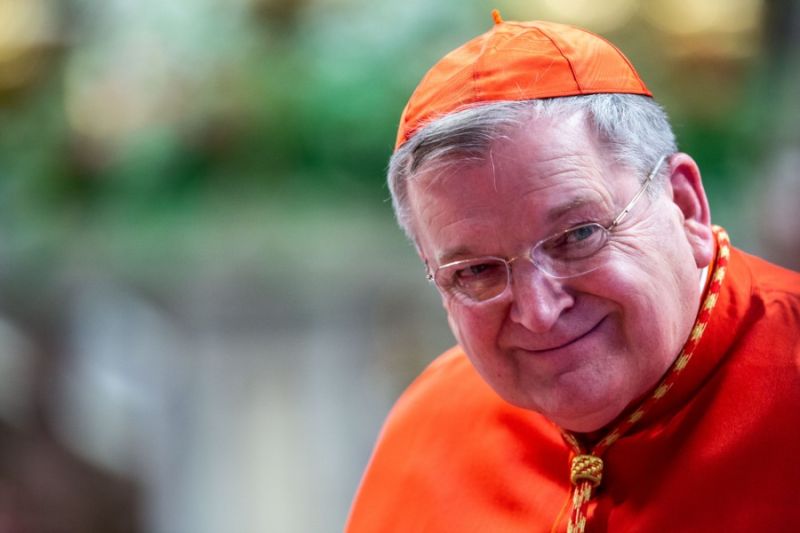
Raymond Leo Cardinal Burke during the solemnity of Saints Peter and Paul in St. Peter’s Basilica in Vatican City, June 29, 2019. / Credit: Daniel Ibáñez/CNA

CNA Staff, Dec 6, 2023 / 10:10 am (CNA).

Reports emerged last week that Cardinal Raymond Burke — a prominent American archbishop — will soon lose his current Vatican housing and salary privileges. As the details of the situation continue to come to light, here are some important things to know about Burke. 

  1. He is the former head of the Church’s highest court.

A native of Wisconsin, Burke was ordained a priest in 1975 by Pope Paul VI. Later ordained a bishop in 1995 by Pope John Paul II, Burke shepherded the Diocese of La Crosse, Wisconsin, founding the Shrine of Our Lady of Guadalupe while there. In 2003, he was appointed archbishop of St. Louis, a post he held from 2004–2008. 

Widely respected for his expertise in canon law, Pope Benedict XVI appointed Burke in 2008 as prefect of the Apostolic Signatura — head of the Church’s highest court. The next year, Benedict appointed Burke to the Congregation (now Dicastery) for Bishops, which is responsible for giving recommendations to the pope on episcopal candidates. The year after that, in 2010, Benedict elevated the then-62-year-old Burke to the rank of cardinal.

Burke continued to serve as prefect of the Apostolic Signatura until 2014. On his personal website, Burke notes that he has “written and spoken widely on Roman Catholic canon law, the Holy Eucharist, devotion to the Sacred Heart of Jesus, devotion to Our Lady of Guadalupe, and the sanctity of human life.”

  1. He has been publicly critical of various papal initiatives.

Burke’s public questioning of initiatives led by Pope Francis began in earnest in 2016, when he along with three other cardinals first privately submitted “dubia” — formal requests for clarification — to Pope Francis regarding the interpretation of his apostolic exhortation Amoris Laetitia, published after the 2015’s Synod on the Family. (As far as is known, the pope has never replied to those requests.) The cardinals released the dubia to the public two months later, igniting significant debate in the Church and in the media. 

In an interview conducted the following year, Burke stated that he’s wrongly depicted as an “enemy” of Pope Francis but also stressed his view that current divisions in the Church demand answers to requests for clarity.

“The urgency of a response to the dubia derives from the harm done to souls by the confusion and error, which result as long as the fundamental questions raised are not answered in accord with the constant teaching and practice of the Church,” Burke said at the time.

Later on, in 2019, Burke was critical of that year’s Synod on the Pan-Amazon Region, convened by Pope Francis at the Vatican, claiming that the meeting’s working document seemed “not only in dissonance with respect to the authentic teaching of the Church, but even contrary to it.”

When Pope Francis moved to restrict the use of the Traditional Latin Mass worldwide in 2021, Burke called the new restrictions “severe and revolutionary” and questioned the pope’s authority to revoke the use of the rite. 

More recently, this fall Burke was one of five cardinals who sent a new set of dubia to Pope Francis asking for clarification on the Church’s position on doctrinal development, the blessing of same-sex unions, the authority of the ongoing Synod on Synodality, women’s ordination, and sacramental absolution. Burke has insisted that the dubia were aimed neither at the pope’s person nor his agenda but merely at safeguarding the Church’s perennial doctrine.

The cardinal has also spoken out on other hot-button topics, such as when he released a lengthy defense in 2021 of what he called a “sacred duty” on the part of Catholic bishops to apply canon law by advising pro-abortion politicians not to receive holy Communion. He recently wrote a book detailing his views on fostering a greater respect for the Eucharist and discernment of cases when the sacrament ought to be denied to people in a state of manifest grave sin. 

  1. Pope Francis has gradually reduced Burke’s official roles.

Near the end of 2013, the year of Pope Francis’ election, the new pope declined to reappoint Burke to his role as a member of the Dicastery for Bishops. 

The following year, Pope Francis removed Burke from his post as prefect of the Apostolic Signatura, appointing him instead to a largely ceremonial role as cardinal patron of the Sovereign Military Order of Malta — a role dedicated to the spiritual welfare of the members of the medieval lay religious order. 

Despite holding that post until this year, Burke had been reportedly sidelined from active involvement for several years after Pope Francis appointed then-Archbishop Angelo Becciu in 2017 as his special delegate to oversee the order’s reform. Burke thus was sidelined during the extensive institutional reforms of the order that have since taken place. 

  1. Burke survived a severe bout with COVID.

The septuagenarian Burke was hospitalized with COVID-19 in August 2021 and put on a ventilator. Burke had previously announced his diagnosis four days earlier, having fallen ill during a visit to Wisconsin.

A week later, the Shrine of Our Lady of Guadalupe, which shared official news from the cardinal at the time, reported that Burke was in “serious but stable condition” and that the next few days would be critical. The shrine asked for continued prayers for Burke and his family, especially through praying the rosary and attending Mass. By Aug. 21, the shrine stated that he was off the ventilator and was leaving the hospital ICU.

By mid-October, Burke announced that he had recovered to the point of being able to once again offer daily Mass. It is not known if Burke was vaccinated against the virus, but he has been a vocal opponent of mandatory vaccines as well as the closing of churches.

  1. Burke intends to remain in Rome.

Burke lives in Rome and has signaled his intention to remain there even if he has to find and pay for his own accommodations, telling the Wall Street Journal last week that “it’s my duty as a cardinal to remain in Rome.”

[…]