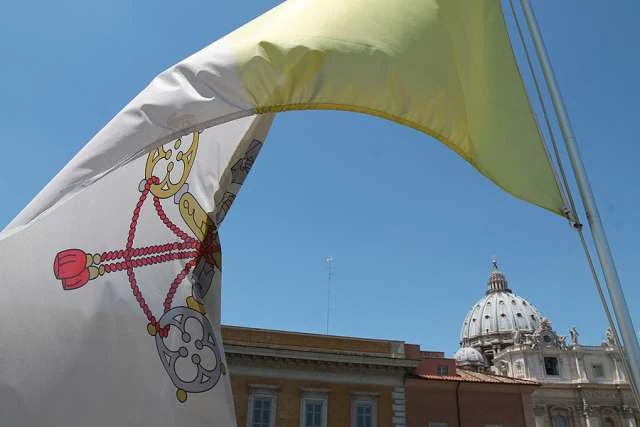
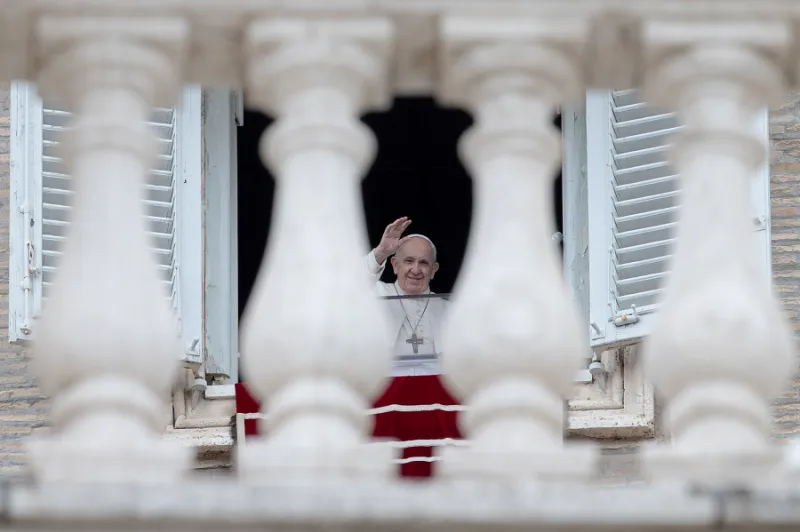
 Pope Francis waves to people in St. Peter’s Square during his Regina caeli address May 2, 2021. / Daniel Ibanez/CNA.
Vatican City, May 2, 2021 / 05:30 am (CNA).
It is our task as Christians to proclaim the good news of the Gospel and to bear the good fruit of love in the world, Pope Francis said at his Regina caeli address on Sunday.
“The fruit that, like the branches, we must give, bears witness to our Christian life,” the pope said May 2.
“After Jesus ascended to the Father, it is the task of the disciples – it is our task – to continue to proclaim the Gospel in words and in deeds,” he added. “And they and us, disciples of Jesus, do so by bearing witness to his love: the fruit to be borne is love.”
Francis gave his weekly Sunday reflection from a window overlooking St. Peter’s Square. Afterward, he led the recitation of the Regina caeli, a Marian prayer said during the Easter season.
The pope explained the importance of being attached to Christ, the vine, so that “we receive the gifts of the Holy Spirit, and in this way we can do good to our neighbor and do good to society, to the Church.”
“We recognize the tree by its fruits,” he stated. “A truly Christian life bears witness to Christ.”
Pope Francis’ meditation centered on the day’s Gospel reading from St. John, in which Jesus tells his disciples “I am the vine, you are the branches. Whoever remains in me and I in him will bear much fruit, because without me you can do nothing.”
“The Lord presents himself as the true vine, and speaks of us as the branches that cannot live without being united to him,” the pope said, noting that Jesus used the verb “to abide,” also sometimes translated as “to remain,” seven times in the Gospel reading.
Francis said to abide or remain in Jesus is not a passive activity, “letting oneself be lulled by life,” but an active and reciprocal action: “We abide in Jesus and Jesus abides in us.”
“How can we do this?” he said. “Jesus says to us: ‘If you abide in me, and my words abide in you, ask whatever you will, and it shall be done for you.'”
“The fruitfulness of our life depends on prayer,” he stated, explaining that in prayer we can ask Jesus for the gift of seeing the world with his eyes.
This way, he said, we can “love our brothers and sisters, starting from the poorest and those who suffer the most, as he did, and to love them with his heart and to bring to the world fruits of goodness, fruits of charity, and fruits of peace.”
Pope Francis explained that first of all, we need the Lord. Before we can follow God’s commandments, before we can live the beatitudes, and perform works of mercy, “it is necessary to be joined to him, to abide in him.”
“We cannot be good Christians if we do not abide in Jesus. And yet with him, we can do everything,” he underlined. “With him we can do everything.”
“Let us entrust ourselves to the intercession of the Virgin Mary,” he concluded. “She remained fully united to Jesus and bore much fruit. May she help us abide in Christ, in his love, in his word, to bear witness in the world to the Risen Lord.”
At the end of the Regina caeli, Pope Francis sent his good wishes to Christians of the Orthodox Church and Eastern and Latin Catholic Churches, who celebrate Easter according to the Julian calendar, which falls this year on May 2.
“May the risen Lord fill them with light and peace, and comfort the communities living in particularly difficult situations. Happy Easter to them!” he said.
The pope also referenced the ongoing situation in Burma, where security forces have opened fire on people protesting the military coup, resulting in injuries and deaths.
He said the Church in Burma is encouraging everyone to devote one Hail Mary of their daily rosary during the month of May for peace in Burma.
“Each of us turns to our mother when he or she is in need or in difficulty,” he said. “We, this month, ask our Heavenly Mother to speak to the hearts of all those responsible in Myanmar, so that they may find the courage to walk the path of encounter, reconciliation and peace.”
Pope Francis also expressed his closeness to the people of Israel, where crowds at a Jewish religious festival on Mount Maron led to a crush of people resulting in 45 deaths and some 150 injuries the night of April 29 to April 30.
“I assure my remembrance in prayer for the victims of this tragedy and their families,” he said.
Francis also mentioned the example of Bl. José Gregorio Hernández Cisneros, who was beatified in Caracas, Venezuela on April 30.
“He was a doctor, rich in science and faith. He was able to recognize the face of Christ in the sick and, as a good Samaritan, he helped them with evangelical charity. May his example help us to take care of those who suffer in body and spirit,” he said, encouraging a round of applause for the new blessed.

[…]