No Picture
News Briefs

German bishops to accept Vatican offer of ‘clarifying discussion’ on parish instruction

August 24, 2020 CNA Daily News 2

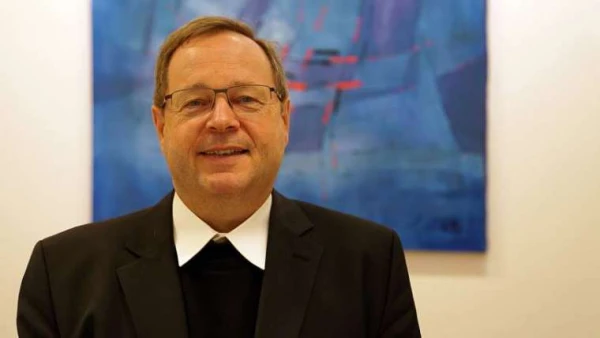
Würzburg, Germany, Aug 24, 2020 / 06:01 pm (CNA).- The German Bishops’ Conference has said it will accept the Vatican’s invitation to discuss the new instruction on parishes at a meeting in Rome, suggesting that it will be accompanied by laymen representing the “Synodal Process” under way in Germany.

At the conclusion of their meeting in the Bavarian town of Würzburg Aug. 24, the permanent council, comprising the diocesan bishops of the 27 Catholic dioceses in Germany, announced the decision that Bishop Georg Bätzing of Limburg would “accept the offer of conversation made by the Prefect of the Congregation for the Clergy, Cardinal Beniamino Stella”.

Furthermore, as CNA Deutsch, CNA’s German news partner, reported, the German Bishops’ Conference announced that Bätzing “will suggest to the Congregation that the conversation be conducted with the Presidium of the Synodal Way, since bishops, priests, deacons and laity are equally addressed in the instruction”.

If and when the meeting is scheduled to take place is still unclear.

Cardinal Beniamino Stella, prefect of the Congregation for the Clergy, said July 29 that he would be happy to receive the bishops in order to “remove doubts and perplexity” voiced by German prelates.

Stella said that the meeting could take place “in due course” if the bishops wished to present their objections to the instruction, issued by his congregation July 20. He reportedly declined to respond to specific criticisms ahead of the potential meeting.

He made the comments after several German bishops sharply criticized the document, which underlined that according to canon law only priests can direct the pastoral care of parishes.

CNA Deutsch reported that some commentators saw the instruction as a response to plans drastically to reduce the number of parishes in German dioceses.

The Vatican recently blocked a plan by the Diocese of Trier to turn 800 parishes into 35. Meanwhile, the Archdiocese of Freiburg has said that it will press ahead with plans to reduce its 1,000 parishes to 40.

In a July 28 interview with the Italian newspaper La Stampa, Stella said that “care must be taken not to reduce the parish to the rank of ‘branch’ of a ‘company’ — in this case, the diocese — with the consequence that it can be ‘directed’ by anyone, perhaps even by groups of ‘officials’ with different skills.” He added that the instruction encouraged parishes to see themselves above all as a “missionary community.”

The document provoked a mixed reaction in Germany. While Cardinal Rainer Maria Woelki of Cologne and Bishop Gregor Maria Hanke of Eichstätt expressed their gratitude for the text, Bishop Franz-Josef Bode of Osnabrück, vice-president of the German bishops’ conference, described the instruction as a “strong brake on the motivation and appreciation of the services of lay people.”

Bode said he feared that the text indicated a “conversion to clericalization” because it emphasized the priest’s role in directing parishes.

Cardinal Walter Kasper, meanwhile, defended the Vatican intervention, saying: “The German criticism completely misses the actual concern of the instruction: the pastoral conversion to a missionary footing. But precisely this basic concern of Pope Francis would be highly topical in view of the disturbing recently published numbers of departures from the Church.”

He was referring to statistics issued last month which showed that a record number of Catholics left the Church in Germany in 2019.

[…]

No Picture
News Briefs

Nuns in Poland care for newborn in baby box

August 24, 2020 CNA Daily News 1

Warsaw, Poland, Aug 24, 2020 / 04:30 pm (CNA).- The Franciscan Sisters of the Family of Mary in Warsaw, Poland, found a baby girl Monday morning who had been left in their "Window of Life," a baby box installed in the convent wall accessible … […]

No Picture
News Briefs

Catholic bishop: ‘the Church must proclaim the truth’ on new French abortion law

August 21, 2020 CNA Daily News 0

CNA Staff, Aug 21, 2020 / 10:00 am (CNA).-  

French Bishop Marc Aillet expressed his objections to a bioethics bill recently passed by the National Assembly, which expands the legally protected grounds for an abortion in France to include “psychosocial distress,” a move which bishops have said assures abortion nearly on demand.

Aillet, the Bishop of Bayonne, Lescar and Oloron, criticized the bill in light of the teaching of the Church in an Aug. 15 statement. The bishop said the Church must fulfill its prophetic mission of proclaiming the truth about man and God’s design for his creation.

France’s National Assembly, the lower house of the country’s parliament, passed a bill Aug. 1 adding “psychosocial distress” as grounds for an abortion as part of the country’s Bioethics Law.

Abortion is permitted in France in the first trimester of pregnancy, and later in the pregnancy under certain medical circumstances.

The Assembly also approved state-funded medically assisted procreation for lesbian couples, as well as the genetic modification of embryos for research.

Aillet said the bill represents a “major anthropological rupture.”

“Some courageous opposition MPs defended with pertinent arguments the right of a child to have a father and a mother and the inviolable dignity of the human embryo, which would be unreasonable in the light of science to not recognize as a full human being. A few members of the majority, no less courageous, dared to vote against the bill,” the bishop noted.

“The government took advantage of summertime lethargy and the French taking time to relax, understandable after the constraints of the lockdown, to pass this bill during a time of general indifference. The mainstream media have mysteriously remained very quiet on the subject throughout these days,” Aillet lamented.

An ethical disaster

The bill will turn human embryos into “laboratory mice,” the bishop charged, opening the door to “making transgenic and even chimeric embryos, thus in a certain way abolishing the dividing line between man and animal.”

Aillet also said the subjective grounds of  “psychosocial distress” for abortion are unverifiable. 

Abortion is always “the murder of a child who has no voice,” the bishop said, what Saint John Paul II called “the deliberate suppression of an innocent human being” in his encyclical Evangelium vitae.

The prophetic mission of the Church

Aillet declared that “the prophetic mission of the Church is precisely to proclaim, in season and out of season, the Truth about man, of which the Church is the depositary by divine mandate.”

“The prophetic mission of the Church,” the bishop said, “is to alert humanity today and to warn it against the temptation of self-destruction.”

He noted the incongruence of “on one hand recognizing that by claiming to be master of the universe by the prowess of science, that we are leading the planet on the path of an ‘ecological catastrophe,’ and deciding, in the name of the same science, to take control of human life, from its conception to its natural death, without leading humanity towards an even more damaging catastrophe!”

“One cannot, without serious prejudice to the future of mankind, oppose with impunity the Design of the Creator,” he added.

“This is the fundamental reason for our defense of the dignity of the human person, beginning with the smallest and most vulnerable,” Aillet explained.

For the French bishop “the prophetic mission of the Church therefore consists, not first of all in trying to be heard according to the criteria of the world, but in speaking to  people’s consciences, that intimate sanctuary where the voice of God resounds, who commands every man to do good and avoid evil.”

“The prophetic mission of the Church still consists in pointing to the moral gravity of this bioethical bill in deciding to deprive children of the right to have a father and a mother.”

“It is not, however, a question of judging or condemning the people who, often in spite of themselves and under pressure from the surrounding environment or abused by flattering and lying propaganda, come to use these means in order to satisfy a legitimate desire to have a child or to avoid other ailments. The Lord knows their hearts and is always quick to show Mercy. All the more reason to warn them and accompany them with charity, but in the Truth.”

However, the prelate warned that “those who, knowing the moral gravity of these practices, through electioneering demagogy or ideology, enact unjust laws that are binding on all, are more guilty and reprehensible. Saint Thomas Aquinas asserted that a civil law inconsistent with natural law and divine law “is more violence than law.”

The bioethics bill goes back to the French Senate for a second reading, where it can be amended again, before being put to a vote by a joint committee of the two houses at the end of 2020. However, the decision of the National Assembly is final when a consensus cannot be reached.

“It is therefore necessary to continue to alert consciences, in particular of the senators who will have study the bill,” Aillet urged.

Spiritual Warfare

Spiritual warfare is also part of the prophetic mission of the Church, the bishop said. “What is at stake is the creative and redemptive Design of God, which it is clear “the one we call the Devil or Satan opposes from the beginning and until the end of time.”

“It is no doubt a matter of battling with all the human means at our disposal as responsible citizens,” he continued.

“For us faithful of the Catholic Church, it will also be a matter of fighting with the traditional spiritual weapons: the prophetic Word – which like that of Jesus can push back darkness and cast out demons – prayer, in particular the Rosary, and fasting.”

Therefore “the Lord is looking for souls of prayer and sacrifice to courageously engage in this combat,” the prelate encouraged.

“On the solemnity of the Assumption of Our Lady, principal patroness of France, we will entrust this fight to the Virgin Mary, renewing the vow of Louis XIII,” Aillet concluded.


A version of this report was first published by ACI Prensa, CNA’s Spanish-language news partner. It has been translated and adapted by CNA.

[…]

No Picture
News Briefs

‘I really pray for these kids’: the Catholic ambassador on a mission to help Europe’s largest minority

August 21, 2020 CNA Daily News 1

CNA Staff, Aug 21, 2020 / 04:00 am (CNA).- In 2013, Franz Salm-Reifferscheidt made a life-changing visit to Rome. The retired Austrian businessman had an appointment with the Grand Chancellor of the Order of Malta, an almost 1,000-year-old Catholic lay religious order.

After working for 30 years for a baby food company, Salm had settled into a comfortable retirement. 

“I had a nice life, making a walk with my dog, and so on, and journeys with my wife and grandchildren,” he told CNA. 

“And then this friend, the president of the [order’s] German association, said: ‘Come on! You have time. You are fit. Couldn’t you do something for the order?’”

Salm joined the Order of Malta when he was 26. But as he was now in his late 60s, he wasn’t sure what he could offer the organization which, as a sovereign body, has diplomatic relations with more than 100 states, and engages in charitable work in 120 countries.

When he arrived for the meeting in Rome, the Grand Chancellor spoke about the order’s diplomatic work.

“Then all of a sudden, he said: ‘What would you do better?’ And I thought about the Roma, because these people are the biggest minority in Europe with 12 million people. They are segregated. Nobody likes them. They live in terrible conditions in settlements without running water and electricity,” he recalled.

Salm suggested that the order could combine its diplomatic and social missions if it extended its outreach to the Roma people — commonly known as Gypsies — because their plight was also a political issue. 

“The Grand Chancellor said: ‘That’s what we are really looking for.’ And two weeks later, I was appointed Ambassador for the Roma People at Large,” he said.

Salm quickly realized that he had accepted a staggeringly difficult challenge. Ever since the Roma arrived in Europe from northern India around the ninth century, they have suffered from hardship and persecution. Locals named them “Gypsies,” mistakenly believing that they came from Egypt.

Today, despite their nomadic reputation, Roma are overwhelmingly sedentary. More than 70% of Roma households live in poverty and just one in four Roma children graduate from high school. 

Despite these daunting facts, Salm set to work with an energy that impressed members of the order. Building on the organisation’s previous work with Roma communities, he developed initiatives in Albania, Austria, Belgium, Hungary, Romania, Slovakia, Slovenia, and Ukraine.

As a roving ambassador, he was able to link the projects together, drawing on his experience of building up the market for baby food in Eastern Europe.

Salm (pictured above) explained that a fully equipped center offers seven services: washing facilities, health checks, a kindergarten and playground, tutoring for children, counseling for mothers, apprenticeships, and a music school or other cultural endeavor. 

One of the biggest obstacles to improving the wellbeing of the Roma is that parents take their children out of school in order to work. Salm believes that the Order of Malta has found a way of overcoming this problem that could serve as a model across Europe. 

“Our donors ask: ‘How do you measure the success of your work?’ And it’s always the same: the children have more self-esteem, are clean and friendly — because that’s what we teach them every day — and, finally, much better in school.”

Salm cites a school run by the order in Romania. 

“This school was within the last rank of all the schools in this district. And after four or five years, it went better and better. And now, seven years later, this school is in the upper third, far above the average. No kid in the last two years failed the class,” he said. 

“And in our center, we could really come to the point where no kid misses the school. Of course, because they want to come to us.”

On Aug. 29, Salm will open the order’s 19th center for Roma people, in Croatia. 

“The hardest part is to convince the mayors of the area that this work is necessary,” he said, because they believe that offering any help to the Roma encourages them to settle permanently. 

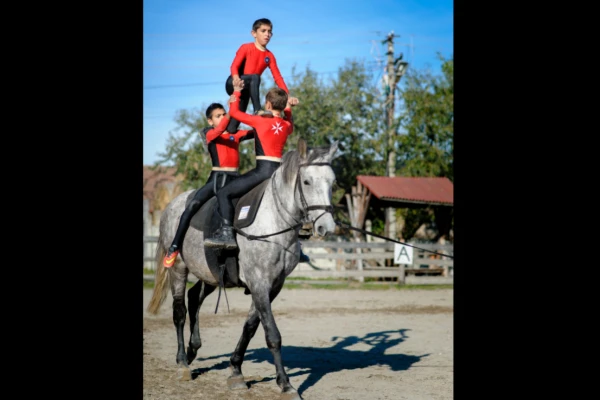
But it is possible to win local officials over. The ambassador cited the example of a settlement in Romania, where the order has opened a riding school, giving children the opportunity to learn skills such as equestrian vaulting, or gymnastics on horseback.

When lockdown was imposed on the country this spring, some Roma communities resisted quarantine measures, leading to clashes with police. 

“Almost everywhere there was an aggressive reaction, unfriendly. So for the authorities not a very easy situation, very unpleasant. But not in this center where we have this horse riding. The mayor was from the beginning against this center, always, until this year when there had to be quarantine for this center,” he said.

“The Roma people in this settlement understood the situation, understood that it was necessary to put the settlement under quarantine. They accepted the situation. So the mayor excused himself officially that he changed his mind. Now he is not, I would say, a friend of the Roma, but now he understands that this work is successful.”

Another major concern for Salm is fundraising. He currently has a budget of 1.5 million euros ($1.8 million). But given the economic uncertainty resulting from the coronavirus crisis, he is not sure if he will be able to replenish it when it runs out. 

He said: “I have to do the fundraising myself. I would say this is the most difficult work. My wife is always astonished that it is possible for me to find donors. But this year it’s 1.5 million euros and I have it. I can finance the work for this year. But what will be next year?”

Salm emphasized that the Roma community in Europe is not homogenous. There are different subgroups in different countries. 

“You have the very proud Lovari in Hungary. ‘Ló’ means ‘horse.’ You have the very poor Băieși living in Romania. You have many, many different groups,” he explained.

This diversity extends to religion. 

“They take the religion of the country they live in,” Salm said. “So in Hungary they are Catholic. In Bucharest [Romania] they are Orthodox. In Bosnia they are Muslims. But most of the Roma are Catholic. They are Catholic in Hungary, Transylvania in Romania, Slovakia, Austria, Croatia, France, Spain, Italy — in all the Catholic countries they are Catholic.”

Salm is now 76, but he is determined to keep serving the Roma people until his 80th birthday.

“I want to do it four years more, if God allows me and gives me the power and the help to do it. And then I have to find somebody else who does it,” he said. 

In the coming weeks, Salm will not only celebrate the opening of the new center in Croatia. He will also mark the 50th anniversary of his wedding — coronavirus restrictions permitting — with his four children, seven grandchildren, and other close family. 

Asked if his Catholic faith helped him in his work, he said: “Very much. I really pray for these kids, these families, and I have to live with the knowledge that every human being has the same dignity. And if you believe in this dignity, then it’s not a question if you help, it’s just a question how to help.”

[…]

No Picture
News Briefs

Renewed effort to preserve mural at Catholic church building in England

August 19, 2020 CNA Daily News 0

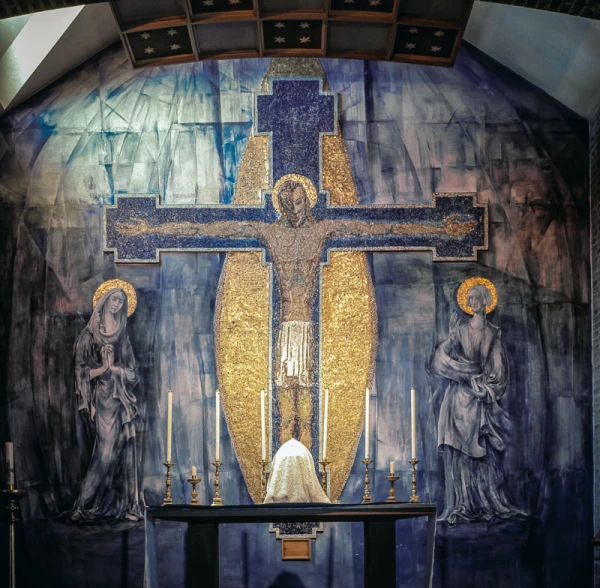
CNA Staff, Aug 19, 2020 / 01:29 pm (CNA).- A conservationist charity is calling for the preservation of George Mayer-Marton’s The Crucifixion, a 1955 mosaic and fresco work located in a church that was closed in 2017 amid a diocesan reorganization.

The artwork “is increasingly at risk of vandalism, theft, and the threat of redevelopment,” according to an Aug. 17 statement from Save Britain’s Heritage.

The 26 foot mosaic depicts the crucified Christ in front of a gold mandorla. It is flanked by paintings of Our Lady and Saint John on a background of blue ombré.

The fresco was painted over in off-white in the 1980s, according to Save Britain’s Heritage “new evidence has concluded that the fresco remains intact under the paint and that it is possible to restore the mural to its original condition.”

It is behind the altar of the Church of the Holy Rosary in Oldham, about 12 miles northeast of Salford.

“This is an incredibly rare, well executed and important mural for Oldham and for England by a leading 20th century artist and lecturer – it needs protection and national recognition through listing and SAVE is ready to help find a secure future for it,” the director of Save Britain’s Heritage, Henrietta Billings, said.

The charity has asked that Historic England designate Holy Rosary as a listed building because of the mural.

The public body told the BBC that it is considering a request for listing, but that when it was asked to do so when the church was closed in 2017 it “advised that, although of some interest, it didn’t have enough special interest to meet the high benchmark for listing post-war artwork”.

A spokeswoman for the Diocese of Salford said preservation of The Crucifixion has been “of paramount importance” since the church closure, the BBC reported.

She said that “we have taken action to improve the security of the building to ensure the safety of the work and have co-operated with parties who have shown an interest in it,” and that the diocese would “continue to explore options to find a place where it can be permanently displayed” and is “committed to finding a new home” for the mural.

Another of Mayer-Marton’s mosaics, depicting Pentecost, was transferred in 1989 from Holy Ghost church in Netherton to the Liverpool Metropolitan Cathedral.

Several groups have indicated an interest in preserving The Crucifixion since Holy Rosary’s closure.

A November 2018 piece at The Mallard reported that the Christian Heritage Centre had received permission from Bishop John Arnold of Salford to raise money to transfer the mosaic to its retreat center, the Theodore House.

The article indicated that the mosaic would dissembled and reassembled at its new location, at a cost of about GBP 250,000, or about $329,000. About $26,000 had been raised at the time of The Mallard’s article.

When Holy Rosary was designated for closure, the Public Monuments and Sculpture Association commented that the mosaic’s loss would be “very regrettable,” according to The Guardian.

Mayer-Marton was born in Hungary in 1897 to an agnostic family of Jewish heritage. He studied art in Vienna and Munich and was prominent among Viennese artists, but fled Austria in 1938 after its annexation by Nazi Germany. He and his wife settled in England, and he taught for the Arts Council of Great Britain and then, beginning in 1952, at the Liverpool College of Art. He died in 1960.

[…]