No Picture
News Briefs

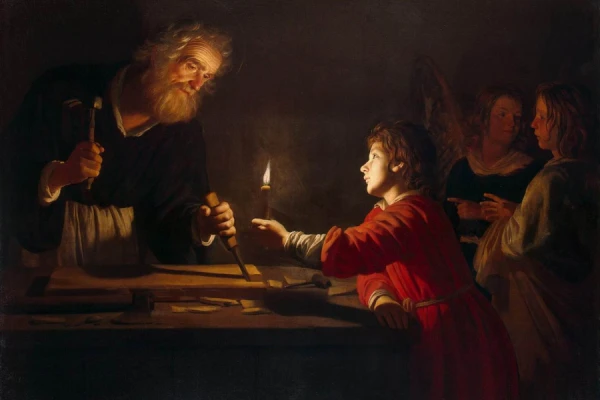
Fifteen ways to gain an indulgence in the Year of St. Joseph

December 10, 2020 CNA Daily News 0

Rome Newsroom, Dec 10, 2020 / 08:30 am (CNA).- Pope Francis has decreed a Year of St. Joseph in which Catholics will have the opportunity to obtain a special plenary indulgence.

Until December 2021, there are many new ways that Catholics can receive an indulgence, including entrusting their daily work to the protection of St. Joseph the Worker or reciting the rosary with their families.

These acts must be accompanied by sacramental confession, Eucharistic Communion, and prayer for the pope’s intentions, the usual conditions to obtain any plenary indulgence.

Plenary indulgences remit all temporal punishment due to sin and must be accompanied by full detachment from sin. 

According to the decree issued by the Apostolic Penitentiary on Dec. 8, there are 15 ways to receive an indulgence in the Year of St. Joseph:

1) Participate in a spiritual retreat for at least one day that includes a meditation on St. Joseph. 

2) Pray for St. Joseph’s intercession for the unemployed that they might find dignifying work.

3) Recite the Litany of St. Joseph for persecuted Christians. Byzantine Catholics have the option of an Akathist to St. Joseph.

4) Entrust one’s daily work and activity to the protection of St. Joseph the Worker.

5) Follow St. Joseph’s example in performing a corporal work of mercy. These include feeding the hungry, giving drink to the thirsty, clothing the naked, sheltering the homeless, visiting the imprisoned, visiting the sick, and burying the dead.

6) Perform one of the spiritual works of mercy, such as comforting the sorrowful, counseling the doubtful, instructing the ignorant, admonishing the sinner, bearing wrongs patiently, forgiving injuries, and praying for the living and the dead.

7) Pray the rosary together with one’s family in order that “all Christian families may be stimulated to recreate the same atmosphere of intimate communion, love and prayer that was in the Holy Family.”

8) Engaged couples can also receive an indulgence from praying the rosary together.

9) Meditate for at least 30 minutes on the Lord’s Prayer, because St. Joseph “invites us to rediscover our filial relationship with the Father, to renew fidelity to prayer, to listen and correspond with profound discernment to God’s will.”

10) Pray an approved prayer to St. Joseph on St. Joseph Sunday, the Sunday after Christmas in the Byzantine Catholic tradition.

11) Celebrate the feast of St. Joseph on March 19 with an act of piety in honor of St. Joseph.

12) Pray an approved prayer to St. Joseph on the 19th of any month. 

13) Honor Joseph with an act of piety or approved prayer on a Wednesday, the day traditionally dedicated to St. Joseph.

14) Pray to St. Joseph on the Feast of the Holy Family on Dec. 29.

15) Celebrate the feast of St. Joseph the Worker on May 1 with an act of piety or prayer.

“All the faithful will thus have the opportunity to commit themselves, with prayers and good works, to obtain with the help of St. Joseph, head of the celestial Family of Nazareth, comfort and relief from the serious human and social tribulations that today afflict the contemporary world,” the decree signed by Cardinal Mauro Piacenza said.

The elderly, the sick, and the dying who are unable to leave their homes due to the coronavirus pandemic also have special permission to receive an indulgence by “offering with trust in God the pains and discomforts” of their lives with a prayer to St. Joseph, hope of the sick and patron of a happy death.

The decree noted that in this instance the person must have the intention of fulfilling, as soon as possible, the three usual conditions for an indulgence, as well as a detachment from sin.

The Apostolic Penitentiary permits any prayer to St. Joseph approved by the Church, mentioning in particular the “To you, O blessed Joseph” prayer composed by Pope Leo XIII:

“To you, O blessed Joseph, do we come in our tribulation, and having implored the help of your most holy Spouse, we confidently invoke your patronage also. Through that charity which bound you to the Immaculate Virgin Mother of God and through the paternal love with which you embraced the Child Jesus, we humbly beg you graciously to regard the inheritance which Jesus Christ has purchased by his Blood, and with your power and strength to aid us in our necessities.”

“O most watchful guardian of the Holy Family, defend the chosen children of Jesus Christ; O most loving father, ward off from us every contagion of error and corrupting influence; O our most mighty protector, be kind to us and from heaven assist us in our struggle with the power of darkness.”

“As once you rescued the Child Jesus from deadly peril, so now protect God’s Holy Church from the snares of the enemy and from all adversity; shield, too, each one of us by your constant protection, so that, supported by your example and your aid, we may be able to live piously, to die in holiness, and to obtain eternal happiness in heaven. Amen.”


[…]

No Picture
News Briefs

Nice attack suspect charged with terrorism

December 9, 2020 CNA Daily News 2

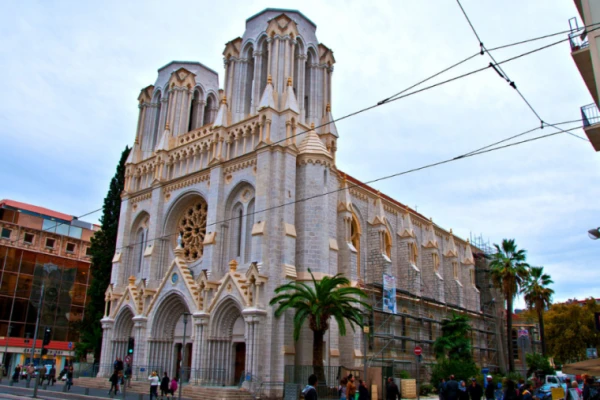
CNA Staff, Dec 9, 2020 / 05:19 pm (CNA).- The perpetrator of an October knife attack inside Notre-Dame de Nice has been charged with terrorism, French officials said Monday.

Brahim Aouissaoui, 21, has charged with “assassinations in connection with a terrorist enterprise” and “participation in a criminal terrorist association”, authorities said Dec. 7.

The attacker on Oct. 29 killed three people in the church, including a 44-year-old mother of three; a 60 year old woman who had come to the church to pray; and the church’s 55 year old sacristan.

The attacker used a knife to carry out the killings and reportedly shouted “Allahu Akbar” as he did so.

Aouissaoui was shot and arrested by police, and was sent to hospital.

A Tunisian, Aouissaoui reportedly arrived in Europe in late September, first at the Italian island Lampedusa before traveling to France.

A 47 year old man suspected of being in contact with Aouissaoui was arrested Oct. 30.

Mohammed Moussaoui, president of French Council of Muslim Faith, condemned the terrorist attack and asked French Muslims to cancel their festivities for Mawlid, the Oct. 29 celebration of Muhammad’s birthday, “as a sign of mourning and solidarity with the victims and their loved ones.”

Cardinal Robert Sarah, prefect of the Congregation for Divine Worship, responded to the news of the attack on the basilica, writing on Twitter: “Islamism is a monstrous fanaticism which must be fought with force and determination … Unfortunately, we Africans know this too well. The barbarians are always the enemies of peace. The West, today France, must understand this.”


[…]

No Picture
News Briefs

Swiss bishops: Same-sex marriage proposal ‘fraught with difficulties’

December 9, 2020 CNA Daily News 3

CNA Staff, Dec 9, 2020 / 04:48 pm (CNA).- The Catholic bishops of Switzerland are voicing opposition to a legal measure that would legalize same-sex marriage in the country, calling the proposal “fraught with numerous administrative, legal and ethical difficulties.”

The Swiss senate on Dec. 1 passed a bill entitled “Marriage for All,” which had been debated in the Swiss parliament since its introduction by the Green Liberal Party of Switzerland in 2013. It would legalize same-sex marriage and pave the way for allowing same-sex couples to avail themselves of sperm donation, facilitated citizenship for partners, and co-adoption rights.

Switzerland has recognized civil unions for same-sex couples since 2007, following a 2005 referendum.

While affirming the importance of “equality in terms of civil rights and social benefits” for self-described LGBT people, the bishops noted that differentiation between civil unions and the institution of marriage does not amount to discrimination.

“[T]he Catholic Church is primarily entrusted with the sacrament of marriage. She celebrates before God the union of man and woman as a common, stable and reproductive life laid out in love,” the Swiss Bishops’ Conference said in a Dec. 4 statement.

“This is why [we are] convinced, also with regard to civil marriage, that the use of the term ‘marriage’ should not be extended to any connection between two people regardless of their gender. Such a use of the term would bring about an equality that, in [our] opinion, cannot exist.”

The “Marriage for All” bill will continue to be debated throughout the winter parliamentary session.

Among the reasons the bishops gave for opposing the measure is that same-sex couples would need to resort to reproductive medicine techniques such as in vitro fertilization (IVF) and surrogacy in order to have children, which are morally illicit.

The Congregation for the Doctrine of the Faith in 2008 issued an instruction that laid out guidelines for treatment assisting with infertility, writing that medical techniques regarding fertility must respect the right to life and to physical integrity of every human being from conception to natural death, the unity of marriage, and the requirement that “the procreation of a human person be brought about as the fruit of the conjugal act specific to the love between spouses.’”

The CDF also noted that even in modern IVF treatments, the number of embryos sacrificed in order to achieve pregnancy remains high, and embryos with defects may be discarded altogether. Moreover, IVF disassociates procreation from the personal marital act of a husband and wife, which in itself is ethically unacceptable.

“The ethical implications of reproductive medicine and the rights of the child are profound,” the Swiss bishops noted.

“Not addressing these effects in order to facilitate equality today without distinguishing between heterosexual and homosexual couples could tomorrow lead to an already accepted principle being accepted unconditionally.”

The Catechism of the Catholic Church teaches that those who identify as LGBT “must be accepted with respect, compassion, and sensitivity. Every sign of unjust discrimination in their regard should be avoided. These persons are called to fulfill God’s will in their lives and, if they are Christians, to unite to the sacrifice of the Lord’s Cross the difficulties they may encounter from their condition.”

The Catechism elaborates that homosexual inclinations are “objectively disordered,” homosexual acts are “contrary to the natural law,” and those who identify as lesbian and gay, like all people, are called to the virtue of chastity.

In a 2003 document approved by St. John Paul II and written by Cardinal Joseph Ratzinger, the Congregation for the Doctrine of the Faith taught that “respect for homosexual persons cannot lead in any way to approval of homosexual behaviour or to legal recognition of homosexual unions.”

Even if civil unions might be chosen by people other than same-sex couples, like siblings or committed friends, the CDF said that homosexual relationships would be “foreseen and approved by the law,” and that civil unions “would obscure certain basic moral values and cause a devaluation of the institution of marriage.”

“Legal recognition of homosexual unions or placing them on the same level as marriage would mean not only the approval of deviant behaviour, with the consequence of making it a model in present-day society, but would also obscure basic values which belong to the common inheritance of humanity,” the document concluded.

Benedict XVI in 2005 said that acceptance of various alternatives to marriage devalue the institution of marriage.


[…]

No Picture
News Briefs

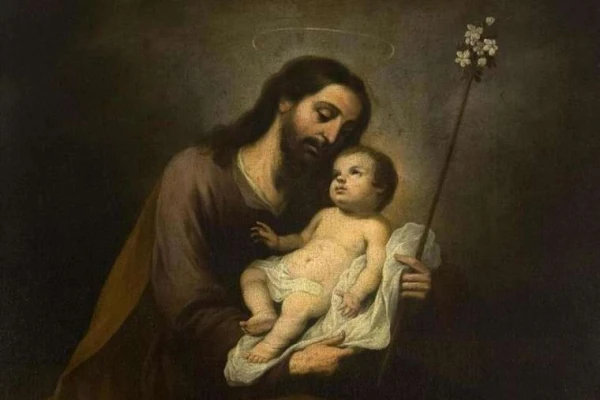
‘Go to Joseph’: What popes from Pius IX to Francis have said about St. Joseph

December 9, 2020 CNA Daily News 0

Rome Newsroom, Dec 9, 2020 / 02:00 pm (CNA).- Pope Francis has proclaimed that the Church will honor St. Joseph in a particular way over the course of the next year.

The pope’s announcement of a Year of St. Joseph purposely coincided with the 150th anniversary of the saint’s proclamation as patron of the Universal Church by Pope Pius IX on Dec. 8, 1870.

“Jesus Christ our Lord … whom countless kings and prophets had desired to see, Joseph not only saw but conversed with, and embraced in paternal affection, and kissed. He most diligently reared Him whom the faithful were to receive as the bread that came down from heaven whereby they might obtain eternal life,” the proclamation, “Quemadmodum Deus,” stated.

Pius IX’s successor, Pope Leo XIII, went on to dedicate an encyclical letter to devotion to St. Joseph, “Quamquam pluries.”

“Joseph became the guardian, the administrator, and the legal defender of the divine house whose chief he was,” Leo XIII wrote in the encyclical published in 1889.

“Now the divine house which Joseph ruled with the authority of a father, contained within its limits the scarce-born Church,” he added.

Leo XIII presented St. Joseph as a model at a time when the world and the Church were wrestling with the challenges posed by modernity. A few years later, the pope went on to publish “Rerum novarum,” an encyclical on capital and labor which outlined principles to ensure the dignity of laborers.

In the past 150 years, nearly every pope has taken steps to further devotion to St. Joseph in the Church and to use the humble father and carpenter as a witness for the modern world. 

“If you want to be close to Christ, I repeat to you ‘Ite ad Ioseph’: Go to Joseph!” said Ven. Pius XII in 1955 as he instituted the feast of St. Joseph the Worker, to be celebrated on May 1.

The new feast was intentionally placed on the calendar to counter communist May Day rallies. But this was not the first time that the Church had presented St. Joseph’s example as an alternative path toward workers’ dignity.

In 1889, the International Socialist Conference instituted May 1 as a holiday for labor in remembrance of Chicago’s “Haymarket affair” labor protests. In that same year, Leo XIII warned the poor against the false promises of “seditious men,” calling them to turn instead to St. Joseph, with a reminder that mother Church “each day takes an increasing compassion on their lot.”

According to the pontiff, the witness of St. Joseph’s life taught the rich “what are the goods most to be desired,” while workers could claim St. Joseph’s recourse as their “special right, and his example is for their particular imitation.”

“It is, then, true that the condition of the lowly has nothing shameful in it, and the work of the laborer is not only not dishonoring, but can, if virtue be joined to it, be singularly ennobled,” wrote Leo XIII in “Quamquam pluries.

In 1920, Benedict XV prayerfully offered St. Joseph as the “special guide” and “heavenly patron” of laborers “to keep them immune from the contagion of socialism, the bitter enemy of Christian principles.”

And, in the 1937 encyclical on atheistic communism, “Divini Redemptoris,” Pius XI placed “the vast campaign of the Church against world Communism under the standard of St. Joseph, her mighty Protector.”

“He belongs to the working-class, and he bore the burdens of poverty for himself and the Holy Family, whose tender and vigilant head he was. To him was entrusted the Divine Child when Herod loosed his assassins against Him,” Pope XI continued. “He won for himself the title of ‘The Just,’ serving thus as a living model of that Christian justice which should reign in social life.

Yet, despite the 20th century Church’s emphasis on St. Joseph the Worker, Joseph’s life was not defined solely by his work, but also by his vocation to fatherhood.

“For St. Joseph, life with Jesus was a continuous discovery of his own vocation as a father,” wrote St. John Paul II in his 2004 book “Rise, Let Let Us Be On Our Way.”

He continued: “Jesus Himself, as a man, experienced the fatherhood of God through the father-son relationship with St. Joseph. This filial encounter with Joseph then fed into Our Lord’s revelation of the paternal name of God. What a profound mystery!”

John Paul II saw firsthand communist attempts to weaken the family unit and undermine parental authority in Poland. He said that he looked to St. Joseph’s fatherhood as a model for his own priestly fatherhood.

In 1989 — 100 years after Leo XIII’s encyclical — St. John Paul II wrote “Redemptoris custos,” an apostolic exhortation on the person and mission of St. Joseph in the life of Christ and of the Church. 

In his announcement of the Year of St. Joseph, Pope Francis released a letter, “Patris corde” (“With a father’s heart”), explaining that he wanted to share some “personal reflections” on the spouse of the Blessed Virgin Mary.

“My desire to do so increased during these months of pandemic,” he said, noting that many people had made hidden sacrifices during the crisis in order to protect others.

“Each of us can discover in Joseph — the man who goes unnoticed, a daily, discreet and hidden presence — an intercessor, a support and a guide in times of trouble,” he wrote.

“St. Joseph reminds us that those who appear hidden or in the shadows can play an incomparable role in the history of salvation.”

The Year of St. Joseph provides the opportunity for Catholics to receive a plenary indulgence by reciting any approved prayer or act of piety in honor of St. Joseph, especially on March 19, the saint’s solemnity, and May 1, the Feast of St. Joseph the Worker. 

For an approved prayer, one can use the Litany of St. Joseph, which Pope St. Pius X approved for public use in 1909.

Pope Leo XIII also asked that the following prayer to St. Joseph be said at the end of the rosary in his encyclical on St. Joseph:

“To thee, O blessed Joseph, we have recourse in our affliction, and having implored the help of thy thrice holy Spouse, we now, with hearts filled with confidence, earnestly beg thee also to take us under thy protection. By that charity wherewith thou wert united to the Immaculate Virgin Mother of God, and by that fatherly love with which thou didst cherish the Child Jesus, we beseech thee and we humbly pray that thou wilt look down with gracious eye upon that inheritance which Jesus Christ purchased by His blood, and wilt succor us in our need by thy power and strength.”

“Defend, O most watchful guardian of the Holy Family, the chosen off-spring of Jesus Christ. Keep from us, O most loving Father, all blight of error and corruption. Aid us from on high, most valiant defender, in this conflict with the powers of darkness. And even as of old thou didst rescue the Child Jesus from the peril of His life, so now defend God’s Holy Church from the snares of the enemy and from all adversity. Shield us ever under thy patronage, that, following thine example and strengthened by thy help, we may live a holy life, die a happy death, and attain to everlasting bliss in Heaven. Amen.”


[…]