No Picture
News Briefs

March for Life in Argentina draws massive crowds

March 27, 2018 CNA Daily News 0

Buenos Aires, Argentina, Mar 27, 2018 / 03:10 pm (ACI Prensa).- Marking the Day of the Unborn Child in much of Latin America, tens of thousands of Argentinians took to the streets throughout the country to demonstrate for the sanctity of all human life.

According to organizers, approximately 150,000 people marched from Plaza Italia down Sarmiento and Libertador avenues on March 25, ending up at the University of Buenos Aires Law School.

The main goal of the march was to reject abortion and to call for comprehensive solutions upholding the dignity of the mother and the unborn child.

Argentina was the first country in Latin America to mark a Day of the Unborn Child, declared Dec. 7, 1998 by then-president Carlos Saul Menem.

The 2018 March for Life took place simultaneously in 200 cities throughout the South American country in the provinces of Buenos Aires, Catamarca, Chaco, Corrientes, Córdoba, Chubut, Mendoza, Entre Ríos, and others.

The Buenos Aires march was accompanied by Dr. Soledad Otazua, who explained the process of human development in the mother’s womb with a large-scale model of a baby at 12 weeks gestation.

A group of doctors also read a pro-life manifesto. “Harming a living human being in any way with the intention of ending its life under no conditions constitutes a medical act,” the text states.

“Neither the state nor anyone can force any agent or healthcare professional to engage in practices that go against their conscience,” the manifesto adds.

Pro-life activist Patricia Sandoval traveled to Argentina to participate in the event and share her life’s testimony. She explained that the she had undergone three abortions earlier in her life. Later, she worked with Planned Parenthood in California and assisted in an abortion, when she realized the humanity of the unborn child and underwent a powerful conversion.


This article was originally published by our sister agency, ACI Prensa. It has been translated and adapted by CNA.
 

[…]

No Picture
News Briefs

Chilean pregnant mothers pay unique tribute to unborn children

March 23, 2018 CNA Daily News 0

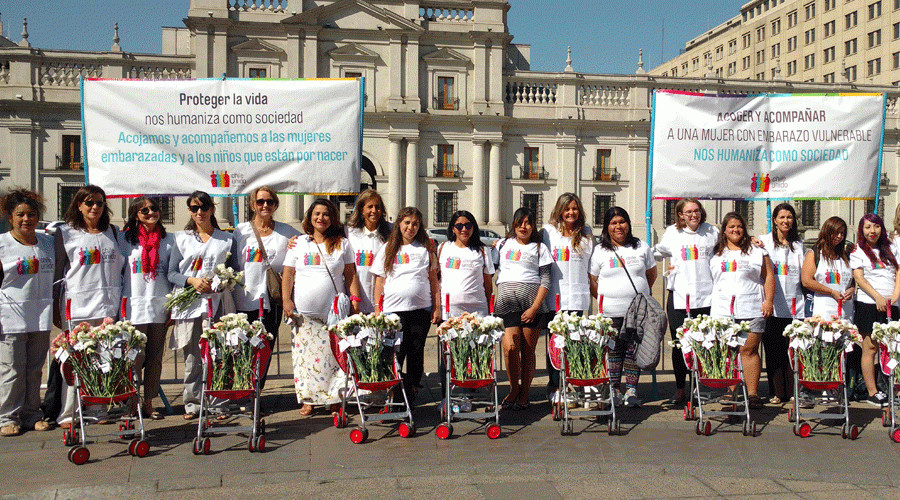
Santiago, Chile, Mar 24, 2018 / 12:00 am (CNA/EWTN News).- Pregnant mothers carrying children, volunteers, and staff of the Chile United Foundation celebrated the Day of the Unborn Child and Adoption on March 22 in front of Chile’s presidential palace.

For four years the NGO has gathered there to hand out carnations to passersby and to give them a message of hope, as a tribute to the unborn children they carry in their womb.

Chile passed a law  Sept. 23, 2017 permitting abortion if an unborn child is judged to be “non-viable,” if a pregnancy poses risk to the life of the mother, and in cases of rape.

Initiatives like Chile United’s celebration demonstrate that it is necessary to “continue working day and night with more effort than ever to be there for the woman in that crucial moment,” Veronica Hoffman, executive director of Chile United, told ACI Prensa, the Spanish-language news partner of CNA.

“When you give emotional support, welcome, and accompany her, women decide to continue with pregnancy,” Hoffman said.

“What we are calling for today is to strengthen support programs nationwide,”she added.

Chile United has programs of support for women and their children, but the recently passed abortion law also requires government support for women who chose to continue with a pregnancy.

The Chile United Foundation has been working for 19 years for the development of social and cultural values for human progress in the country. Their efforts include a support program for women in crisis pregnancies, which has supported the birth of some 5,000 children, such as Yasna Gonzalez’s child.

Yasna told ACI Prensa that after overcoming cervical cancer, she went through a difficult pregnancy with her fourth child when she was 43. Her husband and some of the children reproached her, and even her boss at work advised her to abort.

In a moment of anguish, she said she found the Chile United Foundation. “They gave me everything, all the love, the emotional support, to be able to have my child,” she said.

Today Yasna tearfully recalls that period, but “I see my child who’s already six and he is everything for me, he’s my little piece of heaven,” she said.

Another woman at the demonstration told ACI Prensa that she is 38 weeks pregnant, she does not have any relatives in Chile, and she already has a seven-year-old child.

For her, the Chile United Foundation is “like a family” that has protected her, helped her to find a job and, and provided material assistance.

Passerby Kristli Guerrero was delighted to get the carnation. “What they’re doing is a beautiful thing and there ought to be more awareness, more programs,” she said.


This article was originally published by our sister agency, ACI Prensa. It has been translated and adapted by CNA.

[…]

No Picture
News Briefs

Bishop, five priests arrested in Brazil, accused of embezzling Church funds

March 21, 2018 CNA Daily News 1

Brasilia, Brazil, Mar 21, 2018 / 01:58 pm (ACI Prensa).- A Catholic bishop, five priests and other administrative officials in the Brazilian state of Goiás have been arrested on accusations of embezzling more than two million reales (about $600,000) from the Catholic Church.

Bishop José Ronaldo of the Diocese of Formosa was among those arrested March 19, as part of operation “Caiaphas.” Among other findings, the operation discovered 70,000 reales (about $21,000) in cash in a cabinet with a false bottom. The cabinet belonged to Fr. Epitácio Cardoso Pereira, in the Planaltina township.

In wake of these developments, Pope Francis on March 21 appointed the Archbishop of Uberaba, Paulo Mendes Peixoto, as apostolic administrator of the diocese.

According to prosecutors, the embezzled money comes from tithes, donations, stipends for baptisms and weddings from churches. Authorities said the diversion of money has been going on since 2015 when the bishop took possession of the Diocese of Formosa.

Judge Fernando Oliveira Samuel said that the money “was systematically diverted by order of José Ronaldo and also approved by the rest of the clerics.”

According to authorities, legal wiretaps suggested that Bishop Ronaldo and four other priests purchased a ranch to raise livestock and a store where lottery tickets are sold.

“In addition to that, it is possible that the vehicles acquired by the diocese were intended for Fr. Moacyr Santana’s personal use in the city of Posse,” the judge added.

The public prosecutor in charge of the case, Douglas Chegury, said that similar irregularities occurred when Bishop Ronaldo was in the Diocese of Janauba.

Authorities began investigating the current case in December 2017 when members of the faithful complained that monthly expenses for the bishop’s residence had gone from 5,000 reales ($1,520) to 35,000 reales ($10,600) since Bishop Ronaldo assumed the diocese.

Consequently, the local faithful requested an open disclosure of the diocesan accounts. When the bishop refused, they said they would boycott church collections until the measure was taken.

Bishop Ronaldo claimed at the time that there were  “no improprieties” and that he did not take any of the money collected.

ACI Digital, the Portuguese language sister agency of CNA, repeatedly sought the reaction of the Diocese of Formosa but did not receive a response by press time.

The Secretary General of the Brazilian Bishops’ Conference, Bishop Leonardo Steiner, issued a press release March 20 stating that “In face of the jailing of the bishop of the Diocese of Formosa in Goiás State, the Brazilian Bishops’ Conference expresses its solidarity with the clergy and faithful of the diocese, reminding the brother bishop that justice is to abandon oneself, trusting in the merciful will of God.”

“The truth of the facts must be established with justice and transparency, considering the good of the particular church and the bishop,” the conference said.

The bishops of Brazil asked ”all the faithful of the Church to remain united in prayer to be true witnesses to the Gospel.”


[…]

No Picture
News Briefs

In feeding the hungry of Chile, beloved friar’s legacy lives on

March 21, 2018 CNA Daily News 1

Santiago, Chile, Mar 21, 2018 / 03:12 am (ACI Prensa).- Although he died in 1853, the legacy of Friar Andrés Garcia Acosta is as alive as ever in Santiago, Chile, through a soup kitchen bearing his name that feeds 150 people per day.

This outreach is part of the “Spoon Trail,” a Franciscan ministry where those in need can stop at different locations to receive breakfast, lunch, and dinner.

Following the friar’s example, dozens of volunteers at “Friar Andresito’s Soup Kitchen” help feed the poor and homeless, including those facing addictions and prostitution.

For volunteers, the work is more than just an act of charity.

“This has meant everything to me,” volunteer Magdalena Urquhart told the postulator of the friar’s cause.

She said working with the poor has changed the way she viewed them. “Although in the beginning one has a certain amount of fear because there are a lot of alcoholics, a lot of drug addictions, they’re people who need a lot of love, for someone to listen to them.”

Rogelio Caroca, who has volunteered for seven years, considers Friar Andresito to be his friend and admires him because of his witness as “a simple man who generously practiced charity across the board.”

Andrés Garcia Acosta, known as Friar Andresito, was born in the Canary Islands on Jan. 10, 1800. He became acquainted with the Franciscan Order during his childhood and youth.

In 1832, he embarked for the Americas, in one of the great waves of migration from the island caused by famines, lack of employment, and droughts.

He arrived in Montevideo, Uruguay, and in 1834, he entered the Franciscan Order. In 1838 the government expelled the Franciscans from the country, and he traveled to Chile when he learned that the Franciscans of the Strict Observance had been reestablished there.

Friar Andresito was assigned to the Franciscan Church of the Strict Observance from 1839 to 1853. He served as almoner and helped out in the kitchen. As almoner he got to know the physical and spiritual needs of both the wealthy and the poor.

Friar Andresito was beloved and renowned by the people of his time. Besides being almoner, he visited jails and hospitals, attended to the sick and gave spiritual advice. He was known for his humility, dedication and joy.

On Sundays, he would distribute fruit and bread to the poor, an activity that today inspires “Friar Andresito’s Soup Kitchen.”

On Jan. 9, 1853, Friar Andresito came down with pneumonia. He died Jan. 14 and hundreds of people came to pay their respects.

On July 10, 1855, the friar’s remains were exhumed, and his body was found incorrupt.

In 1927, the “Friar Andrés Brotherhood” was founded and spread throughout Chile. In 1977, the “Friends of Friar Andresito” society was established, with devotees in Chile, Argentina, Bolivia and the United States.

Pope Francis recognized Friar Andresito’s heroic virtues June 8, 2016 and he was declared venerable.

This article was originally published by our sister agency, ACI Prensa. It has been translated and adapted by CNA.

[…]

No Picture
News Briefs

‘Godmothers for Life’ serve vulnerable moms in Uruguay

March 18, 2018 CNA Daily News 0

Montevideo, Uruguay, Mar 18, 2018 / 03:41 am (CNA/EWTN News).- An Uruguayan non-profit organization called “Godmothers for Life” has been serving mothers in crisis pregnancies for more than 17 years, working out of a facility at Saint Jerome Chapel in Montevideo.   

Offering talks, one-on-one conversations, and job training, these “godmothers” help vulnerable moms face their pregnancies with dignity and hope, and not to see abortion as the only way out of their situation.

Being chosen as a godparent is a significant honor in Latin America, where godparents are typically highly involved in the lives of their godchildren, which gives the group’s name a special meaning.

The organization has its origins in 2000 at Basilica of Our Lady of Guadalupe in Mexico. Marta Grego and her husband traveled from Uruguay to visit the shrine where they experienced in prayer what they described as “Our Lady of Guadalupe’s call” to dedicate themselves to the cause of life.

Marta felt in her heart that God was asking her to fight abortion and save babies when she got back to Uruguay. However, she did not see a clear path forward at the time, because she was working and supporting her family. Nevertheless, she felt God telling her, “You take care of my things and I’ll take care of yours.”

When the couple returned to Uruguay, a pregnant woman rang their doorbell asking for food. She had made up her mind to get an abortion. That encounter was how Godmothers for Life got its start, with Marta Grego as its founder and director.

Although the original purpose of the organization was to help women decide to keep their babies, Teresa Rodriguez, the group’s current president, explained that they eventually saw “that besides the girls who wanted to abort, there were pregnant girls who were not thinking of aborting but were in a very vulnerable situation.”

In response, the group expanded its work by providing free job training courses and workshops on Christian and human formation, “always focusing on the mom and her baby, helping her to value motherhood, but also helping the family,” so they can find their way out of poverty. Currently, Godmothers for Life is serving about 60 at-risk women in Montevideo, relying solely on donations for their work.

“A bond is created between us and the mothers which is not based on dependency but on affection. We are one big family,” Rodriguez said.

In addition to their main location in Montevideo, Godmothers for Life has a place at Saint Eugene Chapel in the administrative district, where they care for an additional 60 women. They hope to extend the project to other areas of Uruguay. They have already begun plans in several other districts.


[…]

No Picture
News Briefs

Baby box safe haven bill clears key hurdle in Peruvian congress

March 16, 2018 CNA Daily News 0

Lima, Peru, Mar 16, 2018 / 10:46 am (ACI Prensa).- A save haven bill that would allow mothers to leave their children at certain drop off locations to be taken into state custody without punishment is moving forward in the Peruvian legislature.

The “Saving Cradles and Confidential Birth” bill passed out of the Committee on Women March 14 with a favorable vote of 4-2, clearing the way for its final passage by the full assembly of the unicameral Peruvian congress.

The Saving Cradles Association, which is backing the legislation, told ACI Prensa, the Spanish-language sister agency of CNA, that this bill seeks to help “Peruvian women who for some very personal reason cannot or do not want to raise the children they are expecting, as well to help their own unborn children, and to protect babies abandoned on the street which puts their lives in danger.”

The bill provides for adequate and safe locations installed in private and public health care centers where women can leave their newborns. It establishes a legal procedure that allows for anonymity for the parents and places the state in charge of the adoption process.

Members of congress supporting the bill said that the legislation seeks to “give an alternative to women who cannot or do not want to raise their newborns, as well as to ensure the boy or girl’s right to life and to live in a family.”

The Saving Cradles Association congratulated “members of congress Betty Ananculi, Juan Carlos Gonzales, Tamar Arimborgo and Cecilia Chacón who are working in a concrete and effective manner for the women and children of Peru.”

The organization said it is “hopeful that this goal will soon be achieved with a favorable vote in the full assembly of the Congress of the Republic.”


[…]

No Picture
News Briefs

Archdiocese of Mexico backs sentence of priest jailed for abuse

March 15, 2018 CNA Daily News 0

Mexico City, Mexico, Mar 15, 2018 / 02:58 pm (ACI Prensa).- The Archdiocese of Mexico reaffirmed its commitment to fighting sexual abuse and expressed its support for the 62-year jail sentence for a priest found guilty of abuse.

The archdiocesan communications office issued a statement March 13 on the sentence imposed on the priest Carlos Lopez Valdés, who was found guilty of molesting Jesús Romero Colín several times between 1994 and 1998.

Lopez Valdés, who is now 72, served at San Agustín de las Cuevas parish in Tlapan, south of Mexico City. Romero was his altar boy, and was abused between the ages of 7 and 11.

Romero filed a complaint against the priest in 2007 and the Archdiocese of Mexico then opened an ecclesiastical trial, which found the priest guilty and dismissed him from the clerical state.

Lopez Valdés was arrested Aug. 27, 2016, in Jiutepec. Morelos State, and sent to the Reclusorio Oriente (prison) in Mexico City.

Romero has also accused former Mexican cardinal Norberto Rivera Carrera of protecting the priest and concealing the abuse. The now-retired Cardinal Rivera was accused last year by two former priests of failing to report several cases of abuse. The Mexico of Archdiocese at the time denied any failure to act on the part of the cardinal.

Romero sent a letter to Pope Francis in 2013. The Holy Father replied expressing his “pain” and “shame” for what had happened and asked for “forgiveness in the name of the Church.”

In their March 13 statement, the archdiocese expressed its “complete readiness to cooperate with the authorities to procure justice in society.”

“We express our solidarity with the victim and his family. We deeply regret what happened. This terrible behavior causes us pain and shame and confirms us in our commitment to do everything necessary to address the root cause of these situations,” they continued.

“We will not be satisfied until this evil is extirpated. As Pope Francis has recently said, this is one of the priorities of the Church in our time.”

The archdiocese also reiterated that “our standard is ‘zero tolerance’ in face of these situations,” and acknowledged “the need to report, recognize the evil and ask forgiveness.”


This article was originally published by our sister agency, ACI Prensa. It has been translated and adapted by CNA.

[…]

No Picture
News Briefs

Peruvian bishops: Welcome Venezuelan migrants with solidarity

March 15, 2018 CNA Daily News 0

Lima, Peru, Mar 15, 2018 / 11:07 am (ACI Prensa).- The Peruvian Bishops’ Conference called on the people of the country to act with Christian solidarity toward Venezuelan migrants fleeing hardship in their homeland.

In a statement issued March 9, the Peruvian bishops meeting in a plenary assembly expressed their “fraternity with the Venezuelan people” and recalled that “in decades past thousands of our compatriots had to emigrate to Venezuela.”

“Current circumstances require us to act with Christian solidarity toward our brothers from that country, who for various reasons have been forced to leave their homeland and are with us today. May Peru be a second home for them where they feel very welcome and safe,” the bishops stated.

Venezuela is in the midst of an acute political and economic crisis under President Nicolas Maduro, resulting in severe shortages of food and medicine, which is increasing emigration.

The Peruvian department that oversees immigration has estimated that there are currently 115,000 Venezuelans in the country, of which 31,000 have a temporary work permit which allows them to work and study for one year.

Peru is increasing the number of permits it issues to accommodate for the surge in newcomers.

In a statement released March 8, the immigration department head, Eduardo Sevilla, said that some 900 Venezuelans are arriving in Peru every day.

“But not all stay in the country,” he said. “Many of them have tourist visas and can stay for up to six months.”

Other countries, including Colombia, have also seen an increase in Venezuelan immigrants in recent months.


This article was originally published by our sister agency, ACI Prensa. It has been translated and adapted by CNA.

 

[…]

No Picture
News Briefs

Argentine Church to release baptismal records from dictatorship period

March 14, 2018 CNA Daily News 0

Buenos Aires, Argentina, Mar 14, 2018 / 02:03 pm (ACI Prensa).- The Argentine Bishops’ Conference will release to the justice system, in accordance with Pope Francis’ wishes, dozens of baptismal records from the country’s dictatorship period.

The conference said it will release the records of 127 baptisms performed in the Stella Maris chapel of the Escuela Superior de Mecánica de la Armada, a naval school for technical instruction in Buenos Aires.

The school functioned as one of the largest clandestine centers for detention, torture and extermination during the military dictatorship in power from 1976 to 1983.

The Military Diocese recently found the records, which will be turned over to federal judge Sergio Gabriel Torres and attorney general Pablo Parenti.

According to the Associated Press, local courts have discovered a “systematic plan of stealing the children of disappeared women and illegally adopting them out during the dictatorship.” After detained women gave birth, the children were reportedly given new identities and illegally adopted out to military families.

However, the records to be turned over by the local Church are not believed to be illegally adopted children of the detained-disappeared, but rather children of soldiers who were baptized, said Bishop Santiago Olivera of the Military Diocese.

He clarified to the Argentine National News Agency Telam that an investigation into the records will bring certainty on this point.

“Sharing the sentiments and earnest desire of the Holy Father, the Argentine Bishops’ Conference is making available to the justice system the totality of the recorded information and the aforementioned documentation, in continuity with the procedures of this conference as to the requirements of the justice system in recent years,” the committee said in a statement.

They also stressed that “these records can be accessible to well-recognized human rights organizations and researchers from various academic fields.”

“We have the firm conviction that the Church must maximize its efforts to contribute to the path of remembrance, truth and justice in all fields, especially in face of the gravity of the crimes against humanity perpetrated under State Terrorism,” the statement said.

The Executive Committee of the Argentine Bishop’s Conference also stressed its “commitment to immediately inform the judicial authorities of any data and information that may come forth in the future.”

In January this year, Pope Francis authorized the publication of the chapel’s baptismal records when he met in the Vatican with the Bishop for the Military Diocese, Santiago Olivera, Telam reported.

Also with the Holy Father’s authorization, the Vatican initiated a system in October 2016 for relatives of those who were detained-disappeared to access the archives that the Holy See has on the dictatorship in Argentina.

This article was originally published by our sister agency, ACI Prensa. It has been translated and adapted by CNA.

[…]