No Picture
News Briefs

This ‘pilgrim grandmother’ walked 570 miles to pray for families
May 14, 2018 CNA Daily News 0

Mexico City, Mexico, May 14, 2018 / 07:00 pm (CNA/EWTN News).- Emma Morosini has been called the “pilgrim grandmother.”  Earlier this month, at the age of 94, she earned that nickname by concluding a 570-mile walking pilgrimage in honor of Our Lady of Guadalupe.

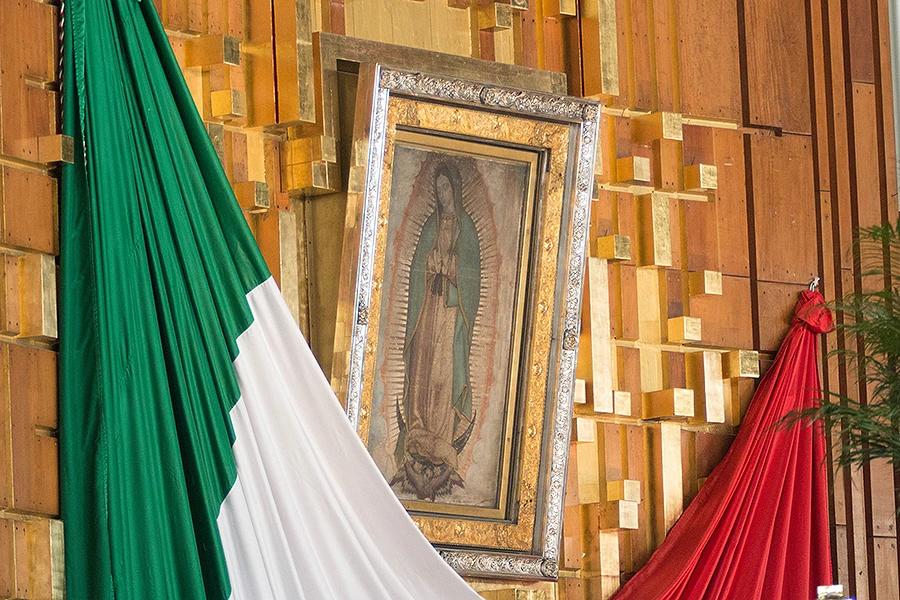
Her 40 day pilgrimage took Morosini from Monterrey, in northeastern Mexico, to Mexico City, where she prayed at the Basilica of Our Lady of Guadalupe, before the tilma of Saint Juan Diego.


Emma Moronsini. 91 años. Camina hace 1 mes. Salió de Tucumán. Quiere llegar a la Basílica (Luján). Ya está en Córdoba pic.twitter.com/zwXJFnIRFw

— Sebastián Volterri (@SebaVolte) February 13, 2015


Morosini, a native of Italy who for more than 25 years has made pilgrimages to shrines around the world, arrived the afternoon of May 12 at the Basilica of Our Lady of Guadalupe in Mexico City, to pray for families, young people, and “world peace.”

The “pilgrim grandmother” has visited shrines in Portugal, Spain, Poland, Israel, Brazil and Argentina.

During this pilgrimage, Morosini began walking each day at 6:30 am, carrying a small suitcase and an umbrella, and wearing a reflective vest as a safety precaution.

For food, Morosini carried milk, juice, bread, and water, receiving along the way some donations of fruits and vegetables.

At various points on her way she was accompanied by medical and civil defense personnel or by Mexico’s Federal Police. She was often housed by municipal authorities along her route.

During a 2015 pilgrimage in Argentina, when she was 91, Morosini told reporters that she was praying for “peace in the world, for young people, for all these families that are divided. Many are separated, some live together but aren’t spouses, or they don’t have children. It’s very sad.”

The “pilgrim grandmother” was applauded by fellow pilgrims when she arrived at the the Basilica of Our Lady of Guadalupe. Before entering the church, she woman knelt down, kissed the ground, made the sign of the cross and prayed silently for a few moments.

This article was originally published by our sister agency, ACI Prensa. It has been translated and adapted by CNA.


[…]

No Picture
News Briefs

Argentine bishops call for prayer as congress considers expanded abortion access

May 14, 2018 CNA Daily News 0

Buenos Aires, Argentina, May 14, 2018 / 05:01 pm (ACI Prensa).- As the Argentine congress debates legalizing abortion up to 14 weeks of pregnancy, the country’s bishops called for a special time of prayer for life, especially for the unborn child.

“Prayer has a transformational power which will aid the discernment of those who have the responsibility to make a decision of such magnitude,” the Argentine bishop’s conference stated.

The nation’s legislature is considering a bill that would give women legal access to abortion during the first 14 weeks of pregnancy. The current law in Argentina prohibits abortion, except when the mother’s life or health is determined to be in danger, or in cases of rape.

President Mauricio Macri has encouraged “responsible” debate over the topic, while remaining personally opposed to the legislation, according to the Associated Press. He has said he would not veto the bill if it is passed by congress.

The congress’ lower house, the Chamber of Deputies, is expected to vote on the bill in June.

The time of prayer began May 13 and will conclude June 3.

The bishops asked Catholics to “pray unceasingly” as individuals and in community in parishes, at Mass, as families, among friends, or at work.

The bishops’ call for prayer is part of the #ValeTodaVida (every life matters) campaign.

To support this effort, they sent each parish suggestions to encourage prayer, including the prayer for life composed by Saint John Paul II, which will be prayed at all church services during this time.

“Prayer inspired and animated by the Spirit will allow us to confess with our understanding and our hearts that Every Life Matters,” the bishop’s conference stated.

Finally, regarding the various pro-life marches, the bishops renewed their desire to accompany  those who participate and encouraged them to exercise “the right to freedom of speech proper to a democracy.”

They also expressed their strong desire that “every public demonstration be an opportunity to bear witness respectfully to love for life.”

Annually, between 370,000 and 522,000 Argentine women receive illegal abortions, the country’s health ministry has estimated. Both procuring and performing abortions are criminal offenses in the country.

On March 25, around 150,000 people across Argentina marched for the “Day of the Unborn Child,” which honors the sanctity of all human life.


This article was originally published by our sister agency, ACI Prensa. It has been translated and adapted by CNA.

[…]

No Picture
News Briefs

For chaplain, prison visits are about bringing Jesus – and meeting him

May 8, 2018 CNA Daily News 0

San Justo, Argentina, May 9, 2018 / 12:24 am (CNA/EWTN News).- When Fr. Juan Carlos Cagliani goes on prison visits, he is not only seeking to bring Christ to the inmates, but to encounter Christ in them as well.

“I’m not going to bring Christ to the prison, I am going to meet Christ in the prison. I am not bringing Jesus, I am going to meet Jesus!” said of priest, who belongs to the Diocese of San Justo in Argentina.

Fr. Cagliani, who has spent 37 years working with prisoners, participated in the Prison Ministry Regional Meeting held in Neuquén, Argentina, April 28-30.

The theme of the regional meeting was “Where is your brother?” (Genesis 4:9) In addition to ministers, government officials were present and spoke about recent changes to the Criminal Code.

Approximately 70 delegates from the Diocese of Patagonia listened to the presentation given by Fr. Cagliani, who said that “to embrace Christ behind bars is to discover the merciful gesture of knowing that we love each other as brothers.”

“You begin to discover the face of Christ in those faces, where you don’t look at the crime but only go to find the love and mercy that come from God,” he said. “You find in those visits, in that human contact, in that closeness, in that presence, in that sharing, a God who loves you.”

The priest said that he experiences the love of God when he encounters each particular brother or sisters who is serving a sentence in prison.

“Often hated, cursed by so many brothers, including Christians, and they don’t realize that Jesus is there in that place.”

Bishop Pedro Maria Laxague of Viedma, a member of the Bishops’ Prison Ministry Commission, said that “God challenges us to take responsibility for our brothers.”

“He invites all of us to shepherd our brothers, the way he did,” the bishop said.

Bishop Laxague also noted that “prison ministry challenges us to be a Church closer to the people.”

He suggested that “the world of the prison” reveals underlying problems in society.

“Many things are going wrong in the neighborhoods, in the cities, in the towns,” he said, “and that is where all of us who are baptized live, where we carry out our service.”


[…]

No Picture
News Briefs

Bishop confirms 15 inmates at Mexican prison visited by Pope Francis

May 8, 2018 CNA Daily News 0

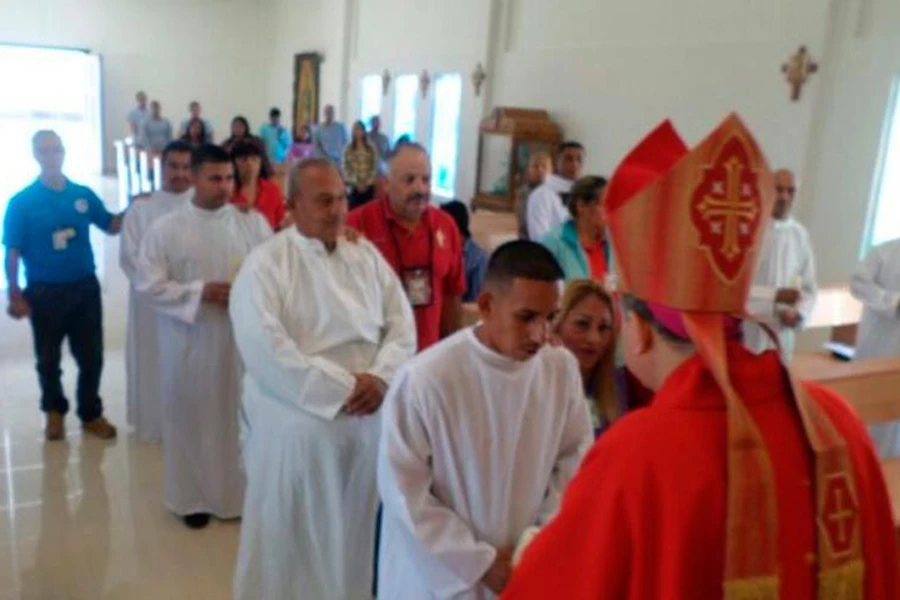
Chihuahua, Mexico, May 8, 2018 / 01:55 pm (ACI Prensa).- Bishop José Guadalupe Torres Campos of Ciudad Juárez, in Chihuahua state, Mexico, conferred the Sacrament of Confirmation on 15 inmates at the prison that Pope Francis visited in 2016.

The May 4 ceremony at the Social Readaptation Center No. 3. was organized by the prison ministry of Ciudad Juarez with the support of the prosecutor’s office.

The prison ministry helps prepare inmates who want to receive the sacraments of Baptism, First Communion and Confirmation.

Relatives were permitted to attend the ceremony. The Attorney General’s Office of the State of Chihuahua assured that the ceremony was conducted “under all necessary security measures and with complete respect for freedom of worship.”

The Attorney General’s Office also stated that “this type of activity” is carried out in accordance with the Law on Prison Sentences, “which provides that every inmate must be treated with dignity by the prison staff.”

During his trip to Mexico in 2016, Pope Francis visited the prison on Feb. 17. The pope said that the inmates “have known the power of suffering and sin,” and urged them to “not forget that you have available to you the power of the resurrection, the power of divine mercy which makes all things new.”

“Now you have to face the toughest, the hardest part, but which possibly may bear the most fruit, fight from within here to work to change the situations the create more exclusion,” he said.

“Work so that this society with uses people and throws them away will not go on claiming victims,” he asked them.
 

This article was originally published by our sister agency, ACI Prensa. It has been translated and adapted by CNA.

[…]

No Picture
News Briefs

Hundreds of thousands march for life across Latin America

May 7, 2018 CNA Daily News 1

Lima, Peru, May 7, 2018 / 03:32 pm (ACI Prensa).- Huge crowds across Latin America took to the streets in recent days to call for the protection of human life from conception to natural death.

On May 5, some 400,000 Colombians in 53 cities across the country turned out for pro-life marches.

Event organizer “United for Life” told ACI Prensa, CNA’s Spanish language sister agency, that the objectives of the march included annulling court rulings in recent years that legalized abortion in some cases and euthanasia.

“The right to life is the first right that every human being has. It cannot be manipulated, nor limited, it can only be recognized and protected by the State and society. To violate this right, or to ignore it even with rulings issued by the courts is the most serious crime,” the organization said.

It called for the creation of a government agency to assist mothers in crisis pregnancies and for “greater application of the law on palliative care, and sufficient and timely medical care for patients with serious and terminal illnesses, especially children.”

United for Life urged the Colombian congress to pass pro-life laws, enforce the constitution and prevent the courts from usurping the functions of the legislature.

In Peru, an estimated 800,000 people turned out on the streets of Lima May 5 to defend the lives of the unborn. The right to life is upheld by the nation’s constitution and civil code; however, various organizations within the country – including those financed by foreign NGOs – have been seeking for years to legalize abortion in the country. In 2014, the government decriminalized abortion in cases where the mother’s life or health were deemed to be in danger.

Participating in the Lima event were Catholics and Christians of various denominations, young people and the elderly, pregnant women, families with children and babies, and people with disabilities.

Addressing the crowd, Cardinal Juan Luis Cipriani of Lima urged those assembled to be “a visible believing people, as we are now… when it’s necessary, we take to the streets… in the name of all those who have gone on before us, to give to the next generation life and the family.”

In Mexico, about 22,000 people turned out for the Great March for Life April 28 in the capital, Mexico City. While abortion is banned in much of the country, it was legalized in 2007 in Mexico City for the first 12 weeks of pregnancy.

Pro-life leaders Fernanda Del Villar and María José Berrueta of the Steps for Life (Pasos por la Vida) organization spoke at the march.

They said that the vast majority of Mexicans are pro-life and that “we are tired of not being properly represented by those we ourselves elect. We’re tired of the attempts to shut us up, to silence even our thoughts.”

The leaders called on presidential candidates to unequivocally state their position on abortion. They said the country needs leaders with values, committed to elementary principles such as respect for the life of the unborn.

The pro-life position, they said, “is in fact politically correct. It is the sentiment of millions of Mexicans.”

A March for Life was also held May 6 in Rio de Janeiro, Brazil, with a focus on the country’s supreme court, which is currently considering a case that could legalize abortion on demand up to 12 weeks.

Currently, abortion is legal in Brazil only in cases of rape, serious fetal deformity, or if the mother’s life is deemed to be at risk.

The march for life also supported the passage of a bill to protect the lives of the unborn, which has been pending in the congress.

Archbishop Orani João Tempesta of Rio de Janerio told participants of the march, “Peace will come the moment we respect life.”

“I am here and I am participating in this march as a resistance to the culture of death, a resistance in favor of life,” he said, according to JMNoticia.
 

This article was originally published by our sister agency, ACI Prensa. It has been translated and adapted by CNA.

[…]

No Picture
News Briefs

Mexican bishop warns against mob justice: ‘violence engenders more violence’

May 4, 2018 CNA Daily News 2

Tabasco, Mexico, May 4, 2018 / 11:46 am (ACI Prensa).- Bishop Gerardo de Jesús Rojas Lopez of Tabasco in southern Mexico criticized acts of mob justice recently carried out by the community against alleged thieves.

“Jesus Christ crucified and glorified in the only one who can heal the wounds and save us from the violence unleashed in our beloved Tabasco due to multiple circumstances,” he said.

The Attorney General’s Office of Tabasco State reported that on April 29, a man who allegedly tried to steal a motorcycle in the town of Tamulté de las Sabanas was beaten and burned to death by the people of the town.

That same day in the town of Vicente Guerrero in Centla, an alleged thief was stabbed, and is now undergoing medical treatment.

According to Leonor Ramirez, president of the Tabasco Human Rights Committee, these two incidents make 24 acts of mob justice so far this yea. Ramirez said that people justify these acts due to a lack of security and mistrust of the authorities.

In a statement released April 30, Bishop Rojas Lopez deplored the “acts of extreme violence” the state of Tabasco has suffered in recent days, including the murders of women and children.

However, he said, despite the desperation and lack of security in the state, “taking justice into your own hands is not the way and the solution to attain the peace so longed for.”

The bishop affirmed that “we categorically reject as contrary to the Spirit of the Gospel of Jesus Christ the acts that have occurred which profoundly wound the same communities and all our people, reminding that violence engenders more violence.”

He stressed that “Jesus Christ always shows us the way to conversion, mercy and forgiveness; the Heavenly Father never tires of waiting for the return of the son when he has left the home.”

Bishop Rojas Lopez called on authorities to commit themselves to better security.

“But we also continue to insistently call on all families to work harder for an integral education that forms values in their children, in order to be able repair the social fabric we live in, certain that there will not be a better society without renewed families,” he said.

The bishop of Tabasco invited Catholics and non-Catholics to “hold prayer campaigns to pray to the Lord for the gift of peace, light and strength that come from the Holy Spirit to find the paths of justice, brotherhood, authentic progress and peace.”


This article was originally published by our sister agency, ACI Prensa. It has been translated and adapted by CNA.
 

[…]