No Picture
News Briefs

New Michigan vocational school combines Catholic education, skilled trades 

August 9, 2019 CNA Daily News 3

Grand Rapids, Mich., Aug 9, 2019 / 03:18 am (CNA).- A new vocational school in Grand Rapids, Michigan will open its doors next year to young men interested in learning both a skilled trade and formation through a Catholic curriculum.

Harmel Academy is founded by Brain Black, head of Grand Rapids Construction, and Ryan Pohl, a journeyman CNC machinist. The program is supported by Kuyper College and Micron Manufacturing, both located in Grands Rapids, Michigan.

Black told CNA that the first year will begin with 12-15 students, and the program will grow each year. The goal is to offer students an authentically Catholic experience, like they might find at Thomas Aquinas College or Ave Maria University, he said, but with trades instead of a bachelor’s degree.

He said the students will have the opportunity to gain hands-on-experience in actual trades and grow in an understanding of “Christ in their lives as it relates specifically to work, their family life,  and their own mission in the Church.”

“We are going to tell you about the integrity of your life. We are going to inform you about Christ who chose to become man as a carpenter, as a tradesman,” he added.

The two year program’s initial education will be centered on Machine and System Technology, which includes experience in electrical, machine operation, and 3D printing. The school will eventually add other skilled trades, including HVAC and plumbing. The curriculum is split into three parts: lessons, apprenticeship, and humanities.

Classes will take place both online and on the Kuyper campus, which can house 300 people. Students will work part-time in a particular trade as part of a paid apprenticeship. After two years, graduates will receive a certificate in their trade and be half-way through the completion of their journeymen card.

In addition to their education in a trade, students at Harmel Academy will receive spiritual formation through a two-year long humanities course. They will study history, philosophy, theology, and politics, with texts including papal documents and the works of Aristotle.

Black said the humanities course will not include lengthy written assignments, but is still designed to be challenging to the students, though classroom discussions and light reading.

“It’s going to be very practical. It’s going to be rigorous and vigorous at the same time. We are planning on challenging and [investing] into some of this stuff because there are a lot of issues that young men have to face now.”

The humanities course will be split into four sections: the self, the other, the family, and the community, which includes courses on the nature of work, economics, politics, taxes, the structure of the state, and military service.

Students will also gather daily for the Divine Office’s morning prayer. Bishop David Walkowiak of Grand Rapids has approved the project and is helping the school find a priest so the campus can eventually hold Mass and retreats.

Black said the school wants to remain small to help to ensure strong relationships among the students and with the staff. The campus environment will be conducive to building genuine friendships, he said, noting that college relationships are a considerable aspect of formation.

“We want faculty and students to know each other well and larger than that size becomes difficult,” he said. “The key thing here is to foster a physical environment that fosters community. The college experience is a unique opportunity to form lifelong friendships.”

Tuition at Harmel Academy is $18,500 year, which covers room and board. To apply, candidates must have their GED or High School Diploma, a car, and letters of recommendation. The students must also take a personality test, pass a criminal background check and drug test, and undergo an interview process. The school’s accreditation process is in progress.

Black said he and Pohl came up with the idea for the school several years ago, upon noticing that some men were uninterested in a four-year college but still wanted to prepare for a career while in a Catholic environment.

“[Some] young men struggle with what to do when they had a strong mechanical interest. They don’t want the enormous debt of college and they didn’t feel called to spend that much time at something that didn’t really have a direct relationship to their lives,” he said.

“[These] men are more mechanically minded and it seemed like there really wasn’t anything in the Church [for them].”

Across the U.S. the skilled trades industries are seeing a labor shortage, as the number of workers retiring far outstrips the numbers entering the field.

Black said many young adults are a good fit for the typical four-year university experience, but others are more naturally suited for skilled trades, working with their hands, and seeing the results of their labor. He noted that Christ himself was a carpenter.

“I think the trades give young men a unique ability to truly imitate Christ and that’s pretty powerful stuff.”

Black is enthusiastic about the opportunities Harmel Academy will provide for its students. He said the goal of the academy is not only to lead young men to a career, but to form their understanding of work and faith.

“The key thing we are looking at here is forming a fully integrated man who knows what he is about [and] knows how God built him.”


[…]

No Picture
News Briefs

Catholic Church in Wisconsin opposes bill attacking seal of confession

August 8, 2019 CNA Daily News 0

Madison, Wis., Aug 8, 2019 / 06:01 pm (CNA).- Two bills were announced in Wisconsin this week intended to protect victims of child sexual abuse. The Catholic Church in the state has registered its strong objection to one bill’s intention to force violation of the seal of confession.

The Child Victims Act would remove the statute of limitations for victims of child sexual abuse, while the Clergy Mandatory Reporter Act would force priests to report child abuse learned of during the sacrament of confession.

Kim Vercauteren, executive director of the Wisconsin Catholic Conference, told CNA that there is room to improve victims’ pursuit of justice, but decried the attack on the confessional.

“I think more needs to be done to highlight what can be done for victim survivors and what are some of the other resources out there,” she told CNA. “Part of this is to provide more education and information to survivors to what they can and can’t do, like what is the expectation to further the case along.”

The bills were circulated via email Aug. 7 inviting legislators to add themselves as a sponsor. The sponsor deadline is Aug. 21; the measures will not be introduced to the legislature until after this date.

The bills have been sponsored by Senator Lena Taylor (D-Milwaukee) and Representatives Chris Taylor (D-Madison) and Melissa Sargent (D-Madison).

“Child victims in our own state suffered greatly as pedophile priests were not reported to authorities and simply moved to other parishes where they continued to abuse children,” reads an Aug. 7 statement from Chris Taylor’s office.

“The Milwaukee Archdiocese’s own files reveal how the systemic sexual abuse of children was covered up, ignored, and seldom reported to authorities until the early 2000s,” the statement reads.

The Clergy Mandatory Reporter Act would replace a 2004 law of the same name.

Clerics are already mandatory reporters of abuse under Wisconsin law, but are exempted from reporting instances learned of during sacramental confession.

The new mandatory reporter act would require that priests violate the seal of the confessional.

The statement from Chris Taylor’s office characterizes the exemption for the seal of the confessional as “a loophole allowing child sexual abuse by clergy to remain secret and unreported.”

The Child Victims Act would abolish the civil statute of limitations for child sex abuse cases.

Wisconsin currently bars victims of child sex abuse from bringing legal action after age 35.  

The bill would also grant those previously unable to pursue legal action because of the statue of limitations a three year window after its passage to do so.

“Every 9 minutes, Child Protective Services agencies substantiate or find strong evidence indicating a child has been the victim of sexual abuse,” Chris Taylor, sometime public policy director for Planned Parenthood of Wisconsin,  said Aug. 7.

She claimed that “in Wisconsin, clergy are not mandatory reporters of most child abuse, unlike large categories of physicians and health care providers, school teachers and staff, counselors and social workers, to name a few. And members of the clergy do not have to report the sexual abuse of children, even by other clergy members, if they received evidence of this abuse through private, confidential communications.”

Priests who violate the seal of confession by sharing anything learned within the sacramental context to anyone, at any time, for any reason is subject to automatic excommunication and and further punishments, including loss of the clerical state.

Vercauteren said priests already have an obligation to report child abuse committed by other clerics. The 2004 Clergy Mandatory Reporter Act already requires that they report any knowledge of sexual abuse gleaned in any circumstance but confession.

“With the clergymen reporting, there is actually an additional requirement instituted at the time [of the previous bill],” she said.

“If they have a reasonable case based on information received or observations made to presume that child abuse is occurring or will occur that they have to report that as well as relates to another member of the clergy,” she said.

Vercauteren emphasized the importance of the confidentiality of confession. She said the anonymous structure allows the penitent to be truly transparent, while a lack of secrecy might otherwise prevent this vulnerability.

“If you look at our teaching, [confession] is ultimately between the person and God, and the priest acts as an intermediary in that relationship,” she said. “The need for secrecy and to be able to candid in that circumstance is kind of the whole premise behind confession that this is the opportunity to completely unburden your soul.”

She said the confessional has not been used as a tool to conceal sexual abuse in the past, nor has the bill cited such a case. She said the bill ignores difficult practical obstacles, like the anonymous structure of the confessional, where many Catholics confess from behind screens.

When asked about how Catholics can best respond, she said parishioners should encounter victims with compassion and learn more about the safety measures already in place.

“Catholics should always respond with care and consideration for the victims. I can’t stress that enough because these individuals have suffered irreparable damage in their lives and we have to meet them where they are at in this process.”

“There are ways in which we can provide greater reporting of child abuse in Wisconsin and elsewhere, expanding that to other forms of abuse or setting up a third party reporting mechanisms.”

She stressed the importance of investigational reviews from third parties. She said numerous dioceses have begun to involve themselves with outside independent groups to review records and confirm the diocese is aligned with reporting policies.

“We are serious about doing something about child abuse and trying to help them surviving what has been a horrendous act in their lives,” she said.

A similar bill was introduced in California this year, but it was withdrawn before it was to be debated in committee.

California’s Public Safety Committee had released a report on the bill raising a number of First Amendment concerns.

The dropping of the bill was “good for the Catholic people of California and for believers of all faiths, not only in this state but across the country,” Archbishop José Gomez of Los Angeles said.

“It was a threat to the sacrament of confession that would have denied the right to confidential confessions to priests and tens of thousands of Catholics who work with priests in parishes and other Church agencies and ministries,” he said.

[…]

No Picture
News Briefs

Guam archdiocese faces more than 200 lawsuits amid bankruptcy

August 8, 2019 CNA Daily News 0

Hagatna, Guam, Aug 8, 2019 / 03:03 pm (CNA).- The Archdiocese of Agaña is facing dozens of lawsuits related to clerical sexual abuse, and is encouraging any other alleged victims to contact the archdiocese before the deadline to file lawsuits expires this month.

More than 220 former altar boys, students, and Boy Scouts are suing the archdiocese over sexual assaults by 35 clergy, teachers and scoutmasters, the Associated Press reports.

The last day to file a claim against the archdiocese is Aug. 15.

In 2016, Guam’s territorial legislature eliminated the statute of limitations for civil lawsuits involving child sexual abuse. Former Archbishop Anthony Apuron was found guilty of some of several abuse-related charges by the Congregation for the Doctrine of the Faith last year.

In January 2019, the archdiocese filed for bankruptcy in federal court in the wake of numerous sex abuse allegations. The move, decided upon in November 2018, allows the archdiocese to avoid trial and to begin to reach settlements in the abuse lawsuits, which amount to over $115 million.

Archbishop Michael Byrnes of Agaña has said that Apuron left behind no records of sexual abuse allegations in the archdiocese. And unlike many dioceses on the U.S. mainland, Guam has yet to issue a list of priests whom the Church deems credibly accused of sexual abuse of a minor, the AP reports.

Archbishop Byrnes has offered “deepest apologies” to the victims of Apuron, whom he listed by name. The victims were altar boys. They included the former archbishop’s nephew and a former seminarian. They said the crimes happened while Apuron was a parish priest.

The Vatican first opened its investigation in 2015 after a victim reported his alleged abuse to the apostolic nuncio for the Pacific. The Apostolic Tribunal of the Congregation for the Doctrine of the Faith in March 2018 found Apuron, 73, guilty of some of several abuse-related charges. He immediately appealed the decision.

The Vatican court upheld the original decision Feb. 7, and the CDF announced the final sentencing April 4. Apuron has maintained his innocence and said he is “deeply saddened” by Pope Francis’ decision to sentence him.

Apuron was sentenced to privation of office; forbidden from using the insignia attached to the rank of bishop, such as the mitre and ring; and forbidden from living within the jurisdiction of the archdiocese.

He was not removed from ministry or from the clerical state, nor has he been assigned to live in prayer and penance.


[…]

No Picture
News Briefs

Archbishop Chaput: Look deeper than symptoms to solve mass violence

August 6, 2019 CNA Daily News 1

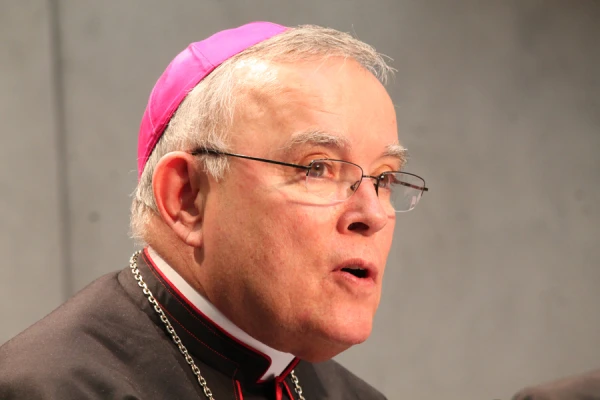
Philadelphia, Pa., Aug 6, 2019 / 10:50 am (CNA).- Gun control laws alone will not stop mass shootings effectively, Archbishop Charles Chaput of Philadelphia, said in a column written in response to the recent shootings in Gilroy, Calif., El Paso, and Dayton, Ohio.

Chaput belives that there needs to be societal shift to transform the present “culture of violence.”

Writing in his Aug. 5 column, Chaput said that while he fully supports the use of background checks and restrictions on who is able to purchase firearms, “only a fool can believe that ‘gun control’ will solve the problem of mass violence.”

“The people using the guns in these loathsome incidents are moral agents with twisted hearts. And the twisting is done by the culture of sexual anarchy, personal excess, political hatreds, intellectual dishonesty, and perverted freedoms that we’ve systematically created over the past half-century.”

Chaput drew from his experience as Archbishop of Denver consoling the community after the shooting at Columbine High School. At the time, he buried some of the victims, and met with their families.

During his testimony to the U.S. Senate shortly after the Columbine shooting, Chaput spoke of “a culture that markets violence in dozens of different ways” that has become “part of our social fabric.”

“When we build our advertising campaigns on consumer selfishness and greed, and when money becomes the universal measure of value, how can we be surprised when our sense of community erodes,” he asked at the time. “When we glorify and multiply guns, why are we shocked when kids use them?”

Chaput also addressed the use of the death penalty and the legality of abortion as “certain kinds of killings we enshrine as rights and protect by law,” which creates a societal “contradiction.” This contradiction has reduced the view of human life, he said.

In 1999, Chaput suggested that America embrace a “relentless commitment to respect the sanctity of each human life, from womb to natural death,” and that he did not think the shooting at Columbine High School would be the last mass shooting.

“In examining how and why our culture markets violence, I ask you not to stop with the symptoms,” he said. “Look deeper.”

Chaput repeated this call in his column Monday, saying, “treating the symptoms in a culture of violence doesn’t work. We need to look deeper. Until we’re willing to do that, nothing fundamental will change.”

In focusing on the hearts of those who commit mass schootings, twisted by the culture created in the past 50 years, Chaput’s statement was markedly different than others published by Catholic bishops in the wake of the shootings.

The USCCB issued a sweeping statement Aug. 4 requesting “effective legislation that addresses why these unimaginable and repeated occurrences of murderous gun violence continue to take place in our communities.”

“As people of faith, we continue to pray for all the victims, and for healing in all these stricken communities. But action is also needed to end these abhorrent acts,” said the bishops.

Bishop David Zubik of Pittsburgh called for various gun control measures in an Aug. 5 statement, including “limiting civilian access to high capacity weapons and magazines.” Zubik also said there was a need to address websites that encourage violent acts, as well as to improve access to mental healthcare and work to overcome racism.

Bishop Mark Seitz of El Paso did not call for increased gun control measure, but instead urged the people of El Paso to “recommit to love” and to “brace ourselves for just action that will overcome the forces of division and build a more loving society.”

And Archbishop Dennis Schnurr of Cincinnati said Aug. 4 that “it is with a heavy heart that we turn to the Lord in prayer on this Sunday. As tragic and violent shootings continue in our country … I ask for everyone of faith to join in prayer for the victims and their loved ones. May we, the Catholics of the Archdiocese of Cincinnati, in unity petition our Blessed Mother to intercede for our families and neighbors to know the peace and healing of Jesus, her Son.”

[…]