World Youth Day cross, Marian icon console Mexican earthquake victims

October 4, 2017 CNA Daily News 0

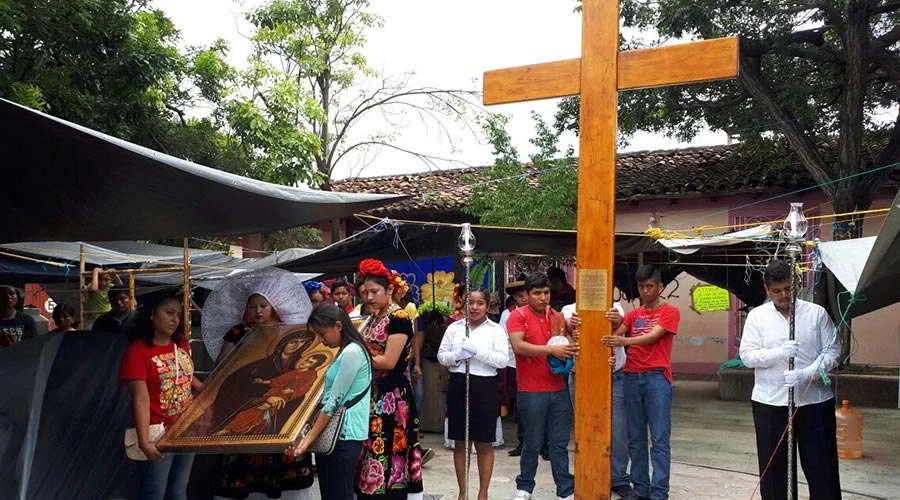
Oaxaca, Mexico, Oct 5, 2017 / 12:07 am (ACI Prensa).- A team of pilgrims representing World Youth Day 2019 offered a message of hope and consolation to Mexicans impacted by a devastating Sept. 7 earthquake.  

On Oct. 2, the team visited areas affected by the earthquake with the official World Youth Day Pilgrim Cross and a Marian icon, as a sign of solidarity.

The team is touring Mexico as part of an international pilgrimage promoting the 2019 World Youth Day, to be held in Panama City, Panama. They had been scheduled to stop in Oaxaca, in the south of Mexico, during their tour, but local churches cancelled their visits after the earthquake, due to the extensive damage in that area.

The group decided to “make a visit anyway as a sign of solidarity, as a sign of the presence of Christ through the cross and the Blessed Mother with the icon,”  Fr. José de la Luz López, national adviser to the Mexican bishops’ youth ministry, told CNA.

They received permission to bring the World Youth Day symbols to the cathedral and two shelters in Tehuantepec, an area heavily impacted by the earthquake. Young people from the Tehuantepec diocesan team also participated in organizing the reception of the cross and icon.

Fr. José de la Luz said that the symbols were transported to Oaxaca in a pickup truck from Acapulco, a distance of 400 miles that typically takes more than 12 hours by car.

The priest said he would “sum up in two ways” the reaction of the earthquake victims when they received the cross and icon.

“First, these symbols gave a lot of hope. The young people were very enthusiastic, they were very hopeful in the midst of all their bewilderment and pain, and they were committed to rebuild their homes,” he said.

“The second thing I take away is that we Mexicans are going to have a lot to learn from the young people from these hard hit places. The people of Oaxaca have shown us a great deal of fortitude and faith,” he continued.

At the cathedral in Tehuantepec, the World Youth Day cross was displayed during a service drawing more than 120 people.

From the cathedral, the cross was taken to a nearby shelter, where nearly 100 people gathered to pray.  Most of them were elderly, the priest said, because the young people and adults were out removing the debris from their homes in order to rescue their belongings.

The team then transported the cross through devastated areas, displayed in the bed of their pickup truck. “We passed through the most affected areas and we prayed from the pickup truck. Then we went to the town of Ixtepec, where the situation is somewhat different – the shelters are very small because most of the people have set up tents next to their homes,” Lopez said.

Besides visiting one of the shelters in Ixtepec, the cross and icon were also present at a Holy Hour that a local parish held for the victims.

The pilgrimage will continue in Mexico until Oct. 13, before travelling through Central America and the Caribbean, and concluding August 2018 in Panama.

The 8.1-magnitude earthquake that struck the southern coast of Mexico on Sept. 7 resulted in widespread damage and nearly 100 deaths. It was followed less than two weeks later by a 7.1-magnitude earthquake 400 miles away, which killed more than 300 people and injured 6,000.


This article was originally published by our sister agency, ACI Prensa.  It has been translated and adapted by CNA.

[…]

Internet porn is the ‘neon colosseum’ of the digital age, expert says

October 4, 2017 CNA Daily News 1

Rome, Italy, Oct 4, 2017 / 04:57 pm (CNA/EWTN News).- It’s well-known that in ancient Rome hundreds of thousands of people would to pile into the stacked layers of stone seating in the Colosseum to watch gladiators fight to their death, cheering on as the warriors met a bloody and often drawn-out end.

However, while being a “gladiator” in modern Rome has mostly become a way pick up extra cash in photo-ops with tourists, there are some who argue that the gruesome nature of the ancient battles, in which people would essentially celebrate and take pleasure in the pain of others, hasn’t gone away, but has rather taken on a new, less obvious form in the digital world: pornography.

When it comes to internet pornography, Dr. Donald Hilton Jr. of the University of Texas Health Science Center said we as a society have to learn to ask the “uncomfortable questions about our culture, why we’re so easily voyeuristic to watch people being harmed.”

While pornography has always been a problem, the new widespread access offered through the digital world has led to a culture that enjoys “watching women being hurt on screen,” he told CNA.

Hilton recalled that in a tour of the Colosseum, his guide explained that throughout the centuries of its of operation, the structure “had up to several hundred thousand animals and gladiators dying in the colosseum with people watching them and enjoying watching their pain.”

Now “I think we have a neon colosseum, a colosseum of screens where far more, now, are watching people being harmed. And people are enjoying it,” he said, adding that in his opinion, “we’re no better than the ancient Romans in that.”

“In fact, in some way I think we’re worse, because at least they did it openly, but we hide behind our screens at night and do it, and tell ourselves it’s okay.”

Hilton spoke as part of a four-day conference on protecting children in a digitally connected and global society. Titled “Child Dignity in the Digital World,” the conference is being held in Rome Oct. 3-6 and is organized by the Pontifical Gregorian University’s Center for Child Protection.

Vatican Secretary of State Cardinal Pietro Parolin opened the conference as a keynote speaker. Other participants in the congress include social scientists, civic leaders, and religious representatives. Discussion points include prevention of abuse, pornography, the responsibility of internet providers and the media, and ethical governance.

Several leading personalities participating argued that given the easy access children have to the internet, they are increasingly falling prey to an industry that, without the proper protections, can ultimately leave them vulnerable, becoming victims to a wide variety of abuses.

On day two of the conference, Hilton was part of a panel of experts exploring the dangers of internet pornography and its impact on children, specifically the link between pornography and violence, and the effects of porn use on the human brain, particularly among youth.

A celebrated neuroscientist and world-renown surgeon, Hilton examined the scientific changes in the human brain when viewing pornography.

Essentially, he said human beings have “two brains,” one being the cortex, which he called our “thinking brain,” and the other being the brain stem, referred to by Hilton as our “wanting brain.” So while the brain might tell us to do something because it feels good, the cortex will tell us to slow down and think about the consequences.

Between the two is the “reward center” of the brain, he said, explaining that while it is intended to help motivate us, the reward center can be “hijacked and diverted” from this purpose if we take in “powerful rewards indiscriminately.”

In this case, the reward center can “reset the pleasure thermostat of the brain,” and a “new normal” is established, which can quickly become addiction, Hilton said, explaining that the brain structure is impacted by learning, and that “addictive learning sculpts the brain in a very damaging way.”

Referring to a recent study done by medical personnel, he said addictions to food and sex have now been put on par with substance abuse, because the same changes are found in brain studies “and the behaviors are almost identical.”

Children and young adults are particularly at risk from this, he said, because for one, the frontal-lobe control center of the brain don’t fully mature until the person is in their mid-20s. However, most exposure to pornography happens at a young age, leaving children particularly vulnerable to changes in the brain structure.

He said children are also more at risk because the chemicals for processing rewards and addictions are more potent brains that are not yet mature, so “an immature breaking system is essentially paired with an accelerated reward-seeking drive.” He also cited problems with brains systems that identify observers with the “motivational state” of those performing in the program, which in pornography is often linked to violence.

In his comments to CNA, Hilton said porn access at a young age is particularly concerning because since the brain of a child or teenager is not yet developed, it makes a strong imprint and “sets their template” in way that essentially sculpts the brain to prefer what they watch over reality.

Quoting American author, feminist, and political adviser Naomi Wolf, he said “pornified” boys are increasingly led to a mentality that “real women are just bad porn.”

Hilton said that in order to help counter the online porn industry, the issue has to be addressed in a new way. Whereas in the past it has primarily been relegated to the moral realm, he said the issue is wider, and that it’s important to bring the issue up in public settings “without mentioning religion.”

“Can we talk about exploitation not only of youth who are viewing pornography, but of young female performers that are being used up so quickly and exploited by a very powerful industry? Can we leave the religion out of it and talk about it from a public health perspective?” he said.

“This is a vast industry, the internet is a vast industry,” he said, adding that if any other industry had the same amount of disease, emotional health issues, and drug abuse involved, “they would cry out and there would be outrage.

However, “with porn, as long as they take their clothes off and put a camera there, you can do anything you want,” he said, comparing porn to “filmed prostitution.”

“Can we really say that porn is good and that people should view it if the people that make it are being harmed? Is it an ethical product then?” he asked, and noted that according to one study paper, 88 percent of the scenes in the 250 most popular porn movies show aggression toward women.

So when looking at the concrete numbers, “if it’s not ethical to produce it, is it ethical to watch it? What is the price someone is paying to film that?”

Also speaking at the conference was Dr. Mary Anne Layden, a psychotherapist and Director of Education for the University of Pennsylvania, who addressed the link between violence and pornography.

In her speech, she presented various research studies linking the use of pornography to increased aggression toward women. In youth particularly, various studies have proved that exposure to porn at a young age increases the likelihood youth will be promiscuous at an earlier age, and are more prone to partner abuse as they get older.

Porn use also and the misconceived belief that if access is so common, it isn’t harmful, and that women who are treated violently in porn films actually like it, she said.

In comments to CNA after her speech, Layden said pornography is especially dangerous for children because “everything children see is educational,” and since porn is typically the only imagery kids have when it comes to sex, they learn about it from “this toxic form.”

“Now their brains are absorbing this and they are getting these messages, and then they very quickly start to act on that,” she said, explaining that they “will likely start having sex earlier, they will likely think all relationships are sexual, they’ll start to try and get their partner to try and act out things they’ve seen in pornography.”

Pornography also leads to misconceptions about the human body and what constitutes abuse, she said, explaining that many young adults have come into her clinic complaining that their bodies “don’t work” because things don’t happen like they do in movies.

While numerous research studies have proven that performers in pornography films don’t enjoy what they do on-set, many people still believe the opposite, Layden said, because they don’t see the suffering the performers endure.

What most people don’t know, she said is that “on those porn sets there is a doctor, on every porn set,” and “he will give you any drug you can name – he will give you Percocet, he will give you Xanex, he will give you heroine, he will give you anything to get you to go through that scene, take that torture and smile while they’re doing it.”

She said that when children first come into contact with pornography their initial reaction is that “there’s something scary” about it, and even something violent, but that very quickly they start to learn from what they see that “violence is a sex act,” and this notion becomes more normal as they get older.

In terms of protecting children from harmful images, Layden stressed the importance of educating parents on the risks and finding the right software to block problematic content from popping up.

Unfortunately, she said around only 20 percent of parents have actually put protective software on their children’s devices and activated it.

But if parents are looking for a good company, she said “Covenant Eyes” has programs that work very effectively through blocks and accountability software that will send a list of their child’s search history to them at the end of the week.

While it might not be possible bring the porn access to zero, it is possible to reduce it, Layden said.

“The fact that we can’t reduce it to zero doesn’t make us stop anything else,” she said, naming youth smokers and cancer patients as examples. And concrete ways to reduce exposure is to put filters on computers in libraries and at schools, as well as personal devices children own, and to not let them put their computers in their bedrooms.

She also stressed the need to get legislators and governments involved, explaining that pornography sites have finally been legally required to check the age of someone trying to access their web-pages.

“That won’t stop the damage that’s done to adult men,” she said, explaining that pornography first of all does damage to those who use it, “but it will stop with the most vulnerable, which is the children.”

Perpetrators of pornography must also be held accountable, Layden said, because the industry ultimately makes money by “hurting children.”

“This is an absolute scandal, these are child abuse perpetrators, these pornographic websites,” she said, explaining that they ought to be treated as perpetrators and put in jail, because “if you actually enforce law against obscenity, you can actually take all of their profits.”

Doing this would also “send the message to culture that if we’re putting them in jail, this must be a bad thing,” she said. “The permission-giving beliefs that say everyone is doing it, it must be fine, is just one of the biggest damages, and we can start the sending the message that it’s not okay.”

“We’ve got to stop saying ‘boys will be boys,’” and instead begin educating families more effectively on what healthy sexuality entails, she said, because pornography “hurts everyone involved; men, women, children, performers…it hurts everybody that comes close to it.”

[…]

Pro-life leaders: Life has value. Always.

October 4, 2017 CNA Daily News 1

Washington D.C., Oct 4, 2017 / 03:42 pm (CNA/EWTN News).- All life is valuable – especially those who are suffering, urged speakers at a recent pro-life program at Georgetown University on Monday. Their lives deserve care and accompaniment, even … […]

Sales of Essure birth control coil halted everywhere, except US

October 4, 2017 CNA Daily News 1

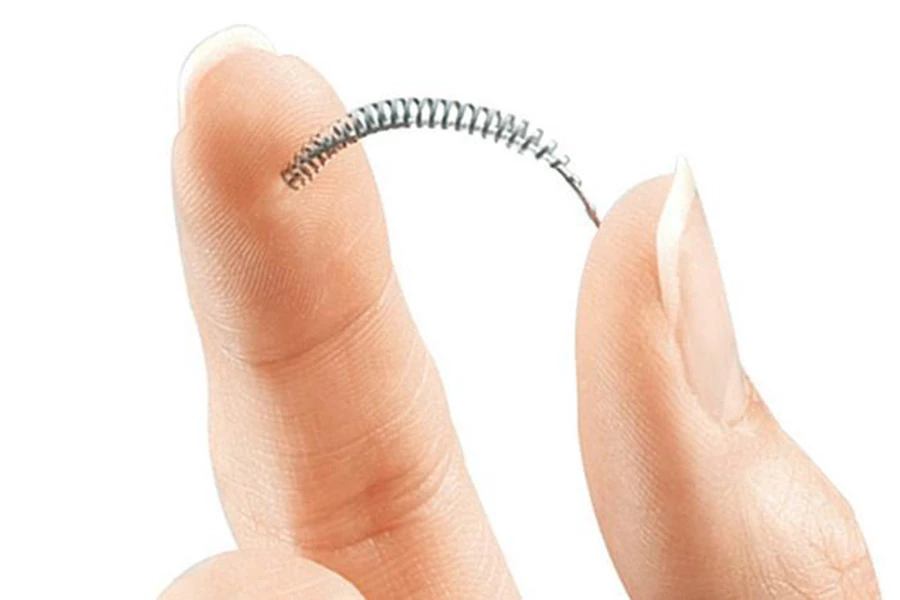
Washington D.C., Oct 4, 2017 / 03:09 pm (CNA/EWTN News).- German pharmaceutical company Bayer announced recently that it has suspended from all non-US sales the Essure coil, a controversial form of birth control which has received the strictest possible FDA warning for its side effects, which include chronic pain, bleeding, and severe allergic reactions.

“The device [Essure] was sold to me as a simple and easy procedure. I was told that I’d be in and out of the doctor’s office in 10 minutes and that there’d be no recovery time,” said Laura Linkson, a user of Essure who shared her testimony on the UK show Victoria Derbyshire, according to the BBC.

“I went from being a mum who was doing everything with her children, to a mum that was stuck in bed unable to move without pain, at some points being suicidal,” Linkson continued, saying, “I felt like I was a burden to everyone around me.”

Essure is a nickel and polyester coil which is inserted into the fallopian tubes, causing scar tissue growth, as a way of preventing eggs from reaching the womb. This form of birth control, known as hysteroscopy sterilization, has been around since 2002 and is currently manufactured and distributed by Bayer.

Last week, Bayer announced its voluntary decision to halt all sales outside of the U.S., citing “commercial reasons.”

“We would like to reassure the Essure patients and their accompanying healthcare professionals that this decision is made for commercial reasons and that it is not related to a safety or product quality issue,” read a statement from Bayer’s website. “According to our scientific assessment, the positive risk-benefit ratio of Essure remains unchanged.”

Essure sales in the EU were temporarily halted last month, following product license suspension in Ireland due to overall concerns for the product. Bayer also encouraged hospitals in the UK to suspend the use of their existing stocks for the time being.

However, Essure is still being sold in the U.S., its most popular market, although Bayer announced it is no longer marketing outside of the country.

Despite its popularity, more than 15,000 women in the U.S. alone have reported serious health issues resulting from the birth control coil, according to BBC.

In fact, over the past few years a group has surfaced called Essure Problems – an organization of women who are lobbying against Essure in court due to negative experiences with the product. The group now has more than 35,000 members.

Some reported side effects included chronic pain, flu-like symptoms, bleeding, depression, exhaustion, suicidal thoughts, and allergic reactions. In some cases, the coil had moved into other parts of the body, protruding into nearby organs and the pelvis.

These side-effects are a far cry from the device’s label warnings, which include “mild to moderate pain and/or cramping, vaginal bleeding and pelvic or back discomfort for a few days.”

“Whatever they’ve put on the label, multiply it by 200,” said Angela Desa-Lynch, an administrator for the Essure Problems Group, in a previous interview with CNA.

“They don’t tell you that it’s ‘I can’t get out of bed and take care of my kids’ kind of pain,” she continued.

Surgery or a hysterectomy is the only way to remove the Essure coil, which has resulted in additional complications with the birth control device.

The coils can easily break during surgery, causing further health issues such as additional surgeries, inflamed abdomens, and cysts. In addition, most health insurance companies will not cover the cost of the coil’s removal, resulting in a hefty medical bill.

“One woman had a coil in her colon, she went from a business owner to bankruptcy” after four surgeries, Desa-Lynch stated.

The FDA placed its most severe warning on the birth control coil in November 2016. Known as the “black box” label, it is “designed to call attention to serious or life-threatening risks,” according to the FDA’s website.

An FDA spokesman said that the agency “has taken several steps to ensure the ongoing evaluation of Essure’s safety and efficacy, as well as to educate healthcare professionals and women about the potential risks of using the device.”

[…]

US bishops’ anti-racism chairman announces committee membership

October 4, 2017 CNA Daily News 1

Washington D.C., Oct 4, 2017 / 02:52 pm (CNA/EWTN News).- In an interview with CNA on Monday, Bishop George Murry of Youngstown, who chairs the US bishops’ newly-formed anti-racism committee, revealed the names of the seven other bishops who are committee members.

The bishop members of the committee, Murry told CNA Oct. 2, are Cardinal Timothy Dolan of New York, Cardinal Joseph Tobin of Newark, Archbishop Charles Chaput of Philadelphia, Archbishop Jose Gomez of Los Angeles, Archbishop Wilton Gregory of Atlanta, Archbishop Allen Vigneron of Detroit, and Bishop Martin Holley of Memphis.

Bishop consultants to the committee include Cardinal Blase Cupich of Chicago; Cardinal Theodore McCarrick, Archbishop Emeritus of Washington, D.C.; Archbishop William Lori of Baltimore; Bishop Frank Dewane of Venice; and Bishop Joe Vasquez of Austin.

Lay consultants to the committee will be announced later this week, Murry said.

Murry reflected that “the problems of racism are deep and widespread, and will take time to heal … Young people are understandably frustrated. We don’t do them a service by not talking about this, by hoping it’ll go away.”

“We need to turn to them and say instead of throwing rocks, instead of destroying buildings, and instead of setting cars on fire, let’s sit down and talk about what concrete steps can we take to overcome this problem.”

The ad hoc committee was announced in August after white supremacists and neo-Nazis rallied in Charlottesville, Va., and a 20 year-old man drove a car into the counter-protest killing one and injuring 19.

The committee will explore ways the Church can address the root causes of contemporary manifestations of racism, the conference said. The bishops will also hold public conversations about racism and race-related problems.

[…]

Will the real St. Francis please stand up?

October 4, 2017 CNA Daily News 0

Washington D.C., Oct 4, 2017 / 10:16 am (CNA/EWTN News).- St. Francis of Assisi is widely known for his life of poverty and love of creation. But there’s a lesser-known side to the friar as well – a side that showed a deep reverence for the… […]

Pope announces pre-synod meeting with youth as participants

October 4, 2017 CNA Daily News 0

Vatican City, Oct 4, 2017 / 09:57 am (CNA/EWTN News).- Pope Francis announced Wednesday that ahead of next year’s synod of bishops on youth, a preliminary meeting will take place drawing young people from various countries and walks of life.

The gathering will give them a platform to share not only their convictions in the faith, but also their doubts and critiques.

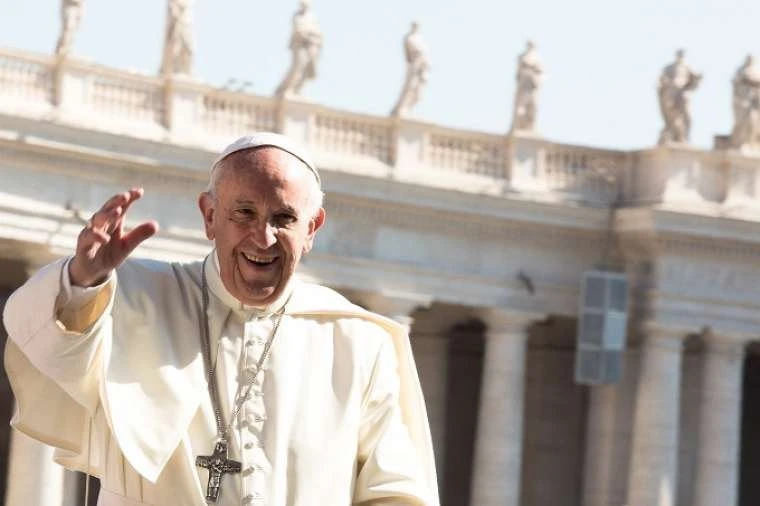
“With this path the Church wishes to listen to the voices, feelings, faith and even the doubts and critiques of the youth,” Pope Francis said during his Oct. 4 General Audience.

The meeting is scheduled to take place March 19-24, 2018 – seven months before the synod – and will draw youth from countries all over the world, including non-Catholics and non-Christians.

The synod, titled “Young People, Faith and the Discernment of Vocation,” is scheduled to take place in a year’s time, in October 2018.

According to an Oct. 4 communique from the Synod of Bishops, participants in the pre-synod meeting will represent bishops’ conferences and the Eastern Churches, as well as youth who are consecrated or preparing for the priesthood.

Youth involved in various associations and ecclesial movements will also participate alongside peers from other Christian denominations, other religions, as well as those skeptical of religion.

The young people who come will also represent various fields, including those still in school, those already working, and those involved in sports, the arts, and volunteering activities. Young people from the “extreme existential peripheries” will also be invited along with experts, educators, and trainers engaged in helping youth to “discern their life choices.”

At the end of the meeting, which is being organized by the Synod of Bishops in collaboration with the Dicastery for Laity, Family and Life, conclusions from the discussion will be compiled and given to synod participants with other documentation in order to “encourage their reflection and further examination.”

According to the Synod of Bishops, the pre-synod discussion is meant to compliment and “enrich” the consultation that has already begun with the publication of the synod’s preparatory document and a questionnaire available for youth to fill out online.

The dates for the meeting were selected intentionally to coincide with the celebration of the 2018 diocesan World Youth Day event, titled “Do not be afraid, Mary, for you have found favor with God,” which is traditionally celebrated on Palm Sunday with Mass celebrated by the Pope.

In their communique, the Synod of Bishops thanked the Pope convoking the meeting, “which will allow young people to express their expectations and desires, as well as their uncertainties and concerns in the complex events of today’s world.”

[…]

Christians must be ‘missionaries of hope,’ Pope Francis says

October 4, 2017 CNA Daily News 2

Vatican City, Oct 4, 2017 / 03:51 am (CNA/EWTN News).- On Wednesday Pope Francis said true Christians aren’t sad or gloomy, but have the specific task of being bearers of hope not only with their words, but with actions as simple as a smile or an act of charity.

In his Oct. 4 general audience, the Pope said it’s encouraging to know that the’ disciples “are announcers of Jesus’ resurrection not only in word, but with facts and with the testimony of their life!”

Jesus, he said, “doesn’t want disciples capable only of repeating learned and memorized formulas. He wants witnesses: people who spread hope with their way of welcoming, smiling and loving.”

The most important part loving, he said, “because the strength of the resurrection renders Christians capable of loving even when love seems to have lost it’s meaning.”

For Christians, there is a “more” to existence that can’t be explained simply with the strength of spirit or a great amount of optimism. Rather, believers are people that seem to have a “piece of heaven” with them, and who are accompanied “by a presence that no one can even intuit.”

Pope Francis spoke to pilgrims gathered in St Peter’s Square, continuing his catechesis on Christian hope. This week, he spoke of the need to have “missionaries of hope,” noting that the call for such witnesses is key in the month of October, which is traditionally dedicated to mission.

A Christian, the Pope said, not “a prophet of misfortune,” but rather, their task entails announcing Jesus, “who died out of love and who God resurrected on the morning of Easter.”

“This is the nucleus of our Christian faith,” he said, explaining that if the Gospels had stopped at the the crucifixion and tomb, “the story of this prophet would add itself to the many biographies of heroic personalities that often have spent their lives for an ideal.”

In this case, the Gospel would simply become “an edifying and consoling book,” but it would in no way “be an announcement of hope.”

However, the Gospels go beyond the tomb, Francis said, explaining that “it is precisely this last part that transforms our lives.”

Although everything seemed hopeless after Jesus’ death, with some disciples already beginning to leave Jerusalem, Jesus rose. And this “unexpected fact” completely “overturns and subverts the heart of the disciples.”

Christians, then, are called to spread this news in the world and “open spaces for salvation, like regenerative cells capable of restoring vigor to those seem lost forever.”

True Christians, Pope Francis said, are “not sad and angry, but convinced by the strength of the resurrection, that no evil is infinite, no night without end, no man is definitively in wrong, no hate is invincible from love.”

But while there is joy that comes from announcing the Gospel, disciples at times have had to “pay a dear price” for their hope, Francis said, and pointed to the many Christians who “have not abandoned their people” in times of persecution.

“They have stayed there, where tomorrow isn’t certain, where they couldn’t have plans of any sort, (but) they stayed hoping in God.”

Referring, as he often does, to the many modern martyrs who give their lives for Christ, the Pope said their fidelity proves that “injustice does not have the final word in life.”

“In Christ Risen we can continue to hope,” he said, noting that while men and women who have a certain reason to live are able to resist more than others in times of difficulty, “those who have Christ at their side truly no longer fear anything.”

“Because of this Christians are never easy and accommodating men,” he said, stressing that “their meekness must not be confused with a sense of insecurity or of submissiveness.”

And this, he said, “is why the Christian is a missionary of hope. Not by their merit, but thanks to Jesus, the grain of wheat who, fallen to the earth, died and brought much fruit.”

At the end of the audience, just before leading pilgrims in the Our Father, Pope Francis announced that a special meeting will be held March 19-24 with youth from all over the world in order to prepare for the 2018 Synod of Bishops on “Young People, Faith and the Discernment of Vocation.”

Youth who will attend the conference will also include non-believers and non-Catholics, whether they come from other Christian traditions, other faiths entirely. Conclusions of the discussion will be given to synod participants to take into consideration during the discussion.

In preparing for the synod, “the Church wants to listen to the voices, feelings, faith and even doubts and critiques of the youth,” Pope Francis said, which is why the March meeting will gather such a vast panorama of participants, and why, ultimately, their reflections will be taken into consideration during the synod itself.

[…]