Denver archbishop signs petition to end 4/20 rallies

May 4, 2017 CNA Daily News 0

Washington D.C., May 4, 2017 / 03:09 am (CNA/EWTN News).- After marijuana-themed rallies celebrating 4/20 left a downtown park trashed and threatened the safety of some civilians, Denver’s Archbishop Samuel Aquila has signed a petition to put an end to the rallies.

“Some of the attendees at the recent 4/20 rally downtown demonstrated that they respect neither Civic Center Park, which is the community’s property, nor their fellow citizens of Denver,” said Archbishop Aquila after signing the petition.

“Coloradans should take pride in protecting our land, environment and people. Mayor Hancock has worked hard to promote these values, and I hope he will take them into consideration as he weighs the future of the 4/20 rally.”

April 20th (4/20) has become the unofficial holiday for cannabis enthusiasts, thought to be taken from an old police code that meant “marijuana smoking in progress.”

According to reports from The Denver Post, several thousand people attended a festival in Civic Center Park in downtown Denver for the annual 4/20 rally. The event included vendors, food trucks, the 4:20 p.m. marijuana exhale and a concert.

The event was scheduled to end at 8 p.m., but park cleanup was still underway at 10:30 p.m. when, according to a rally organizer, a man ran through the park slashing open trash bags with a knife and threatening the clean-up crew. In the morning, the park, a national historic landmark, was still littered with trash.


Nothing like waking up to seas of trash in the morning pic.twitter.com/Gqb0Fk52UA

— Danika Worthington (@Dani_Worth) April 21, 2017


Now, a petition, circulated by the Centennial Institute of Colorado Christian University, argues that Denver’s 4/20 rallies “have become unsafe, flaunting blatant illegal activity” and are “a threat to attendees and the people of Denver.” Besides the report of a knife-wielding man, gunshots were heard nearby at one point during the rally, according to the group.

They also complained that despite warnings, signs and the presence of police, marijuana was widely smoked in public. While possession and consumption of marijuana is legal in Colorado for anyone over the age of 21, it cannot be smoked in public, according to regulations in Amendment 64 to the Colorado constitution.  

“…marijuana was allowed to be consumed openly and publicly by many attendees, even in the presence of children and infants. Marijuana was also consumed on stage by performers with no action by law enforcement,” the petition states.

The petition, released last week, directly asks Mayor Michael Hancock to terminate future 4/20 rallies in the city of Denver, and “concludes that the organizers do not have the safety or well-being of Denver residents in mind.”

The petition can be found at: http://www.ccu.edu/centennial/media/420-rallies-petition/


[…]

The Green Pope isn’t who you think it is.

May 4, 2017 CNA Daily News 0

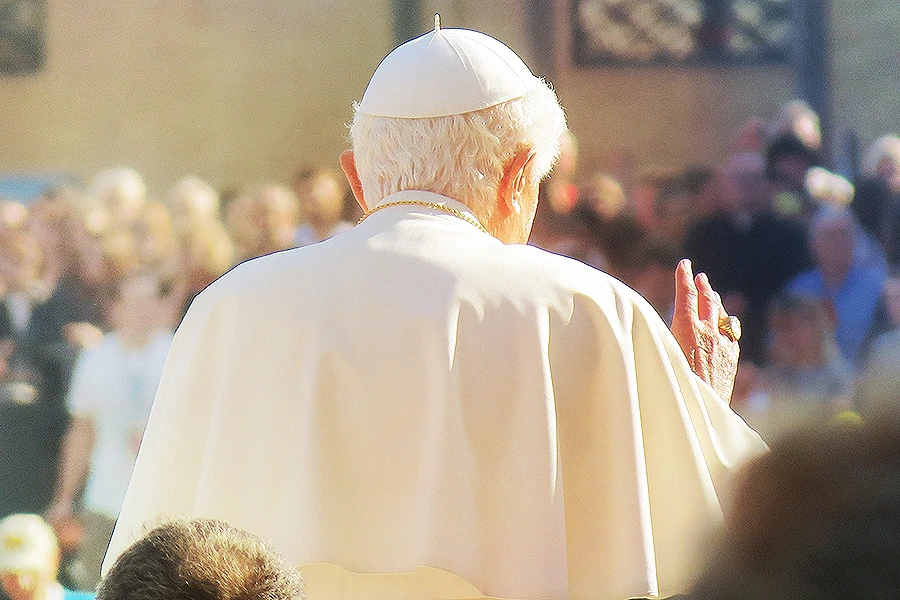
Vatican City, May 4, 2017 / 12:02 am (CNA/EWTN News).- There once was a Pope called “The Green Pope.”

He earned the title from both the religious and the secular alike, because he wrote frequently about the environment and asked all Catholics to be better stewards of God’s creation.  

Under this pope’s pontificate, the Vatican became the world’s first sovereign state to become carbon-neutral, meaning that all of the small country’s greenhouse gas emissions are offset by renewable energies and carbon credits, thanks to extra trees and solar panels. He also made use of a more energy efficient, partially electric popemobile.

No, “The Green Pope” is not Pope Francis.

It’s his predecessor, Pope Benedict XVI, which may come as a surprise to those who believe Benedict’s legacy was his staunch conservatism.  

During the World Day of Peace celebration in 2010, Pope Benedict XVI chose the theme “If You Want to Cultivate Peace, Protect Creation.”

“We are all responsible for the protection and care of the environment,” he said.

Drawing on the wisdom from his own predecessors, including Pope John Paul II, Pope Leo XIII and Pope Paul VI, Benedict in his message implored his flock to view climate change and care for creation as an extension of the Church’s care for humanity. He also addressed the phenomenon of “environmental refugees” several years before Francis noted the environment’s contribution to the current refugee crisis.

“Can we remain indifferent before the problems associated with such realities as climate change, desertification, the deterioration and loss of productivity in vast agricultural areas, the pollution of rivers and aquifers, the loss of biodiversity, the increase of natural catastrophes and the deforestation of equatorial and tropical regions? Can we disregard the growing phenomenon of ‘environmental refugees’, people who are forced by the degradation of their natural habitat to forsake it – and often their possessions as well – in order to face the dangers and uncertainties of forced displacement? Can we remain impassive in the face of actual and potential conflicts involving access to natural resources?” Benedict asked in his message.

“All these are issues with a profound impact on the exercise of human rights, such as the right to life, food, health and development,” he added.

This was not the only time Pope Benedict addressed the environment and climate change. In Sydney in 2008, he told the young people of World Youth Day in his opening remarks that care for creation and care for humanity are interconnected.

“The concerns for non-violence, sustainable development, justice and peace, and care for our environment are of vital importance for humanity. They cannot, however, be understood apart from a profound reflection on the innate dignity of every human life from conception to natural death: a dignity conferred by God himself and thus inviolable,” he said.

He even managed to work the topic into his 2007 apostolic exhortation “Sacramentum Caritatis”, on the topic of Eucharist as the source and summit of the life and mission of the Church.

In the letter, in a section entitled “The sanctification of the world and the protection of creation”, Pope Benedict XVI noted that even the liturgy reminds the faithful of the importance of God’s creation when “the priest raises to God a prayer of blessing and petition over the bread and wine, ‘fruit of the earth,’ ‘fruit of the vine’ and ‘work of human hands,’” he wrote.

“With these words, the rite not only includes in our offering to God all human efforts and activity, but also leads us to see the world as God’s creation, which brings forth everything we need for our sustenance. The world is not something indifferent, raw material to be utilized simply as we see fit. Rather, it is part of God’s good plan, in which all of us are called to be sons and daughters in the one Son of God, Jesus Christ,” he added.  

His writings on the topic were so prolific and profound that he is quoted numerous times in Pope Francis’ environmental encyclical, “Laudato Si”.

Like Benedict and his other papal predecessors, Pope Francis noted that an ecology of the environment was directly related to a proper human ecology.

“There can be no renewal of our relationship with nature without a renewal of humanity itself. There can be no ecology without an adequate anthropology. When the human person is considered as simply one being among others, the product of chance or physical determinism, then ‘our overall sense of responsibility wanes,’” Pope Francis wrote in “Laudato Si”, quoting Benedict XVI.

Care for creation, or for “our common home”, as Francis often calls it, will most likely continue to be one of the primary concerns of his pontificate. Besides his encyclical, Pope Francis frequently speaks about climate change and the environment in various audiences, including when he became the first pope to address the United States Congress last fall.

But the important intellectual and practical groundwork laid by his predecessors, and particularly by Pope Emeritus Benedict XVI, cannot be overlooked.


This article was originally published Oct. 11, 2016.

[…]

US bishops support petition for religious freedom executive order

May 3, 2017 CNA Daily News 0

Washington D.C., May 3, 2017 / 03:35 pm (CNA/EWTN News).- The U.S. Conference of Catholic Bishops on Wednesday sent out a text message alert urging Catholics to sign a petition calling on President Donald Trump to issue an executive order protecting religious freedom.

The petition, hosted by Human Life Action, encourages the president to sign such an executive order, which is rumored to be in the works for Thursday.

Religious freedom advocates have warned that, due to various mandates and rules issued during the Obama administration, religious institutions that uphold traditional marriage or do not cooperate with abortions and contraceptive use could soon face federal action if no executive order is issued to protect them.

A draft of such an executive order was leaked earlier this year, but was reportedly scuttled due to the efforts of Trump’s daughter Ivanka and her husband Jared Kushner.

An executive order could help mitigate the effects of the HHS birth control mandate, which caused hundreds of religious non-profits and other employers to sue the federal government claiming the mandate forced them to violate their consciences.

The Trump administration has not yet stopped defending the mandate in court, although White House advisor Leonard Leo told Axios recently that the administration was not planning to defend the mandate indefinitely, but was rather still considering the best “litigation proof” route for lifting the mandate’s burden on religious employers.

Another reason for an executive order would be the protection of health care providers and crisis pregnancy centers from mandates that they perform abortions or cover them in employee health plans, according to religious freedom advocates.

Currently, the Weldon Amendments bars federal funding of states that force employers to provide abortion coverage for employees. But after California ruled that health care plans – including those of churches and religious organizations – had to include coverage for elective abortions, the head of the Office of Civil Rights at the federal Department of Health and Human Services decided last summer that the state had not violated the Weldon Amendment.

Also at stake is the tax-exempt status of schools and other religious institutions which teach that marriage is one man and one woman.

In 2015 oral arguments in the same-sex marriage case Obergefell v. Hodges, President Obama’s solicitor general Donald Verrilli said that the ability of these colleges to retain their tax-exempt status if same-sex marriage is the law of the land is “certainly going to be an issue.”

Another way an executive order could protect religious freedom would be to protect federal contractors, and dioceses and churches that provide military chaplains, from having to comply with mandates that they support same-sex marriage.

The Russell Amendment had upheld this freedom and was included in the 2017 National Defense Authorization Act that passed the House, but was removed by Senate Republicans so the bill could pass the Senate.

“Any Executive Order should make it clear that religious freedom entails more than the freedom to worship but also includes the ability to act on one’s beliefs,” the U.S. Bishops’ Conference stated earlier this year on the need for an executive order.

“It should also protect individuals and families who run closely-held businesses in accordance with their faith to the greatest extent possible.”


[…]

Demolished cross in India sparks outrage among Catholics

May 3, 2017 CNA Daily News 0

Mumbai, India, May 3, 2017 / 03:34 pm (CNA/EWTN News).- Despite being located on private property, a 122 year-old cross was demolished late last month in a suburb of Mumbai, sparking legal action from the archdiocese.

“This is gross misuse of authority and the archdiocese, in collaboration with various representative bodies, will legally pursue the matter,” archdiocesan spokesperson Father Nigel Barrett told Matters India in an April 30 article.

Local civic officers had demolished the cross a day before, inciting an angry response from the Catholic community. A makeshift cross was established hours later.

In 2016 the Allahabad High Court issued a directive calling for the removal of all religious structures which infringe upon any public roads, ranging from highways to pathways. The ruling is meant to restrict religious activities hindering the flow of traffic on public roads.

The court ordered any religious structure raised before 2011 to be removed within two months, and those issued before would need to be moved to private land or removed in six months. However, the cross was already located on private property.

Assistant municipal commissioner Sharad Ughade had sent notice to the church on April 26 that the cross would be demolished, referring to the ruling. In response, the owner of the land that the cross was located on provided documents that proved the land was private.

Father Barrett said that legal action was on its way over the destruction of the cross, decrying that the proper documentation was seemingly ignored by civic authorities.

The representative for the area’s state legal assembly, Ashish Shelar, met with all affected parties on May 2. According to Mid-Day, he said the cross was included on a list of illegal structures which interfere with the development plan of the city.

He said the cross was mistakenly added to the list “without proper homework.”

Moving forward, he said the plan would be to reexamine the documents of the demolitions completed so far, to give all religious structures on the list a month to be relocated. Shelar also granted the request for a Christian cemetery to be built in Malad, a suburb on the other side of Mumbai.

Thirty-two temples and six crosses have also been removed since the court order, according to the Times of India.

[…]

Why a spike in religious hate crimes should worry all of us

May 3, 2017 CNA Daily News 0

Washington D.C., May 3, 2017 / 03:20 pm (CNA/EWTN News).- Civic and religious leaders this week addressed a disturbing rise in religious hate crimes in recent years, especially harassment and violence perpetrated against Jews, Muslims, and Sikhs.

“While it is clear that Sikh Americans are not alone in experiencing a rise in hate crimes, the experience of our community is important to understand how dangerous this current era of inflammatory rhetoric promises to be if action is not taken,” Dr. Prabhjot Singh, a Sikh physician, said in his May 2 written testimony before the Senate Judiciary Committee.

The Senate Judiciary Committee heard testimony from representatives of the Anti-Defamation League, a Sikh doctor, and the civil rights division at the Justice Department on “responses to the increase in religious hate crimes” in the U.S.

“Crimes against Jews are the most common religious hate crimes and they have increased,” Sen. Chuck Grassley (R-Iowa), chair of the committee, noted, but Islamophobic incidents rose the sharpest amongst all religious groups with a 67 percent spike from 2014 to 2015 according to FBI statistics.

Although overall hate crimes, including crimes based on race, sexual orientation, religion and ethnicity, went down in number from 2000 to 2015, religion-based hate crimes went up 23 percent from 2014 to 2015, Eric Treene, special counsel for religious discrimination at the Justice Department’s civil rights division, pointed to FBI statistics.

Dr. Singh, in his written testimony, told of how Sikhs are only one of many religious groups in the U.S., yet violence against them is representative of a worsening in religious bigotry.

Singh was violently beaten by a mob on the streets of New York City in 2013. As he lay awaiting treatment for his injuries in the hospital, he learned that the Muslim woman lying next to him in the emergency room wearing a hijab, or a religious headscarf, was attacked by the same group of young men.

“They threw a bottle of urine at her face, cutting her nose,” he said. Yet reporters who documented Singh’s attack in a story did not mention the assault on the Muslim woman because, in Singh’s words, “they said it would complicate the story, which was about a professor and doctor who was ‘mistakenly’ attacked in his own neighborhood.”

“We cannot accept this premise,” he insisted in his Tuesday testimony. “There is no such thing as a ‘mistaken’ hate crime. No one should ever be targeted. The only mistake is thinking otherwise.”

The attack, he continued, was only the latest incident in a rash of harassment and violence against Sikhs in the U.S. since the 9/11 attacks in 2001.

“Some of our fellow Americans,” Singh said, “call us ‘ragheads and towelheads,’ or ‘ISIS and Al Qaeda.’”

“Ominously, the Sikh Coalition has consistently found that a majority of Sikh students in our nation’s public schools experience bias-based bullying and harassment,” he added. “Some of our children are accused of being ‘terrorists.’ Others have had their turbans ripped off.”

Sadly, these attacks are part of a larger landscape of “threats, arson, assault, and murder” against Muslims, Jews, Hindus, African-Americans, and LGBTQ persons, he said.

“We seem to be backsliding into a new nativist era. This endangers us all,” he said.

Anti-Semitic and Islamophobic acts rose in 2016 in the presidential election and have continued in 2017, Jonathan Greenblatt, CEO and national director of the Anti-Defamation League, explained in his testimony.

Anti-Semitic incidents rose by over one-third in 2016 with “1,266 acts targeting Jews and Jewish institutions,” according to the ADL 2016 audit of incidents.

The campaign only intensified tensions that had already been aggravated, he added.

“And anti-Semitic abuse has soared on social media,” he noted, as “hateful, anti-Semitic invective” flourished on the mediums during the election season as well as harassment of Jewish journalists by white supremacists including the use of “triple parentheses, to publicly ‘tag’ Jews online.”

The election “featured harshly anti-Muslim rhetoric and anti-Semitic dog whistles,” he said, “and fostered an atmosphere in which white supremacists and other anti-Semites and bigots feel emboldened and believe that their views are becoming more broadly acceptable.”

President Trump’s “initial reluctance to address rising anti-Semitism” has helped normalize this bigotry, Greenblatt said, and some of his supporters played a direct role in it.

“Much of the vandalism and harassment used slogans sourced from the Trump campaign such as ‘Make America Great Again,’” he said. Incidents during and after the election – anti-Semitic graffiti and assault – were perpetrated with expressed support for Trump.

In addition, in the election there were “stereotyping of many groups, including women and immigrants, threats to ban Muslims from entering or living in the country, pronouncements that Islam ‘hates’ America, mocking of disabled people, and political candidates attacking one another based on their physical appearance,” he said.

Dr. Singh said he “was horrified to hear our President last weekend telling thousands of people at a rally that immigrants are snakes waiting to bite America,” he referred to Trump’s words at a recent rally in Harrisburg, Pa.

“Words matter, and when political leaders divide and dehumanize us, this lays the groundwork for hate to infect our society,” he stated.

All this has not only continued in 2017, but the number of incidents has spiked sharply, Greenblatt said.

He noted 161 bomb threats against Jewish synagogues or buildings so far and three reported desecrations of Jewish cemeteries.

“The bomb threats against JCCs, schools, ADL offices, and other community institutions in dozens of states across the country attracted very considerable attention,” he said, “causing evacuations, significant service disruptions, program cancellations, and deep community anxiety.”

Some of the threats were graphic in nature, warning of a “bloodbath” or the decapitations of Jews in explosions.

Action must be taken to stem these incidents, witnesses insisted. Preventative measures could include mandatory reporting laws for hate crimes, a federal inter-agency task force on hate crimes, and public officials speaking out against bigotry.

Dr. Singh shared how his son will soon enter Kindergarten, yet according to statistics, will probably be the victim of bigotry.

“These young years are formative, and how children are treated tells us so much about who we are as a nation, and who we aspire to be,” he said.

[…]

Diocese says ‘ordination’ of woman as Catholic priest not valid

May 3, 2017 CNA Daily News 0

Charlotte, N.C., May 3, 2017 / 06:02 am (CNA/EWTN News).- A breakaway Catholic group is in the news for attempting to ordain a woman as a Catholic priest at a non-denominational church in North Carolina.

Abigail Eltzroth, 64, went through the simulated ordination at the Jubilee! church in Asheville, N.C. under the aegis of the group Association of Roman Catholic Women Priests. She has said she intends to start a Catholic community in the area of Asheville.

The local diocese, however, reaffirmed Catholic teaching that such an ordination is null.

“I hope that Catholics in the diocese will understand that it would be sinful to receive a fake sacrament from a woman priest and that includes attending a fake Mass,” said David Hains, spokesperson for the Catholic Diocese of Charlotte.

Eltzroth converted to Catholicism from a Presbyterian background in her 50s, the Charlotte Observer reports. The simulated ordination was carried out by Bridget Mary Meehan, who presents herself as a Catholic bishop.

Association of Roman Catholic Women Priests traces itself back to the attempted ordination of seven women on a ship cruising the Danube River in 2002. Attempted ordination of a woman is automatic excommunication for both the person attempting the ordination and the person attempting to be ordained.

From the beginning of his papacy, Pope Francis has been clear on the issue of women priests, while still emphasizing the unique and important role of women in the Church.

On his return flight from Philadelphia for the World Meeting of Families Sept. 28, 2015, the Pope reiterated that women priests “cannot be done,” and called for a more comprehensive theology on women.

In an interview with Vatican Insider in December 2013, Francis responded to a question on whether or not he’d ever consider naming a woman a cardinal. The very question, he indicated, stemmed from an attitude of clericalism.

“I don’t know where this idea sprang from. Women in the Church must be valued not ‘clericalised,’” the Pope said. “Whoever thinks of women as cardinals suffers a bit from clericalism.”

Throughout the three years since, Francis has consistently called for a more “incisive” feminine presence in the Church, yet has refrained from limiting this presence to a mere position.

[…]

After visit, Pope Francis says Egypt is a ‘sign of hope’

May 3, 2017 CNA Daily News 0

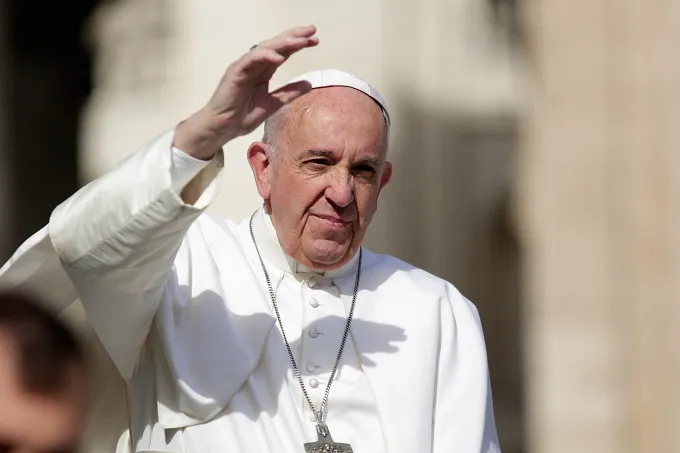
Vatican City, May 3, 2017 / 04:30 am (CNA/EWTN News).- On Wednesday Pope Francis recalled his recent visit to Egypt, saying that given its rich biblical and cultural history, the country is a sign of hope, and has a special role to play in brokering peace in the Middle East.

“Egypt for us was a sign of hope, of refuge and of help,” the Pope said during his May 3 general audience.

He noted how in scripture Jacob and his sons traveled to the region when it was in famine, and later Jesus himself also found refuge there from Herod.

“So recounting this trip enters on the path of recounting hope,” he said, adding that for Christians, “Egypt has the sense of speaking about hope, whether in history or today, and of this brotherhood that I am telling you about.”

Pope Francis spoke just days after returning from his April 28-29 visit to Egypt, which was made largely as the result of a recent thawing in relations between the Vatican and the prestigious al-Azhar University, one of the highest institutional authorities in Sunni Islam, which had been strained since 2011.

The visit also took place in wake of increasing attacks on Egypt’s Coptic community, and as such was meant to offer support for local Christians as well as cement Catholic-Muslim relations.

During his visit, Pope Francis met with the Great Imam of al-Azhar, Ahmed Mohamed al-Tayyeb, at the al-Azhar University, where he also spoke to the International Conference for Peace. He then met with Egypt’s president, Abdel Fattah el-Sisi, and civil authorities before sharing a moment of prayer with Coptic Orthodox Patriarch Tawadros II.

He also spent time with Egypt’s Christian community, celebrating Mass for Catholics on the second and final day of his trip, and meeting with the country’s priests, religious and seminarians.

In his general audience address, the Pope thanked Egypt for “the truly warm welcome” he was given, saying President el-Sisi and the Egyptian authorities made “an extraordinary commitment so this event could take place in the best of ways.”

The goal, he said, was for the visit to be “a sign of peace for Egypt and for that entire region, which unfortunately suffers from conflicts and terrorism.”

Francis told pilgrims that his visit to the al-Azhar University had the “double horizon” of promoting dialogue between Christians and Muslims, and of promoting peace on a global level.

“In this context, I offered a reflection that valued the history of Egypt as a land of civilization and alliance,” he said, explaining that Egypt is widely considered to be “synonymous with ancient civilization and with treasures of art and knowledge.”

This serves as a reminder “that peace is built through education, the formation of wisdom, of a humanism which includes as the religious dimension, the relationship with God, as an integral part,” he said, pointing to the speech given by al-Tayyeb.

“Peace is also built starting from the alliance between God and man, founded on the alliance between men,” he said, explaining that this is a law which can be summed up in the two commandments of love of God and neighbor.

Francis then said this same foundation is also the basis of building “the social and civic order, in which all citizens of every culture, origin and religion are called to participate.”

Because of “the great historic and religious patrimony” of Egypt and its role in the Middle East, the country has “a peculiar task on the path toward a stable and lasting peace, which does not rely on the law of force, but the force of the law.”

Turning to his encounter with Egypt’s Christian community, the Pope said that Christians in Egypt, as in every other nation, “are called to be the leaven of brotherhood,” which is only possible if they are in communion with Christ.

Recalling how he signed a joint-declaration with Patriarch Tawadros, Francis said the two renewed their commitment to finding a shared baptism, and prayed together for the “the martyrs” who have died in recent attacks on the Coptic community.

“Their blood fertilized that ecumenical encounter,” he said, noting that in addition to himself and Tawadros, Patriarch Bartholomew I of Constantinople was also present.  

Francis then pointed to the Mass he celebrated with Egyptian Catholics, calling it a celebration of “faith and fraternity,” in which the presence of the Risen Lord was truly felt.

He also recalled his meeting with the priests, religious and seminarians of Egypt, saying he saw in them “the beauty of the Church in Egypt,” and could pray with them for all Christians in the Middle East, that “they be salt and light in that land, in the midst of that people.”

Speaking off-the-cuff, he noted that Egypt has “a lot of seminarians,” which he said is “a consolation.”

He closed by offering his thanks and praying that the Holy Family of Nazareth, who “emigrated on the banks of the Nile to avoid the violence of Herod,” would always bless and protect the Egyptian people, “and guide them on the path of prosperity, fraternity and peace.”

[…]