Venezuelan National Guard attacks church during Mass

May 2, 2019 CNA Daily News 2

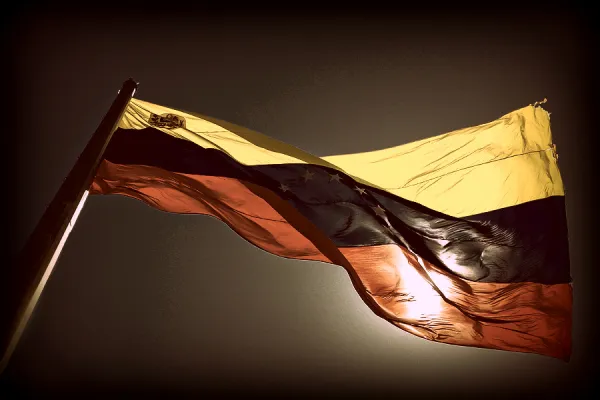
San Cristobal, Venezuela, May 2, 2019 / 04:01 pm (CNA).- Members of the Venezuelan National Guard attacked a Catholic church in San Cristobal Wednesday, amid nationwide protests against the government of president Nicolas Maduro.

Bishop Mario del Valle Moronta Rodriguez of San Cristóbal de Venezuela said May 1 that “this afternoon a horde of Bolivarian National Guardsmen attacked Our Lady of Fatima church in Barrio Sucre of San Cristóbal.”

A Mass was ending, he said, “when two (members of) the GNB entered the church on a motorcycle.”

Bishop Moronta said that “the pastor came down from the rectory in order to stop them,” but “in the attempt to dialogue, a horde of 40 GNB arrived trying to enter.”

“The pastor,  Fr. Jairo Clavijo, stopped them, and after them a general arrived by the last name of  Ochoa who started arguing with the pastor, in hardly respectful terms.”

“Not content with the outrage, the GNB threw tear gas canisters inside the church,” he complained.

The Bishop of San Cristóbal said, “they were unable to evacuate the sacred precinct where there were a good number of faithful including quite a few elderly people. A nun fainted.”

For Bishop Moronta “this incident is extremely serious and is an attack on the Catholic Church.”

“I blame the aforementioned General Ochoa as well as the military authorities in the region for this despicable incident which by itself speaks of the intentionality of the attackers who don’t have the least respect for human dignity and don’t even show any fear of God.”

The Venezuelan prelate said the Diocese of San Cristóbal “will take preventive measures and  appropriate actions in this case.”

“As a bishop and a pastor I express my complete solidarity with the pastor, Fr. Jairo Clavijo, and the entire congregation of Our Lady of Fatima, whom I accompany with my prayers and the actions we will put forward.”

The clash was one of many that took place across Venezuela April 30-May 1 after opposition leader Juan Guaidó urged protests against Maduro.

Guaidó, head of the opposition-controlled legislature, the National Assembly, declared himself interim president in January and has been recognized by a number of Western governments, but has been largely unable to secure the support of Venezuela’s military.

Both supportors and opponents of Maduro have been on the streets in Venezuelan cities since Guaidó’s call on Tuesday. The military responded to opponents in violent clashes, firing tear gas, and by arresting peaceful demonstrators.

Maduro said he had stopped an “attempted coup.”

Guaidó has called for continuing protests, and announced a series of strikes beginning May 2.

Under Maduro’s socialist administration, Venezuela has been marred by violence and social upheaval, with severe shortages and hyperinflation leading 3 million to emigrate.

[…]

Public Masses suspended for second week in Sri Lanka

May 2, 2019 CNA Daily News 0

Colombo, Sri Lanka, May 2, 2019 / 02:09 pm (CNA).- Following terrorist attacks and ongoing threats to safety, Masses will be suspended in the Archdiocese of Colombo for a second week, Catholic leaders have said.

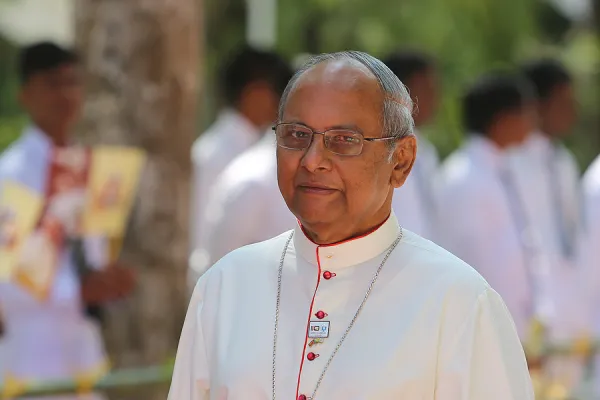
Fr. Edmund Tillakaratne, a spokesperson for the archdiocese, told journalists Thursday that Cardinal Malcolm Ranjith had decided to suspend weekend Masses for a second weekend, according to the AP.

Two weekends ago, on Easter Sunday, bombs detonated at two Catholic churches, an evangelical church, three hotels, and a private residence, killing at least 257 people and injuring at least 500 others. Of the injured, 47 are still hospitalized for their injuries, the AP reported.

Last weekend, Cardinal Ranjith celebrated a televised Mass at his residence in lieu of the cancelled public Masses. A funeral service was held April 23 for many of the victims of the attacks.

The Islamic State has claimed responsibility for the attacks, and Sri Lankan officials believe that nine suicide bombers were involved in the attacks, according to the AP. Multiple arrests have also been made as officials search for additional suspects connected to the attacks, but officials have warned that some suspects are still at large.

Even though Sri Lanka’s 26-year civil war ended in 2009, the island nation has suffered periodic bouts of violence ever since. Sri Lanka is a majority-Buddhist country; the small minority of Christians in the country (fewer that 8%) are mostly Catholics. Roughly 10% of the population are Muslims.

Cardinal Ranjith criticized the government for “absolutely unacceptable” behavior, in ignoring intelligence that may have led to the prevention of the attacks. The country’s chief of police and defense minister have both resigned following criticisms of mishandling intelligence related to the attacks.

Sri Lankan officials have taken several safety precautions in the wake of the attacks, including banning face veils, and banning the Islamist group National Thowheeth Jama’ath which was reportedly behind the attacks.

Ranjith has also warned that failure to provide sufficient security in the aftermath of the attacks may lead to more violence.

In his April 28 sermon Ranjith reflected on the mercy of God: “The finest expression of God’s love is God’s mercy. Therefore we must love and respect each other,” he said.

He also prayed for a greater respect for human life, and for the victims of the Easter attacks.

“We feel truly sorry for all the families that have lost their loved ones and their dear ones. And I ask you dear brothers and sisters, please pray for them. They were the treasure of our lives, of our faith, of our existence. We pray for them; Lord receive them into your care and your love.”

“We will help all those who are left destitute,” he added. “Let’s think of this today as we commemorate one week of (the loss of these people). I ask you please do something good today to another person, and (offer it) for the wellbeing of these people. May the Good Lord bless and keep each and everyone of them always in his love.”

[…]

Zimbabwean bishops reportedly approve beatification cause of lay missionary

May 2, 2019 CNA Daily News 0

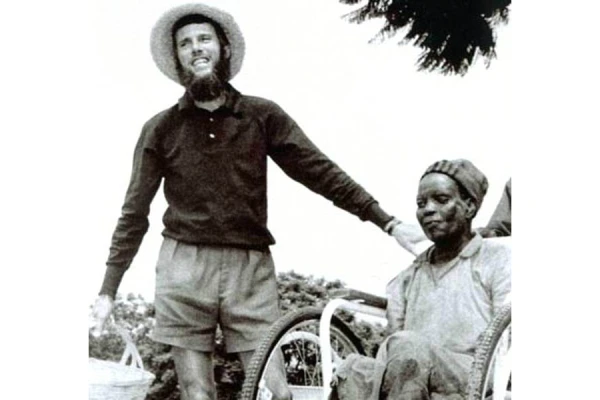
Harare, Zimbabwe, May 2, 2019 / 10:24 am (CNA).- The bishops’ conference of Zimbabwe approved Wednesday the opening of the cause for canonization of John Bradburne, a lay missionary to the area in the 1970s, according to a report.

Independent Catholic News reported May 1 that the bishops had given their approval unanimously, and that the cause will be launched Sept. 5.

Bradburne was born in 1921 in England, the son of an Anglican clergyman. He served in the British army in World War II, and he converted to Catholicism in 1947 after staying with the Benedictines of Buckfast Abbey.

He wished to become a monk at Buckfast, but had not been long enough in the Church, and he became a wanderer throughout Europe and the Middle East. He was a prolific poet. He stayed at other Benedictine abbeys, with Carthusians, the Congregation of Our Lady of Sion, tried living as a hermit on Dartmoor in England, and became a Third Order Franciscan in 1956.

Through a Jesuit friend in the British colony of Southern Rhodesia (present-day Zimbabwe), Bradburne came to serve at the Mutemwa Leper Settlement, spending the last 10 years of his life there.

Southern Rhodesia declared independence in 1965, and the Rhodesian Bush War was fought from 1964 to 1979 among the white minority government, the Marxist Zimbabwe People’s Revolutionary Army, and the Zimbabwe African National Union (ZANU).

As ZANU forces approached Mutemwa, Bradburne was urged to leave, but he insisted on remaining. He was kidnapped, and murdered Sept. 5, 1979.

He had confided in a Franciscan priest that his wishes were to serve leprosy patients, to die a martyr, and to be buried in the habit of St. Francis.

According to Independent Catholic News, two people have claimed miraculous cures through Bradburne’s intercession: a woman in South African who regained the use of her legs, and a man in Scotland cured of a brain tumor.

The Jonn Bradburne Memorial Society is supporting the an investigation into his life and viritues. It wishes to raise GBP 20,000 ($26,600) for the investigation. The group was led by Bradburne’s niece, Celia Brigstocke, until her death in August 2018. Brigstocke’s eldest daughter, Kate Macpherson, now leads the efforts.

[…]

Right to life a ‘core value’ of newly-launched Irish political party

May 2, 2019 CNA Daily News 1

Dublin, Ireland, May 2, 2019 / 03:01 am (CNA).- The leader of a new political party that spans both Ireland and Northern Ireland promised to uphold the right to life as a key value at the party’s launch on Tuesday.

The new party, Aontú, is headed by Peadar Toibin, an Irish politician who was suspended from the Sinn Fein party two times for breaking with the party line on legalized abortion, which it favored.

“It is unbelievable that Aontú is the only party that stands up for the human right to life,” Tóibín said at the launch of his party’s manifesto, according to the BBC.

Abortion was legalized in the Republic of Ireland just last year. Abortion remains illegal in Northern Ireland, which is a part of the UK, except in cases where a mother’s life is in danger.

“Aontú want to make sure that there is a real voice and a real alternative for many people who feel that they have no-one to vote for,” Tóibín added at the launch. “We are simply saying that this is a core value for ourselves, and we won’t let you down on this issue.”

“Aontú” roughly translates in English to “unification” or “agreement.”

The party will have 16 candidates on ballots this week during Northern Ireland’s local council elections, the BBC reports.

At the party launch, Tóibín said that he wanted to offer an alternative option from the mainstream parties, and that Aontú was more in touch with the people of Ireland at the grassroots level.

Toibin told reporters in November that he wanted to give a voice to the 34% of people who voted to keep abortion illegal in the Republic of Ireland, and to make sure that pro-life people were not marginalized.  

Michael Kelly, editor of the newspaper The Irish Catholic, told CNA in November that Ireland was “crying out” for a new political movement that would protect the right to life.

Toibin added at the launch of the party’s manifesto that Aontú supports a unified Ireland, and a “strong all-Ireland economy” as a solution to problems that could arise due to Brexit, the UK’s withdrawal from the European Union.

[…]

Nicaraguan bishops lament continued suffering under Ortega

May 1, 2019 CNA Daily News 0

Managua, Nicaragua, May 1, 2019 / 05:03 pm (CNA).- The Nicaraguan bishops lamented Wednesday that “the Nicaraguan family continues to suffer,” and called for no more “repressive actions and persecution.”

Anti-government protests in Nicaragua began in April 2018. They resulted in more than 300 deaths, and the country’s bishops mediated on-again, off-again peace talks until they broke down in June. A new round of dialogue began in February.

In a May 1 message, the Nicaraguan bishops said that “our faith in Jesus Christ who died and rose again for our salvation does not allow us to remain on the sidelines of world events, and for us, the cultural, political, economic, familial and social situation in the country.”

“To selfishly close yourself up in your own comfort and still worse to stoke up feelings of hatred between brothers, is not the way of the Gospel,”  they added.

The bishops’ conference said that “the sufferings of the Nicaraguan family” are seen in “the political prisoners, the lack of respect for constitutional rights, those exiled, the refugees, those living in asylum, poverty, unemployment, lack of public safety, conflicts over land and their corresponding consequences, families from the western part of the country moving into the Caribbean coastal area, invading the fertile lands that the indigenous people have historically possessed.”

This problem, they noted, makes evident “that without the presence of God … we have no future.”

The bishops called on Nicaraguans to build a country “where we can be capable of achieving a vision of change that leads to a qualitative transformation.”

“We are called to build an integral concept of peace and, in that sense, to build up a society where peace will be lasting, just and consistent with the interests of all,” they said.

“The peace that comes down from the Crucified and Risen One who remains despite the ravages of time and is not the object of short-tern arrangements,” they added.

It is also necessary to work for “a Nicaragua where the centrality of the human person and his dignity as a child of God is upheld.”

“The exercise of freedom and the dignity of the human person are prior to the state. A state that is modern and functional, ethical and moral, has the obligation to protect, respect, promote and defend these rights, which are also prior any social accord,” they pointed out.

“It is then an imperative that in a society there not be any repressive actions or persecution, making possible a climate of unhindered freedom and trust.”

The bishops’ conference then said that “democracy and its institutional dimension”  must be respected and strengthened in Nicaragua, since “the life of a human being has meaning in the framework of democratic values, principles and institutions.”

“We must not forget that respect for a democracy must be inspired by the idea of strengthening the institutions and principles that the rule of law is founded on: the supremacy of the law, the separation of powers and respect for human rights.”

The bishops also said that “a Nicaragua where the freedom of expression is exercised without restrictions” must be built.

“Every principle of the freedom of expression has its origin in the maximum expression of God who freely expressed his love for humanity through the Incarnate Word,” they stated.

Peace must be “the fruit of justice,” they added. “In this time of crisis we Nicaraguans are called to establish accords in the matter of justice that will be lasting and that are respected.”

“In such a way that  we support every initiative to dialogue made with good will and particularly the effort that the Holy See has been making through the several messages that Pope Francis has sent us, and the presence of the nuncio as a witness and international observer.”

The bishops stressed that “this is not a matter of looking for ways to evade the current situation but to face it stemming from communion with Christ. In the same way that the Resurrection is rooted in the night of the Cross so does the energy and joy of the Christian spring from communion with the sufferings of his Lord.”

“May the Queen of Heaven, who rejoiced at the resurrection of her Son, by participating in his sorrowful Passion, intercede for us and make us to to share in her joy,” they concluded.

Nicaragua’s crisis began last year after president Daniel Ortega announced social security and pension reforms. The changes were soon abandoned in the face of widespread, vocal opposition, but protests only intensified after more than 40 protestors were killed by security forces.

The pension reforms which triggered the unrest were modest, but protests quickly turned to Ortega’s authoritarian bent.

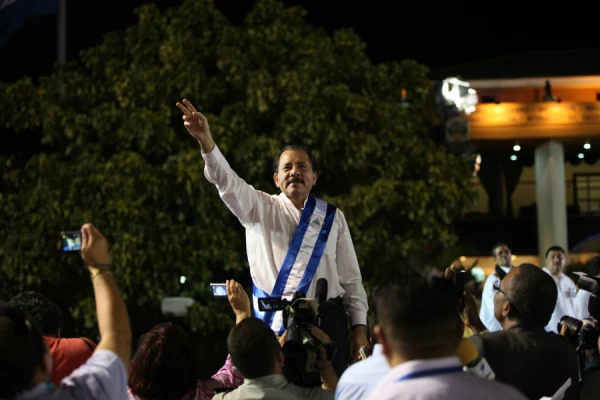
Ortega has been president of Nicaragua since 2007, and oversaw the abolition of presidential term limits in 2014.

The Church had suggested that elections, which are not scheduled until 2021, be held this year, but Ortega has ruled this out.

Ortega was a leader in the Sandinista National Liberation Front, which had ousted the Somoza dictatorship in 1979 and fought US-backed right-wing counterrevolutionaries during the 1980s. Ortega was also leader of Nicaragua from 1979 to 1990.

[…]