Bid to end death penalty in Louisiana fails

May 8, 2019 CNA Daily News 0

Baton Rouge, La., May 8, 2019 / 11:00 am (CNA).- A proposal to allow voters to decide if capital punishment should remain legal in Louisiana has been defeated in the state senate.

Senate Bill 112 would have added a question to the next state-wide ballot proposing a constitutional amendment to abolish the death penalty. It was defeated Monday by a vote of 25-13 against, having needed a two-thirds majority to pass.

The measure narrowly passed out of legislative committee on April 30. Speaking during the senate debate, the bill’s sponsor Sen. Dan Claitor, (R-Baton Rouge) said that respect for all human life was paramount.

“It’s a morally wrong thing to do, and at the end of the day, it cheapens life,” Claitor said.

The senator, a former prosecutor, argued that execution did not work as an effective deterrent, was often flawed in its application, and had resulted in miscarriages of justice.

Claitor was supported by a minority of senators across party lines.

Sen. JP Morrell (D-New Orleans) spoke during the committee debate about the high percentage of exonerations of death row inmates which suggested the potential for mistaken executions.

“It’s indisputable that we had people on death row who were [then] found innocent,” Morrell said in support of Claitor’s bill.

State representative Terry Landry (D-New Iberia) has proposed a similar measure in the House. A former superintendent of the Louisiana State Police and a former supported of capital punishment, he said that his beliefs had evolved and that he “now believe[s] the death penalty is wrong.”

The measure was supported by the Catholic bishops of the state. Speaking on behalf of the Louisiana Conference of Catholic Bishops, executive director Rob Tasman said that “justice can never be wrought by killing a human being.”

Pope Francis has called the death penalty a rejection of the Gospel and of human dignity, calling on civil authorities to end its use. Last year, he ordered a revision of paragraph 2267 of the Catechism of the Catholic Church to describe the death penalty “inadmissible” and urging its elimination.

Opponents of the measure said that Claitor’s argument about deterrence was irrelevant.

“Nowhere does [the law] say we shall ‘deter,’ said Sen. Bodi White (R-Baton Rouge). “It says ‘shall be punished’ and that’s what this does.”

District Attorney Scott Perrilloux of the 21st district told News Star that deterrence was not a relevant factor in cases where he sought the death penalty.  

“What we consider is the victims and what victims consider as justice” he said.

The last execution to take place in Louisiana was in 2010.

Although there are currently 72 inmates on death row in the state, Gov. John Bel Edwards has imposed a moratorium on any further executions until July of this year because of the unavailability of the drugs used in lethal injections.

[…]

Why these men walked 24 miles to the ‘Rome of the Midwest’

May 8, 2019 CNA Daily News 0

St. Louis, Mo., May 8, 2019 / 03:37 am (CNA).- It can be hard to find time for silent reflection in today’s bustling modern society. But a group of men this past weekend found peace and silence in an unlikely place – on the sidewalks and shoulders of busy roads leading into the heart of a Midwestern metropolis.

The annual Joseph Challenge Pilgrimage, held this year May 4-5 in St. Louis, Missouri, brought together men ranging from their 20s to their 60s who were looking for both a physical challenge and spiritual rejuvenation.

Along the way, the pilgrims would encounter four Catholic churches dedicated to St. Joseph – appropriate, considering the Church celebrated the feast of St. Joseph the Worker the previous Wednesday.

The challenge

The idea was to start at a parish in Manchester, a western St. Louis suburb, and trek 24 miles along sidewalks, paths, through parks, and occasionally on road shoulders all the way to downtown St. Louis.

The men – around 20 total – gathered at St. Joseph Church and began their walk around 10 a.m. Saturday. They stopped for lunch in a park, and again for Mass at the Carmel of St. Joseph, a monastery of discalced Carmelite nuns, around 3:30 p.m.

In addition to carrying a yellow and white Vatican flag, the men took turns carrying a large wooden cross along with them.

“The experience of having carried a cross, basically a nailed together 2×4 cross that I’m sure doesn’t weigh as much as Christ’s cross, but carrying that a mile and a half was a very challenging and yet rewarding experience,” said Patrick Swackhammer, 45.

After Mass at the monastery, the group continued for several more miles before reaching the place of the night’s rest – St. Joseph’s in Clayton, Missouri. Total distance walked the first day: approximately 14 miles.

The men had dinner, adoration of the Blessed Sacrament and a holy hour including a Latin rosary, followed by fellowship and a few beers before settling into their sleeping bags on the tile floor of the church basement for the night.

Origins

“This was kind of my crazy idea several years ago,” said Gabe Jones, 30, one of the two main organizers of the pilgrimage.

Jones said he had been on pilgrimages and men’s retreats in the past that usually involved an invitation for men to drive to and meet at a sacred destination, rather than walking to it. To him, driving straight to a pilgrimage site defeated the purpose; it removed the physical hardship involved in actually getting to the site.

“A pilgrimage is: you walk, and you walk, and you walk, and you walk, and you get to this beautiful church, and you fall on your knees when you get there. That’s a pilgrimage,” he said.

The United States does not have the same kind of culture of pilgrimage that Europe has, he said, partly because the U.S. as a country is much younger than the European continent, and thus is built primarily around the automobile.

Jones said the idea for the St. Joseph pilgrimage started as “just a bunch of guys getting together.”

The first year, 2015, a handful of guys expressed interest in the challenge, but nearly all of them canceled before it began or dropped out along the way for various reasons – a tweaked back, other plans for the weekend, a torn ACL – until, by the end, the only two pilgrims left were Jones and the priest that had come with him.

Jones said he was disappointed in the turnout the first year, but came to understand that the idea of walking 24 miles over a weekend and being away from your family is perhaps a bigger ask than he thought.

“What I learned from that first year is that material success and immediately seeing the fruits of our labor are not the most important thing,” Jones said.

“Just do the thing that you’re called to do, and if it’s the right thing then there will be good fruit. And it may not be right away, heck, it may not be in your lifetime. But just stick to it, and if God’s calling you to that, do it.”

The next year, 2016, they had more like 40 guys sign up, with around 38 walking at any one time, Jones said. The pilgrims were coming from a whole range of places, physically and spiritually.

But the feeling of being the same boat and taking on the same physical challenge fostered a sense of brotherhood among the men.

“As a convert to the Catholic faith, the concept of a pilgrimage is something new, it’s something I had to embrace along with embracing all the other unique aspects of the Catholic faith,” second-year participant Russell Yount reflected.

“But it’s an idea that resonates with me, of having a goal and pursuing it.”

The importance of silence

Walking twenty-plus miles through an urban jungle may not sound like the most peaceful way to spend a weekend. But the organizers made sure that despite the constant hum of traffic next to the marching group of men, there were times when quiet contemplation was encouraged.

During some stretches of the route, the men were encouraged to socialize and get to know one another. During other sections, the organizers led rosaries via megaphone.

At other points, the men were encouraged simply to walk in silence, their quiet reverie interrupted only occasionally by drivers in passing cars pipping their horns in support.

“It’s a good visible witness as we walk through the city,” co-organizer Chris Horan said.

“To people who aren’t Catholic, people who are Catholic, to just plant seeds and show them that Catholicism is not dead, it’s growing and growing, and maybe is more alive than ever.”

The homilist at Mass on Saturday pointed to St. Joseph as a model of silent masculinity.

“Given that [St. Joseph] said absolutely nothing in scripture…when he would have spoken, he was obedient, he was prayerful, and he’s just the perfect model of silence, I think,” Horan said.

“And especially for men who are flooded with junk in the culture, it can be hard for us to keep St. Joseph in mind. But if we do that then it’s only going to bring us grace…that’s the main model for us as husbands, fathers, brothers, and even those called to the priesthood.”

Fr. Gustavo Serpa, a member of the Miles Christi religious order based in Detroit, was the official chaplain for the pilgrimage, giving several talks over the course of the weekend.

Horan said he appreciated Father Gustavo’s presence on the pilgrimage.

“I think his youth, his love of the Church, his love of St. Joseph have helped get us through and been a good example and model for us,” Horan commented.

Many of the participants pointed to the silence aspect as one of the most helpful parts of the pilgrimage, and one that helped them to bond with their fellow men.

“You can hear the cars going by, the footsteps on the pavement, and sometimes even voices. But it gives you an opportunity when you’re not required to be speaking or doing things – it lets your mind and your soul kind of settle down and be quiet with Christ for a little while,” Bill Hennessy, 55, reflected.

Cory Ross, a 30-year-old stay at home dad, was similarly inspired by the call to silence in his everyday life.

“Silence is one of those things that we can hold as an important practice in our daily lives,” he said. “And Father kind of talked about how it helps us grow in virtue and reflect upon our lives and purpose and things of that nature. It has been really profitable.”

For Yount, a weightlifter, the pilgrimage was an opportunity to take on a physical challenge while also developing the virtues he has come to value as a convert to the Catholic faith. He said he got to tell his conversion story at his home parish soon after last year’s Joseph Challenge.

“I think of things in terms of the cardinal virtues of prudence, justice, fortitude, and temperance, and then the theological virtues of faith, hope and charity,” Yount explained.

So, he says, he always approaches anything he does with the question: “How does each thing that I’m doing here help to build one of those virtues?” In terms of the St. Joseph Challenge, he said, he’ll be pondering what virtues are in play; certainly fortitude and prudence.

Rome of the Midwest

Apart from being a physical challenge and an opportunity for silent retreat, the pilgrimage offered a unique opportunity for the men to experience the Catholic culture of the city.

“It’s a city that I had always just kind of driven through before, but I have a totally different understanding of St. Louis now, having walked through it,” Yount said.

Much of the city’s robust Catholic culture originates in the mid-19th century, when a massive influx of foreign immigrants – many from Germany, Ireland, and Italy- arrived in the area, complementing the dominant French heritage in the city at that time.

Today, there are around 180 parishes in the Archdiocese of St. Louis, and so many beautiful Catholic churches that the city has been unofficially dubbed the “Rome of the Midwest.”

“Having walked all the way from Manchester to downtown, and realizing just how Catholic the city is. How strong the Catholic heritage of St. Louis is – I had no idea,” Yount said. “But now I know, and I tell people all the time: if you’re ever in St. Louis, there are these places that you don’t want to miss that are of importance to us as Catholics.”

Push to the finish

Bright and early Sunday morning, the men packed their belongings, and set off on the final day of the pilgrimage. Today would involve about 10 more miles before they reached their destination: The Shrine of St. Joseph, downtown.

Eventually, to the pilgrims’ delight, the shining curves of the St. Louis Arch, located on the riverfront in the heart of downtown, came into view. Soon the shrine itself was in view, and the group was all smiles as they finally approached the impressive edifice – just in time for the regularly scheduled 11 a.m. Sunday Mass.

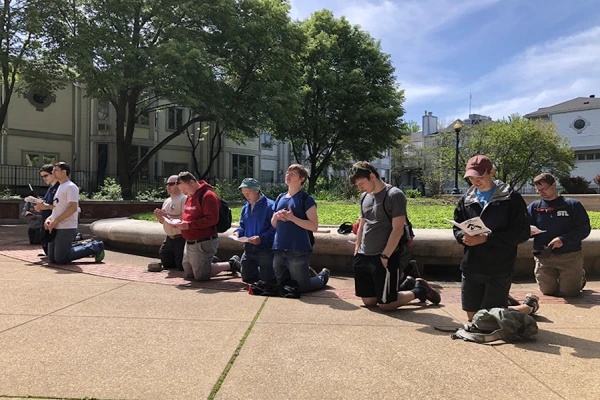
Many of the men’s wives and families were there to meet them at the end of their pilgrimage. They knelt in front of the shrine and prayed a litany to St. Joseph as they concluded their journey.

“If you want something more physical – physical suffering, physical sacrifice, as opposed to just spiritual sacrifice – come out and join us next year. You’re only going to get grace from it, meeting like-minded Catholic men, and you’re going to grow, God willing, in greater devotion to St. Joseph,” Horan said.

“You’ll experience beautiful liturgies, and you’ll take what you experience from this back home to your wives, your kids.”

The spiritual experience isn’t all the men will bring back with them.

“Of course, I’ll be taking the blisters and the aches and pains back, too,” Swackhammer added.

All in all, it was a fitting introduction to the concept of pilgrimage, something many of the men had not encountered before.

“You may have to start small, but I think we make everything too stress-free and too easy, which also leads to distraction, and comfort, and not a lot of difference from our day to day lives,” Hennessy reflected.

“And being on foot, with being disconnected from our creature comforts for a few hours, a few days, it makes it much much easier to focus on what you’re supposed to be focused on, which is basically getting to heaven.”

All photos credit: Jonah McKeown / CNA.

[…]

Asia Bibi leaves Pakistan, arrives in Canada

May 8, 2019 CNA Daily News 0

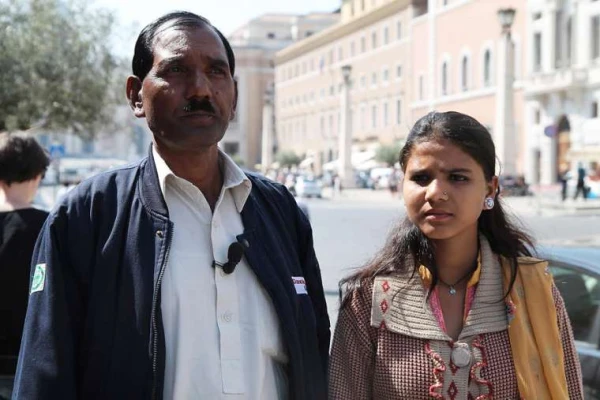
——-, Canada, May 8, 2019 / 03:11 am (CNA).- Asia Bibi, the Catholic wife and mother who spent 9 years on death row on blasphemy charges in Pakistan, has left the country and arrived safely in Canada.

According to Spanish news agency COPE, Bibi, a Pakistani, has arrived in Canada, which has offered asylum to her and her daughters. Her health is reportedly in a delicate condition.

Pakistani government officials confirmed that Bibi left the country, but did not state her destination.

Bibi, 53, had been in protective custody in Islamabad since her death sentence was overturned at the end of October. The verdict and her subsequent release from prison sparked protests from Islamic hardliners who support strong blasphemy laws in the country.

Bibi’s imprisonment began in 2010 when she was convicted of blasphemy and sentenced to death by hanging. The charges stemmed from 2009 accusations that she had made disparaging remarks about the Islamic prophet Muhammad after an argument over a cup of water.

Bibi immediately appealed the conviction, which the Lahore High Court upheld conviction in 2014. She then appealed to the country’s Supreme Court. The Supreme Court agreed to hear her appeal in 2015.

The Supreme Court aquitted Bibi on Oct. 31, 2018.

Since her arrest, Bibi has garnered international support from numerous world leaders calling for her immediate release, including Benedict XVI and Pope Francis. In 2015, Pope Francis met with her daughter and offered prayers.

In Pakistan, Islamic hardliners have been calling for her execution since her initial conviction. Pakistan’s Prime Minister Imran Khan said that he supports the country’s harsh blasphemy laws.

Pakistan’s blasphemy laws impose strict punishment on those who desecrate the Quran or who defame or insult Muhammad. Pakistan’s state religion is Islam, and around 97% of the population is Muslim.

Although the government has never executed a person under the blasphemy law, accusations alone have inspired mob and vigilante violence.

Blasphemy laws are reportedly used to settle scores or to persecute religious minorities; while non-Muslims constitute only three percent of the Pakistani population, 14% of blasphemy cases have been levied against them.

Many of those accused of blasphemy are murdered, and advocates of changing the law are also targeted by violence.

[…]

Full text of Pope Francis’ in-flight press conference from North Macedonia

May 7, 2019 CNA Daily News 2

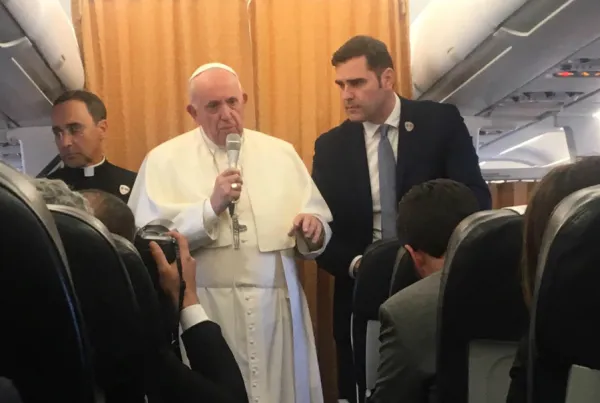
Aboard the papal plane, May 7, 2019 / 04:30 pm (CNA).- Please read below for CNA’s full transcript of the pope’s May 7 in-flight press conference from Skopje, North Macedonia to Rome:


Alessandro Gisotti:
Good evening Holy Father, thank you after such intense days for being here to share a thought about this journey that was so intense and so beautiful. A short trip, inevitably a short press conference, I will not add words other than these: Holy Father you have already walked in the footsteps of Mother Teresa, a great witness of Christian love, and we have all been struck today, as you know it, by the death of Jean Vanier, another friend, brother of the least of these, another great witness. Here, before the questions I wanted to ask if you wanted to share a thought about Jean Vanier.  

Pope Francis:
Yes, I knew of the illness of Jean Vanier. His sister, Geneviève Jeanningros, informed me on a regular basis. One week ago, I called him on the phone, he listened to me, but could hardly speak. I would like to express my gratitude for this testimony. He was a man who knew how to read the Christian existence from the mystery of death on the cross of illness, from the mystery of those who are despised and rejected in the world. He worked, not only for the least of these, but also for those who before birth face the possibility of being sentenced to death. He spent his life like this. I am simply thankful to him and thankful to God for giving us this man with a great witness.

Gisotti:
Thank you, Holy Father, the first question will be from Biljana Zherevska of TV Macedonia.

Biljana Zherevska, MRT: [In English] Your Holiness, it is a great pleasure to have you in our country. We feel honored by your visit. What is interesting for us is to hear from you what is your greatest impression from the two countries, what touched you the most? The persons, objects, atmosphere. What will you remember of these two countries when you go [back] to the Holy See?

Pope Francis: They are two totally diverse nations. Bulgaria is a nation of a tradition from centuries ago. Macedonia, on the other hand, has a tradition from centuries, but not as a country: as a people, that ultimately rose to form as a nation… It is a beautiful fight! For us Christians Macedonia is a symbol of the entrance of Christianity in the East. Christianity entered in the East through you all.. those Macedonians that appeared to Paul in a dream: “come to us, come to us.” He was leaving for Asia, it is a mystery that call… And the Macedonian people are proud of this, they do not lose the opportunity to say that Christianity entered Europe through us, through our door, because Paul was called by a Macedonian.

Bulgaria has had to fight so much for its identity as a nation. The mere fact that in the 1800s, I believe 1823, more or less, 200,000 Russian soldiers died to regain independence from the hands of the Turks … we think of what 200,000 means. So much struggle for independence, so much blood, so much mystique to find consolidation of identity.

Macedonia had the identity and now it has come to consolidate it as a people, with small, big problems, like its name, and this we all know. Both have Christian, Orthodox, Catholic and Muslim communities. The percentage of Orthodox is very strong in both with a small amount of Muslims and even fewer Catholics, in Macedonia more so than Bulgaria. A thing I saw in both nations is the good relationship between the different faiths. In Bulgaria we saw it in the prayer for peace. This is a normal and beautiful thing for Bulgarians, because they have a good relationship, each person has the right to express his own religion and has the right to be respected. This touched me. Then the dialogue with Patriarch Neophyte was a beauty… he is a man of God, a great man of God. In Macedonia I was struck by a phrase the president told me: “Here there is not religious tolerance, there is respect.” They have respect. In a world like this respect is missed very much. Respect for human rights, we miss respect for so many things, respect for children, for the elderly, that the mystique of a country would be respect is striking. I do not know if I answered more or less briefly.  

Gisotti:
Holy Father, the next question will be asked by Peter Nanev from Bulgarian television.

Peter Nanev, BTV: Good evening. Peter Nanev, BTV Bulgaria. [In English] It is more of a personal question, as Your Holiness, you’re like a human being, from where do you find strength in your body, in your spirit in cases when you have to give even more strength for a heavily sick child?

Pope Francis: First of all I would like to tell you that I do not go to the witch… [laughs]. I do not know. I do not know, really. It is a gift from the Lord. When I am in a country, I forget everything, but not because I want to forget it, I forget it, and I am only there. And then this gives me perseverance, I don’t know, but [when] I am on the trip I am not tired! Then I am tired! After! But where do I take the strength from? I believe that the Lord gives it to me, there is no explanation. I ask the Lord to be faithful, to serve him in this work of travels, that the trip will not be tourism. I ask. All is his grace. Nothing else comes to me to say. But then I do not do so much work, huh? Thank you.  

Gisotti:
He will now address a question. We remain in Eastern Europe, Silvije Tomasevic of Croatian press and television, Vecernij List.

Silvije Tomasevic, Vecernij List: The national Orthodox Churches are not always in agreement among them, for example, they have not recognized the Macedonian Church. But when they have to criticise the Catholic Church they are always in unison, for example the Serbian Church does not want Cardinal Stepinac to be canonized. Your comment on this situation?

Pope Francis: In general, the relationships are good, they are good and there is good will. I can tell you sincerely that I have met men of God among the patriarchs. Neophyte is a man of God, and then him that I carry in my heart, a favorite, Ilia II of Georgia is a man of God, that has been good to me, Bartholomew is a man of God, Kirill is a man of God. They are great patriarchs that give witness. You can tell me. But everyone, we have defects. Everyone. But in the patriarchs I have found brothers and some… I do not want to exaggerate, but I would like to say the word ‘saints’ and this is important.

Then there are historic things between our Churches, some old things, for example today the president was saying to me that the Eastern schism began here in Macedonia.

Now the pope comes for the first time, to mend the schism I do not know, but to say we are brothers, because we cannot adore the Holy Trinity without hands united as brothers. This is not only my conviction, also the patriarchs’, everyone.

Then there is a historic world… you are Croatian? It was seeming to me I sensed the aroma of Croatia. The canonization of Stepinac is a historic case. He is a virtuous man for this Church, which has proclaimed him Blessed, you can pray [through his intercession]. But at a certain moment of the canonization process there are unclear points, historic points, and I should sign the canonization, it is my responsibility, I prayed, I reflected, I asked advice, and I saw that I should ask Irenej, a great patriarch, for help. We made a historic commission together and we worked together, and both Irenej and I are interested in the truth. Who is helped by a declaration of sanctity if the truth is not clear? We know that [Stepinac] was a good man, but to make this step I looked for the help of Irenej and they are studying. First of all the commission was set up and gave its opinion. They are studying other sources, deepening some points so that the truth is clear. I am not afraid of the truth, I am not afraid. I am afraid of the judgment of God.

Gisotti: There is time for another question. Joshua McElwee.

Josh McElwee, National Catholic Reporter: Thank you so much, Holy Father. In Bulgaria you visited an Orthodox community that has continued a long tradition of ordaining women deacons. In a few days you will meet with the International Union of Superiors General*, that three years ago requested a commision for women deacons. Can you tell us something you have learned from the report of the commission on the ministry of women in the early years of the Church? Have you made some decision?

Pope Francis: I did not hear the first part of your question.

McElwee: [repeats a part of the question.]

Pope Francis: The commission was made, it worked for almost two years. They were all different, all toads from different wells, all thinking differently, but they worked together and were in agreement until a certain point. But each of them then has her own view that does not agree with that of the others. And there they stopped as a commission and each is studying [how] to go forward.

For the female diaconate, there is a way to imagine it with a different view from the male diaconate. For example, the formulas of female deacon ordination found until now, according to the commission, are not the same for the ordination of a male deacon and are more similar to what today would be the abbatial blessing of an abbess. This is the answer of some of them. I’m speaking a little from the ear, from memory.

Others say that it is a female deacon formula, but they argue that it is not clear. There were female deacons, but was it a sacramental ordination or not? And that is discussed, it is not clear. That they helped in liturgy, in Baptisms by immersion, when the woman was baptized the deaconesses helped, also for [unclear] the woman’s body. Then a document came out where diaconesses were called by the bishop when there was a matrimonial argument for the dissolution of the marriage or divorce or separation. When the woman accused her husband of beating her and the bishop called the deaconesses to look at the woman’s body for the bruises and so they testified in the judgment. These are the things I remember.

But fundamentally, there is no certainty that it was an ordination with the same form, in the same purpose as male ordination. Some say there is doubt, let’s go ahead and study. I am not afraid of studying, but up to this moment it does not proceed.

Then it is curious that where there were deaconesses it was almost always a geographic zone, especially in Syria. And then in another part, it does not touch or nothing. All these things I received from the commission. Each one continues to study, and [they have] done a good job, because up to a certain point [they were] in agreement. And this can be an impetus to go ahead and study and give a definitive answer, yes or no, according to the characteristics of that time.

An interesting thing. Some theologians of a few years ago, 30 years ago for example, said that there were no deaconesses because women were in the background in the Church, not only in the Church. Always women… But it is a curious thing: in that period there were so many pagan priestesses, the female priesthood in pagan cults was ordinary in that day. As it is understood as a female priesthood, a pagan priesthood in women, it was not done in Christianity. This is being studied also. They have arrived at a point, now each of the members is studying according to her theory. This is good. Varietas delectat.

Gisotti: Holy Father, thank you for your availability. The press conference finishes here, at this point, because in a little while they will serve the dinner. And so, thank you to you all. Especially during this trip when we woke up at night to move [from place to place].

Pope Francis: I would like to say one thing about the trip: Something I found much consolation in and which has touched me profoundly during the trip. Two extreme experiences. The experience with the poor today here in Macedonia at the Mother Teresa Memorial. There were so many poor people, but to see the meekness of those sisters: they were caring for the poor without paternalism, but as children. But a meekness, the ability to caress the poor, the tenderness of these sisters. Today, we are used to insulting each other. One politician insults the other, one neighbor insults the other, even in families they insult each other. I cannot say that it is a culture of insult, but the insult is a weapon in the hand, even to speak ill of others, slander, defamation, and to see these sisters that care for every person as Jesus. It hit me, a good young man approached and the superior told me, ‘this is a good boy’ and caressed him and she said it with the tenderness of a mom and made me feel the Church a mother. It is one of the most beautiful things to feel the maternity of the Church. Today I felt it there.

I thank Macedonia for having this [inaudible]. Another extreme experience was the First Communion in Bulgaria. I was moved because my memory went back to October 8, 1944, to my First Communion, when they sang [the hymn] ‘O santo altare custodito dagli angeli’ (who here remembers it?), I saw those children that open themselves to life with a sacramental decision. The Church guards the children, they are limited, they have to grow, I am promised, and I lived it very strongly, I felt in that moment those 249 children were the future of the Church, they were the future of Bulgaria. These are two things that I lived with much intensity I wanted to communicate. Thank you very much, pray for me. I do not want to leave without speaking about these days, the centenary of trips. They are roses from Bulgaria, a small thought to mark the 100th trip.

They tell us that now there will be whiskey.

[…]

Pa. legislator acknowledges aggression toward woman praying at Planned Parenthood

May 7, 2019 CNA Daily News 0

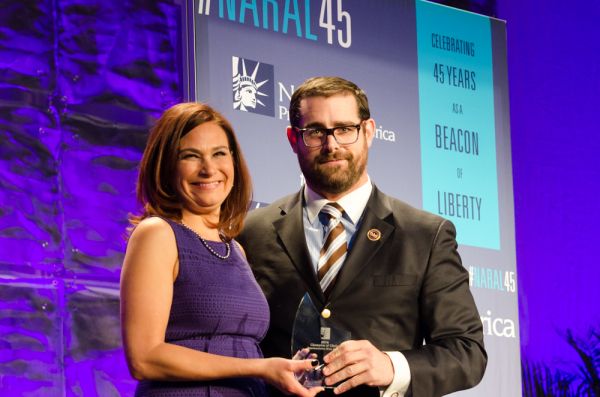
Harrisburg, Pa., May 7, 2019 / 03:06 pm (CNA).- Brian Sims, a Pennsylvania state legislator who confronted a woman praying outside Planned Parenthood last week, said in a video posted to social media Tuesday that he was aggressive, and he reiterated his intention of “pushing back” against those who pray or protest outside abortion clinics.

Sims had livestreamed a video May 2 in which he can be seen approaching a woman outside of Planned Parenthood of Southeastern Pennsylvania in Philadelphia. The woman, by herself, can be seen praying the rosary across the street from the Planned Parenthood.

He aggressively questioned her for several minutes, and addressing livestream viewers he solicited the woman’s name and address, saying, “we’ll protest outside of her home. Let’s go protest out in front of her house and tell her what’s right for her body.”

The lawmaker posted a video May 7 discussing the prior week’s video.


I will fiercely protect a woman’s right to make the best choices for her health & her body, unimpeded. I also know that two wrongs don’t make a right, especially on the front lines of a civil rights battle. I can do better, and I will do better, for the women of Pennsylvania. pic.twitter.com/jURL1UX9qE

— Brian Sims (@BrianSimsPA) May 7, 2019


“I’ve lived across the street or next door to this particular Planned Parenthood … for the last 15 years,” he said. “I’ve seen men and women and teens try to go there for routine healthcare … and, yes, for abortions.”

“I’ve also spent the last seven years serving as a volunteer patient escort at this Planned Parenthood, and I have seen first hand the insults, the slurs, the attacks, and the racism that those protesters aim at mostly young girls … and last week was no different.”

“What I should have shown you in that video was protestors gathered together to pray at, not to silently pray for, people coming in and out of Planned Parenthood as they intercepted them and harassed them,” he stated.

“In my years with Planned Parenthood I’ve seen women and girls circle that block, two, three, four times before finally driving away because they know they weren’t going to get in because of those protesters.”

Sims said that “as a Planned Parenthood volunteer and as a supporter, I fully understand, respect, and appreciate the non-engagement policy that they have, and I would never want to do anything that interfered with the care that they’re providing to their patients. As an activist and an advocate I know why pushing back against harassment and discrimination are a must, even when they’re uncomfortable.”

“But last week, I wasn’t a patient escort, I was a neighbor and a concerned citizen, and I was aggressive. I know that two wrongs don’t make a right, and I can do better, and I will do better, for the women of Pennsylvania.”

Sims did not apologize to the woman he confronted in the video.

In a tweet accompanying the video, Sims wrote, “I will fiercely protect a woman’s right to make the best choices for her health & her body, unimpeded. I also know that two wrongs don’t make a right, especially on the front lines of a civil rights battle. I can do better, and I will do better, for the women of Pennsylvania.”

Sims has represented District 182, a heavily-Democratic area of Philadelphia, in the Pennsylvania House of Representatives since 2013. Sims is an LGBT activist and was the first person to identify as gay elected to the Pennsylvania House of Representatives.

He has been seen in other videos approaching people outside the same Planned Parenthood location as in his May 2 post. Many of those he approached, whom he characterized as “white people” and “psuedo-Christian protestors who have been out here shaming young girls for being here”, appear to be teenagers.

Sims have been the subject of an investigation by Pennsylvania’s State Ethics Commission, after questions were raised in 2017 regarding speaking fees he received while in office. He is accused of accepting honoraria, including fees and free travel and accommodation, in violation of policies governing state legislators.

A consortium of pro-life groups will hold a rally at the same Planned Parenthood location May 10. They have invited Sims to attend.

[…]