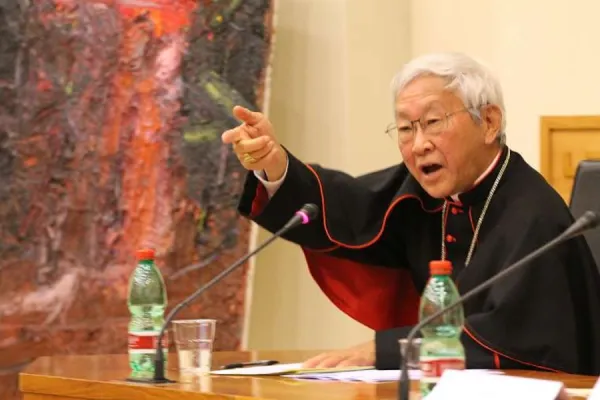
CNA Staff, Jun 30, 2020 / 01:00 pm (CNA).- Cardinal Joseph Zen, the bishop emeritus of Hong Kong, has warned that new security laws in the province could lead to a clamp down on religious freedom.
In a series of videos posted Tuesday on the Facebook page “Catholics Concerned about the Hong Kong National Security Law Group,” Zen said that he had ‘no confidence” in religious freedom protections in the new security law.
On May 28, the Chinese legislature approved a resolution imposing “security laws” on Hong Kong. These laws aim to criminalize anything Beijing considers “foreign interference,” secessionist activities, or subversion of state power, and will permit Chinese security forces to operate in the city.
Although the full provisions of the law were only released on June 30, last week Cardinal John Tong Hon, Zen’s successor as bishop and currently the administrator of the diocese, publicly voiced support for the measures, and said that it was not a threat to religious freedom.
“I personally believe that the National Security Law will have no effect on religious freedom, because Article 32 of the Basic Law guarantees that we have freedom of religion, and we can also openly preach and hold religious ceremonies, and participate in religious activities,” Cardinal Tong Hon told the diocesan newspaper last week.
Zen said that he thought it was “wrong” that people were encouraged by the government to speak out in support of the law before the full details were unveiled, but acknowledged that his successor was in a “tricky” situation.
“On the one hand, it will be a lot of trouble if we don’t support the government. We never know what they will do to our Church,” said Zen. “On the other hand, [Tong] disappointed many within the Church by giving his support.”
The full terms of the law were released on the evening of June 30 shortly ahead of July 1, the anniversary of the handover of the area from Great Britain to China, traditionally a day of pro-democracy protest in the city.
Under the new law, a person who is convicted of secession, subversion, terrorism or collusion with foreign forces will receive a minimum of 10 years in prison, with the possibility of a life sentence. The law’s broad definition of terrorism includes arson and vandalizing public transportation “with an intent to intimidate the Hong Kong government or Chinese government for political purposes.”
“This is not only against the ‘one country, two systems’ policy, but also the basic law [of Hong Kong],” Zen said of the new measures.
The provision of the law regarding collusion with foreign governments has raised alarm bells among Hong Kong’s Catholic population.
Cardinal Tong Hon said last week that he believed that the diocese’s independence from the mainland government and state-sponsored Church, the Chinese Patriotic Catholic Association, would not be considered to be colluding with a foreign government. The diocese, he said, “has always had a direct relationship with the Vatican; the relationship between the Hong Kong diocese and the Vatican should be regarded as an internal matter.”
“After the national security legislation, it should not be regarded as ‘collusion with foreign forces’,” he said to the diocesan newspaper.
Zen said that while Tong may be confident the new law would not be used to bring the local Church under mainland control, he had “no confidence” that this would be the case.
“Our religious freedom means that the affairs of the Church are handled by ourselves without the need to involve the government,” said Zen in the video posted on Tuesday.
The cardinal noted the long record of state interference in religion on the mainland, including recent efforts by the government to re-translate scriptures to be more in line with Chinese customs and reflective of Communist principles.
“Even His Eminence Cardinal Tong will agree there is no true religious freedom [on the mainland], yet the government denies this fact,” Zen said. “It’s meaningless to argue in the literal sense of the terms [of the law], it is a fact to be perceived,” Zen added.
Zen said that Tong had yet to face questions he “might find difficult to answer,” including if “the Chinese Patriotic Association can comply with the traditions of our Catholic faith,” and what Cardinal Tong’s response will be if the government sets up a Catholic Patriotic Association group in the city.
Zen also noted the lack of support, or even reaction from the Holy See on the recent developments both in Hong Kong and on the mainland.
“I have no idea on why the Vatican remained silent–perhaps she hopes to establish diplomatic relations with (Mainland) China,” said Zen who also criticized the Vatican’s provisional deal with China on the regularization and appointment of bishops on the mainland, which is set to expire in September.
While the terms of the agreement remain unpublished, Zen said “we can see no benefit” to the deal for Chinese Catholics, adding there is “no true religious freedom” on the mainland.
“It is not a worthy deal,” he said.
 […]
[…]