Easter Vigil 2022: Full text of Pope Francis’ homily
April 16, 2022 Catholic News Agency 0
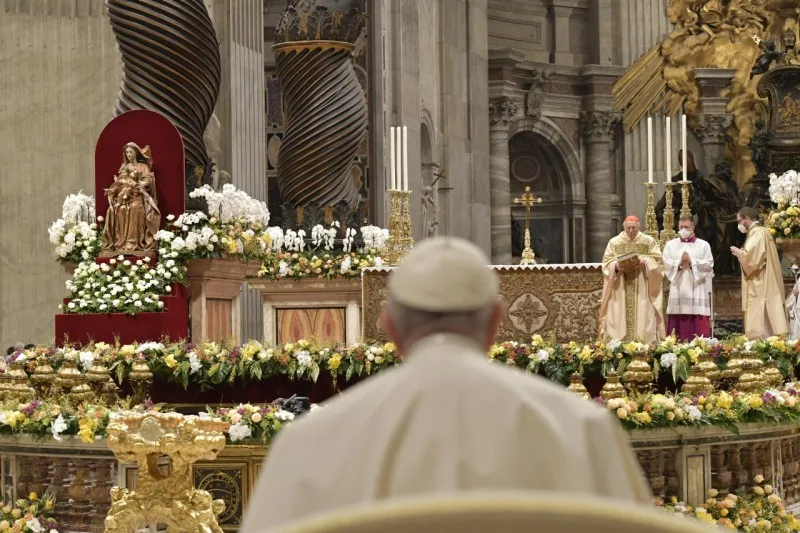
Pope Francis at the Easter Vigil Mass in St. Peter’s Basilica on April 16, 2022. / Vatican Media

Vatican City, Apr 16, 2022 / 15:00 pm (CNA).

Here is the full text of Pope Francis’ homily for Easter Vigil 2022, which was celebrated in St. Peter’s Basilica on April 16, 2022.

Many writers have evoked the beauty of starlit nights. The nights of war, however, are riven by streams of light that portend death. On this night, brothers and sisters, let us allow the women of the Gospel to lead us by the hand, so that, with them, we may glimpse the first rays of the dawn of God’s life rising in the darkness of our world. As the shadows of night were dispelled before the quiet coming of the light, the women set out for the tomb, to anoint the body of Jesus. There they had a disconcerting experience. First, they discovered that the tomb was empty; then they saw two figures in dazzling garments who told them that Jesus was risen. Immediately they ran back to proclaim the news to the other disciples (cf. Lk 24:1-10). They saw, they heard, they proclaimed. With these three verbs, may we too enter into the passover of the Lord from death to life.

The women saw. The first proclamation of the resurrection was not a statement to be unpacked, but a sign to be contemplated. In a burial ground, near a grave, in a place where everything should be orderly and peaceful, the women “found the stone rolled away from the tomb; but when they went in, they did not find the body” (vv. 2-3). Easter begins by upsetting our expectations. It comes with the gift of a hope that surprises and amazes us. Yet it is not easy to welcome that gift. At times – we must admit – this hope does not find a place in our hearts. Like the women in the Gospel, we are overtaken by questions and doubts, and our first reaction before the unexpected sign is one of fear: “They were terrified and bowed their faces to the ground” (v. 5).

All too often we look at life and reality with downcast eyes; we fix our gaze only on this passing day, disenchanted by the future, concerned only with ourselves and our needs, settled into the prison of our apathy, even as we keep complaining that things will never change. In this way, we halt before the tomb of resignation and fatalism, and we bury the joy of living. Yet tonight the Lord wants to give us different eyes, alive with hope that fear, pain and death will not have the last word over us. Thanks to Jesus’ paschal mystery, we can make the leap from nothingness to life. “Death will no longer be able to rob our life” (K. RAHNER), for that life is now completely and eternally embraced by the boundless love of God. True, death can fill us with dread; it can paralyze us. But the Lord is risen! Let us lift up our gaze, remove the veil of sadness and sorrow from our eyes, and open our hearts to the hope that God brings!

In the second place, the women heard. After they had seen the empty tomb, the two men in dazzling garments said to them, “Why do you look for the living among the dead? He is not here, but has risen” (vv. 5-6). We do well to listen to those words and to repeat them: He is not here! Whenever we think we have understood everything there is to know about God, and can pigeonhole him in our own ideas and categories, let us repeat to ourselves: He is not here! Whenever we seek him only in times of emotion, so often passing, and moments of need, only to set him aside and forget about him in the rest of our daily life and decisions, let us repeat: He is not here! And whenever we think we can imprison him in our words, in our formulas, and in our customary ways of thinking and acting, and neglect to seek him in the darkest corners of life, where there are people who weep, who struggle, suffer and hope, let us repeat: He is not here!

May we too hear the question asked of the women: “Why do you look for the living among the dead?” We cannot celebrate Easter if we continue to be dead; if we remain prisoners of the past; if in our lives we lack the courage to let ourselves be forgiven by God who forgives everything, the courage to change, to break with the works of evil, to decide for Jesus and his love. If we continue to reduce faith to a talisman, making God a lovely memory from times past, instead of encountering him today as the living God who desires to change us and to change our world. A Christianity that seeks the Lord among the ruins of the past and encloses him in the tomb of habit is a Christianity without Easter. Yet the Lord is risen! Let us not tarry among the tombs, but run to find him, the Living One! Nor may we be afraid to seek him also in the faces of our brothers and sisters, in the stories of those who hope and dream, in the pain of those who we suffer: God is there!

Finally, the women proclaimed. What did they proclaim? The joy of the resurrection. Easter did not occur simply to console those who mourned the death of Jesus, but to open hearts to the extraordinary message of God’s triumph over evil and death. The light of the resurrection was not meant to let the women bask in a transport of joy, but to generate missionary disciples who “return from the tomb” (v. 9) in order to bring to all the Gospel of the risen Christ. That is why, after seeing and hearing, the women ran to proclaim to the disciples the joy of the resurrection. They knew that the others might think they were mad; indeed, the Gospel says that the women’s words “seemed to them an idle tale” (v. 11). Yet those women were not concerned for their reputation, for preserving their image; they did not contain their emotions or measure their words. They had only the fire in their hearts with which to bear the news, the proclamation: “The Lord is risen!”

And how beautiful is a Church that can run this way through the streets of our world! Without fear, without schemes and stratagems, but solely with the desire to lead everyone to the joy of the Gospel. That is what we are called to do: to experience the risen Christ and to share the experience with others; to roll away the stone from the tomb where we may have enclosed the Lord, in order to spread his joy in the world. Let us make Jesus, the Living One, rise again from all those tombs in which we have sealed him. Let us set him free from the narrow cells in which we have so often imprisoned him. Let us awaken from our peaceful slumber and let him disturb and inconvenience us. Let us bring him into our everyday lives: through gestures of peace in these days marked by the horrors of war, through acts of reconciliation amid broken relationships, acts of compassion towards those in need, acts of justice amid situations of inequality and of truth in the midst of lies. And above all, through works of love and fraternity.

Brothers and sisters our hope has a name: the name of Jesus. He entered the tomb of our sin; he descended to those depths where we feel most lost; he wove his way through the tangles of our fears, bore the weight of our burdens and from the dark abyss of death restored us to life and turned our mourning into joy. Let us celebrate Easter with Christ! He is alive! Today, too, he walks in our midst, changes us and sets us free. Thanks to him, evil has been robbed of its power; failure can no longer hold us back from starting anew; and death has become a passage to the stirrings of new life. For with Jesus, the Risen Lord, no night will last forever; and even in the darkest night, in that darkness, the morning star continues to shine.

In this darkness that you are living, Mr. Mayor, Parliamentarians, the thick darkness of war, of cruelty, we are all praying, praying with you and for you this night. We are praying for all the suffering. We can only give you our company, our prayer and say to you: “Courage! We are accompanying you!” And also to say to you the greatest thing we are celebrating today: Christòs voskrés! Christ is risen!
[…]

Pope Francis at Easter Vigil: The Risen Lord has robbed evil of its power

April 16, 2022 Catholic News Agency 0
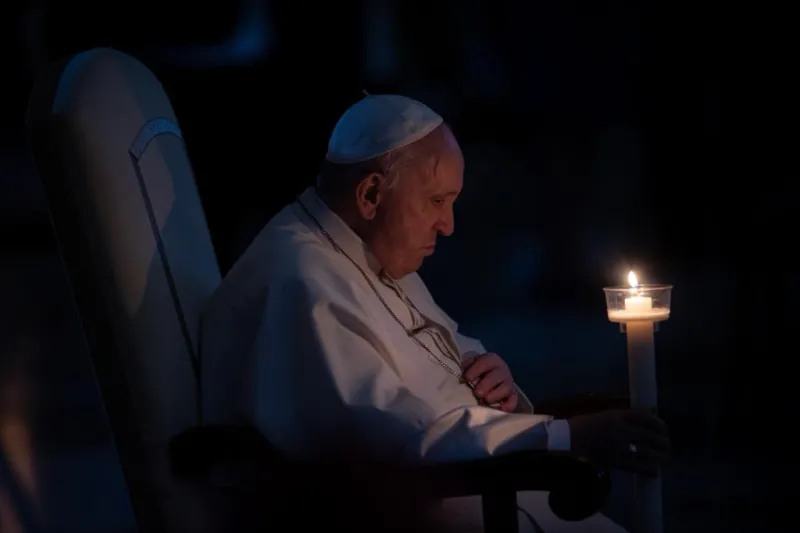
Pope Francis prays at the Easter Vigil Mass in St. Peter’s Basilica on April 16, 2022. / Daniel Ibanez/CNA

Vatican City, Apr 16, 2022 / 13:45 pm (CNA).

At the Vatican’s Easter Vigil Mass, Pope Francis said that Jesus has “entered the tomb of our sin” and restored us to life.

“Let us celebrate Easter with Christ! He is alive! Today, too, he walks in our midst, changes us and sets us free,” Pope Francis said in his homily in St. Peter’s Basilica on April 16.

“Thanks to him, evil has been robbed of its power; failure can no longer hold us back from starting anew; and death has become a passage to the stirrings of new life.”

“For with Jesus, the Risen Lord, no night will last forever; and even in the darkest night … the morning star continues to shine,” the pope said.

Pope Francis did not preside over the Easter Vigil Mass or participate in the Paschal candle procession, but sat in the front of the congregation in a white chair.

The pope has suffered from acute knee pain recently which has made it difficult to walk and has led him to cancel some public appearances.

Cardinal Giovanni Battista Re, the dean of the College of Cardinals, served as the main celebrant of the Mass. The pope participated in the Easter Vigil by delivering the homily and baptizing seven catechumens.

In his homily, Pope Francis spoke of bringing Christ’s light into days “marked by the horrors of war” through gestures of peace and acts of compassion.

“Let us make Jesus, the Living One, rise again from all those tombs in which we have sealed him,” Francis said.

“Let us bring him into our everyday lives: through gestures of peace in these days marked by the horrors of war, through acts of reconciliation amid broken relationships, acts of compassion towards those in need, acts of justice amid situations of inequality … and of truth in the midst of lies,” he added.

A Vatican spokesman said that the pope also met briefly with a delegation of local government officials from Ukraine ahead of the Mass.

The Easter Vigil, which takes place on Holy Saturday night, “is the greatest and most noble of all solemnities,” according to the Roman Missal.

The liturgy began in darkness with the blessing of the new fire and the preparation of the Paschal Candle. The candle symbolizes the light of Christ, which “shines in the darkness” and “has not overcome it.” (John 1:5)

Re and the concelebrating cardinals, bishops, and about 200 priests processed through the dark church carrying lit candles to signify the light of Christ coming to dispel the darkness.

“Many writers … have evoked the beauty of starlit nights. The nights of war, however, are riven by streams of light that portend death,” Pope Francis said in his homily.

“On this night, brothers and sisters, let us allow the women of the Gospel to lead us by the hand, so that, with them, we may glimpse the first rays of the dawn of God’s life rising in the darkness of our world.”

Pope Francis baptized seven people in St. Peter’s Basilica during the Easter Vigil Mass, including an American, Taylor Pescante.

The congregation prayed the Litany of the Saints and renewed their baptismal promises as Pescante prepared to be received fully into the Catholic Church, alongside four Italians, one Albanian, and one Cuban.

“Brothers and sisters our hope has a name: the name of Jesus,” Pope Francis said.

“He entered the tomb of our sin; he descended to those depths where we feel most lost; he wove his way through the tangles of our fears, bore the weight of our burdens and from the dark abyss of death restored us to life and turned our mourning into joy.”

At the beginning of the liturgy, a cantor sang the Exsultet Easter Proclamation, which tells the story of salvation from the creation, the testing and fall of Adam, the liberation of the people of Israel from slavery in Egypt, and culminates in Jesus Christ, who died for our sins and leads us to salvation.

The basilica was lit up gradually until it was fully illuminated at the Gloria, when the bells of St. Peter’s tolled.

About 5,500 people were present inside the basilica for the Vigil Mass, according to the Holy See Press Office.

The pope is also scheduled to celebrate Mass on Easter Sunday morning in St. Peter’s Square, followed by the traditional “Urbi et Orbi” blessing.

“How beautiful is a Church that can run … through the streets of our world. Without fear, without schemes and stratagems, but solely with the desire to lead everyone to the joy of the Gospel,” Pope Francis said.

“That is what we are called to do: to experience the risen Christ and to share the experience with others; to roll away the stone from the tomb where we may have enclosed the Lord, in order to spread his joy in the world.”

[…]

Finding faith at Harvard: These 5 Easter conversion stories will make your day

April 16, 2022 Catholic News Agency 3
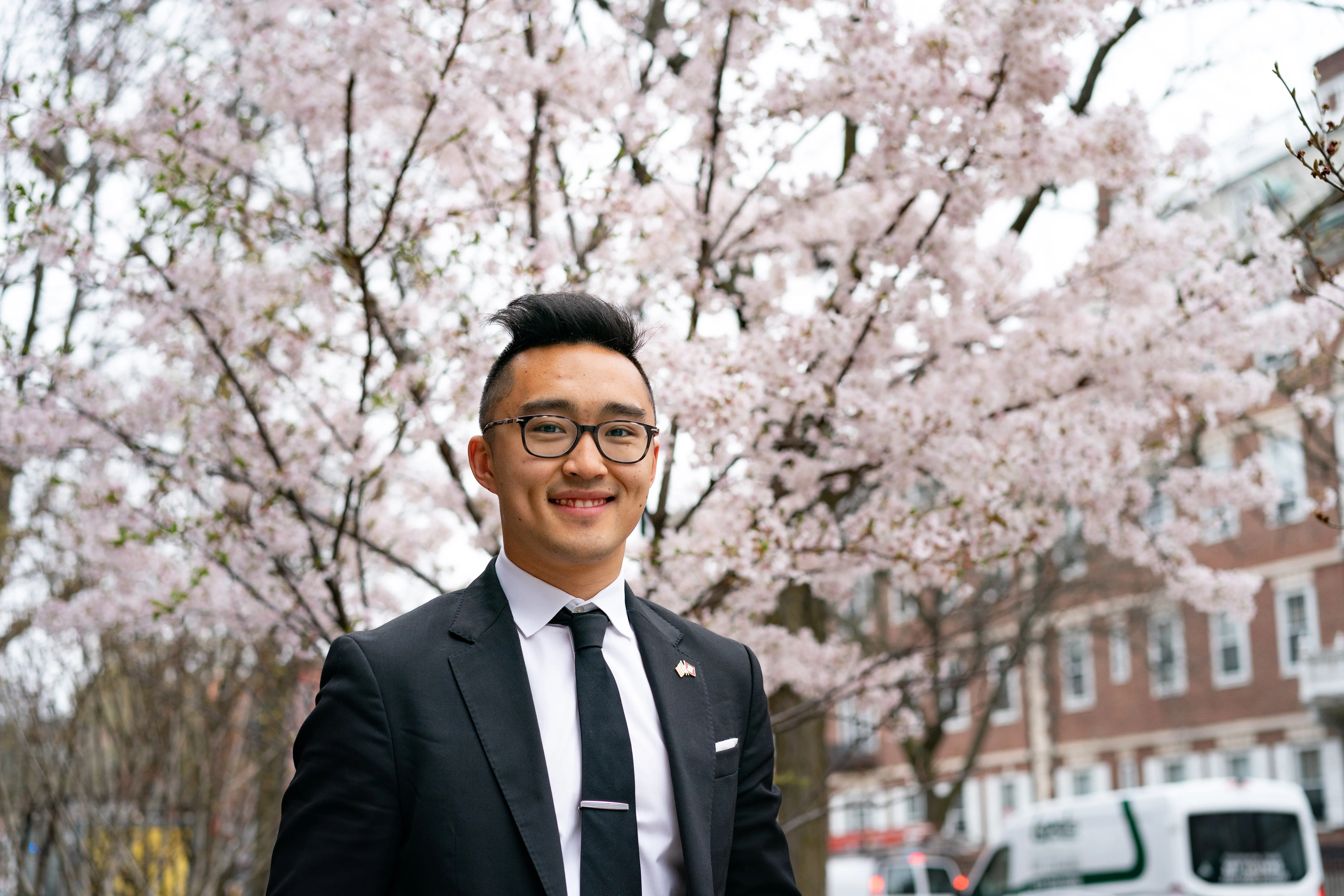
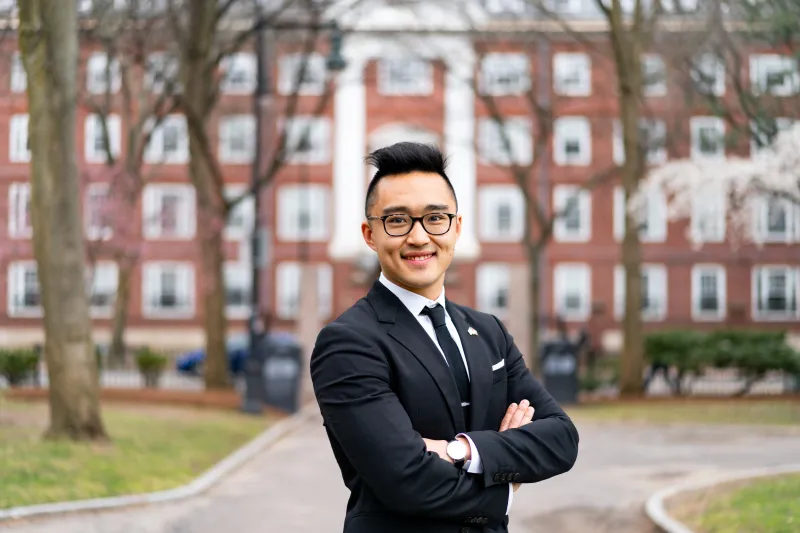
“What’s the Eucharist?” Kent Shi, a 25-year-old Harvard graduate student, asked that question when he attended eucharistic adoration for the first time. The answer put him on a path to conversion. / Julia Monaco | CNA

Cambridge, Massachusetts, Apr 16, 2022 / 09:03 am (CNA).

One convert’s journey to Catholicism began with an invitation to an ice-cream social. 

Another says he instantly believed in the Real Presence the moment someone explained what the round object was that everyone was staring at during eucharistic adoration.

For a third, the poems of T.S. Eliot — and a seemingly random encounter with a priest on a public street — led to deeper questions about truth and faith.

Their paths differed but led them to the same destination: St. Paul’s Catholic Church in Cambridge, Massachusetts, where they are among 31 people set to be fully initiated into the Catholic Church during the Easter vigil Mass on Saturday, April 16.

That number of initiates is a record high for St. Paul’s, a nearly century-old Romanesque-style brick church whose bell tower looms over Harvard Square.

A scheduling backlog caused by the COVID-19 pandemic is partly responsible for the size of this year’s group of catechumens (non-baptized) and candidates (baptized non-Catholics.) But Father Patrick J. Fiorillo, the parochial vicar at St. Paul’s, believes there’s more to it than that.

“There’s definitely a significant segment of people who started thinking more deeply about their lives and faith during COVID-19,” Fiorillo said. “So, coming out of Covid has given them the occasion to take the next step and move forward.”

Fiorillo is the undergraduate chaplain for the Harvard Catholic Center, a chaplaincy based at St. Paul’s for undergraduate and graduate students at Harvard University and other academic institutions in the area. This year, 17 of the 31 initiates are Harvard students.

“Everybody assumes that, because this is the Harvard Catholic Center, that everybody here is very smart and therefore has a very highly intellectual orientation towards their faith,” Fiorillo told CNA.

“That is definitely true of some people. But I would say the majority are not here because of intellectually thinking their way into the faith. Some are. But the majority are just kind of ordinary life circumstances, just seeking, questioning the ways of the world, and just trying to get in touch with this desire on their heart for something more,” he said. 

Fiorillo says welcoming converts into the Church at the Easter vigil is one of the highlights of his ministry.

“It’s an honor. It gives me hope just seeing all this new life and new faith here. So much in one place,” he said.

“When I tell other people about it, it gives them hope to hear that many young people are still converting to Catholicism, and they’re doing it in a place as secular as Cambridge.”

Prior to the Easter vigil, CNA spoke with five of St. Paul’s newest converts. Here are their stories:

‘This is what I’ve been looking for’ 

Katie Cabrera, a 19-year-old Harvard freshman, told CNA that she was excited to experience the “transformative power of Christ through his body and blood” at Mass for the first time at the Easter vigil. 

A native of Dorchester, Massachusetts, she said she was baptized as a child and comes from a family of Dominican immigrants. Her father, who grew up in an extremely impoverished area, lacked a formal education, but always kept the traditions of the Catholic faith close to him in order to persevere in difficult times. 

Her father’s love for her and his Catholic faith deeply inspired Cabrera, and served as an anchor for her faith throughout her life. 

Growing up, however, Cabrera attended a non-denominational church with her mother. Because she felt the church’s teachings lacked an emphasis on God’s love and mercy, Cabrera eventually left.

“Even though I Ieft, I always knew that I believed in God,” Cabrera said. “So, I was at a place where I felt kind of lost, because I always had that faith, but I didn’t know what to do with it.”

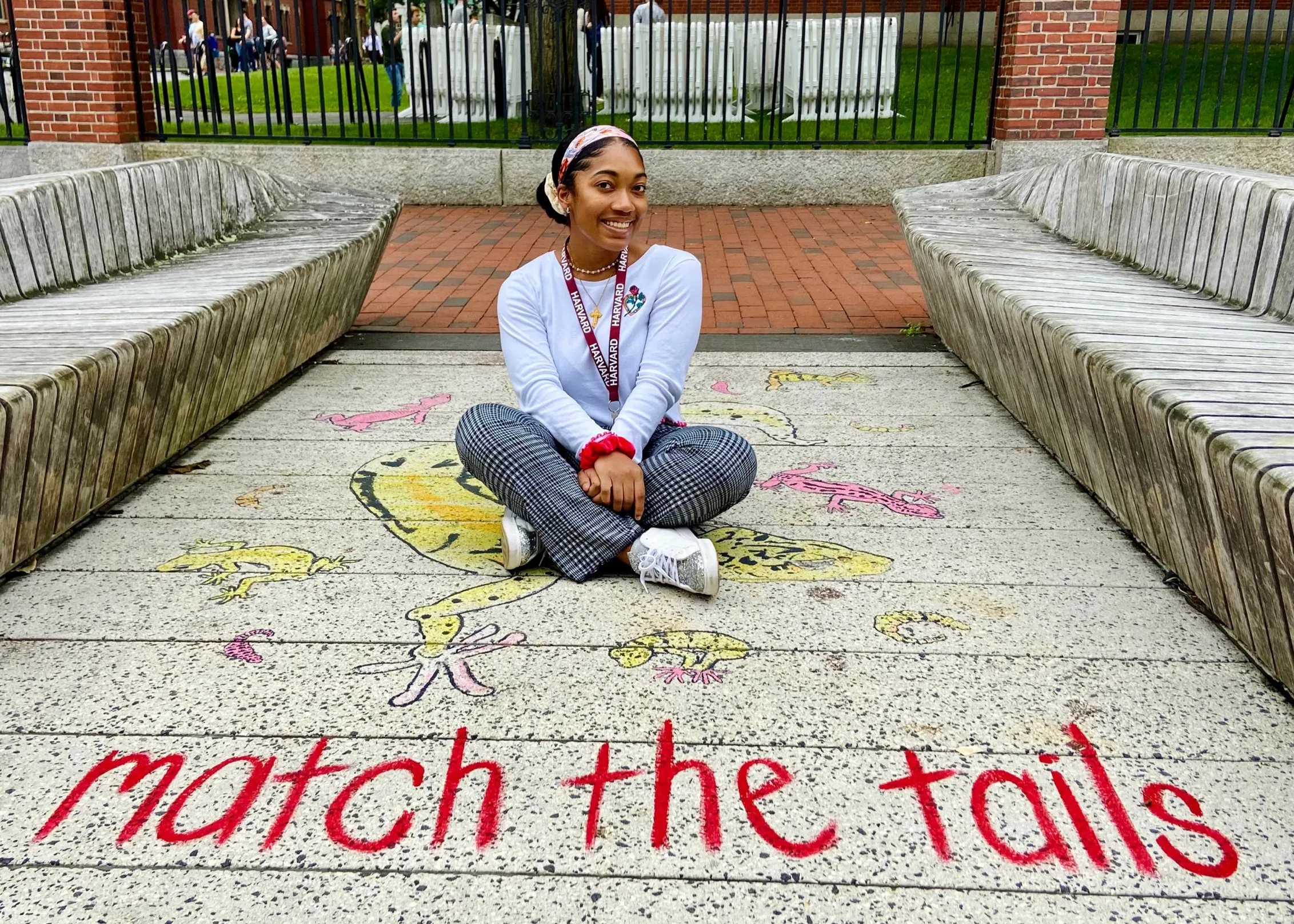
"There was a void that existed in my heart," says Katie Cabrera, a Harvard undergraduate student. She discovered what was missing when she started to get involved with the Harvard Catholic Center. Courtesy of Katie Cabrera
“There was a void that existed in my heart,” says Katie Cabrera, a Harvard undergraduate student. She discovered what was missing when she started to get involved with the Harvard Catholic Center. Courtesy of Katie Cabrera

After she arrived at Harvard, she accepted a friend’s invitation to attend an ice-cream social at the Harvard Catholic Center — “and that was like, sort of, how it all started,” she told CNA.

Once she was added to the email list for the center’s events, she felt a “calling” that she “really wanted to officially become Catholic” after many difficult years without a faith community. 

Catholic doctrine about the sacraments was no hurdle for Cabrera, as she credits Fiorillo with explaining the faith well. 

“There was a void that existed in my heart,” she said. “As soon as Father Patrick started teaching about marriage and family, theology of the body, and the sacraments, I was like, ‘This is what I’ve been looking for my whole life.’”

‘What’s the Eucharist?’

“What is that thing on the thing?”

Kent Shi laughs when he recalls how perplexed he was the first time he attended eucharistic adoration at St. Mary’s of the Assumption in Cambridge.

Someone helpfully explained that what Shi was looking at was the Eucharist displayed inside a monstrance.

“What’s the Eucharist?” he wanted to know.

For many non-Catholics considering entering the Catholic Church, the Real Presence can be a major obstacle. But Kent Shi, a Harvard graduate student, says that once the Eucharist was explained to him, he instantly believed. Julia Monaco | CNA

For many non-Catholics considering entering the Catholic Church, the Real Presence can be a major obstacle.

Not Shi. He says that once the Eucharist was explained to him that day, he instantly believed.

Shi, 25, told CNA that he considered himself an agnostic for most of his life, meaning he neither believed nor disbelieved in God.

Between his first and second years as a graduate student in Harvard’s Kennedy School of Government, however, he accepted Christ and started attending services at a Presbyterian church.

One day in the summer of 2021, a crucifix outside St. Paul’s that Shi says he “must have passed multiple times a week for months and never noticed” caught his eye, and deeply moved him.

Shortly after, he accepted a friend’s invitation to attend eucharistic adoration at St. Mary’s even though he “didn’t know what adoration meant.” Unaware of what he was about to walk into, Shi asked a friend what the dress code was for adoration. His friend replied, “Respectful.”

And so, respectfully dressed in a button-down shirt and slacks, Shi sat in the front row with his friend, only a few feet from the monstrance. That’s when the questions began.

It wasn’t long after that encounter that Shi began attending Mass at St. Paul’s and the parish’s RCIA (Rite of Christian Initiation for Adults) program. Shi asked CNA readers to pray for him and his fellow RCIA classmates.

“There’s a lot of prodigal sons and daughters here, so we would very much appreciate that,” he said, “especially me.”

Poetry and art opened the door

For Loren Brown, choosing to attend a secular university like Harvard proved to be “providential.”

The 25-year-old junior from La Center, Washington, said he comes from a “lapsed” Catholic family and wasn’t baptized.

He didn’t think much about the faith until the spring semester of his freshman year, when, he says, Catholic friends of his “began to question my lack of commitment to faith.”

Later, when students were sent home to take classes virtually due to the pandemic, he had time to reflect and began to read some of the books they’d recommended to him. The poetry of T.S. Eliot (his favorite set of poems being “Four Quartets”) and the “Confessions” by St. Augustine, in particular, “pulled me towards the faith,” he said.

Brown describes his conversion as a “gradual process” which backed him into a “logical corner.” But a chance meeting with a priest also played a pivotal role.

One day in the summer of 2021 while walking back to his dormitory he encountered a man wearing a priestly collar outside St. Paul’s Church on busy Mount Auburn Street.

It was Father George Salzmann, O.S.F.S., graduate chaplain of the Harvard Catholic Center.

“He asked me how I was doing, what I was studying, and we immediately found a common interest in St. Augustine,” Brown told CNA. 

“You know, there’s this great window of St. Augustine inside St. Paul’s and you should come see it,” Brown remembers the gregarious priest telling him. Salzmann wound up giving Brown a brief tour of the church, which was completed in 1923.

Harvard undergraduate student Loren Brown describes his conversion to Catholicism as a “gradual process” which backed him into a “logical corner.” But a chance meeting with a priest also played a pivotal role. Courtesy of Loren Brown

The next week, Brown found himself sitting in a pew for his first Sunday Mass at St. Paul’s. He hasn’t missed a Sunday since, a routine that ultimately led him to join the RCIA program that fall.

Brown says he now realizes that coming to Harvard was about more than majoring in education.

“What I wanted out of Harvard has completely changed,” he said. “Instead of an education that prepares me for a job or a career, I want one that forms me as a moral being and a human.”

‘I can’t do this alone. Please help me.’

Verena Kaynig-Fittkau, 42, is a German immigrant who came to the U.S. 10 years ago with her husband to do her post-doctoral research in biomedical image processing at Harvard’s engineering school.

The couple settled in Cambridge, where they had their first child. Two subsequent pregnancies ended in miscarriage, however. That second loss was overwhelming for Kaynig-Fittkau, who says she was raised as a “secular Lutheran” without any strong faith.

“It broke me and a lot of my pride and made me realize that I can’t do things by myself,” she told CNA.

She found herself on knees one Thanksgiving, pleading with God. “I can’t do this alone,” she said. “Please help me.” 

She says God answered her prayer by introducing her to another mother, who she met at a playground. She was a Christian who later invited Kaynig-Fittkau to attend services at a Presbyterian church in Somerville, Massachusetts.

In that church, there was a lot of emphasis on “faith alone,” she said. But Kaynig-Fittkau, who now works for Adobe and is the mother of two girls, kept questioning if her faith was deep enough. 

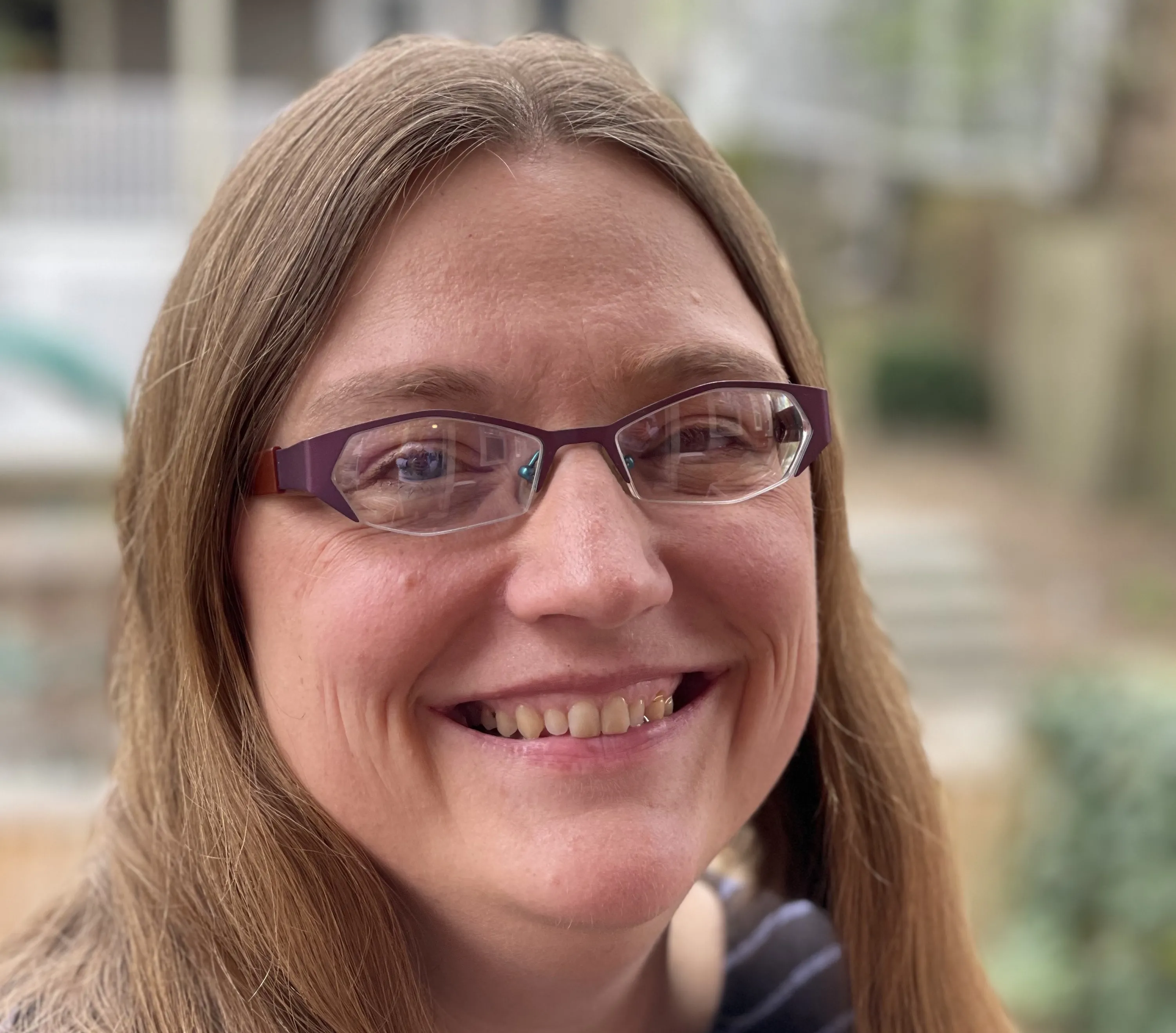
A YouTube video about the Eucharist by Father Mike Schmitz sent Verena Kaynig-Fittkau on a path toward converting to Catholicism. Courtesy of Verena Kaynig-Fittkau

Then one day she stumbled upon a YouTube video titled “The hour that will change your life,” in which Father Mike Schmitz, a Catholic priest from the Diocese of Duluth, Minnesota, known for his “Bible in a Year” podcast, speaks about the Eucharist.

Intrigued, she began watching similar videos by other Catholic speakers, including Father Casey Cole, O.F.M., Bishop Robert Barron, Matt Fradd, and Scott Hahn, each of whom drew her closer and closer to the Catholic faith.

Familiar with St. Paul’s from her days as a Harvard researcher and lecturer, she decided to attend Mass there one day, and made an appointment before she left to meet with Fiorillo.

When they met, Fiorillo answered all of her questions from what she calls “a list of Protestant problems with Catholicism.” She entered the RCIA program three weeks later.

Recalling her first experience attending eucharistic adoration, she said it felt “utterly weird” to be worshiping what she describes as “this golden sun.”

A conversation with a local Jesuit priest helped her better understand the Eucharist, however. Now she finds that spending time before the Blessed Sacrament is “amazing.”

“I am really, really, really excited for the Easter vigil,” Kaynig-Fittkau said. “I can’t wait, I have a big smile on my face just thinking about it.”

The rosary brought him peace

Another catechumen at St. Paul’s this year is Kyle Richard, 37, who lives in the Beacon Hill neighborhood of Boston and works in a technology startup company downtown. 

Although he grew up in a culturally Catholic hub in Louisiana, his parents left the Catholic faith and joined a Full Gospel church. Richard said he found the church “intimidating,” which led him eventually to leave Christianity altogether.

When Richard was in his mid-twenties, his father battled pancreatic cancer. Before he died, he expressed a wish to rejoin the Catholic Church. He never did confess his sins to a priest or receive the Anointing of the Sick, Richard recalls sadly. But years later, his non-believing son would remember his father’s yearning to return to the Church.

“I kind of filed that away for a while, but I never really let it go,” he said.

While Kyle Richard's father was dying from pancreatic cancer, he returned to the Catholic faith, which made a lasting impression on his non-believing son. Courtesy of Kyle Richard
While Kyle Richard’s father was dying from pancreatic cancer, he returned to the Catholic faith, which made a lasting impression on his non-believing son. Courtesy of Kyle Richard

Initially, Richard moved even farther away from the Church. He said he became an atheist who thought that Christianity was simply “something that people used to just soothe themselves.”

Years later, while going through a divorce, he had a change of heart.

Feeling he ought to give Christianity “a fair shot,” he began saying the rosary in hopes of settling his anxiety. The prayer brought him peace, and became a gateway to the Catholic faith.

Before long, he was reading the Bible on the Vatican’s website, downloading prayer apps, and meditating on scripture.

A Google search brought him to St. Paul’s. Joining the RCIA program, he feels, was a continuation of his father’s expressed desire on his deathbed more than a decade ago.

“I think he would be proud, especially because he was born on April 16th and that is the date of the Easter vigil,” he said.

[…]

5 things to know about Benedict XVI on his 95th birthday

April 16, 2022 Catholic News Agency 1
Pope Benedict XVI on Aug. 28, 2010. / L’Osservatore Romano.

Vatican City, Apr 16, 2022 / 01:00 am (CNA).

1. Benedict XVI was born on Holy Saturday

Benedict XVI was born on Holy Saturday, April 16, 1927, in Marktl am Inn, Bavaria. According to CNA’s count, this year is his fourth Holy Saturday birthday; the last time his birthday fell on this day was in 1960. The pope emeritus has also had three birthdays occur on Good Friday: In 1954, 1965, and 1976. But he has had four Easter Sunday birthdays to make up for it.

2. Benedict XVI is the longest-living person to have been pope

On Sept. 4, 2020, Benedict XVI became the longest-living person to have been pope, when he surpassed Pope Leo XIII, who died at the age of 93 years and 140 days in 1903. Leo XIII still holds the title of oldest reigning pope, however, since Benedict XVI made history in another way when he resigned in 2013, becoming the first pope to do so in almost 600 years.

3. Benedict XVI wanted to be called ‘Father Benedict’ in retirement

In an interview with a German journalist in 2014, the pope emeritus revealed that he had wanted to go by the title “Father Benedict” after stepping down from the papacy, but he “was too weak at that point to enforce it.”

4. The pope emeritus prefers orange soda to German beer

Despite enjoying a German beer on his 90th birthday in 2017, those who know Benedict personally say he is a bigger fan of orange soda, commonly known by the Italian brand name Fanta.

5. Benedict XVI prays the rosary daily

After retiring as pope, Benedict XVI would pray a daily rosary while walking in the gardens surrounding his home, the Mater Ecclesiae Monastery. As walking became more difficult for him, he would receive a lift from a golf cart, and pray the rosary while resting on a bench in the Vatican Gardens. Benedict has also greeted people from the same orange-cushioned bench, which is located near a grotto replicating the Grotto of Our Lady of Lourdes in France.

[…]