No Picture
News Briefs

What did Pope Francis say about sinners, baptism and the communion of saints?

February 3, 2022 Catholic News Agency 8
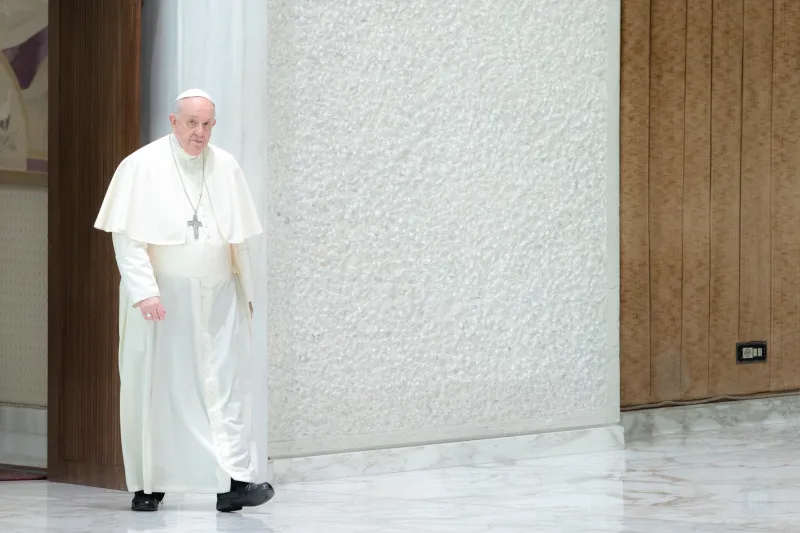
Pope Francis at the General Audience in the Vatican’s Paul VI Hall, Feb. 2, 2022. / Daniel Ibañez/CNA

Denver Newsroom, Feb 3, 2022 / 17:20 pm (CNA).

Any talk about apostates and former Catholics who persecute the Church is bound to grab attention, and Pope Francis’ Wednesday audience drew a reaction from some who wondered whether he had intentionally included the damned in the communion of saints.

For all the controversy, the pope’s comments seem to reflect his personal emphasis on Catholic Christians’ links to the saints in heaven, but also to our loved ones and neighbors who are baptized but currently reject the faith.

“We are brothers. This is the communion of saints. The communion of saints holds together the community of believers on earth and in heaven, and on earth the saints, the sinners, all,” the pope said during his Feb. 2 general audience. During his catechesis, he emphasized that reliance on the intercession of a saint “only has value in relation to Christ.”

“Christ is the bond that unites us to him and to each other, and which has a specific name: this bond that unites us all, between ourselves and us with Christ, it is the ‘communion of saints’,” said the pope.

He cited the Catechism of the Catholic Church, which defines the communion of saints as “the Church.” 

“What does this mean? That the Church is reserved for the perfect? No,” the pope added. “It means that it is the community of saved sinners.”

“No one can exclude themselves from the Church, we are all saved sinners. Our holiness is the fruit of God’s love manifested in Christ, who sanctifies us by loving us in our misery and saving us from it. Thanks always to him we form one single body, says St Paul, in which Jesus is the head and we are the members,” he said.

The image of the Church as the Body of Christ helps us understand what it means to be bound to one another in communion, the pontiff continued. This body can suffer together, or be glorified together. 

Summarizing St. Paul, Pope Francis said: “we are all one body, all united through faith, through baptism… All in communion: united in communion with Jesus Christ. And this is the communion of saints.”

The joy and sorrow of each Christian’s life affects every other Christian, said the pope, and this has consequences for how Christians respond to each other.

“I cannot be indifferent to others, because we are all in one body, in communion,” he explained. “In this sense, even the sin of an individual person always affects everyone, and the love of each individual person affects everyone.”

By virtue of the communion of the saints, every Christian is bound to another in “a profound way,” he said, adding “this bond is so strong that it cannot be broken even by death.”

The communion of saints includes the dead, said the Pope. 

“They too are in communion with us,” he said. “Let us consider, dear brothers and sisters, that in Christ no one can ever truly separate us from those we love because the bond is an existential bond, a strong bond that is in our very nature; only the manner of being together with one another then changes, but nothing and no one can break this bond.”

Pope Francis then raised an objection from a hypothetical speaker: “let’s think about those who have denied the faith, who are apostates, who are the persecutors of the Church, who have denied their baptism: Are these also at home?”

The pope responded: “Yes, these too. All of them. The blasphemers, all of them. We are brothers. This is the communion of saints. The communion of saints holds together the community of believers on earth and in heaven, and on earth: the saints, the sinners, all.” 

“In this sense, the relationship of friendship that I can build with a brother or sister beside me, I can also establish with a brother or sister in heaven,” he said, continuing to explain devotion to the saints.

The pope’s remarks about apostates, persecutors, and those who deny their baptism drew some reaction on the internet. 

CNA sought comment from Father Roch Kereszty, a Cistercian monk and retired University of Dallas theology professor. He said that papal talks are in the genre of “a fatherly exhortation, not a binding document” and must always be interpreted in a Catholic context. 

“Most of Wednesday’s talk is a beautiful meditation on the communion of the saints in which Pope Francis emphasizes so enthusiastically the baptismal bond’s strength that some of his statements can easily be misunderstood,” Kereszty said Feb. 3. “Aware of his many attestations that he is a son of the Church and teaches only what the Church teaches, I exclude an intention to contradict the Church’s faith.”

“Baptism imprints an indelible mark on the soul, called baptismal character, and if there is no opposition by the soul, it also results in sanctifying grace in virtue of which Christ lives in the soul and joins us to himself and to all Christians both on earth and heaven,” he continued. “By grave, mortal sin we lose sanctifying grace and thus the indwelling of Christ in the soul and, of course, the right to heaven. But no sinner, no matter how obstinate, can lose the indelible mark of the baptismal character.”

“Every mortal sin breaks the bond of love on the part of the sinner, but it does not delete the character,” Kereszty said.

“The Pope quoted the Catechism: ‘The communion of the saints is the Church.’ Yes, but the living members of the Church are those in a state of sanctifying grace,” the priest added. “Those baptized members in a state of mortal sin are dead members, but the prayers of the Church are surrounding them with the love of a grieving mother. They will be saved only if they repent.”

“So it seems that when the pope speaks of the baptismal bond he does not distinguish between the character of baptism which one cannot lose, but which does not in itself save, and the bond of love which saves because it assures Christ’s presence in the soul,” Kereszty explained. “But this bond of love is destroyed by mortal sin on the part of the sinner. The Church, by her prayers, however, tries to obtain the grace of repentance for the sinner. And the baptismal character in the sinner may work in his heart to obtain his conversion.”

Asked about baptism and hell, Kereszty said, “the Communion of Saints and the baptismal bond does not include those in hell. One should speak about hell, but not necessarily in the same talk.”

Pope Francis does not particularly focus on hell in his preaching, but he has referred to hell and God’s judgement in the past. 

In Nov. 22, 2016 remarks during a morning meditation at his residence the Casa Santa Marta, he reminded his audience of “(the) call from the Lord to think seriously about the end: about my end, the judgement, about my judgement.”

The pope remarked that children traditionally learn the “four last things” from the Catechism, namely “death, judgement, hell or glory.”

While some might say “Father, this frightens us,” Pope Francis said, he answered: “It is the truth. Because if you do not take care of your heart… (and) you always live far away from the Lord, perhaps there is the danger, the danger of continuing in this way, far away from the Lord for eternity. This is very bad!”

“Today it will be good for us to think about this: what will my end be like? How will it be when I find myself before the Lord?” the pope said.

He recounted Christ’s words from the Book of Revelation: “Be thou faithful unto death… and I will give you the crown of life.”

“Fidelity to the Lord: this does not disappoint,” he said in 2016. “If each one of us is faithful to the Lord, when our death comes, as shall we say what St. Francis said: ‘Sister death, come’. It will not frighten us.”

[…]

No Picture
News Briefs

Four Chaplains Day honors self-sacrificial World War II chaplains, including Catholic priest

February 3, 2022 Catholic News Agency 0
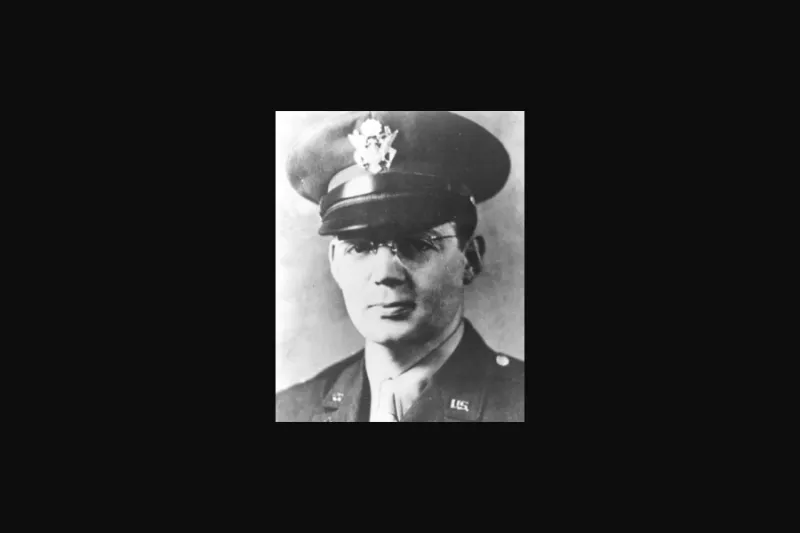
Father John P. Washington, one of the ‘Four Chaplains’ who gave their lives to save others during the sinking of the SS Dorchester, Feb. 3, 1943.x / public domain

Washington, D.C. Newsroom, Feb 3, 2022 / 16:00 pm (CNA).

Four Chaplains Day, Feb. 3, recognizes the heroism of four World War II military chaplains who sacrificed their lives to save those trapped on a sinking U.S. Army transport ship.

“Their voices were the only thing that kept me going,” one survivor remembered of the fateful day in 1943.

The four men — Fr. John P. Washington, a Catholic priest, Rev. George L. Fox, a Methodist minister, Rabbi Alexander D. Goode, and Rev. Clark V. Poling, a Reformed Church in America minister — died after ministering to civilians and military personnel on the sinking SS Dorchester.

The four first met in 1942, at the Army Chaplains School at Harvard University. Each chaplain held the rank of first lieutenant, Columbia magazine reported.

The ship, packed with more than 900 people, departed New York for an Army base in Greenland on Jan. 23, 1943, Military Benefits reported. A few days later, on Feb. 3, a German submarine torpedoed the ship in the middle of the night. The lights went out as the cold Arctic waters surrounded the soldiers.

Amid of panic, the chaplains remained calm — and sprang into action. Fr. Washington, who had celebrated Mass just hours before, now gave absolution, according to the Army Historical Foundation. The four offered their life jackets to men who did not have them, and helped as many as they could escape into lifeboats. They themselves stayed behind.

Several eyewitnesses later spoke of the chaplains’ bravery, Military Benefits reported.

At one point, Petty Officer John J. Mahoney remembered turning back to his cabin to find his gloves. Rabbi Goode halted him, saying, “Never mind. I have two pairs,” and handed him some. 

Mahoney later realized that the rabbi had just one pair.

Off the ship and in the water filled with debris, oil, and dead bodies, Pvt. William B. Bednar remembered hearing “men crying, pleading, praying.” But then he heard the chaplains, who were “preaching courage.” Those voices, he said, kept him alive.

Another survivor, named Grady Clark, recalled the scene.

“As I swam away from the ship, I looked back. The flares had lighted everything. The bow came up high and she slid under,” Clark said. “The last thing I saw, the four chaplains were up there praying for the safety of the men. They had done everything they could. I did not see them again. They themselves did not have a chance without their life jackets.” 

Another eyewitness, John Ladd, said, “It was the finest thing I have seen or hope to see this side of heaven.”

The ship sank in fewer than 30 minutes. 

With the frigid air and water temperatures, many of the men died from hypothermia before they could be rescued. Only 230 survived. Those who did remembered the chaplains linking arms and joining together in prayer and singing as the ship went down.

Today, they are remembered as “the four chaplains,” or “the immortal chaplains.”

In recognition of the chaplains’ heroism, Congress established Feb. 3 as “Four Chaplains Day” in 1988.

A year after their deaths, in 1944, Congress posthumously awarded each chaplain with a Purple Heart and the Distinguished Service Cross. In 1960, Congress also approved the Four Chaplains’ Medal, which was presented to the chaplains’ families the following year.

Throughout the country, the chaplains are remembered with monuments and memorials, including stained glass windows at the Pentagon, Military Benefits reported.

Their faces appeared on U.S. postage stamps in 1948, and, in 1951, President Harry S. Truman dedicated the Chapel of the Four Chaplains in the basement of Grace Baptist church in Philadelphia.

Today, the Four Chaplains Memorial Foundation, founded by the chaplains’ families and the ship’s survivors, continues their legacy, from supporting first responder chaplain programs to hosting student scholarship competitions.

[…]

No Picture
News Briefs

‘Made New’: Blessed Is She book explores Catholic women’s identity

February 3, 2022 Catholic News Agency 0
Nell O’Leary, managing editor of Blessed Is She. / Therese Westby

Washington, D.C. Newsroom, Feb 3, 2022 / 11:01 am (CNA).

When Nell O’Leary sat down with her team to brainstorm a new book for Catholic women, she said they felt drawn to the theme of “identity.”

“This one kept coming back, this idea of identity, of who we are as Catholic women, made in God’s image and likeness,” O’Leary, the managing editor of Blessed Is She, told CNA. This identity, she said, gets battered by the world “with all these lies that you are what you look like, you are your social media following, you are how successful you are, you are how many kids you have.”

Instead, O’Leary says, every woman is unconditionally loved as a “beloved daughter of God.”

This message is central to Made New: 52 Devotions for Catholic Women, a weekly devotional released in December. The book houses personal stories from five writers associated with Blessed Is She (BIS), a “sisterhood” of Catholic women who desire to grow in their faith through prayer and community. Each of the five — O’Leary, Leana Bowler, Brittany Calavitta, Jenna Guizar, and Liz Kelly — focus on a theme under the umbrella of identity: beheld, belong, beloved, believing, and becoming. 

While their stories are different, their tone is consistent. Each writer engages the reader with the frank, casual tone of a friend who’s honest about her struggles, hopeful for the future, and, well, confident in her identity.

“I invite you to journey with me, dear sister, to walk through the next fifty-two weeks as we rediscover our value, our worth, and our identity in Our Lord’s eyes,” Guizar, the founder of BIS, writes in the book’s opening. “He is waiting for you and me, and He desires to be in relationship with us. All it takes is a response to His call: yes.”

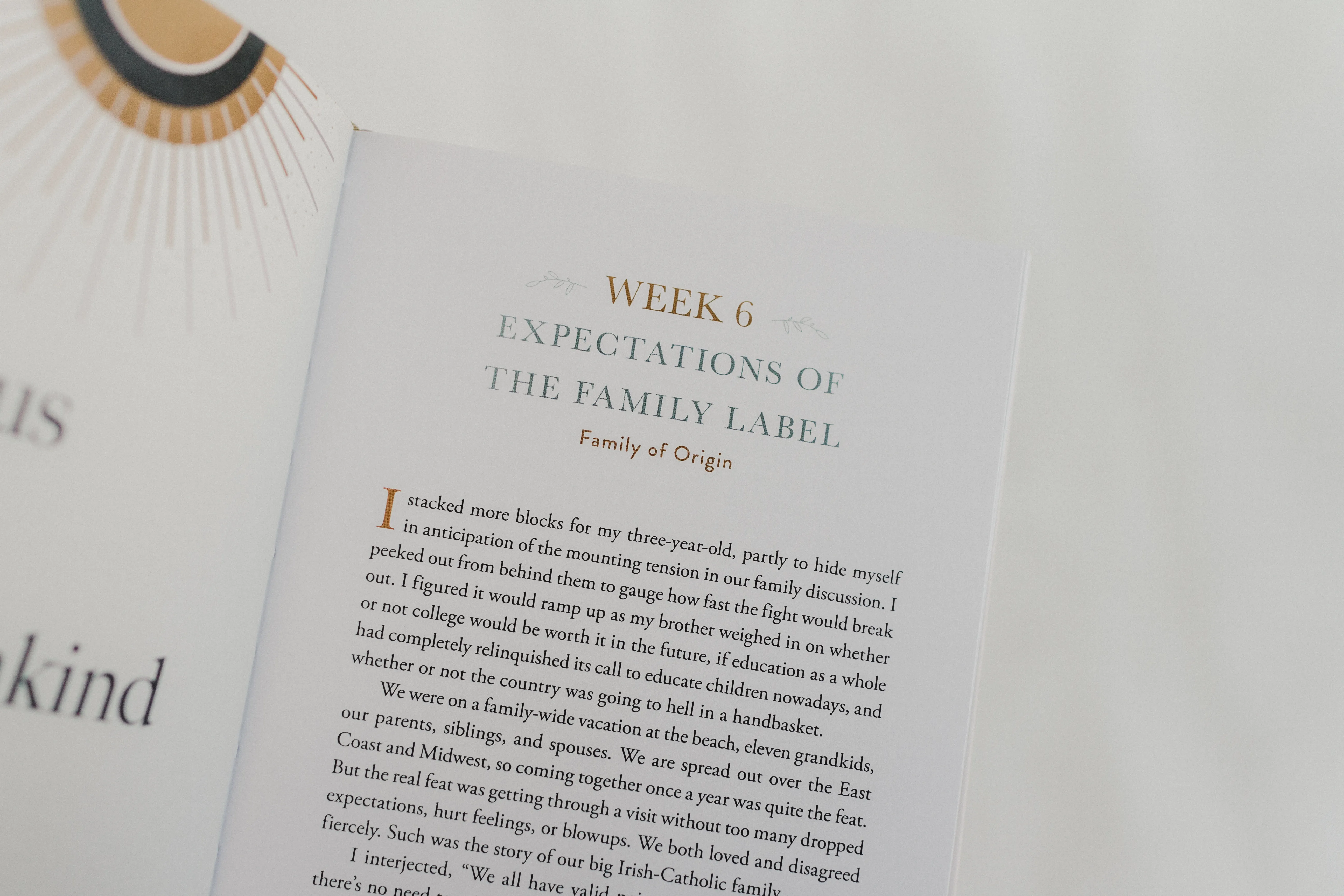
Each week begins with a short reflection or personal story from one of the writers and concludes with a scripture passage and two questions for the reader to ask herself. Along the way, artwork interrupts the text to greet readers with dusty, muted colors and shapes. The rose-gold cover impresses a feminine touch, along with a pink ribbon bookmark. Leaves and plants adorn the pages, suggesting growth and life made new. 

Interior of Made New. Therese Westby

A saint’s calling

If readers come away remembering one thing, O’Leary wants them to believe and remember that “there’s no one way, cookie-cutter way, to become a saint.”

“God is calling you personally, through the circumstances in your life, through the challenges, through the blessings, to grow in holiness in who you are and where you are,” she said. “And to compare yourself to other women and feel like you can’t measure up is simply not where you want to put your energies.”

Instead, she said, God is calling each woman — in her particular, unique life — to become a saint. 

Every woman is different, something that the five writers themselves demonstrate. According to O’Leary, they are not all just a “bunch of young moms.” One struggles with infertility, another married later in life, one started a family before marriage, and another has no children.  

“I think that however old the reader is, they will find part of their own story,” O’Leary said. “When we write [our stories], we want the reader to actually be able to contemplate and ponder… to kind of find their own story. So you’re not just consuming another person’s content, you’re actually looking at yourself too.”

One story particularly moved O’Leary (even though she compared picking her favorite to “picking a favorite flower”). She pointed to writer Liz Kelly, who shares with readers her diagnosis with multiple sclerosis toward the end of the book.

While Kelly originally “thought that meant her role would become really small,” God “used her in that time and in that diagnosis to broadcast his message even further than she thought,” O’Leary summarized. 

She added, “I think the reason I love that story so much is because where we see limitations, God just sees more opportunities for grace.”

Unconditional love

A theme in the book that O’Leary herself touches on is God’s unconditional love — that he loves you as you are right now, regardless of what you do or don’t do, regardless of how your family or friends treat you, regardless of your past or future. He loves you.

“I suppose people in general struggle with the idea of unconditional love because it’s so rarely manifest in our human interaction,” O’Leary said of accepting God’s love. “And so, because the human level of relationship in our lives are fraught with other imperfect people, to really trust in and experience God’s love takes this trust and this faith.”

Her first piece of advice for women who doubt God’s love or think they aren’t good enough is to visit the confessional.

“Get all those embarrassing sins off your chest,” she said. “The priest has heard it all … you can go behind the screen.”

“It’s nothing that’s too embarrassing to bring to the sacrament and really unload yourself of the burden of all those sins and experience God’s grace filling you,” she added. God’s unconditional love can get “so shrouded and clouded by my own, my own humanity, my own mistakes, my own sinfulness.”

Community and Covid

Another topic in the book — and a priority for Blessed Is She as a whole — is community. O’Leary addressed the challenges of community, particularly during the pandemic.

“Living in a global pandemic, so many things being more online, we just see that highlights reel…those drive those envy twinges of, ‘Her life looks perfect. She doesn’t have my struggles,’” she said. “Really puts in wedges in our sisterhood and we need our sisterhood.”

“When we can’t be together, it just starts to look like everyone has it together,” she added. “We don’t.” 

O’Leary advised women to read the free daily devotions offered by Blessed Is She. And delete social media apps off of their phones, even if just for the weekend.

“I know that our phones and the internet are wonderful for connecting us, but they’re also really toxic for making it feel more lonely,” she said. “Live the life that’s in front of you.”

The personal 

O’Leary talked about her personal life and her own struggle with identity. The fourth of five children, she said she grew up surrounded by high-achieving parents and siblings. While she thought that one day she might have a family, she worked toward becoming an attorney. She ended up marrying her “law school love” and worked as an attorney. Then, she became a stay-at-home mom. 

“Realizing that I had hung so much on my identity being what I did, and what the world could see and applaud, that becoming a mom and then eventually staying at home with our kids,” she said. “It’s such a hidden life.” 

“The children are not cheering you on, ‘You did a great job!’ there’s no affirmation, there’s no feedback other than the deep satisfaction I guess, that no one went to the ER,” she added.  

The experience changed her.

“What I realized that I had to have a big mentality shift from, I’m not what I do and I’m not what I accomplish and I’m not even how my children behave,” she said. “That really, in these hidden moments in prayer with God, to say, ‘I know I’m your beloved daughter. I know I’m made in your image and likeness.’”

[…]