No Picture
News Briefs

Who is St. Junipero Serra, anyway?

June 22, 2020 CNA Daily News 0

Denver Newsroom, Jun 22, 2020 / 03:20 pm (CNA).- In Los Angeles and San Francisco over the weekend, protestors tore down two statues of St. Junipero Serra, an 18th-century Franciscan priest and missionary who they accused of contributing to the destruc… […]

No Picture
News Briefs

California mission aims to preserve St. Junipero Serra statue

June 22, 2020 CNA Daily News 2

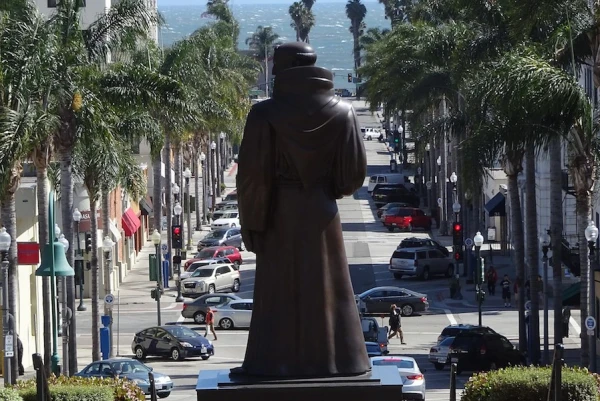
CNA Staff, Jun 22, 2020 / 03:08 pm (CNA).- While statues of St. Junipero Serra have been taken down by protestors in California cities, the mission church in Ventura, California, founded by the saint, has announced it will work with local officials and indigenous tribal leaders to see a Serra statue outside Ventura City Hall moved to “a non-public location.” 

The announcement came days before a statue of St. Serra was torn down in San Francisco’s Golden Gate Park June 20, along with statues of Francis Scott Key and Ulysses S. Grant. In Los Angeles the same day, rioters pulled down a statue of Serra in the city’s downtown.

“Some people disagree with the way that I am handling this, and that’s ok. Some people agree. Some people have even asked that I should be pastor of a mission. Well, everyone is entitled to their own opinion,” Father Tom Elewaut, pastor of the San Buenaventura mission church, said in a homily on June 21.

“The statue is up today, isn’t it? And that is due to not only the joint statement, but the strong position of the elders of the Chumash, who are local here. We want to see the statue preserved. It needs to be relocated— it could have very well been toppled yesterday,” the priest said.

Though protestors rallied at the bronze statue in Ventura on June 20 and reportedly called for it to be torn down, Chumash tribe elders have been adamant that they want a peaceful solution.

“We are going to become a model for the nation so it’s not this riot mob act and desecration, and even having a statue broken into pieces. That is our goal, and that we hope will come to fruition,”  Elewaut added.

Across the country, protestors and rioters this week have pulled down statues of historic figures— some depicting Confederate figures, as part of a call to end systemic racism, but others depicting such figures as George Washington and Grant.

Some California activists view Serra, an 18th-century Franciscan missionary, as having contributed to the destruction of Native American way of life through his founding of the first nine of California’s mission churches. Many of the priest’s biographers dispute those claims.

Elders of the Chumash Native American tribe met last week with Ventura Mayor Matt Lavere and Fr. Elewaut.

“The three of us are confident that a peaceful resolution regarding the Father Junipero Serra statue can be reached, without uncivil discourse and character assassination, much less vandalism of a designated landmark,” the parties said in a June 18 joint statement.

“We all believe that the removal of the statue should be accomplished without force, without anger, and through a collaborative, peaceful process. This process has already commenced through our initial meeting and we look forward to continuing the discussion with the community to help guide further action on this.”

The proposal to remove the statue, which was dedicated in 1989, will need to go before the city council, the parties said, and a formal removal decision has not yet been made.

A similar statue was beheaded at the Old Mission Santa Barbara in 2017, and red paint was used to graffiti the mission in 2018, Ventura’s ABC affiliate reported.

Pope Francis canonized Serra in Washington, D.C. on Sept. 23, 2015, saying that “Junípero sought to defend the dignity of the native community, to protect it from those who had mistreated and abused it,”

Father Elewaut, said in his Sunday homily that while it is true that many Native Americans died after contact with Europeans, “it wasn’t a purposeful or contrived death” because most of them died of disease, which no one at the time fully understood.

Father Elewaut was present at the June 20 rally, and said he hopes the peaceful dialogue in which he and the Chumash elders have so far been engaged can be a model for the nation, to show that controversial statues need not be torn down by force.

The idea that Serra created what were akin to “concentration camps” for the Natives is “categorically false,” Elewaut said.

“The blame cannot be put on one person, or one movement…but the hurt that they feel, the the pain that we should join with them in feeling is true, and it remains true, and it will remain true whether our statue stands or not,”

“But if [the removal] brings some healing, if that brings some peace of mind, then so be it…statues come and go, but the truth will be laid bare,” the priest said, acknowledging that the statue will be removed from its current location, but the Church’s mission will continue.

The mission will continue to be a sign of God’s grace, regardless of the location of any particular statue, he said.

“Serra wanted to share what he truly believed to be the great gift of Christianity, of Catholicism, of sacramental life,” the priest said.

Elewaut said he has been working with the elders of the Chumash tribe, for whom he has “profound respect.” He hopes to continue to work with the Chumash, some of whom are parishioners at the mission.

Elewaut told Ventura’s ABC affiliate that the Archdiocese of Los Angeles is open to moving the statue from City Hall to mission grounds. The LA Archdiocese did not confirm this by time of posting.

Serra was instrumental in founding the first nine of the 21 missions in California, many of which would form the cores of what are today the state’s biggest cities— such as San Diego, San Francisco, and Los Angeles.

A native of Petra Mallorca in Spain, Serra was a renowned scholar who gave up his academic career to become a missionary in North America.

Serra arrived in Mexico City in 1750, entering the vast territory of New Spain. The Spanish had been in North America for over 200 years at that point, after Hernan Cortez’ conquest of the Aztec Empire in 1521.

While many activists today associate Serra with the abuses that the Native Americans suffered, biographies and historical records suggest that Serra actually advocated on behalf of the Natives against the Spanish military and against encroaching European settlement.

Archbishop Salvatore Cordileone of San Francisco decried “mob rule” that led to the tearing down of Serra’s statue in his city. 

Cordileone said in a statement June 20 that he did not want to “deny that historical wrongs have occurred, even by people of good will, and healing of memories and reparation is much needed. But just as historical wrongs cannot be righted by keeping them hidden, neither can they be righted by re-writing the history.”

The archbishop praised the saint’s missionary zeal: “St. Junipero Serra also offered them the best thing he had: the knowledge and love of Jesus Christ, which he and his fellow Franciscan friars did through education, health care, and training in the agrarian arts.”

In 2018, San Francisco’s city government removed a statue of the saint from a prominent location outside City Hall. A statue of the saint remains on display in the U.S. Capitol.


[…]

No Picture
News Briefs

Underground bishop detained in China

June 22, 2020 CNA Daily News 1

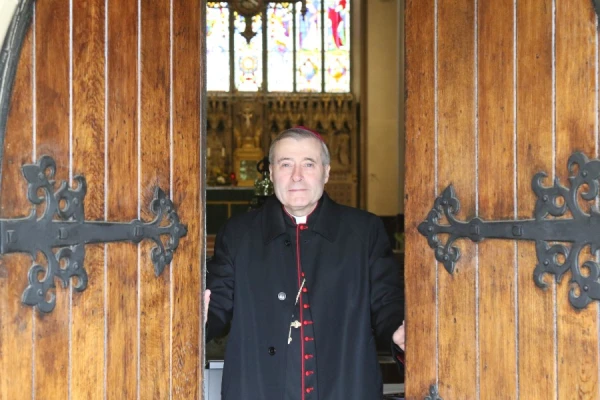
CNA Staff, Jun 22, 2020 / 11:00 am (CNA).- Chinese officials reportedly arrested an elderly bishop of the underground Catholic Church last week.

Coadjutor Bishop Augustine Cui Tai of Xuanhua, 70 years old, was taken by Chinese officials to an undisclo… […]

No Picture
News Briefs

Austrian bishop says he launched study, but not book, on Catholic blessings for same-sex couples

June 22, 2020 CNA Daily News 0

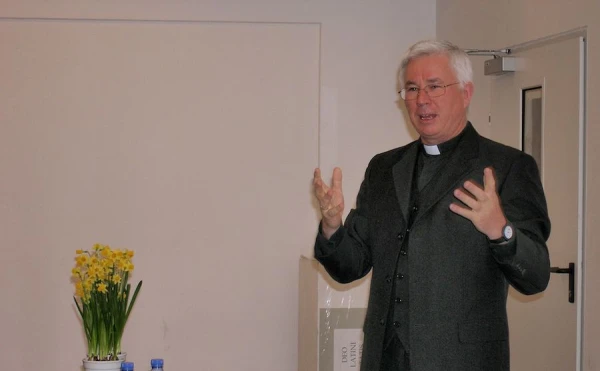
Denver Newsroom, Jun 22, 2020 / 10:00 am (CNA).- The newly elected president of the Austrian bishops’ conference has sought to clarify his role in the publication of a book that suggests how a Church blessing of same-sex couples might be “celebrated” in Catholic churches.

Archbishop Franz Lackner of Salzburg was elected last week to chair the Austrian bishops’ conference. He has been connected to a controversial book concerning the possibility of “official” liturgical blessings of homosexual unions.

While Lackner has been reported to have commissioned or even published the book, a spokesperson said June 18 that the archbishop put in motion a study project on same-sex liturgical blessings, but he did not oversee the publication of that particular text.

The book, “The Benediction of Same-Sex Partnerships,” is edited by Father Ewald Volgger, director of the Institute for Liturgical Studies and Sacramental Theology at the Catholic Private University of Linz.

In its June 16 report on Lackner’s election as head of the Austrian bishops’ conference, CNA noted that the archbishop had served as chairman of the liturgical commission that commissioned the book.

Other reports have suggested a more direct connection between Lackner and the text.

In an April interview about the book’s release with KirchenZeitung, Volgger said that “the Austrian liturgical commission, chaired by Arcbishop Lackner, asked us to deal with” liturgical issues related to homosexuality, including the question of blessings for same-sex couples, which are the topic of the book.

English newspaper The Tablet reported May 6 that the book was “initiated by the archdiocese of Salzburg,” and that “the Austrian liturgical commission, chaired by Archbishop Franz Lackner of Salzburg had commissioned the book’s authors to address the question of an official benediction.”

New Ways Ministries, which describes itself as a “a gay-positive ministry of advocacy and justice for lesbian and gay Catholics,” reported May 25 that Lackner was responsible for publishing the book, because of “his desire for a more inclusive church.”

Television news program EWTN News Nightly also reported June 16 that Lackner commissioned the book. CNA and EWTN News Nightly are both services of EWTN News.

But in a June 18 email obtained by CNA, a spokesperson for the archbishop said that Lackner did not directly commission the book edited by Volgger, because his term as liturgical commission chairman ended in 2018. The archbishop did initiate the liturgical commission’s years-long study project on liturgical blessings for same-sex couples, the spokesperson explained.

While he was chairman, Lackner “asked the LKÖ to discuss the topic of liturgical offers for people in homosexual relationships in general,” the spokesperson said.

In the book’s foreword, Volgger offered more insight on the archbishop’s request.

“In the Liturgical Commission for Austria (LKÖ) on February 27th 2015 in Salzburg, the then chairman, Archbishop Franz Lackner, asked for an exchange on the question of blessings of homosexual couples. The occasion was a blessing ceremony in Switzerland, which had great media attention. In the discussion it became clear that  a moral theological clarification is needed, as well as a change in the magisterium on this point to allow for an official liturgy for same-sex couples.”

The blessing ceremony Volgger referenced was performed by a Swiss Protestant Reformed minister; the media attention Volgger referenced included an interview in which the minister, Sibylle Forrer, explained why she conferred the blessing.

According to Lackner’s spokesperson, the archbishop’s request “led to a study day in February 2016 and the LKÖ agreed, that the results of this study day should be compiled and that the topic should be further monitored.”

The 2020 text was part of the ongoing development of that project, as Volgger indicated to KirchenZeitung, as was a 2019 symposium on the topic. But since November 2018, Bishop Anton Leichtfried of St. Polten has overseen the Austrian liturgical commission. 

In his April interview, Volgger said that from his viewpoint, there are “a considerable number of bishops who would like to see a rethinking of sexual morality for the evaluation of same-sex partnerships.”

The priest also said that “a benediction,” of a same-sex couple “as it is proposed from a liturgical-theological point of view, would also have an official character, through which the Church expresses the obligation of fidelity and the exclusiveness of the relationship.”

In 2003, The Congregation for the Doctrine of the Faith said that “there are absolutely no grounds for considering homosexual unions to be in any way similar or even remotely analogous to God’s plan for marriage and family.”

CNA asked Lackner’s spokesperson why the archbishop was only now attempting to clarify his involvement, given that he has been reported for months to be responsible for the book. CNA also asked whether the book has the official approval of the Austrian bishops’ conference, of which Lackner is now president, or of the conference’s liturgical commission.

The archdiocese has not yet responded.


[…]

No Picture
News Briefs

Benedict XVI returns to Rome after visiting ill brother in Germany

June 22, 2020 CNA Daily News 1

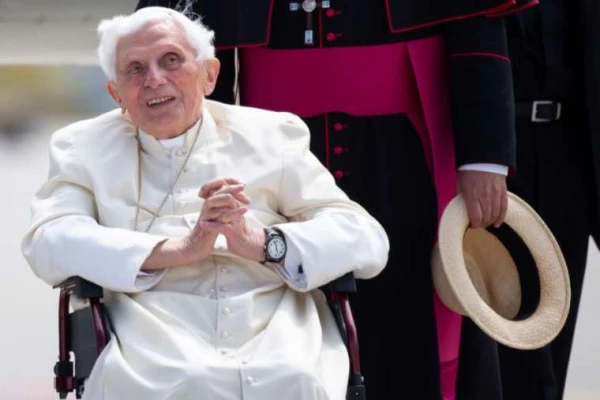
Vatican City, Jun 22, 2020 / 06:00 am (CNA).- Pope emeritus Benedict XVI arrived back in Rome Monday after a four-day trip to Germany to visit his ailing brother.

The Diocese of Regensburg reported June 22 that 93-year-old Benedict XVI said goodbye to his 96-year-old brother, Msgr. Georg Ratzinger, who is in poor health, before departing for Munich airport. 

“It is perhaps the last time that the two brothers, Georg and Joseph Ratzinger, will see each other in this world,” the Regensburg diocese said in an earlier statement.

Benedict XVI was accompanied on the journey to the airport by Bishop Rudolf Voderholzer of Regensburg. Before the pope emeritus boarded an Italian air force plane he was greeted by Bavaria’s premier Markus Söder. The Süddeutsche Zeitung, a German daily newspaper, quoted Söder as saying that the encounter was a moment of “joy and melancholy.”

The pope emeritus landed in Rome at 1 p.m. local time, according to Vatican News. Benedict XVI and his entourage arrived 45 minutes later at the Mater Ecclesiae monastery, his residence in the Vatican. 

Benedict XVI was born Joseph Aloisius Ratzinger in the town of Marktl in Bavaria in 1927. His older brother Georg is his last living family member.

On his final full day in Bavaria, Benedict XVI offered Sunday Mass with his brother in Luzengasse, Regensburg. He later went to pray at the shrine of St. Wolfgang, the patron saint of Regensburg diocese.

Archbishop Nikola Eterović, the apostolic nuncio in Germany, traveled from Berlin to meet with the pope emeritus in Regensburg over the weekend.

“It is an honor to welcome the pope emeritus again in Germany, even in this difficult family situation,” Eterović said June 21 following their meeting.

The nuncio said his impression during his meeting with Benedict was “that he feels good here in Regensburg.”

The former pope arrived in Bavaria on Thursday, June 16. Immediately upon his arrival, Benedict went to see his brother, the diocese reported. The brothers celebrated Mass together at the house in Regensburg and the pope emeritus then went to the diocesan seminary, where he stayed throughout the visit. In the evening, he returned to see his brother again.

On Friday, the two celebrated Mass for the Solemnity of the Sacred Heart of Jesus, according to a statement.

On Saturday the former pope visited the residence in Pentling, just outside Regensburg, where he lived while serving as a professor from 1970 to 1977.

His last time seeing the home was during his 2006 pastoral trip to Bavaria. 

The diocese said Benedict XVI then stopped at the Ziegetsdorf cemetery to spend time in prayer at the graves of his parents and sister.

Christian Schaller, deputy head of the Pope Benedict XVI Institute, told Regensburg diocese that during the pope emeritus’ visit to his former home “memories awoke.”

“It was a trip back in time,” he said.

Benedict stayed at his Pentling home and in its garden for about 45 minutes, and was reportedly moved by old family portraits.

During his visit to the cemetery an Our Father and Hail Mary were prayed.

“I have the impression that the visit is a source of strength for both brothers,” Schaller said.

According to Regensburg diocese, “Benedict XVI is traveling in the company of his secretary, Archbishop Georg Gänswein, his doctor, his nurse and a religious sister. The Pope emeritus made the decision to travel to his brother in Regensburg at short notice, after consulting with Pope Francis.”

Msgr. Georg Ratzinger is a former choir master of the Regensburger Domspatzen, the cathedral choir of Regensburg.

On June 29, 2011, he celebrated his 60th anniversary as a priest in Rome together with his brother. Both men were ordained priests in 1951.

This report has been updated to include the time of Benedict XVI’s arrival in Rome.

[…]

No Picture
News Briefs

Catholic bishop urges UK to preserve Sunday as a day of rest

June 22, 2020 CNA Daily News 5

CNA Staff, Jun 22, 2020 / 05:30 am (CNA).- A bishop has urged Christians to speak out against plans to relax Sunday trading laws in the United Kingdom as the economy reels from the effects of the coronavirus pandemic. 

In a June 21 homily at Shrewsbury Cathedral, Bishop Mark Davies criticized the government’s intention to lift the current six-hour limit on Sunday trading. 

“As we emerge from lockdown, it is regrettable that the government is considering removing the remaining legal protections of Sunday in order to make it a full trading day,” the bishop of Shrewbury said. 

“Proposals for unrestricted Sunday trading may be included within plans to revive economic activity and so place new demands upon the very shop workers and their families who have supported us throughout this crisis.” 

“Whatever economic advantages the government may calculate, the human loss will surely be greater if Sunday becomes just another working day.” 

The bishop, whose diocese covers the English counties of Shropshire and Cheshire, as well as parts of Merseyside, Derbyshire, and Greater Manchester, said that scrapping Sunday trading restrictions could lead to the downgrading of major Christian celebrations. 

He said: “We would be discarding the Christian heritage of a shared day of rest and all the human values which the observance of Sunday has involved.” 

“At a deeper level, Britain would be discarding a key element of our Christian identity for by logical extension either Easter and Christmas Day might equally be treated as merely another working day.”

“If degrading Sunday as a day of rest, of family, of community, of worship, marginally enhanced our faltering economy it would not be justified because of its deeper impact upon human wellbeing. This is a moment for us to raise our voices, so our Christian Sunday is not discarded by a political sleight of hand.” 

The bishop was speaking via livestream as public Masses are not permitted in the U.K. due to restrictions imposed by the government to contain the coronavirus. Churches were allowed to reopen for individual private prayer June 15. 

The Conservative government is planning to relax Sunday trading laws as part of its coronavirus recovery bill. According to the Office for National Statistics, the U.K.’s monthly gross domestic product (GDP) fell by 20.4% in April, the first full month of a nationwide lockdown.

On the same day that Davies made his remarks, the Daily Telegraph reported that more than 50 Conservative Members of Parliament opposed the change. It said that, given the scale of opposition, the plans “look to be in trouble.”

The U.K., which has a population of almost 67 million, has recorded 42,717 deaths from the virus as of June 22, according to the Johns Hopkins Coronavirus Resource Center — the world’s third highest reported death toll after that of the United States and Brazil.

[…]