No Picture
News Briefs

Conference aims to explain the idea of a classical education

July 26, 2018 CNA Daily News 0

Washington D.C., Jul 26, 2018 / 03:00 am (CNA).- A classical education forms the whole person, leading students to truth and mitigating the influence of internet culture, according to one speaker at a Catholic classical education conference held this week.

The National Catholic Classical Schools Conference is sponsored by the Institute for Catholic Liberal Education and conducted July 23-26 at the Catholic University of America in Washington, D.C. Speakers include priests, classical educators, and academics from Catholic universities and colleges.

Unlike standard academic programs, a “classical” school focuses on memorization, close study of primary-source “great books” and the liberal arts, rather than using conventional text books. The trend of classical education has become popular among some Catholics in recent years.

Dr. Jake Noland, dean of faculty at St. Thomas More Academy in Raleigh, North Carolina, spoke to attendees July 25 about the role a classical education can play in forming children and young adults in faith, character, and intellect.

“Jesus Christ, our Lord, is the truth, and the truth will set you free. This reading is what classical education is all about.”

Noland told the audience that, while the truth does set people free, it is important to prepare students to fruitfully receive truth. That, he explained, is the important role a classical education can play. 

“We are in the business of forming young people to embrace the fullness of Christ in their particular vocations.” This is especially important today, as many cultural factors draw children away from this particular path. Noland cited the ubiquity of smartphones with internet access as especially harmful to the emotional health and well-being of teens, whom he referred to as the “iGen,” a termed coined by psychologist Jean Twenge.

The members of the iGen, born between 1995 and 2012, are far less religious, more morally neutral, more likely to question marriage, and less likely to get married than previous generations, according to Twenge’s data. They are also likely to remain at home, living with their parents, longer than previous generations.

A way to form the iGen, Noland suggested, is with the coherence and logic offered by the classical curriculum. The iGen “needs a new set of stories” to help form them as adults capable of engaging in “functional and fruitful relationships.”

“This will also strengthen the love of truth.”

Noland explained that “truth is real and matters,” and students are more likely to embrace it when it is presented in a consistent and coherent matter, and when “authority can be relied on as trustworthy.”

In a classical Catholic model, reliance on scripture and a lived faith is also key, Noland said, recognizing that ignorance of scripture is “ignorance of Christ.”

While Noland said that daily Mass may not be feasible for every school environment, when it is celebrated it should be the “centerpiece” of a school, and not considered an optional extra.

One conference attendee, Jocelyn Paul, the director of classical education and a teacher at the newly-opened Martin Saints Classical High School in Oreland, Pennsylvania, told CNA that she was first drawn to the classical education model when she was in college.

She said that participating in her university’s great books program “was like a conversation had been going on for centuries, and I got to be part of it now.”

The conference offered a rare opportunity for Paul and other classical educators to meet, compare notes, and share what was and was not working in their classrooms.

“As teachers, we’re so busy, so we don’t often have time to sit down and talk about what it means to be a witness to Christ, and how can we lead our students into a deeper love and sense of wonder about God, about the world around them.”

“So this conference kind of carves out the time to do that.”

David Stiennon, board president of St. Ambrose Academy in Madsion, Wisconsin, offered similar sentiments.

Stiennon admitted he had “no idea” what classical education was when he was asked to serve on the school’s board, apart from that the students “wore uniforms and studied Latin.”

He said attending the conference was a way to hear “the miraculous things that are happening” among attendees, “who are totally transforming their schools for the betterment of the students.”


[…]

No Picture
News Briefs

What makes the Holy See’s diplomacy unique

July 25, 2018 CNA Daily News 0

Washington D.C., Jul 26, 2018 / 12:19 am (CNA/EWTN News).- At a religious freedom event in Washington, D.C., this week, the Vatican’s Secretary for Relations with States explained how the Holy See takes a unique approach to diplomacy and the promotion of religious liberty.

Archbishop Paul Gallagher, who has served as the Vatican Secretary for Relations with States since 2014, explained that he is not a fan of “grandstanding diplomacy,” in which leaders make condemnations from afar.

“It is easy enough for us to say things in Rome or say something in the international press, but the local people have to take the consequences,” Archbishop Gallagher told CNA.

“What we try to do is to engage, to show concern and, very often, to work through our local networks.”

Speaking at a July 24 event co-hosted by the Religious Freedom Institute and The Catholic University of America’s Center for Religious Liberty, the archbishop pointed to the examples of the Vatican’s recent role in negotiations in both Nicaragua and Venezuela.

“The bishops have taken, at the invitation of the government, a role of accompanying and witnessing a dialogue between the government and those groups that are opposing or in conflict. Now that is very complex, and in the moment it is a dialogue that is in great difficulty, but we remain committed to it.”

He added that “we try to remain committed. We don’t pull out. We don’t give up, because we believe that solutions are possible.”

Gallagher, who has previously served as a papal nuncio in Burundi, Guatemala, and Australia, told CNA that he is even more aware of his responsibility to the people on the ground when making decisions in his current role as Secretary for Relations of States.

“We are always very aware of our responsibility to local people because they are the people who have to sometimes pay the price, and I personally feel that very much, and I know the Holy Father does, so we are obviously cautious,” the archbishop explained.

For Gallagher, this is one of the things that differentiates Vatican diplomacy from the foreign policy of individual countries pursuing a specific national interest.

“We are arguably the oldest diplomatic organization in the world,” he explained, “. . .the Holy See and the pope exercise this role on behalf of the benefit of humanity, not just for the promotion of the Catholic Church.”

“Nearly everywhere in the world there are Catholics . . . Sometimes those Catholics might be a minority group. They might be quite vulnerable. Now if we, by what we say and do, may be contributing or aggravating to their vulnerability, then that is something that you have to think long and hard about before you do it. So that’s why we tend to say, ‘Let’s try and do it by diplomatic means. Let’s talk to people privately.’”

While “grandiose statements and denunciations…have their place sometimes,” he said, “I prefer to talk to people and to reason with people or to put people under personal pressure.”

However, Gallagher said that he would like to see more public conversations about freedom of religion and freedom of conscience, calling them “the litmus test of any society.”

The July 24 event, entitled “The Fight for International Religious Freedom: Perspectives from the Vatican,” was an offshoot of a larger State Department Ministerial on international religious freedom taking place from July 24 – 25.

U.S. Ambassador to the Holy See Callista Gingrich and her predecessor Ambassador Miguel Diaz also spoke on how the U.S. and Vatican have worked together to advocate on behalf of persecuted religious communities around the world.

Gingrich chaired a panel in the Ministerial focusing on the intersections between women’s rights and religious freedom.
She spoke of the widespread sexual assault, rape, and killings of the Rohingya women and girls in Burma, Boko Haram kidnappings, and ISIS’s enslavement and rape of countless women from Yazidi, Christian, and Muslim communities.

“While these and other repulsive acts have in part been committed on the basis of religion, they in fact represent perversions of religious faith. These abuses have encouraged a misconception that freedom of religion and women’s rights are incompatible – that increased religious freedom restricts equality and justice for women,” she said.

However she rejected these ideas as “unfair and misled characterizations,” saying, “When religious freedom is protected, women’s rights are strengthened, and societies flourish.”


[…]

No Picture
News Briefs

South African bishops urge government to act after spate of taxi violence

July 25, 2018 CNA Daily News 0

Pretoria, South Africa, Jul 25, 2018 / 05:01 pm (CNA/EWTN News).- The South African Catholic Bishops’ Conference decried Wednesday a recent series of taxi driver murders and encouraged the government to bring the criminals to justice.  

“It is clear that there is a serious problem in the Taxi Industry that needs an immediate response,” the bishops wrote July 24.

“AS [sic] the Catholic Church we implore the government, the relevant authorities and the taxi associations to destroy this demon of viciousness and slaughter.”

Rivalries between taxi associations in South Africa have occurred in the past. Reportedly, tensions develop between groups of taxi drivers aiming to access particular routes. Minibus taxis are among the country’s most popular forms of transport.

One driver was killed July 24 in Springs, 30 miles east of Johannesburg. Another was shot July 23 in Alexandra, immediately north of South Africa’s largest city.

A massacre occurred July 21, when members of Ivory Park Taxi Association from Gauteng province were attacked on the way back from a colleague’s funeral. The minibus was shot up on the R74 road between Colenso and Weenen in Kwa-Zulu Natal.

In the attack, 11 people were killed immediately and another died later at hospital, according to Times Live. Three men were also critically injured and only two men escaped unharmed.

Another driver had been killed July 19 in Johannesburg, and in Cape Town, 10 were killed in one weekend in May.

“For years now the Taxi Industry in the country has been mired in violence, resulting in killings, including the killing of the innocent people who depend on taxis for transport,” wrote the bishops.

Taxi services are a major source of transportation in South Africa, the bishops said, noting that the service “is in danger of being clouded in an aura of criminality.”

“The church believes that the government is capable of addressing the problem and uprooting it totally if it could concern itself with ruling the country, putting the lives of ordinary people on the top of their agenda.”

“It is not enough for those in power to condemn taxi violence. It is time that serious and radical measures should be put in place to make South Africa a safe place to live in.”

The bishop offered their condolences to those affected by the violence and encouraged all citizens to co-operate with the authorities.

“We convey our sincere condolences to the victims of violence and crime in the country. We invite all citizens to co-operate with the security authorities in identifying and rooting out murderers.”

[…]

No Picture
News Briefs

Walking, biking pilgrimage to Our Lady of Guadalupe draws 60,000

July 25, 2018 CNA Daily News 0

Mexico City, Mexico, Jul 25, 2018 / 04:20 pm (ACI Prensa).- By foot and by bicycle, some 60,000 people arrived at the Guadalupe Basilica in Mexico City on July 22, for a pilgrimage that covered more than 185 miles from Querétaro state.

The pilgrims came in three groups, arriving at the basilica after 17 days of travel. The first to arrive, at around 6:00 a.m. on Sunday, were 300 cyclists, followed by 23,000 women at noon, and then 34,600 men, known as “soldiers of Our Lady of Guadalupe.”

Bishop Faustino Armendáriz Jiménez of Querétaro accompanied the faithful for more than 185 miles of the pilgrimage.

In the first of three Masses he celebrated with the pilgrims, Bishop Armendáriz Jiménez encouraged them to not be afraid “to give our time to Christ.”

“Let’s not be afraid to spend our free time with Jesus and to have a time shared with him! Yes, let us open up our time to Christ so he can illuminate and direct it,” he said.

At the Mass he celebrated for the women who made the pilgrimage, the bishop stressed that only by resting with Jesus “can you find true and complete peace, the fruit of reconciliation within yourself, in all your relationships: with God, with others and with the world.”

To the men’s pilgrimage that arrived shortly afterwards, the bishop lamented that “many of our adolescents and young adults go about like sheep without a shepherd.” However, he cautioned that “if we don’t have our hearts renewed in Christ and on fire with the Spirit, it will be impossible to feel compassion for them and sadly we will thus be unable to do anything.”

“Let’s not say that it’s harder today; it’s different. But let’s learn from the saints who have preceded us and faced their own difficulties in their times,” he encouraged.

In a video posted on the Facebook page of the Diocese of Querétaro after the pilgrimage was over, Bishop Armendáriz Jiménez highlighted that it was “an extraordinary experience of faith, that certainly strengthens us.” 

He said that accompanying people on the pilgrimage allowed him to “interact and especially to get to know [them] better and more personally.”

“Knowing our people makes us love them more,” he emphasized.

Bishop Armendáriz Jiménez congratulated the Diocese of Querétaro “for this treasure that we have,” and assured that God will continue blessing this community “with many spiritual fruits.”


[…]

No Picture
News Briefs

Two churches desecrated in Nicaraguan diocese

July 25, 2018 CNA Daily News 0

Jinotega, Nicaragua, Jul 25, 2018 / 03:31 pm (ACI Prensa).- Two churches in the Diocese of Jinotega in northern Nicaragua have been desecrated in the past week, amid rising tensions between the Church and the government of president Daniel Ortega.

At a pro-government celebration July 20, Ortega accused the bishops of Nicaragua of plotting a coup, as they have proposed early elections in response to widespread protests against the government.

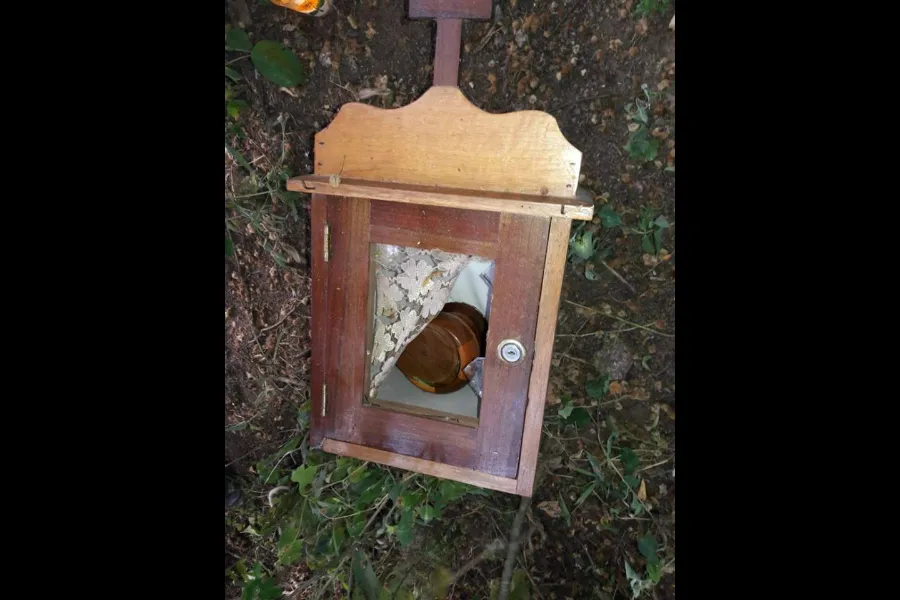
The Jinotega diocese announced on Facebook that the night of July 22, uknown persons forced open the window of the Sacred Heart chapel of St. Mark the Evangelist parish in San Rafael del Norte, about 15 miles northwest of Jinotega.

They took the tabernacle containing the Blessed Sacrament, without touching anything else, reported Fr. Noé Armando Flores, the parish priest.

The tabernacle was found later in the day of July 23 in an abandoned field.

And in Jinotega, the chapel of Our Lady of Mt Carmel at Most Precious Blood parish was profaned the night of July 20.

The Blessed Sacrament was desecrated, and the diocese showed photos of a broken window and sacred objects strewn on the ground. Sound equipment and a collection box were stolen.

At least eight Catholic churches have been desecrated in Nicaragua during the country’s three months of political and social unrest.

Protests against president Ortega which began April 18 have resulted in more than 300 deaths, according to local human rights groups. The country’s bishops have mediated on-again, off-again peace talks between the government and opposition groups.

Barricades and roadblocks are now found throughout Nicaragua, and clashes frequently turn lethal. Bishops and priests across the country have worked to separate protesters and security forces, and have been threatened and shot.

Nicaragua’s crisis began after Ortega announced social security and pension reforms. The changes were soon abandoned in the face of widespread, vocal opposition, but protests only intensified after more than 40 protestors were killed by security forces initially.

Anti-government protesters have been attacked by “combined forces” made up of regular police, riot police, paramilitaries, and pro-government vigilantes.

The Nicaraguan government has suggested that protestors are killing their own supporters so as to destabilize Ortega’s administration.

The Church in Nicaragua was quick to acknowledge the protestors’ complaints.

The pension reforms which triggered the unrest were modest, but protests quickly turned to Ortega’s authoritarian bent.

Ortega has been president of Nicaragua since 2007, and oversaw the abolition of presidential term limits in 2014.

The Church has suggested that elections, which are not scheduled until 2021, be held in 2019, but Ortega has ruled this out.

Ortega was a leader in the Sandinista National Liberation Front, which had ousted the Somoza dictatorship in 1979 and fought US-backed right-wing counterrevolutionaries during the 1980s. Ortega was also leader of Nicaragua from 1979 to 1990.

[…]

No Picture
News Briefs

Three children were euthanized in Belgium in the past two years

July 25, 2018 CNA Daily News 0

Brussels, Belgium, Jul 25, 2018 / 12:30 pm (CNA/EWTN News).- A recent government report revealed that in 2016 and 2017, three minors were euthanized in Belgium, amid a profound rise in the number of individuals legally procuring their own deaths.

“In all three cases, the patients were suffering from insufferable and incurable conditions which were already in a terminal phase,” Alan Hope reported July 18 in the Brussels Times.

The euthanization of children was legalized in Belgium in 2014. The practice had first been introduced in 2003 for adults.

Belgium’s federal control and evaluation committee recently issued a report on the use of euthanasia.

There were 2,028 euthanasia deaths in 2016, and 2,309 in 2017, a 13 percent rise year-on-year. The report found that cancer is the primary reason individuals seek euthanasia.

Most were people between 60 and 89 who exhibited multiple illnesses or ailments. 710 of those euthanized in 2016 and 2017 sought their death because of conditions like sight loss or incontinence. 19 young people, between the ages of 18 and 29, were euthanized in 2016 and 2017. 77 people sought euthanasia because of psychiatric suffering.

 Men and women are equally represented, but three times as many Dutch speakers as French speakers requested the procedure. Dutch speakers represent roughly 60 percent of Belgians, and French speakers 40 percent.

The number of persons procuring euthanasia in their homes has also increased.

Belgium’s law allows minors of any age who are terminally ill to request euthanasia. Parental consent, as well as the agreement of doctors and psychiatrists, is required.

When euthanasia for minors was legalized, a governing member of the Pontifical Academy for Life told CNA the development was “dreadful.”

“They are appealing to ‘rights of children’ to make these determinations, but children aren’t capable of making those types of self-determinations,” Haas said.

“So what is really going to happen is that, under the rules of children making these decisions for themselves, parents and physicians are going to be making those decisions, for children, to eliminate them because they’ve become excessive burdens on them and on the rest of society.”

“It’s a terrible situation. Unbelievable, if I may say so.”

The euthanization of minors is also permitted in the Netherlands, though they must be at least 12 years of age.

Teaching in his 1995 encyclical Evangelium Vitae, St. John Paul II wrote that “euthanasia is a grave violation of the law of God, since it is the deliberate and morally unacceptable killing of a human person. This doctrine is based upon the natural law and upon the written word of God, is transmitted by the Church’s Tradition and taught by the ordinary and universal Magisterium.”

“Even when not motivated by a selfish refusal to be burdened with the life of someone who is suffering, euthanasia must be called a false mercy, and indeed a disturbing ‘perversion’ of mercy … Moreover, the act of euthanasia appears all the more perverse if it is carried out by those, like relatives, who are supposed to treat a family member with patience and love, or by those, such as doctors, who by virtue of their specific profession are supposed to care for the sick person even in the most painful terminal stages.”

[…]

No Picture
News Briefs

On 50th anniversary of Humanae Vitae, reasons for hope

July 25, 2018 CNA Daily News 0

Detroit, Mich., Jul 25, 2018 / 12:16 pm (CNA).- Fifty years after Pope Paul VI issued Humanae Vitae, the landmark encyclical reaffirming Church teaching against contraception, many Catholics still don’t really understand the document and what it teaches.

“The woeful fact is that pathetically few have ever read Humanae Vitae or ever heard a homily or defense of it,” said Dr. Janet Smith, a professor at Sacred Heart Major Seminary in Detroit.

However, she told CNA, “[t]here is encouraging evidence that when they do, they find it persuasive.”

Smith, who is also a consulter to the Pontifical Council on the Family, has written and spoken extensively on the Church’s teaching in Humanae Vitae.

A quarter-century ago, for the 25th anniversary of Humanae Vitae, she released “Why Humanae Vitae Was Right: A Reader” in the hopes of helping people see the wisdom in Catholic teaching.

For the 50th anniversary, Smith is releasing an update of essays, entitled, “Why Humanae Vitae is Still Right.”

“Much has happened in the last 25 years, including the tremendous influence of the Theology of the Body on our understanding Humanae Vitae, and the scientific evidence of the detrimental effects of contraception on women’s health and male/female relationships. While the first volume remains relevant, an update of essays was needed,” she explained.

In Humanae Vitae, Pope Paul VI warned of serious social consequences that would follow if the widespread use of contraceptives became accepted.

Smith said that 50 years have shown the “prophetic power” of Humanae Vitae to be “abundantly substantiated,” with clear connections between widespread contraceptive use and the rise in unwed pregnancy, abortion, divorce, pornography, same-sex unions and transgenderism.  

“When the baby-making power of sexual intercourse is no longer considered a defining feature of sexual intercourse, virtually all sorts of sexual relationships are permissible, providing, I suppose, that they are consensual,” she said.

One common misunderstanding of Humanae Vitae, Smith said, that “it is based upon an outmoded notion of natural law that gives undue weight to simple biology.”

“The fact is that the literally infinitely greater value of human sexual intercourse is the foundation of the Church’s teaching,” she said, emphasizing that human sexuality has a dual purpose: “the facilitating of a lifelong, faithful committed relationship and the participating in God’s creation of new immortal souls – hence the necessity for human sexual relationships to be rooted in marriage, open to new life.”

Another common misconception, she said, is that Catholics may follow their consciences, even against Church teaching, whereas the Church actually says that “freedom to follow one’s conscience is based on the requirement that individuals form their consciences in accord with Church teaching.”

“I believe that few faithful Catholics [who] prayerfully read Humanae Vitae and seek out further instruction should doubts arise would not find the teaching true to God’s plan for sexuality.”

Most Catholics today fail to follow Humanae Vitae, Smith acknowledged. But rather than finding this figure discouraging, she sees hope in a study finding that Church teaching on sexuality is accepted by 37 percent of Catholic women between the ages of 18 and 34 who attend Mass weekly and go to Confession at least once a year.

“In a Church where the teaching is rarely presented and a culture that mocks the Church’s teaching, such compliance is astonishing,” she said. 

And there are other encouraging signs that the Church is working to better reach people with the message of Humanae Vitae, Smith said, such as recent efforts by the U.S. bishops to teach about the issue and encourage priests to do so as well.   

In addition, she said, diocesan family life offices and young seminarians and priests have the training and desire to teach and promote Natural Family Planning, through which a couple uses a woman’s natural fertile and infertile periods to pursue responsible parenthood. Unlike contraception, this method is accepted by the Church because it cooperates with human fertility rather than trying to stifle it.

Smith also noted marriage preparation programs that address cohabitation and contraception, as well as new teaching materials inspired by Theology of the Body, websites with resources and testimonies that are widely accessible, and an increase in faithful Catholic colleges and universities.

“My count indicates there are about 40 conferences being held that feature support of Humanae Vitae in the U.S., not to mention the webinars and likely hundreds of supportive pieces being published in print and online journals and blogs,” she added.

“More of all of this needs to be done, but a tremendous start has been made.”


[…]