No Picture
News Briefs

Lawmakers in Mexican state defeat bill to expand legalization of abortion
December 17, 2019 CNA Daily News 1

Pachuca, Mexico, Dec 17, 2019 / 04:35 pm (CNA).- Last week, the Hidalgo state legislature in Mexico defeated a bill that would have legalized abortion up to 24 weeks of pregnancy.

Abortion is already legal in the state in cases where doctors determine there is a grave risk to the health of the mother, for serious genetic or congenital malformations in the child, and for up to 90 days in cases of rape.

The bill would have legalized abortion on demand up to 12 weeks, and up to 24 weeks for minors, persons with disabilities, and in cases of rape. The legislation stated that “the embryo cannot be considered a person or a human being until the first trimester of pregnancy is completed.”

The bill was introduced March 21 by representatives Areli Miranda of the Democratic Revolution Party and Viridiana Aceves of the Social Encounter Party, along with more than a dozen members of the National Regeneration Party (Morena) of President Andrés Manuel López Obrador.

The Dec. 12 vote on the bill was 10 for and 15 against, with 5 abstentions.

Pro-life organizations hailed the vote. The Network of Pro-Life Youth of Mexico thanked the lawmakers who voted against the bill. In a statement sent to ACI Prensa, they said that “we always back public policies and the development of specific strategies by the government so they can support vulnerable women and always defend both lives.”

Rodrigo Iván Cortés of the National Front for the Family told ACI Prensa, CNA’s Spanish language news partner, that “Life has won today in Hidalgo.”

He noted that there is a tradition in Mexico, which takes place at noon on Dec. 12, of recalling the Archangel Gabriel’s annunciation to Mary that she would conceive a son, Jesus. The vote against the abortion legislation occurred at noon on Dec. 12, he said.

Cortés praised the work of Javier Serbulo, Hidalgo state director of the National Front for the Family, who helped set up the Blue Wave (pro-life) Coalition that allowed the 15 pro-life legislators to stand firm.

He also criticized the heavy pressure exerted on Morena party members to vote for the abortion bill.

Speaking to ACI Prensa, Marcial Padilla, director of the pro-life organization ConParticipación, said the Dec. 12 vote showed that “despite various efforts by sectors in the government and political parties to impose abortion on the country, they failed to get the legislators and society to buy an anti-life narrative.”

“This motivates society, especially the young people who support the right to life, that they don’t have to yield to the pressure by abortion groups,” he said.
[…]

No Picture
News Briefs

Former Continuing Anglican bishop to be received into the Catholic Church

December 17, 2019 CNA Daily News 0

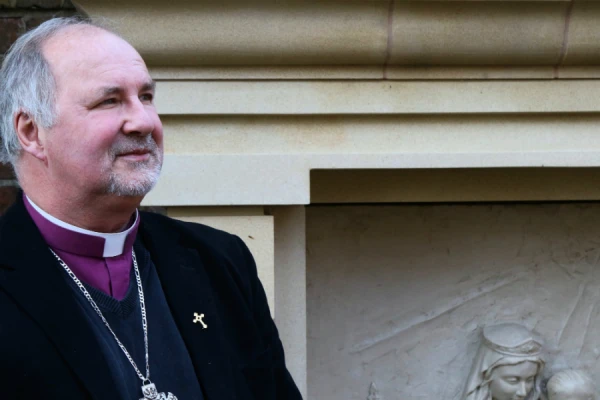
Shrewsbury, England, Dec 17, 2019 / 02:06 pm (CNA).- Gavin Ashenden, a former Honorary Chaplain to the Queen in the Church of England who was consecrated a bishop in a Continuing Anglican ecclesial community, will be received into the Catholic Church on Sunday.

He will receive confirmation Dec. 22 during a Mass at Shrewsbury Cathedral from Bishop Mark Davies of Shrewsbury.

His wife, Helen, became a Catholic about two years ago in the Diocese of Shrewsbury.

“Having come to believe that the claims and expression of the Catholic faith are the most profound and potent expression of apostolic and patristic belief, and to accept the primacy of the Petrine tradition, I am grateful to the Bishop of Shrewsbury and the Catholic community in his diocese for the opportunity to mend 500 years of fractured history and be reconciled to the Church that gave birth to my earlier tradition,” Ashenden has said.

“I am especially grateful for the example and the prayers of St John Henry Newman. He did his best to remain a faithful Anglican and renew his mother Church with the vigour and integrity of the Catholic tradition,” he added. “Now, as then, however, his experience informs ours that the Church of England is inclined to be rooted in secularised culture rather than the integrity and insight of biblical, apostolic and patristic values.”

Ashenden added that St. John Henry Newman’s experience “also inspires ours, and charts the way to our proper ecclesial home which is the rock that is the Petrine charism of faith and witness in our struggle for salvation and heaven.”

Ashenden was raised in London and Kent, and studied Law at Bristol University. He studied for priesthood in the Church of England at Oak Hill College, and received orders in 1980.

He served 10 years as a parish priest, and taught 23 years at the University of Sussex, lecturing in literature and pyschology of religion. He also earned a doctorate writing on Charles Williams, a writer and member of the Inklings. He was a member of the Church of England’s General Synod for 20 years.

Ashenden was appointed an Honoray Chaplain to the Queen in 2008.

He was consecrated a bishop in the Christian Episcopal Church, a Continuing Anglican ecclesial community, in 2013, while remaining an Honorary Chaplain to the Queen, Christian Today reported in 2017.

In 2017 he resigned from the Royal Household and relinquished his Church of England orders after a passage from the Quran denying Christ’s divinity was read at the Glaswegian cathedral of the Scottish Episcopal Church.

“It should not happen in the holy Eucharist and particularly a Eucharist whose main intention is to celebrate Christ the word made flesh come into the world,” he told BBC at the time.

Later that year, Ashenden left the Church of England, “convinced that the consecration of women to the episcopate represented the replacement of apostolic and biblical patterns with the competing culture of the values of Cultural Marxism, and dissenting from the increasing accommodation of the Church of England to radical secular views on gender.”

His episcopal consecration was announced in 2017.

When a Church of England bishop delivered a sermon while sliding down an amusement park ride built inside of Norwich Cathedral in August, Ashenden told the BBC that the event was a “mistake” that misjudged “what a cathedral is good for.”

“For such a place, steeped in mystery and marvel to buy in to sensory pleasure and distraction, is to poison the very medicine it offers the human soul,” he said.

Ashenden has said that praying the rosary and researching Eucharistic miracles helped lead him to the Catholic Church.

Bishop Davies commented that “it is very humbling to be able to receive a bishop of the Anglican tradition into full communion in the year of canonisation of St John Henry Newman.”

“I am conscious of the witness which Gavin Ashenden has given in the public square to the historic faith and values on which our society has been built. I pray that this witness will continue to be an encouragement to many,” he added.

Ashenden wrote in the Catholic Herald that “I watched as Anglicanism suffered a collapse of inner integrity as it swallowed wholesale secular society’s descent into a post-Christian culture.”

“I came to realise (too long after both Newman and Chesterton had already explained why) that only the Catholic Church, with the weight of the Magisterium, had the ecclesial integrity, theological maturity and spiritual potency to defend the Faith, renew society and save souls in the fullness of faith,” he said.

[…]

No Picture
News Briefs

Vatican’s investment funds were vehicles for Italian bank fraud

December 17, 2019 CNA Daily News 0

Vatican City, Dec 17, 2019 / 01:50 pm (CNA).- Two investment funds used by Vatican dicasteries were also used by a major Italian bank to conceal illegal investments for which the bank was eventually closed.

On Friday, Matlese media reported that the IOR, or Vatican Bank, is suing Optimum Asset Management over 230 million euros in losses through a fund under its management. The IOR is being sued in turn by Optimum for breach of contract; the firm claims the Vatican’s bank owes an additional 24 million euros as an already agreed-upon investment in another of its funds.

Optimum was in 2015 identified by Italian authorities, as a fund manager through which Banca Popolare di Vincenza fraudulently funneled money meant for outside investments back into investment in the bank itself.

While the bank was required by European law to maintain a diversified investment portfolio as a hedge against risk, it was found to have used Optimum to fraudulently invest in itself instead, leaving the accounts and investments of customers at a high degree of risk.

The bank used the same tactic, channeling investment funds back into itself, through the Athena Global Fund, run by Raffaele Mincione.

Italian media have estimated that the fraud involved hundreds of millions of euros in bank funds.

Mincione’s Athena Global Fund was also used by the Holy See’s Secretariat of State to invest hundreds of millions of Church funds, most notably through the purchase of a luxury property development in London from his own holding company, Time & Life SA.

Through dedicated funds created by Athena in which the Vatican and Banca Popolare were the exclusive investors, Mincione also used funds from both to buy unrated, non-recourse bonds in Time & Life – essentially using investor funds to make no-strings-attached loans to his own holding company.

Time & Life used some of the money raised this way to buy shares in Banca Popolare – meaning that Mincione was returning bank invested funds to the bank through the back door.

By using its own investment funds to purchase its own shares indirectly through Optimum and Mincione’s holding company, Banca Popolare secretly consolidated its ownership and evaded regulatory requirements to raise additional equity capital. The scheme inflated the bank’s financial returns and concealed its portfolio’s exposure to risk at the same time.

When the scheme was discovered by Italian authorities, Banca Popolare was fined, and then closed by a forced sale to Intesa San Paolo, one of Italy’s largest lenders, in 2017. 

Mincione and Optimum were paid millions of euros in management fees for redirecting the bank’s investment back into itself, while also benefiting by directing the remainder of the bank’s investment funds.

According to filings made on the Irish Stock Exchange in 2012 and 2013, Mincione also borrowed tens of millions of euros from his own company Time & Life, in which the Vatican’s Secretariat of State was heavily invested, through low-interest loans made to a trust, of which he was the beneficiary, based in the Isle of Jersey – a well-known European tax haven. 
 
These funds were in turn used by Mincione for other investments in high-risk ventures.

In 2015, Mincione bought a 5% stake in EZTD Ltd, an Israeli-based company providing an online options trading platform to American investors. That investment lost 90% of its value after a 2016 SEC finding that the company had misled investors and violated both the Securities Act and the Securities and Exchanges Act. The SEC found that fewer than three percent of the company’s 4,000 U.S. account holders made a profit investing through the company.

While the Vatican spent hundreds of millions buying control of the London property development from Mincione, he also cleared an additional 60 million euros in management and transaction fees, on top of his profits from actually selling shares of the building to the Secretariat of State.

The Holy See’s Secretary of State, Cardinal Pietro Parolin, has said that the Vatican’s London investment must be investigated, but has not yet indicated what parties are responsible for the investment, or whether internal investment policies have been violated. Pope Francis said last month that some involved in the investment have done things that seem, to him, “not clean.”


[…]

No Picture
News Briefs

‘Angels Unawares’ – Vatican migration sculpture coming to United States

December 17, 2019 CNA Daily News 5

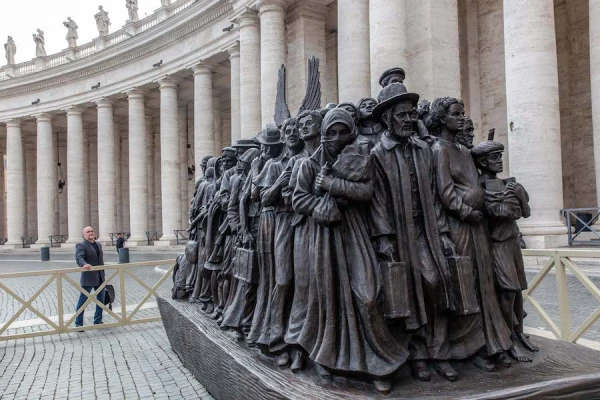
Vatican City, Dec 17, 2019 / 12:56 pm (CNA).- In 2019, Pope Francis unveiled a new bronze sculpture in St. Peter’s Square, “Angels Unawares,” a depiction of migrants throughout history crammed together on a boat with the holy family.

The sculpture’s artist, Timothy Schmalz, told CNA Tuesday that a second cast of the “Angels Unawares” sculpture will be touring different cities around the U.S. before being permanently installed in a yet-to-be-disclosed location in the United States.

The 20-foot-tall bronze statue is based off of Hebrews 13:2, “Be welcoming to strangers, many have entertained angels unawares.”

“Most of the time when I sculpt, I turn on the Bible. Actually I have it on unabridged tapes read by Steven B. Stevens,” Schmalz told CNA. “Just listening to the Bible as I sculpt … turns my studio into a sort of a chapel and a very spiritual place when the sound is being filled up with Biblical texts.”

For this work, Schmalz also had refugees from Africa visit his studio in Canada to model for some of the 140 different people depicted in the sculpture. He also collected vintage photographs of people’s grandparents, who crossed the Atlantic as immigrants.

“What I wanted to do is create a sculpture that is really inclusive of all migration,” he said. “It exemplifies all historical, all cultures, all races that have ever moved throughout the world.”

“You have a Jew escaping Nazi Germany right beside a Muslim from today escaping Syria and … you have a Polish woman leaving communist Poland right beside an Irish boy escaping from the potato famine,” Schmalz said.

“They’re actually sculpted out of one big mass of clay which is to symbolize unity … in it you have Mary and Joseph being worked within this tapestry of people,” he said.

Mother Cabrini, the patron saint of immigrants, is also among the faces huddled together on the sculpted boat.

Pope Francis first revealed the “Angels Unawares” sculpture in St. Peter’s Square after the Mass for the World Day of Migrants and Refugees Sept. 29, 2019.

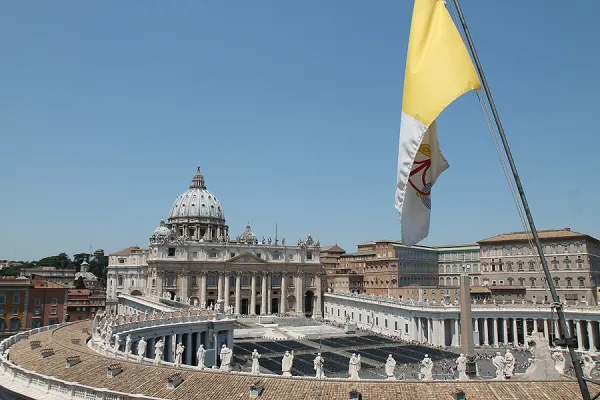
While it is not the first statue to be added to St. Peter’s Square in 400 years as many Vatican pundits claimed — the current statues of St. Peter and St. Paul were commissioned by Pope Pius IX in the mid-19th century — the bronze sculpture is the first post-conciliar statue to be permanently added to the piazza.

“Knowing that it was meant for Saint Peter’s Square, I made sure I created 140 migrants within the piece, sort of a symbolic attachment to the 140 statues around the colonnade,” Schmalz said.

The artist said that he hopes the new piece of art in St. Peter’s Square “confirms the idea that this is a living Church, that it’s not a museum,” as Pope Francis has frequently repeated.

It is “something that has been created in the year 2019, and so it doesn’t necessarily and it should not look like a sculpture that was created in the 1600s,” he said.

It is not his first work for the Vatican – an installation of Schmalz’s “Homeless Jesus” was created for Vatican City in 2016. In November 2019, his sculpture entitled “I was naked and you clothed me” was installed in front of St. Matthew’s Cathedral in Washington D.C.

“Angels Unawares” came about after Cardinal Michael Czerny, then a Jesuit priest, asked Schmalz to think about creating a new sculpture based on the theme of migration.

The artist sent Czerny photos of a small model of his idea, which Fr. Czerny then showed them to Pope Francis who invited Schmalz to come to Rome for further discussions.

“It was probably after six months of working on the concept that I heard that Pope Francis wanted to install it right here in Saint Peter’s Square. And so at that time I began to drop everything in my life to start working on this project,” Schmalz said. “Everyday I woke up at 4 in the morning until basically at then end of the day working obsessively on the piece.”

Schmalz recently completed a live sculpting of a nativity display at the Museum of the Bible in Washington D.C. in which visitors to the museum could watch him as he worked.

“I’m always searching for Scripture that I can bring to life, bring to sculpture, bring to art,” he told CNA.

“Within Christianity today, we need to use as many weapons as possible to get our message across because there’s a lot of competition out there for people’s attention on so many different issues,” Schmalz said.

“Christianity is an endless source of creativity for artists,” he said.

All photos credit: Daniel Ibanez / CNA.

[…]

No Picture
News Briefs

The Vatican and IDI financial scandal: A CNA explainer

December 17, 2019 CNA Daily News 1

Vatican City, Dec 17, 2019 / 10:02 am (CNA).- For more than a year, CNA has been following a Vatican financial scandal involving a bankrupt Italian hospital, a potentially illicit loan from the Vatican’s central bank, and a controversial grant request to an American charitable foundation.

The financial scandal is one of several unfolding at the Vatican, and covered by CNA. Having trouble keeping them straight? You’re not alone. This is the first in a series of CNA explainers, designed to help you keep track of the money trails in and out of the Vatican.

Here’s the IDI scandal in a nutshell:

In 2012, an Italian hospital, owned by a religious order, went bankrupt, because its administrators had run up large debts while embezzling millions of dollars. The Vatican Secretariat of State then created a for-proft partnership with the religious order that had owned the hospital. The partnership agreed to purchase the hospital. To do so, it received – through a complex series of transactions – 50 million euro, through a loan from the Vatican central bank, APSA, despite the fact that APSA had agreed with European banking regulators not to make commercial loans.

In an attempt to take the loan off APSA’s books, officials in the Secretariat of State then asked the Papal Foundation, a U.S.-based charitable foundation, for a $25 million grant, which they reportedly requested under misleading or ambiguous pretenses. The grant was approved, but subsequent questions from board members ultimately led to controversy and opposition. The Vatican’s secretary of state, Cardinal Pietro Parolin, has said he organized the loan and the grant.

Here are the major figures and developments in the ongoing story of the IDI hospital:
 
IDI hospital – The Istituto Dermopatico dell’Immacolata (IDI), an Italian dermatological hospital. After a series of embezzlement scandals drove the hospital into bankruptcy, it was purchased by a for-profit partnership created between the Vatican’s Secretariat of State and the religious order that had owned and managed the hospital.
 
IOR – The Vatican’s commercial bank, also known as the Institute for Religious Works, or the Vatican Bank. In 2015, the IOR rejected a request for a 50 million euro loan to a for-profit partnership created between the Vatican Secretariat of State and a religious order with the intention of purchasing the bankrupt IDI hospital. IOR board members determined that the hospital would never be able to repay the loan.
 
APSA – The Vatican’s central bank, similar to a federal reserve. Under 2012 European regulatory agreements, APSA cannot make commercial loans. However, after the IOR in 2015 rejected a 50 million euro loan request to purchase the bankrupt IDI hospital, APSA approved the loan, raising questions of whether it violated European regulations in doing so. Officials with the Vatican Secretary of State then asked the U.S.-based Papal Foundation for a grant to help remove the loan from APSA’s books. That grant fell through, and APSA has now reportedly written off most of the loan.
 
Papal Foundation – A U.S.-based group that gives grants to causes endorsed by the pope, often in developing nations and typically of $300,000 or less. The Papal Foundation was asked in June 2017 for a $25 million grant to help with a temporary cash shortage at the IDI hospital. The funding was initially approved, with cardinal board members who supported the grant outnumbering lay board members who opposed it. However, some lay board members continued to object to the grant, questioning whether it was actually intended to cover the bad APSA loan. Amid increased scrutiny, the grant collapsed. $13 million of the grant has already been paid, which the Vatican Secretary of State now says is being treated as a loan that will be repaid through discounts against future grant requests.
 
Cardinal Angelo Becciu – Formerly the number two official at the Vatican Secretariat of State. Multiple Vatican sources have told CNA that Becciu, along with Cardinal Giuseppe Versaldi, was key in organizing the effort to acquire the IDI hospital and to pressure the Papal Foundation into approving a $25 million grant to help offset the potentially illicit APSA loan, removing it from the books. Becciu denies any involvement, saying he had lost interest in the project by the time of the Papal Foundation grant.
 
Cardinal Pietro Parolin – Vatican Secretary of State. Parolin told CNA that he was responsible for arranging the 2014 loan of 50 million euros from APSA, the Vatican’s central bank, to partially fund the purchase of the bankrupt IDI hospital. He said the arrangement was “carried out with fair intentions and honest means,” although the loan appears to violate 2012 regulations prohibiting APSA from making commercial loans. He also said that he had devised a plan, along with Cardinal Donald Wuerl, to ask the U.S.-based Papal Foundation for the money to cover APSA’s bad loan.
 
Theodore McCarrick – Former cardinal who has now been laicized for sexually abusing minors. McCarrick met with the secretary of APSA in July 2017. He later pressured lay board members of the Papal Foundation to support the grant, suggesting that questioning the Vatican funding request was inappropriate and would challenge the integrity of the foundation itself.

Cardinal George Pell – Former head of the Prefecture for the Economy, charged with overseeing the Vatican’s financial accountability. In this role, Pell reportedly objected to the APSA loan to buy the IDI hospital. After lobbying from Becciu, Pope Francis withdrew oversight authority of APSA from Pell’s office in 2015. Pell is currently in prison in Australia, convicted on controversial sex abuse charges, which he is appealing.


[…]

No Picture
News Briefs

Accused nuncio to France resigns post

December 17, 2019 CNA Daily News 1

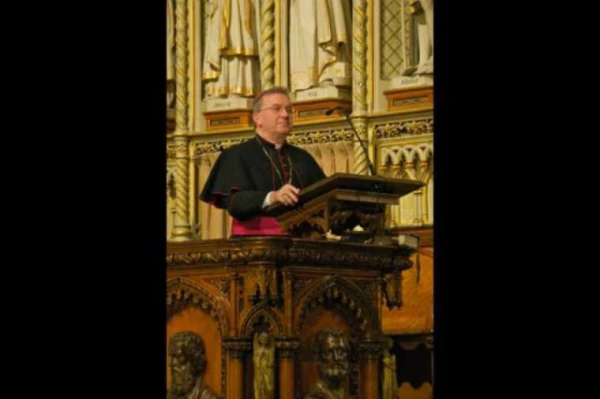
Vatican City, Dec 17, 2019 / 05:27 am (CNA).- Pope Francis Tuesday accepted Archbishop Luigi Ventura’s resignation as apostolic nuncio to France. Ventura was accused of sexual assault earlier this year.

The Vatican revoked Ventura’s diplomatic immunity in July, paving the way for a possible trial.

Ventura turned 75 on Dec. 9, the mandatory age at which bishops submit their resignation to the pope. The pope then accepts the resignation at his discretion.

French news agency I.Media reported at the end of September that Ventura had returned to Rome and was living in a residence for elderly priests near St. Peter’s Square.

He is accused of having inappropriately touched a young male staffer of Paris City Hall during a Jan. 17 reception for the New Year address of Paris mayor Anne Hidalgo. That accusation was under investigation by Parisian authorities but has not yet gone to trial.

After the initial allegation was made against in Ventura in March, he faced a second accusation of sexual misconduct against an adult male relating to his time in Canada in 2008.

Christian Vachon, who was 32 at the time of the alleged incident, claims Ventura touched his buttocks at least twice during a banquet held at the Basilica of Sainte-Anne-de-Beaupré, near Quebec.

Ventura served as nuncio to France from 2009.

He was ordained a priest of the Diocese of Brescia in 1969. He entered the diplomatic service of the Holy See in 1978 and has served in Brazil, Bolivia, and the United Kingdom. From 1984 to 1995 he worked at the Secretariat of State’s Section for Relations with States.

After his episcopal consecration in 1995, Ventura served as nuncio to Ivory Coast, Burkina Faso, Niger, Chile, and Canada, before his transfer to France.


[…]