No Picture
News Briefs

Four seminarians abducted in Nigeria

January 13, 2020 CNA Daily News 3

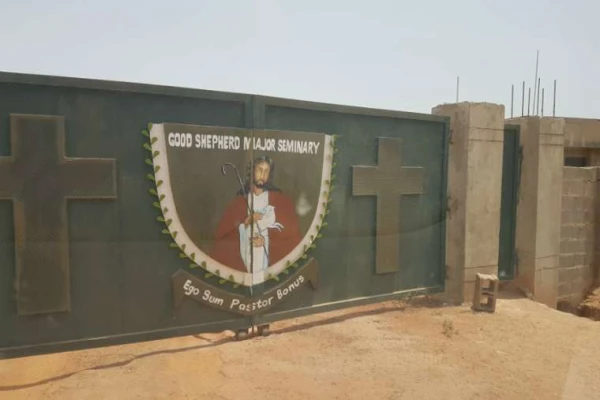
Kaduna, Nigeria, Jan 13, 2020 / 03:01 pm (CNA).- Four seminarians, between the ages of 18 and 23, were abducted Wednesday night from their seminary in Kaduna, in northwestern Nigeria.

Pius Kanwai, 19; Peter Umenukor, 23; Stephen Amos, 23; and Michael Nnadi, 18, were taken from Good Shepherd Seminary in Kaduna, around 10:30 pm on Jan. 8 by gunmen. Police are searching for the four young men.

Nearly 270 seminarians live at Good Shepherd.

“The security situation in Nigeria is appalling”, Thomas Heine-Geldern, executive president of ACN International, said Jan. 13. “Criminal gangs are further exploiting the chaotic situation and making matters still worse.”

He compared the situation in Nigeria to that of Iraq prior to the Islamic State’s invasion: “Already at that stage, Christians were being abducted, robbed and murdered because there was no protection by the state. This must not be allowed to happen to the Christians of Nigeria. The government must act now, before it is too late.”

The gunmen, disguised in military camouflage, broke through the fence surrounding the seminarians’ living quarters and began shooting sporadically. They stole laptops and phones before kidnapping the four young men.

A source in Nigeria told ACI Africa that the kidnappers made contact with family members of the seminarians Jan. 11, “but never pronounced any amount of money as ransom.”

Each of the abductees were first year philosophers, sources told ACI Africa.

Good Shepherd Seminary is located just off the Abuja-Kaduna-Zaria Express Way. According to AFP, the area is “notorious for criminal gangs kidnapping travelers for ransom.”

The news agency said that schoolgirls and staff from a boarding school also located near the highway were kidnapped in October, and were later released.

Kidnappings of Christians in Nigeria have multiplied in recent months, a situation that has prompted Church leaders to express serious concern about the security of their members and to call on the government to prioritize the security of its citizens.


A version of this story was initially reported by CNA’s sister agency, ACI Africa. It has been adapted by CNA.

[…]

No Picture
News Briefs

Lima archbishop offers ‘clarification’ on controversial Eucharist remarks

January 13, 2020 CNA Daily News 0

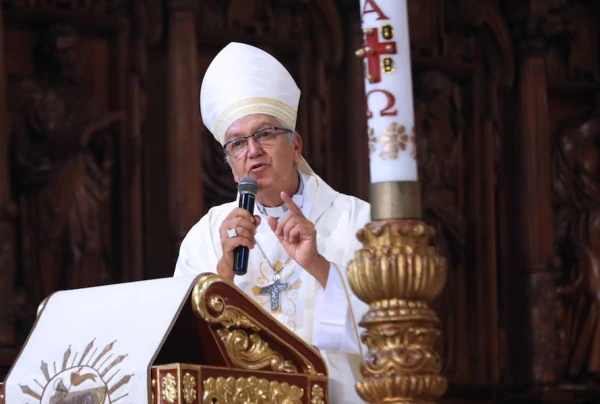
Lima, Peru, Jan 13, 2020 / 12:00 pm (CNA).- After controversial remarks last week, the Archbishop of Lima said Thursday that he did not intend to undermine the importance of prayer in the presence of the Eucharist.

“It is essential for us to maintain a level of entering and contemplating the mystery of the Lord made bread for us, the mystery of the transubstantiation as we call it more technically, which means the real presence of the Lord,” Archbishop Carlos Castillo Mattasoglio said Jan. 7.

Castillo’s remarks came after he told Lima’s synodal assembly Jan. 7 that “no one is converted with the tabernacle.” At that meeting, Castillo said that while Pope Francis has mentioned contemplation of the Eucharist as a source of spiritual growth, “no one is converted with the tabernacle. We are all converted from meeting people who ask us questions and who are human dramas where the possibility of encountering the Lord arises.”

“I can later sit before the tabernacle and pray and all that, and surely; but it is very rare that I have illumination in a passive state…Contemplation is extremely important but to the extent the faith has been transmitted, somebody communicated the faith to me,” Castillo added.

“We are all believers because someone announced the Gospel to us, from our mother who made the sign of the cross, the grandma. the dad, the aunt, classmates at school, the Christian community or the singing group…It’s in human relationships where the Lord is hidden, that his presence appears and we welcome him,” Castillo added.

The archbishop’s remarks, posted on YouTube, became a source of controversy in Peru, where they were seen by some Catholics to downplay the importance of the Eucharist, or the power of prayer.

After his comments were published, Castillo offered a “clarification,” explaining that “some people were a bit surprised by a point I made in the morning. What I said was, let’s say, before the tabernacle you don’t find your vocation, a vocation is found in life. And the tabernacle, as you know, is the place to visit where the permanent presence of the Lord is under the forms of bread and wine, and there the Real Presence.”

“Pope Francis said here in Trujillo that when one has a vocation, the vocation is always received in life,” Castillo added.

Castillo, who was a theology professor at the Pontifical Catholic University of Peru, became Lima’s archbishop March 2, 2019.

Castillo’s remarks were intended as a commentary on a Jan. 20, 2018 discourse from Pope Francis to priests and consecrated religious in Trujillo, Peru. In that speech, the pope discussed the importance of prayer before the Eucharist.

“Sit down a while and allow him to look at you and remember those times he looked at you and looks at you. Allow yourselves to receive his gaze. This is the most precious possession of a consecrated person: the Lord’s gaze,” Francis said in his remarks.

The pope added that the Lord finds and heals believers in the difficult circumstances of their own life, and from those circumstances, brings them to contemplate him in the presence of the Eucharist.

That, Castillo claimed Jan. 7 in his clarification, is the point he had been trying to make.

The “first encounter with the vocation and the successive kerygmatic encounters are in life and in often terrible situations and sometimes also very beautiful situations, but they aren’t, let’s say, in a moment where I’m alone and there’s a kind of look from the Host at me and me at the Host.”

The archbishop’s clarification, however, also raised a concern about the role of contemplation in life.

“And we have to take into account something that is very important: all that which are  sacraments are signs the Lord has left to remember life and to live life more deeply, to nourish life, but not to replace it.” 

Nevertheless, Castillo added, “I can’t then say tomorrow we all go to the tabernacle and we only devote ourselves to be before the tabernacle, because that’s the truest part of life. [Because] who’s cooking?  And who’s preparing something to eat? So if we see things that way, with [contemplation] as the greatest thing there is, and the only thing that is, be careful.”

Pope Francis has referred to the importance of praying before the Eucharist.

In September 2018, speaking to the bishops in mission territories, the pope explained that a bishop, being a successor of the apostles, is called by Jesus to remain with him and therefore “before the tabernacle he learns to entrust himself to and to trust in the Lord,” because “there he finds his strength and his confidence.”

On Jan. 31, 2019, the pope recalled Don Bosco, the founder of the Salesians, and said that for the priest to look at reality “with the eyes of a man and with the eyes of God,” he has to spend “ample time before the tabernacle”

At Midnight Mass, Dec. 24, 2019, Pope Francis also spoke of the importance of contemplating Christ in the Eucharist present in the tabernacle.

“Today is the right day to draw near to the tabernacle, the crèche, the manger, and to say thank you. Let us receive the gift that is Jesus, in order then to become gift like Jesus. To become gift is to give meaning to life. And it is the best way to change the world: we change, the Church changes, history changes, once we stop trying to change others but try to change ourselves and to make of our life a gift,” the pontiff said.


[…]

No Picture
News Briefs

Architect calls for Notre-Dame’s roof to be rebuilt of wood

January 11, 2020 CNA Daily News 2

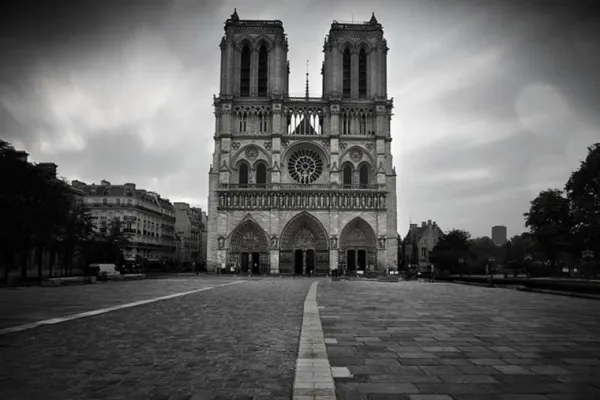
Paris, France, Jan 11, 2020 / 06:01 am (CNA).- A leading architect in France has urged that the roof of Notre-Dame de Paris be reconstructed out of wood, for the sake of the building’s structural integrity.

Eric Wirth of the Guild of French Architects, expressed at a French parliamentary hearing Jan. 8 that rebuilding the roof with concrete or metal would be a mistake.

“We have to be sceptical of seemingly brilliant solutions” involving metal or concrete rafters he said, according to AFP.

“The most modern and ecological material today is wood,” Wirth said.

He said the cathedral is still at risk of collapse after a fire struck the cathedral in April, destroying the roof and spire and damaging the windows and vaults. He said alternative materials to wood might have resulted in further damage to the cathedral.

“The cathedral has been there for 800 years. Had it been built in concrete or steel it would not still be there,” he further added.

“Even with all the (chemical) protection treatments, given the intensity of the blaze… the steel would have held for half an hour and then it would have twisted, pulling on the walls and everything would have collapsed.”

He said that even if metal or concrete roofs were lightweight, the building’s structure is built for a heavy roof, and that such Gothic cathedrals “stand up structurally because there is a large mass on the vaulted ceiling … they only work because the roof is heavy.”

“We are lucky to have all the information we need to rebuild an identical roof.”

The comments came after Jean-Louis Georgelin, army general in charge of the restoration, said the call for an oak roof is just “lobbying” by wood industries. He said all options will be analyzed before anything is put in place.

“There will be a study, and all possible options will be examined,” said Georgelin, according to AFP.

In November, Georgelin had disagreed over whether the cathedral’s new spire should look modern or medieval. Georgelin, who supports a “contemporary” spire, reportedly told the architect Philippe Villeneuve that he should “shut his mouth” over the spire’s design.

The French parliament over the summer passed a bill declaring that Notre-Dame must be rebuilt exactly the way it was prior to the fire

Since the adoption of the 1905 law on separation of church and state, which formalized laïcité, a strict form of public secularism, religious buildings in France have been property of the state.

In December, the cathedral’s rector expressed concern that the Church is still at risk of destruction and may not be able to be reconstructed safely.

The church “is not out of danger,” Monsignor Patrick Chauvet said to the Associated Press Dec. 24. “It will be out of danger when we take out the remaining scaffolding.”

“Today we can say that there is maybe a 50% chance (the cathedral) will be saved,” said Chauvet. “There is also (a) 50% chance of scaffolding falling onto the three vaults, so as you can see, the building is still very fragile,” he added.

The scaffolding, present at the time of the fire on April 15, had melted together, and there are still about 551 tons of metal still present on top of the cathedral.

He said that after the scaffolding has been removed, the team will be able to better assess the state of the cathedral and begin the restoration. He said the scaffold will not likely be removed until 2021 and does not think the cathedral will be completed in time for the 2024 Summer Olympics in Paris, as French president Emmanuel Macron has vowed.

[…]