
No Picture
News Briefs

The beatitudes show the path from selfishness to holiness, says pope
April 29, 2020 CNA Daily News 2

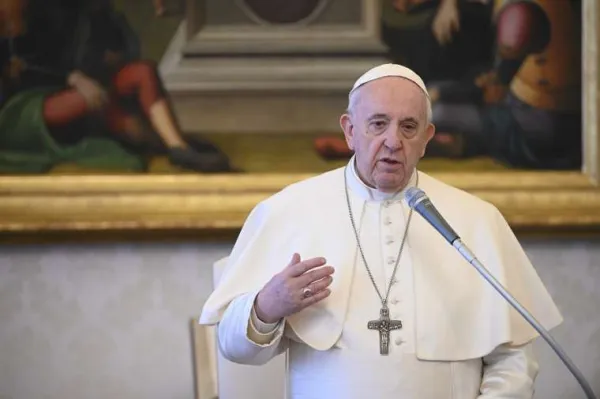
Vatican City, Apr 29, 2020 / 05:15 am (CNA).- The eight beatitudes proclaimed by Jesus in the Sermon on the Mount reveal the path from selfishness to holiness, Pope Francis said at his general audience Wednesday.

Speaking via livestream due to the coronavirus crisis, the pope said April 29: “The path of the Beatitudes is an Easter journey that leads from a life according to the world to a life according to God, from an existence guided by the flesh — that is, by selfishness — to one guided by the Spirit.”

In his address from the library of the apostolic palace, the pope concluded his cycle of catechesis on the beatitudes.

He said that the eighth beatitude, “Blessed are they who are persecuted for the sake of righteousness, for theirs is the kingdom of heaven” (Matthew 5:10), was intimately connected to the first, “Blessed are the poor in spirit, for theirs is the kingdom of heaven” (Matthew 5:3).

“This beatitude announces the same happiness as the first: the kingdom of heaven is for the persecuted just as it is for the poor in spirit,” he said. “We understand that we have arrived at the end of a unified path set out in the previous proclamations.”

Those who follow the path of the beatitudes soon find themselves in conflict with the world, the pope noted. But they are blessed because “they have found something worth more than the whole world.”

“The world, with its idols, its compromises and its priorities, cannot approve of this kind of existence,” he said. So it dismisses life according to the Gospel “as an error and a problem, therefore as something to be marginalized.” 

That is why the world has persecuted Christians throughout history, the pope observed.

“It is painful to remember that, at this moment, there are many Christians suffering persecution in various parts of the world, and we must hope and pray that as soon as possible their tribulation will be stopped,” he said. 

He encouraged Catholics to express their solidarity with the persecuted, who he described as “bleeding members of the body of Christ which is the Church.” 

The pope urged Christians to be careful not to read the eighth beatitude in a “self-pitying way.” Sometimes, he said, we arouse contempt because we have drifted away from the Gospel, rather than because we are witnessing to it.

He said: “In fact, the contempt of men is not always synonymous with persecution: just a little later Jesus says that Christians are the ‘salt of the earth,’ and warns against ‘losing the taste,’ otherwise salt ‘serves no other purpose than to be thrown away and trampled underfoot’ (Matthew 5:13). Therefore, there is also a contempt that is our fault when we lose the taste of Christ and the Gospel.” 

In off-the-cuff remarks at the end of his address, the pope said: “In persecutions there is always the presence of Jesus who accompanies us, the presence of Jesus who consoles us and the strength of the Spirit who helps us to move forward.” 

“Let us not be discouraged when a life consistent with the Gospel attracts people’s persecutions: there is the Spirit that sustains us on this road.”

[…]

No Picture
News Briefs

Vancouver archbishop donates to coronavirus vaccine research

April 28, 2020 CNA Daily News 0

Denver Newsroom, Apr 28, 2020 / 05:17 pm (CNA).- Archbishop Michael Miller of Vancouver has announced that he is donating to the University of British Columbia’s research toward a COVID-19 vaccine.

“May the search for COVID-19 solutions also be a moment of solidarity, of collaboration, and of growing together as a visible sign to the world of the healing and reconciliation so needed right now,” Archbishop Miller said April 27 as reported by the B.C. Catholic.

Ryan Thomas, a special advisor to the archdiocese, told CNA that Archbishop Miller wanted to express, through his donation, the Catholic Church’s support for science and medicine that contribute to the common good.

“The Church— as Pope Francis has said from the beginning of his pontificate— is called to go out, we’re called to engage, not called to retreat,” Thomas told CNA.

“From a scientific standpoint, that means identifying the research that is worthy of our investment, that meets the high standards that we have to protect life,” he said.

Thomas declined to specify the amount of the donation, but said that it was in the thousands of dollars.

The global effort to develop a COVID-19 vaccine includes at least 50 other research teams, the university says, many of which in the U.S. and Canada have received government funding and are being conducted by large pharmaceutical companies.

Pro-life leaders have warned in recent months that among the many COVID-19 vaccines currently in development worldwide, in some cases researchers are using old cell lines derived from the cells of aborted babies.

It was important to Archbishop Miller, Thomas said, that the Church be seen to be promoting research into a vaccine that Catholics can support in good conscience.

A group of Evangelical Christians and Catholics in Vancouver began to rally around the idea of supporting a vaccine that corresponded to Christian ethical standards, and eventually presented the idea of supporting UBC’s research to Archbishop Miller.

Thomas said Miller made sure to inquire about whether UBC’s vaccine research makes use of aborted fetal cells, which it does not.

Dr. Wilf Jefferies, the project’s lead researcher, told CNA via email that his research team is currently in the process of validating the potency of vaccine candidates in preclinical trials, in order to assess their potential toxicity before trying them in human subjects.

The UBC lab is using immune-boosting components called adjuvants in its vaccine candidate, with the hopes of reducing the dosage of vaccine required for complete protection against the disease. In addition, Jefferies hopes that UBC’s vaccine will continue to provide protection against COVID-19 even if the virus mutates over time.

“I am heartened by the unity and kindness that is being demonstrated during this pandemic,” Jefferies told CNA.

“I think the response by the archdiocese is an affirmative and practical way to address the critical need in our society to develop a vaccine…I am sincerely humbled by the support we have received from the archdiocese and from other groups and individuals.”

So far, Jefferies’ lab has received grants from the government-funded Michael Smith Health Research Foundation and the Sullivan Urology Foundation affiliated with the University of British Columbia, as well as a number of private donations.

There are at least 1,000 clinical trials currently taking place around the world to test potential COVID-19 vaccines.

A group of pro-life leaders in a letter to the Trump administration earlier this month reiterated that development of a COVID-19 vaccine should avoid unethical links to abortion.

“No American should be forced to choose between being vaccinated against this potentially deadly virus and violating his or her conscience,” reads the April 17 letter to Dr. Stephen M. Hahn, commissioner of the U.S. Food and Drug Administration.

“Fortunately, there is no need to use ethically problematic cell lines to produce a COVID vaccine, or any vaccine, as other cell lines or processes that do not involve cells from abortions are available and are regularly being used to produce other vaccines,” it continued.

The letter’s signers include Archbishop Joseph Naumann of Kansas City in Kansas, chair of the U.S. Conference of Catholic Bishops’ Committee on Pro-Life Activities; the heads of three other bishops’ conference committees; and leaders of many other Catholic and non-Catholic groups.

The Pontifical Academy for Life has noted that Catholics have an obligation to use ethically-sourced vaccines when available, and have an obligation to speak up and request the development of new cell lines that are not derived from aborted fetuses.

The 2008 Vatican document Dignitatis personae strongly criticized aborted fetal tissue research. However, as regards common vaccines, such as those for chicken pox and measles, mumps, and rubella (MMR), that may be derived from cell lines of aborted babies, the Vatican said they could be used by parents for “grave reasons” such as danger to their children’s health.

In a 2017 document on vaccines, the academy noted a “moral obligation to guarantee the vaccination coverage necessary for the safety of others… especially the safety of more vulnerable subjects such as pregnant women and those affected by immunodeficiency who cannot be vaccinated against these diseases.”


[…]

No Picture
News Briefs

Protect vital migrant and farm workers during coronavirus, bishops say

April 28, 2020 CNA Daily News 1

Washington, D.C. Newsroom, Apr 28, 2020 / 04:47 pm (CNA).- The bishops of the United States have called for increased protections and support for farm workers during the ongoing COVID-19 pandemic.

An April 29 statement from the U.S. bishops’ coference, co-signed by four bishops, advocated that employers of migrant and farm workers, as well as public health officials, acknowledge that “all workers need access to free testing and care related to the COVID-19 virus.”

The bishops called for renewed commitments from employers to ensure that housing and transportation provided for farm workers is safe and compliant with Centers for Disease Control guidelines, that information on health and hygiene practices is “easily accessible in multiple languages” and that workers be given any appropriate personal protective equipment. 

The statement was signed by Archbishop Nelson Perez of Philadelphia, chairman of the USCCB Committee on Cultural Diversity; Bishop Joseph Tyson of Yakima, who leads the Subcommittee on Pastoral Care of Migrants, Refugees and Travelers (PCMRT); Bishop Oscar Cantu of San Jose, the PCMRT’s episcopal liaison for migrant farmworker ministry; and Bishop Mario Dorsonville, an auxiliary bishop of Washington and leader of the USCCB’s Committee on Migration.

The statement also noted the need for emergency plans, establishing protocols for when a worker is diagnosed with COVID-10. 

“To defeat the virus, no one must be left out,” said the bishops. “The COVID-19 virus teaches us we are one human family, says the Holy Father. ‘We can only get out of this situation together, as a whole humanity.’”

The bishops said it was essential to “honor the dignity of farmworkers and make sure that they are paid a livable wage as well as be eligible for other benefits to help protect their health and the health and safety of their families at this time.” 

Bishop Tyson told CNA on Tuesday that the safety of migrant workers is especially important in his own diocese, where much of the population and economy is connected to the agricultural industry. 

“We’re hoping that [these suggestions] are principles that will guide all the stakeholders –whether that’s ranchers, orchardists […] owners of the packing plants, government officials, health department people” Tyson told CNA in an interview.

“We’re just offering those as principles for all of the stakeholders, regardless of how they’re involved in the agricultural industry,” he added. 

Tyson told CNA that the statement was “just at the beginning” of a process of developing policy suggestions. He said he and his brother bishops were “trying to be proactive” with their recommendations and best serve the migrant farmworker population, which swells during the state’s bigger harvesting seasons. 

The Diocese of Yakima, where Tyson has been a bishop since 2011, grows by one-third each summer as migrant workers come to work in the area. More than 62% of his diocesan population are considered “essential workers” during summer months, meaning they are at increased risk of contracting the virus as they continue to work ensuring the country’s food supply. 

“We are very concerned that our workers, our parishioners, our fellow Catholics, have the protection they need in order to do their essential work in the fields” said Tyson. “They are the ones harvesting the fruit, cutting the asparagus, pulling the apples off the trees and sorting them.”

Tyson told CNA that there are “many” employers, ranchers, and orchardists who are working to provide equipment to their workers, for which he is grateful. He said that he hopes these policies will become more widespread across the agricultural industry.

“This is all very real to us,” explained Tyson. “It’s a real key issue, our own folks, here.”

[…]