No Picture
News Briefs

Swiss accounts frozen in Vatican property deal probe

May 29, 2020 CNA Daily News 1

CNA Staff, May 29, 2020 / 02:30 pm (CNA).- Tens of millions of euros have been frozen in Swiss banks as part of the investigation into a Vatican property investment, according to a Swiss media report. Swiss authorities have also forwarded documents to Vatican prosecutors, as part of an investigation into investments made by the Holy See Secretariat of State.

On May 23, NZZ am Sonntag reported that Holy See prosecutors sent Swiss authorities a formal request for help examining the Holy See Secretariat of State’s investment of more than $300 million in a luxury London property development.

“The Federal Office of Justice received a request for legal assistance in this matter,” spokesman Raphael Frei told NZZ. “With a diplomatic note dated April 30, 2020, the Federal Office sent the Vatican a first part of the requested documents.” 

The newspaper also reported that its sources had confirmed tens of millions of euros have been frozen in several Swiss banks as part of the investigation.

Vatican investigators are examining the Secretariat of State’s purchase of the building at 60 Sloane Avenue, London.  In October 2019, four officials at the department were suspended following a raid by Vatican gendarmes in which they seized files and computers. A further raid on a former senior official at the secretariat was conducted in February.

CNA has reported that that deal was at least partially financed with loans from several Swiss banks, including Credit Suisse and BSI.

BSI was the subject of a damning report by Swiss banking authorities in 2016, which found that the bank was in “serious breaches of the statutory due diligence requirements in relation to money laundering and serious violations of the principles of adequate risk management and appropriate organization.” The bank was ordered into an extinctive merger with EFG Group in 2017, on condition that no BSI officer retain a management role.

Credit Suisse acknowledged to NZZ that it was involved in the investigation, but said that it was not the subject of any accusation by either Swiss or Vatican authorities. 

“Credit Suisse is not the subject of the Vatican’s investigation, but is working with the authorities in compliance with the applicable regulations,” said bank spokeswoman Anitta Tuure.

The London building was purchased by the Secretariat of State in stages, over a period of years, from Italian businessman Raffaele Mincione, who at the time was managing hundreds of millions of euros of secretariat funds.

When it sold to the secretariat 30,000 of 31,000 shares in the project, Minicone’s holding company retained the 1,000 voting shares needed to control the holding company which owned the building. Mincione eventually offered to part with those, at greatly inflated prices.

To complete the sale, in 2018 the Secretariat of State enlisted the help of another businessman, Gianluigi Torzi, who acted as a commission-earning middleman for the purchase of the remaining shares. Torzi earned 10 million euros for his role in the deal.

Earlier this month, CNA reported that one of the five suspended employees, Fabrizio Tirabassi, who was charged with managing the secretariat’s investments, was made a director of a Luxembourg-registered holding company belonging to Torzi.  

Sources close to the Prefecture for the Economy told CNA that Tirabassi has been involved in managing several financial transactions at the secretariat that are now being examined by financial investigators at the Vatican.

[…]

No Picture
News Briefs

DC parishes expected to reopen with 10 person limit

May 29, 2020 CNA Daily News 1

CNA Staff, May 29, 2020 / 09:30 am (CNA).- After the mayor of Washington, D.C., lifted a stay-at-home order on Wednesday, public Masses in the Archdiocese of Washington are expected to resume with a limit of 10 people.

Mayor Muriel Bowser of Washington, D.C. on Wednesday lifted the city’s stay-at-home order and allowed some businesses and public spaces to begin reopening by Friday.

Bowser still limited public gatherings, indoor and outdoor, to no more than 10 people. The mayor’s office confirmed to CNA on Wednesday that the 10-person limit applied to religious gatherings.

The Archdiocese of Washington said on its website that, starting May 25, all parishes could resume public Masses in areas where local governments had lifted stay-home restrictions; other parishes still subject to a local stay-home order would not offer public Masses until the order would be lifted.

As the archdiocese spans not only D.C. but also several adjacent Maryland counties, some Maryland parishes have already begun offering public Masses. The state began lifting stay-at-home restrictions in mid-May, but two counties bordering the city kept the original restrictions in place.

According to the archdiocesan newspaper Catholic Standard knowledged that parish reopenings remained limited as “the District of Columbia and Montgomery and Prince George’s counties are maintaining limits on the sizes of public gatherings to 10 people.”

On May 15, the archdiocese had released guidance for parishes on reopening, saying it “will continue to reflect the various limitations that those jurisdictions impose on public assemblies.”

The archdiocese has said that a team “has been planning for liturgical celebrations in the future,” but did not respond to requests for comment on a likely timetable for any further action.

The Washington transition out of a stay-at-home order allows for outdoor seating at restaurants, non-essential retail businesses to offer curbside service, barber shops and nail salons to serve customers by appointment only, and certain parks and public spaces to open.

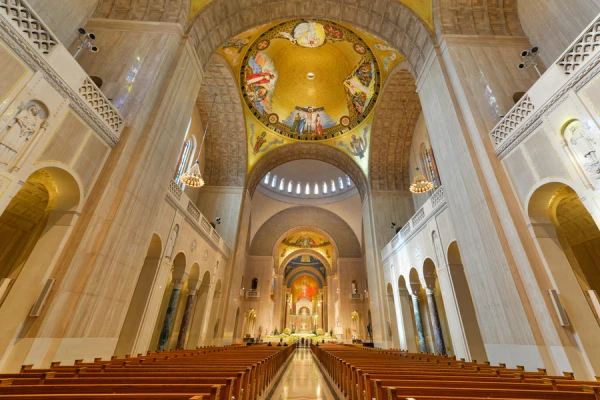
The archdiocese is home to 139 parishes and mission parishes, and 655,000 Catholics. It is also home to major Catholic pilgrimage sites, including the Basilica of the National Shrine of the Immaculate Conception and the Franciscan Monastery of the Holy Land in America. 

Early in the pandemic, a friar at the Franciscan Monastery in the city’s northeast succumbed to the new coronavirus and was the city’s first reported COVID-19 death.

The Basilica of the National Shrine of the Immaculate Conception is not a diocesan church, despite being located within the boundaries of the archdiocese. On March 12, the basilica announced it was continuing public Masses just hours before D.C. Archbishop Wilton Gregory curtailed public Masses in the archdiocese. 

On the next day, March 13, a spokeswoman for the basilica confirmed to CNA that public Masses would still continue at the shrine notwithstanding Archbishop Gregory’s announcement; later on March 13, the basilica said it would suspend public Masses at the instruction of the archdiocese.

On Friday, a spokesperson for the Basilica said the shrine “remains closed to the public.”

“Though the stay at home order was lifted, the state of emergency remains in effect limiting gatherings to 10 people or fewer,” Jacquelyn Hayes, director of communications for the shrine told CNA.

“On this account, we unfortunately are still unable to open to the public.”

[…]

No Picture
News Briefs

Some experts split from Fauci on Holy Communion recommendation

May 29, 2020 CNA Daily News 7

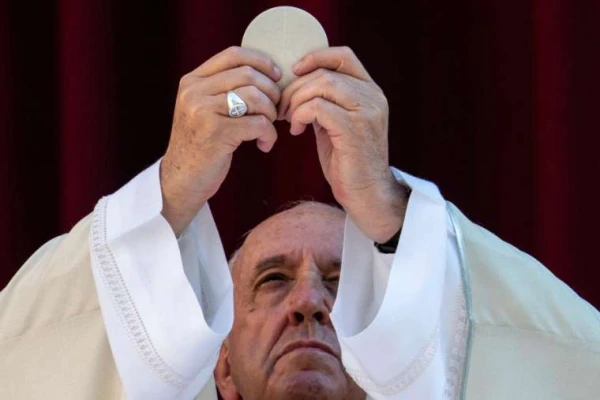
Denver Newsroom, May 29, 2020 / 08:00 am (CNA).- As dioceses across the United States start to reopen public Masses, the scientist leading the government’s response to the coronavirus pandemic recommended that Catholic Churches ought not resume distribution of Holy Communion. But other medical experts told CNA there are ways that Communion can be distributed safely amid the coronavirus pandemic.

Dr. Anthony Fauci, director of the National Institute of Allergy and Infectious Diseases, told America magazine May 26 that he does not consider the distribution of Holy Communion to yet be safe— even if distributed in the hand.

“I think for the time being, you just gotta forestall that,” Fauci said regarding Communion, calling for “common sense” measures to protect worshippers and the wider community such as masks, social distancing, and prohibiting singing.

“As many times as a priest can wash his hands, he gets to Communion, he puts it in somebody’s hand, they put it in their mouth…it’s that kind of close interaction that you don’t want when you’re in the middle of a deadly outbreak,” he told America.

Fauci’s recommendation on the Eucharist came a month after he said it could be possible for Americans to connect with people through dating apps like Tinder, Bumble, or Grindr.

“If you’re willing to take a risk…you could figure out if you want to meet somebody,” Fauci told Snapchat’s “Good Luck America.”

“If you want to go a little bit more intimate, well, then that’s your choice regarding a risk,” he added.

Deacon Robert Lanciotti is a microbiologist and the former chief of the Center for Disease Control and Prevention’s diagnostic and reference laboratory in Fort Collins, Colorado. Lanciotti told CNA that Fauci’s call for “common sense” measures to mitigate the risk of infection does not exclude the possibility of distributing Communion.

“The primary way that this virus is spread is by direct person to person contact; droplets produced when an infected person coughs or sneezes that land on another person and then enter the respiratory tract,” Lanciotti told CNA in an email.

“Maintaining a 6-foot distance or wearing a cloth mask are both methods that disrupt this process. Utilizing one of these measures in a group setting where infected symptomatic people are not present should be a sufficient level of risk reduction.”

Lanciotti, a graduate of Loyola College, was ordained a deacon in 2017.

He took issue with Fauci’s concerns regarding Communion in the hand.

“With the use of hand sanitizer immediately prior to the distribution of Holy Communion, and being careful not to directly touch the communicant, there is virtually no risk in the distribution of Communion,” Lanciotti told CNA.

Deacon Lanciotti pointed to an April 28 document from the Thomistic Institute in Washington D.C., written by medical professionals, researchers, and theologians.

That group recommended that out of respect for the Mass, the priest ought not wear a mask or gloves during the Mass, and neither should anyone distributing Communion.

Under the group’s recommended guidelines, those who wish to receive could approach the altar, spaced six feet apart; if the priest believed he touched the hands or mouth of a recipient, he could use hand sanitizer sitting on a table next to him.

According to the Thomistic Institute’s recommendations, the Precious Blood ought not be distributed at Mass.

To date, dioceses that have developed Church reopening plans have called for suspension of distribution of the Precious Blood. The Catholic Church teaches that reception of either the host or the chalice is a complete act of Eucharistic reception.

The Thomistic Institute’s document, distributed to bishops by the U.S. bishops’ conference, also recommends— as did Dr. Fauci— that singing ought to be discouraged.

It also states that it could be possible to receive Holy Communion on the tongue “without unreasonable risk.”

The document recommends that the elderly and those with underlying medical conditions ought not attend Mass anyway, as they are at especially high risk.

“I completely agree with this statement…In the setting of a church service, the single most important safety measure is for symptomatic individuals to stay home,” Lanciotti told CNA.

“I would argue that having sick individuals stay home, followed by adopting one more measure— masks or social distancing— is a reasonable approach. Utilizing both masks and social distancing represents a safety redundancy that is excessive and counter to ‘common sense,’” he said.

At St. Peter’s Basilica in the Vatican, Masses resumed May 18, after more than two months of closure amid Italy’s coronavirus lockdown.

Visitors are advised to keep two meters apart, hand sanitizer is available at kiosks in the basilica, and, at the church’s entrance, the body temperatures of visitors are checked with scanning thermometers, by two attendants wearing hazmat suits.

The Eucharist is distributed during Masses at the basilica.

Fauci, a Catholic, attended a Jesuit secondary school and Jesuit university.

In 2015, he told C-Span that he is no longer “a regular church-attender. I have evolved into less a Roman Catholic religion person to someone who tries to keep a degree of spirituality about them. I look upon myself as a humanist. I have faith in the goodness of mankind.”

He similarly told America that he appreciates his Catholic education, and especially the values he was taught at the Jesuit institutions he attended.

“I identify more, much more, with that than the concept of organized churches, religions,” he told America.

Other Catholic medical professionals have weighed in on the question of whether Holy Communion can be distributed safely.

An ad-hoc committee of seven Catholic doctors and medical school professors released on May 12 a document entitled “Road Map to Re-Opening our Catholic Churches Safely.” That group of doctors concluded that the safest recommendation is to receive Communion in the hand rather than on the tongue.

The document calls for Mass to be held with social distancing, and for the use of masks and hand sanitizer. Singing should be avoided, and those who are ill or believe they may have been exposed to the virus should stay home, it says.

One member of that committee is Dr. Andrea Baccarelli, chair of Environmental Health Sciences at Columbia University’s School of Public Health.

Baccarelli told CNA that he agrees with and appreciates Fauci’s suggestions, and that there is a risk to the distribution of Holy Communion.

“Our committee wrote a plan to minimize the risk to distribute communion. That doesn’t mean that there will be no risk nor that we advised on whether it was safe to do it now or in the future,” Baccarelli added. “We just provided a document to guide masses and distribute Communion whenever it will be safe enough to do so.”

“If Dr. Fauci suggests it is not time yet to distribute communion, I think we should listen to him and wait before doing that again,” Baccarelli said.

Another member of the committee told CNA last week that he believes Catholics can attend Mass safely, and sacraments can be administered with appropriate precautions.

“I think that if we just use common sense to compare apples to apples for metrics that we know matter – like density, for example – then there’s no real kind of objective scientific reason why Mass is any more dangerous than going to the grocery store. I think the difference here is a perceived risk,” Dr. Andrew Wang, an immunobiologist at the Yale University School of Medicine and one of the plan’s co-authors, told CNA.

The plan calls for confessions to be held in outdoor or well-ventilated indoor areas, with the use of masks, an impermeable barrier between the priest and penitent, and frequent sanitization of surfaces.

Wang said that distributing Holy Communion on the hand, rather than on the tongue, represents an appropriate precaution for churches, especially while some things about the coronavirus spread are not yet completely understood.

Acknowledging that some people may object to that recommendation, Wang said that in his perspective, “it boils down to, is it better to not have communion at all – and by extension not have Mass at all?”

Ultimately, Wang said, going to church at this time is not risk-free, just as any other public activity is not without risk during a pandemic. He noted that dioceses throughout the country have granted dispensations from the Sunday obligation for those who are unable to attend or are not comfortable with the risk involved.

Deacon Tim Flanigan is a member of the Thomistic Institute’s working group, an infectious disease specialist who has battled Ebola outbreaks, and a professor of medicine at Brown University. Flanigan also told CNA that Catholics can return to Mass and the sacraments safely – if they observe CDC protocols.

“The question is: can I follow the CDC guidance just as carefully, in each setting, in order to decrease transmission of coronavirus? Can I maintain safe distancing? Can I maintain good hand hygiene? Can I ensure that I am not ill?” Flanigan told CNA last week.

If CDC guidelines are followed, “There is no reason to prohibit church services when you don’t prohibit other gatherings,” Flanigan said.

“The CDC gives us that guidance to decrease the rate of transmission. It’s just as important that guidance be followed at a house of worship, as at a conference, as at any other gathering.”

“If somebody makes an arbitrary judgment that a church is not going to follow that guidance, without any evidence, that is biased and there is no evidence for that,” he said.

Flanigan questioned the categories of some governors who classified religious gatherings as “non-essential,” compared to more “essential” activities like grocery stores.

“Being able to come together and pray together, being able to receive the sacraments, to encounter the Lord, right there in the sacraments, is so important,” Flanigan said.

Mental health is just as important as physical health, just as important as spiritual health,” he said. “We are a whole self, which has a mind, a body, a heart a soul. To be able to pray together, to be able to support each other, to be able to worship together, to be able to receive the Lord in Communion, is so important for us to be healthy and to thrive.”

“That is why our churches are essential,” Flanigan told CNA.


[…]

No Picture
News Briefs

Vatican offers online book for parents facing difficult prenatal diagnosis

May 29, 2020 CNA Daily News 0

Vatican City, May 29, 2020 / 07:10 am (CNA).- The Vatican has published a free book online that can be a resource for parents facing a difficult or fatal diagnosis for their unborn child during pregnancy. 

The nearly 300-page ebook is a compilation of speeches given at a Vatican conference held last year dedicated to the medical care and ministries that support families who receive a prenatal diagnosis indicating that their baby will likely die before or just after birth. 

“Yes to Life: Caring for the precious gift of life in its frailness,” a conference organized by the Vatican Dicastery for Laity, Family, and Life in May 2019, brought together medical professionals, bioethicists, ministry providers, and families from 70 countries to discuss how best to provide medical, psychological, and emotional support for parents expecting a child with a life-limiting illness.

“Sometimes people ask me, what does perinatal hospice look like? And I answer, ‘It looks like love,’” author and mother Amy Kuebelbeck shared at the conference. 

Kuebelbeck was 25 weeks pregnant when she received the diagnosis that her unborn son had an incurable heart defect. She carried her pregnancy to term and had a little more than two hours with her son, Gabriel, before he died after birth.

“It was one of the most profound experiences of my life,” Kuebelbeck said. She wrote a memoir of her experience of grief, loss, and love called Waiting with Gabriel: A Story of Cherishing a Baby’s Brief Life.

“I know that some people assume that continuing a pregnancy with a baby who will die is all for nothing. But it isn’t all for nothing.  Parents can wait with their baby, protect their baby, and love their baby for as long as that baby is able to live. They can give that baby a peaceful life — and a peaceful goodbye. That’s not nothing. That is a gift,” Kuebelbeck wrote in Waiting with Gabriel.

Kuebelbeck’s testimony at the conference is included in the ebook in English, as is a transcript of the presentation provided by Dr. Byron Calhoun, a medical professor of obstetrics and gynecology, who first coined the term “perinatal hospice.” 

Calhoun’s research has found that allowing parents of newborns with a terminal prenatal diagnosis the chance to be parents can result in less distress for the mother than pregnancy termination. 

Other speeches from the conference are also published in Italian and Spanish, such Sister Giustina Olha Holubets’ Italian presentation. The Ukrainian religious sister, who works as a geneticist at the University of Lviv, helped to found “Imprint of Life,” a perinatal palliative care center in Ukraine.

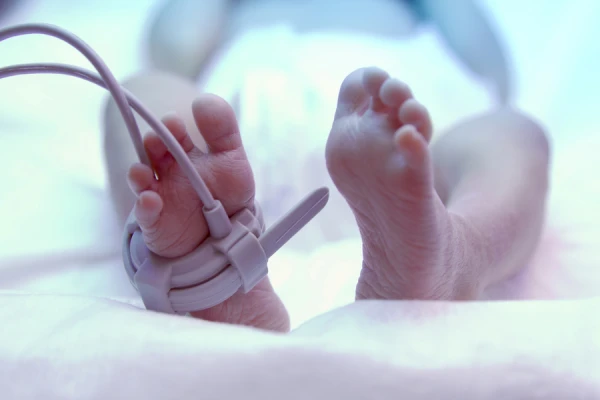
“Imprint of Life” offers grief accompaniment, individualized birth plans, the sacrament of baptism, and burial, as well as respectful photos, footprints, and memory books to help families cherish their brief moments with their child. Their motto is “I cannot give more days to your life, but I can give more life to your days.”

There are now more than 300 hospitals, hospices, and ministries providing perinatal palliative care around the world.

Many families facing these diagnoses have to decide if they will seek extraordinary or disproportionate medical care for their child after birth.

According to the Catechism of the Catholic Church, “Discontinuing medical procedures that are burdensome, dangerous, extraordinary, or disproportionate to the expected outcome can be legitimate; it is the refusal of ‘overzealous’ treatment. Here one does not will to cause death; one’s inability to impede it is merely accepted.”

Ministries like Alexandras House, a perinatal hospice in Kansas City, Missouri, provide counsel and grief support to parents as they face these difficult medical decisions. They also connect families with a network of other parents who have had a terminal prenatal diagnosis.

“Most of the families stay in contact indefinitely,” said MaryCarroll Sullivan, nurse and bioethics adviser for the ministry.

The book, published by the Vatican’s Publishing House, includes Pope Francis’ speech from his meeting with the conference participants in the Vatican’s Apostolic Palace.

In this speech, Pope Francis said that selective abortion of the disabled is the “expression of an inhumane eugenic mentality that deprives families of the chance to accept, embrace and love the weakest of their children.”

“Fear and hostility towards disability often lead to the choice of abortion, presenting it as a practice of ‘prevention,’” the pope said on May 25, 2019.

Pope Francis also thanked the perinatal hospice providers for creating “networks of love” to which couples can turn to receive accompaniment with the undeniable practical, human, and spiritual difficulties they face.

“Your witness of love is a gift to the world,” he said.

“Caring for these children helps parents to process their mourning and to understand it not only as loss, but also as a stage in a journey travelled together. They will have had the opportunity to love their child, and that child will remain in their memory forever,” Pope Francis said.

“Those few hours in which a mother can cradle her child in her arms leave an unforgettable trace in her heart.”

[…]