No Picture
News Briefs

In Milan, Pope makes youth promise to never be a bully

March 25, 2017 CNA Daily News 0

Milan, Italy, Mar 25, 2017 / 01:27 pm (CNA/EWTN News).- In last meeting during his day trip to Milan, Pope Francis issued a harsh criticism of bullying in schools, asking youth to promise him and Jesus to never bully others, and telling teachers to be aware of the problem.

“There is an ugly phenomenon in education today: bullying. Please, be aware,” the Pope said during a March 25 encounter with youth in Milan.

He responded to a question posed by a catechist asking how to foster an open dialogue between educators, students and their parents. Among other points, he told teachers to watch out for bullying before addressing the youth about it themselves.

“I ask you, in silence: in your schools, in your neighborhoods, is there someone that you mock? That you make fun of because they look a little funny, because they are a little fat? That you like to embarrass and hit because of this?” the Pope asked.

“Think about this. This is called bullying,” he said, and asked the youth – many of whom will receive the sacrament of Confirmation this year – to use their Confirmation to “make the promise to the Lord to never do this” and to pray that it doesn’t happen in their schools, neighborhoods or parishes.

“Understood? Promise me: never, never make fun of, never mock a friend, a neighbor, etc. Do you promise this?” he said. Not satisfied with the strength of their answer, he again asked the youth the same question, which was then met with a roaring “yes”.

“Think in silence if you do this and if you are able to promise this to Jesus. Promise Jesus to never bully.”

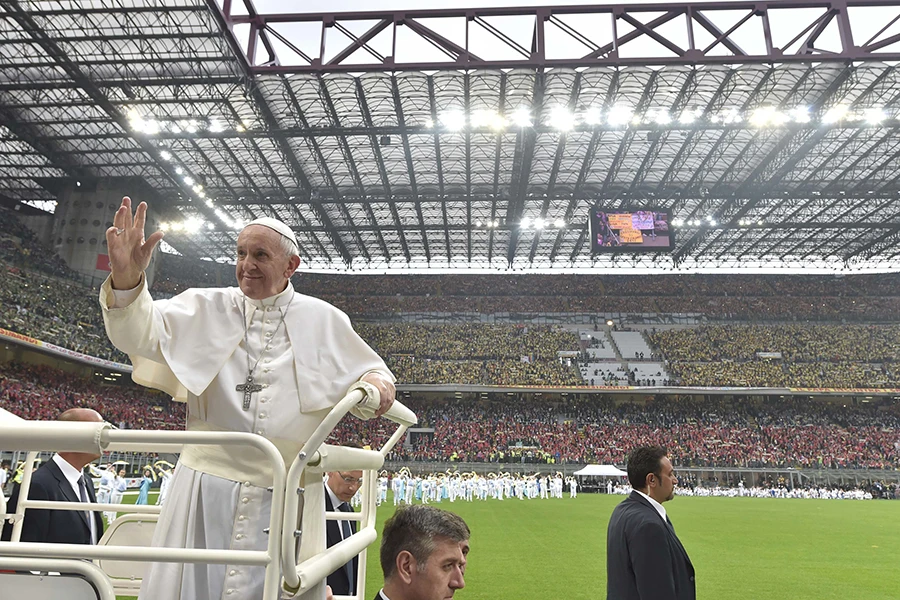
Pope Francis spoke to a stadium filled with youth at the end of his March 25 daytrip to Milan.

The pope started his trip visiting the city’s impoverished “White Houses” complex greeting several of the families who live there, including a Muslim family.

He then headed directly to Milan’s cathedral where he met with the priests and religious before praying the Angelus and eating lunch with inmates at the city’s Casa Circondariale di San Vittore prison.

After lunch, he celebrated Mass at Milan’s Parco di Monza for the Feast of the Annunciation, traveling by car after to the Meazza-San Siro Stadium where he met with some 78,000 people, including catechists, volunteers and many of the 45,000 youth who have either received the Sacrament of Confirmation in 2017 or will receive it, along with their parents and family members.

After scripture readings and a series of performances by the youth, Francis responded to three of their questions, one of which was posed by a boy named Davide, one by a couple with three children and one by the catechist.

In his response to Davide’s question about what helped him to grow in friendship with Jesus when he himself was young, the Pope said it came down to three main things: his grandparents, playing with his friends and participating in groups at this parish.

Francis recalled how one grandfather had told him to “never go to bed without saying something to Jesus; tell him goodnight.” This reinforcement combined with the prayers he learned from his grandmothers and his mother helped reinforce the faith, he said.

“Grandparents have the wisdom of life, and with that wisdom they teach us to grow closer to Jesus,” he said, urging the youth to talk to their grandparents, “ask them whatever questions you want. Listen to what they say.”

Playing with friends also helps, he said, because in knowing how to play well with others, “without insulting each other,” you learn “to respect others, you learn to make a team, to work together, and this unites us to Jesus. So play with your friends!”

Parish life is also crucial, he said, and jestingly encouraged the youth to have the same excitement about Mass as they do about their groups and activities.

When answering the couple’s question on how they can transmit the beauty of the faith to their children without sounding boring, annoying or authoritarian, Pope Francis advised them to think of who helped them to grow in the faith.

He asked the stadium to take a moment and ponder the answer in silence, explaining that an important figure for him was the priest who baptized him and who was then present throughout his life until he entered the novitiate with the Jesuits.

“I never, never forget that priest. He was an apostle of the confessional; merciful, good, a hard worker. And so he helped me to grow,” the Pope said, explaining that he asked for this reflection because “our children watch us constantly; even when we are not aware.”

On this point, as he often has in the past, Francis warned against the damage it can do to children when they see their parents fight.

“You don’t understand the suffering a child experiences when they see their parents fight, they suffer. And when their parents separate, they pay the price,” he said, explaining that when parents bring a child into the world, “you must be aware of this.”

“We take responsibility to help this child grow in the faith,” he said, and suggested that the couple reach Chapters 1 and 4 of his post-synodal apostolic exhortation Amoris Laetitia, a fruit of the 2014 and 2015 Synod of Bishops on the Family.

Dedicated to love in marriage and in the family, the Pope told them the chapters, particularly the first, would be helpful, and told them to never forget that “when you fight, children suffer and they don’t grow in the faith.”

He also stressed the importance of playing with their children and practicing the works of mercy together, which help nourish faith and family life.

Sunday’s are an especially good day to spend together as a family, he said, but noted that for some this is hard to do, since many have to work on weekends in order to provide for their families.

“Parents at this time can’t or have lost the virtue of playing with their children,” he said, explaining that whenever when he hears a parent complaining about their children’s behavior, he often asks if they take time to just sit and play with their children.

Many parents “don’t know how to respond,” he said, recalling how he once spoke with a father who only saw his children on the weekends, since he left for work while they were still asleep and came back after they were already in bed.

“It’s this life that takes your humanity,” he said, and told parents to “play with your children, and transmit the faith.”

[…]

No Picture
News Briefs

Texas pro-lifers target ‘wrongful birth’ lawsuits, Planned Parenthood

March 25, 2017 CNA Daily News 0

Austin, Texas, Mar 25, 2017 / 06:01 am (CNA/EWTN News).- Among the targets of Texas pro-life advocates are so-called ‘wrongful birth’ lawsuits and Planned Parenthood’s alleged involvement in the sale of unborn baby parts. Both are finding some success in the State Senate.

In some cases, parents of a child born with a disability such as Down syndrome have filed lawsuits against doctors claiming that they were not informed of a disability in time to procure an abortion. Such claims aim to secure the costs of raising the child, even lifetime costs.

Senate Bill 25 would prevent parents of children born with disabilities from suing their physician.

The bill, which has the support of the Texas Catholic Conference of Bishops, passed the state senate by a vote of 21-9 March 21. It now heads to the Texas House of Representatives for consideration.

“We are thrilled that the Senate has passed S.B. 25, because it reverses a decades-old injustice and bad public policy that devalues babies, both unborn and born, who have a disability,” Joe Pojman, executive director of the Texas Alliance for Life, told CNA March 23. “In our view, S.B. 25 eliminates wrongful birth lawsuits while holding doctors accountable to practicing good medicine.”

While opponents of the bill charged it would allow doctors to withhold information from parents about an unborn child, Pojman said the bill’s text explicitly excludes such a possibility.
 
He added that the bill is consistent with tTexas’ policy of promoting childbirth over abortion.

Meanwhile, Texas Alliance for Life’s top priority is the passage of S.B. 8, provisions of which would, in Pojman’s words, “shut down Planned Parenthood’s harvesting and sale of body parts harvested from the bodies of aborted babies.”

The bill passed the state senate March 15 by a bipartisan vote of 24-6. The House considered its own version March 22.

Texas Gov. Greg Abbott had called for such a bill in his January State of the State Address.

The bill follows an undercover investigation from the Center for American Progress which found Planned Parenthood staffers and leaders appearing to encourage the illegal sale of fetal tissue and unborn baby body parts for profit.

A Dec. 7, 2016 letter from the Select Investigative Panel of the U.S. House Committee on Energy and Commerce referred an unnamed Houston abortionist to the State Attorney General for alleged violations of a federal partial-birth abortion ban.

S.B. 8 would also bar partial-birth abortion, creating a criminal penalty for the physician and a cause for civil action for the father.

The bill has the support of the Texas Catholic Conference.

Another bill, S.B. 415, passed the state senate by a 21-9 vote.

The ban on “dismemberment abortions” would bar “dilation and evacuation” procedures, which use surgical instruments to grasp the unborn baby and remove his or her parts while he or she is still alive. The procedure is the most common second-trimester abortion procedure.

However, the Texas Alliance for Life opposed it.

“We look forward to the day when laws protect all unborn babies from abortion and the courts uphold those laws,” Pojman said. “Unfortunately,  a ban on dismemberment abortion would never be enforced, and it would save no lives.”

He said the bill had zero chance to survive a federal court challenge and could create a precedent to make overturning Roe v. Wade more difficult.

“We believe it to be naive and harmful to pursue such legislation this session given the makeup of the Supreme Court now and for the foreseeable future. Since these bills will set the pro-life movement back rather than moving us forward, we cannot support these bills.”

A loss in federal court would also fund the abortion movement, as the state is required to pay plaintiff attorney fees if the plaintiff wins on constitutional issues.

Pojman pointed to the Whole Woman’s Health v. Hellerstedt case, which successfully challenged parts of a Texas law requiring more safety regulations at abortion clinics.

The abortion providers are asking for $4.5 million in legal costs.

“We do not know what they will end up receiving,” Pojman said. “We do know, however, that whatever the attorneys for the abortion providers receive will be used to attack other pro-life laws in Texas and in other states.”

[…]

No Picture
News Briefs

Insides that didn’t decompose – and other stunning facts about Oscar Romero

March 24, 2017 CNA Daily News 0

San Salvador, El Salvador, Mar 24, 2017 / 02:49 am (CNA/EWTN News).- In his role as Vicar General, Monsignor Ricardo Urioste was one of the closest collaborators of Oscar Romero, the archbishop of San Salvador who was martyred for the faith in 1980 and beatified two years ago.

And this monsignor has some stories to tell.

Among the most fascinating involve details surrounding the day Romero was killed, what the late archbishop really thought about the controversial and problematic Liberation Theology, and the fact that the martyr’s insides hadn’t decomposed when they were exhumed three years after his death.

Archbishop Romero was brutally killed while celebrating Mass on March 24, 1980 – a time when El Salvador was on the brink of civil war. In February 2015, Pope Francis officially recognized his death as having been for hatred of the faith and gave the green light for his beatification.

Msgr. Urioste, who currently heads up the Archbishop Romero Foundation, said that during the time the martyr lived, whenever “he preached, spoke, was a pastor, they accused him of being communist, Marxist, a politician, and a thousand things.”

However, he noted how after 12 years of extensive study on the life and writings of the archbishop, the Vatican never found anything that supported these claims.

In an interview with CNA, Msgr. revealed some the of the lesser known facts surrounding the new blessed, as well as his continuing legacy on the Church and the world at large.

What happened on the day Archbishop Romero died

Msgr. Urioste can easily recall the day that Archbishop Romero was killed, saying that it was “an ordinary day of work” for him.

In the morning the archbishop had a meeting with a group of priests, and then they ate lunch together. After the meeting he went to confession with his usual confessor, which was a priest named Fr. Segundo Ascue.

Once he confessed, Archbishop Romero went to celebrate a 6 p.m. Mass in San Salvador’s hospital of Divine Providence, which was staffed by nuns. The Mass, Mons. Urioste recalled, had been widely publicized throughout the diocese.

While he was celebrating Mass in the hospital’s chapel, the archbishop was shot in the chest from outside.

Msgr. Urioste said that after getting a phone call informing him of what happened, “I immediately went to the hospital, and he was already taken to the polyclinic. A television set arrived, they interviewed me, and after I went to the hospital where he was.”

He recalled how as the sisters were going to embalm Archbishop Romero’s body, he told them “please be careful not to drop his insides anywhere, but that they pick them up and bury them, and they did, burying them in front of the little apartment he had in the hospital where he lived.”

Three years later, on the occasion St. John Paul II’s visit to the country, the nuns of the hospital “made a monument to the Virgin in the same place where we had buried (Romero’s) insides.”

“When they were digging they ran into the box and the plastic bag where they had placed the insides, and the blood was still liquid and the insides didn’t have any bad smell,” he revealed.

“I don’t want to say that it was a miracle, it’s possible that it’s a natural phenomenon, but the truth is that this happened, and we told the archbishop at the time (Arturo Rivera y Damas), look monsignor, this has happened and he said ‘be quiet, don’t tell anyone because they are going to say that they are our inventions,’” he said.

However, “Pope John Paul II was given a small canister with Archbishop Romero’s blood,” he noted.

Msgr. Urioste recalled that when John Paul II arrived to San Salvador, the first thing he did “was go to the cathedral without telling anyone. The cathedral was closed, they had to go and look for someone to open it so that the Pope could enter and kneel before the tomb of Archbishop Romero.”

John Paul II asked during his visit that no one manipulate the memory of Archbishop Romero, Msgr. Urioste recalled, and lamented how “they politicized him.”

“The left had politicized him, putting him as their banner. And the right politicized him, saying things that are untrue about the bishop, that are purely false, they denigrated him.”

One of the things that the Church in El Salvador wants, Msgr. Urioste said, is that “the figure of the archbishop, known now a little more than he was before, is a cause for reflection, a motive for peace, a motive for forgiveness, a motive for reconciliation with one another, and that we all have more patience to renew ourselves and follow the paths that Archbishop Romero proposed to us.”

“I think that (Romero’s) figure is going to contribute a lot to a better meeting and reconciliation in El Salvador,” he said.

What Archbishop Romero really thought about Liberation Theology

Despite the many accusations leveled against the archbishop of San Salvador, his Vicar General said that Romero “never had a Marxist thought or Marxist ideology in his mind.”

“If there had been, the Vatican, which has studied so much, would not have beatified him, if they had found that he had Marxist interests.”

The real backbone of his closeness to the poor, he said, was the Gospel and the teaching of the Church.

“He was a servant of the Gospel, he never read anything from Liberation Theology, but he read the Bible.”

Msgr. Urioste noted that the archbishop’s library, “had all these books from the early Fathers of the Church, from the current Magisterium of the Church, but (he) never even opened any of the books from Liberation Theology, or Gustavo Gutiérrez, or of anyone else.”

“He read the Bible and there he encountered a Jesus in love with the poor and in this way started walking toward him,” he said.

What set Archbishop Romero apart

One of the most distinguishing characteristics of Archbishop Romero was “his great sense of work. He was an extremely hardworking man and devoted to his work day and night – until midnight and until dawn,” Msgr. Urioste said.

He recalled how the archbishop would begin to prepare his Sunday homilies the day before, and would always include three reflections on the Eucharist. When Romero preached, he made frequent reference to the Fathers of the Church, based his comments on Church teaching and related his thoughts to the country’s current reality.

“A homily that doesn’t have this relation with what is happening sounds the same here as in Ireland, in Paris, as anywhere,” the priest said.

He recalled how in Romero’s time the government was “a ferocious military dictatorship, which had ‘national security’ as it’s theme.”

Everyone who either sided with the poor or expressed concern for them “was accused of being communist, they were sent to be killed without thinking more. There were 70 thousand deaths like this in the country at that time,” Msgr. Urioste noted.

“The social economic reality was of a lot of poverty, of a great lack of unemployment, of low wages.”

Ultimately, Archbishop Romero’s beatification, the monsignor said, is “a triumph of the truth.”

It is a triumph, he said, of the truth of “who Archbishop Romero really was, what he did, how he did it, from the Word of God, from the Magisterium of the Church, in defense of the poor, who were the favored ones of Jesus Christ and who were were also the favored ones of Archbishop Romero.”

A verison of this article was originally published May 23, 2015.

[…]