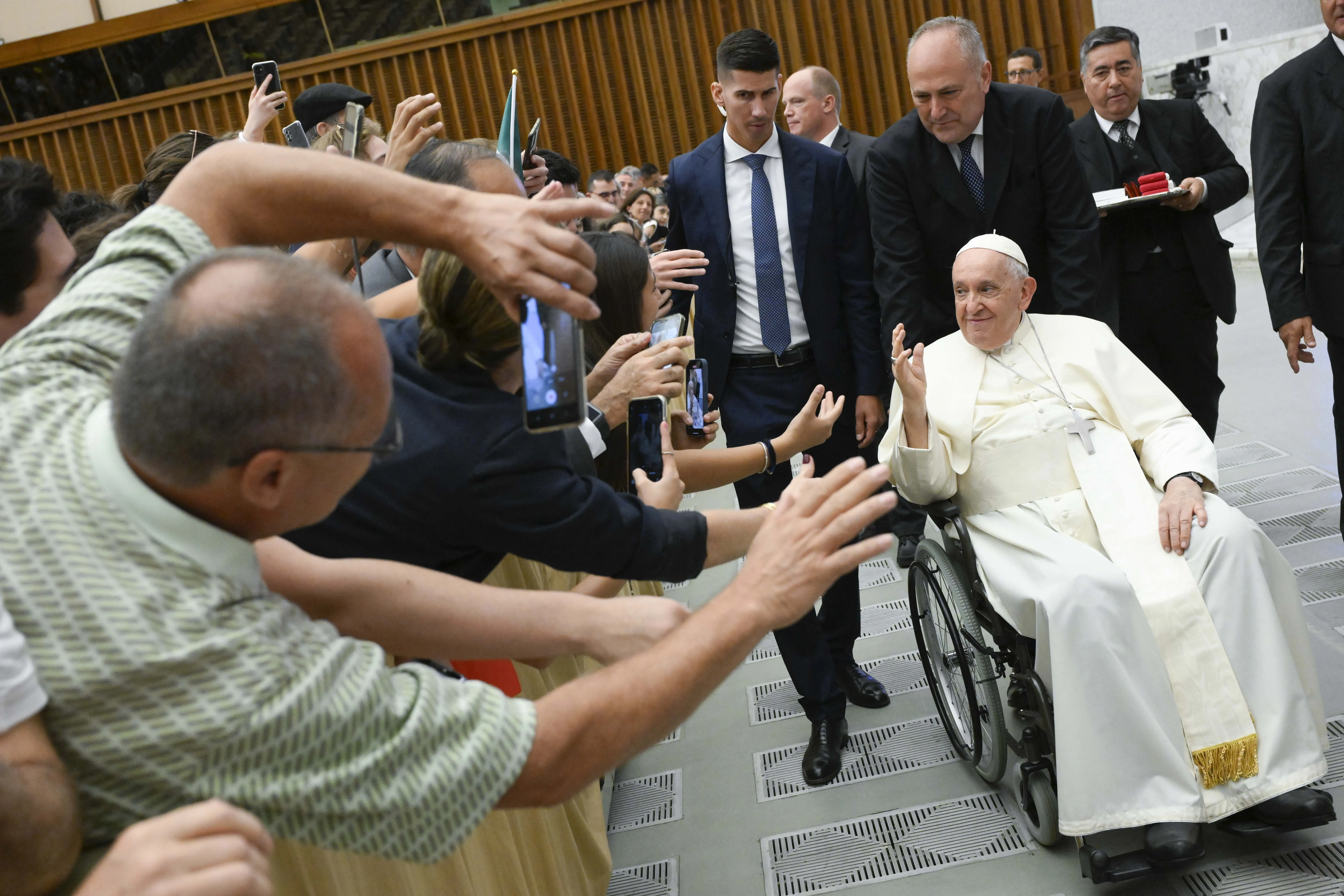
Vatican City, May 19, 2017 / 06:32 pm (CNA/EWTN News).- Pope Francis will deliver his fifth speech on the present and future of Europe during an event organized by the Commission of the European Bishops’ Conferences of the European community (COMECE).
The event, titled “Rethinking Europe,” has been organized by COMECE in collaboration with the Holy See, and will take place in Rome Oct. 27-29 to mark the 60th anniversary of the Treaties of Rome, which laid the foundation for the European Union.
Pope Francis was invited to the event during a private meeting he had with the COMECE standing committee on May 16. The meeting took place in the afternoon in Domus Sanctae Marthae, where Pope Francis lives.
The COMECE delegation is composed of president Cardinal Reinhard Marx and the four vice-presidents, bishops Jean Kockerols, Gianni Ambrosio, Czeslaw Kozon, Rimantas Normila. COMECE general secretary, Fr. Olivier Poquillon also attended the meeting.
The group also had meetings with Cardinal Pietro Parolin, Vatican Secretary of State, and with Archbishop Paul Richard Gallagher, the Vatican Minister of Foreign Affairs.
Cardinal Marx stressed in a press release that the “Rethinking Europe forum will be the start of a process of dialogue between the Churches representatives (both bishops and lay people) and the politicians who have political responsibility and make decisions.”
After the encounter with COMECE’s standing committee, Pope Francis met on May 18 with the new presidency of the Council of the European Bishops’ Conferences, known by the acronym CCEE.
While the COMECE is composed by bishops delegated by their Bishops’ Conferences to deal with institutions associated to the European Union, the CCEE is composed by the presidents of the Bishops Conferences in Europe, and deals with the pastoral challenges of each of the European countries represented.
Cardinal Angelo Bagnasco, current president of the Italian Bishops Conference, was elected President of the CCEE.
The Italian cardinal explained in a press conference that the topics discussed with Pope Francis included secularization, migration, youth and human trafficking.
When the conversation turned to the challenges of young people, “the Pope warned us about the demographic winter. He particularly recommended us to care for young people”.
Cardinal Bagnasco also underscored that “Pope Francis expressed gratitude and admiration for the work done by the Churches in Europe in order to tackle the migration issues.”
If you value the news and views Catholic World Report provides, please consider donating to support our efforts. Your contribution will help us continue to make CWR available to all readers worldwide for free, without a subscription. Thank you for your generosity!
Click here for more information on donating to CWR. Click here to sign up for our newsletter.

Vatican City, Feb 15, 2020 / 11:03 am (CNA).- The next ordinary assembly of the synod of bishops is to be held in the fall of 2022, according to a press release from the Vatican on Saturday.
The theme has not yet been decided, but will be up to Pope F… […]
Pope Francis embraces a man in a wheelchair at the Wednesday general audience in St. Peter’s Square on June 10, 2015. / L’Osservatore Romano.
Vatican City, Nov 25, 2021 / 10:00 am (CNA).
In his message for the International Day of Persons with Disabilities, Pope Francis said that the Catholic Church needs the participation of everyone, and the disabled must not be excluded from the sacraments.
“As we celebrate your International Day, I would like to speak directly to all of you who live with any condition of disability, to tell you that the Church loves you and needs each of you for the fulfillment of her mission at the service of the Gospel,” the pope said on Nov. 25.
Quoting his 2013 exhortationEvangelii gaudium, he said: “The worst form of discrimination … is the lack of spiritual care.”
“Sometimes, as certain of you have unfortunately experienced, this has taken the form of denying access to the sacraments,” he said in his message.
“The Church’s magisterium is very clear in this area, and recently the Directory for Catechesis stated explicitly that ‘no one can deny the sacraments to persons with disabilities.’”
The theme of Pope Francis’ message for the day is friendship with Jesus, which he said is “an undeserved gift” that all have received and that can help those experiencing discrimination.
Friendship with Christ “redeems us and enables us to perceive differences as a treasure. For Jesus does not call us servants, women and men of lesser dignity, but friends: confidants worthy of knowing all that he has received from the Father,” he said.
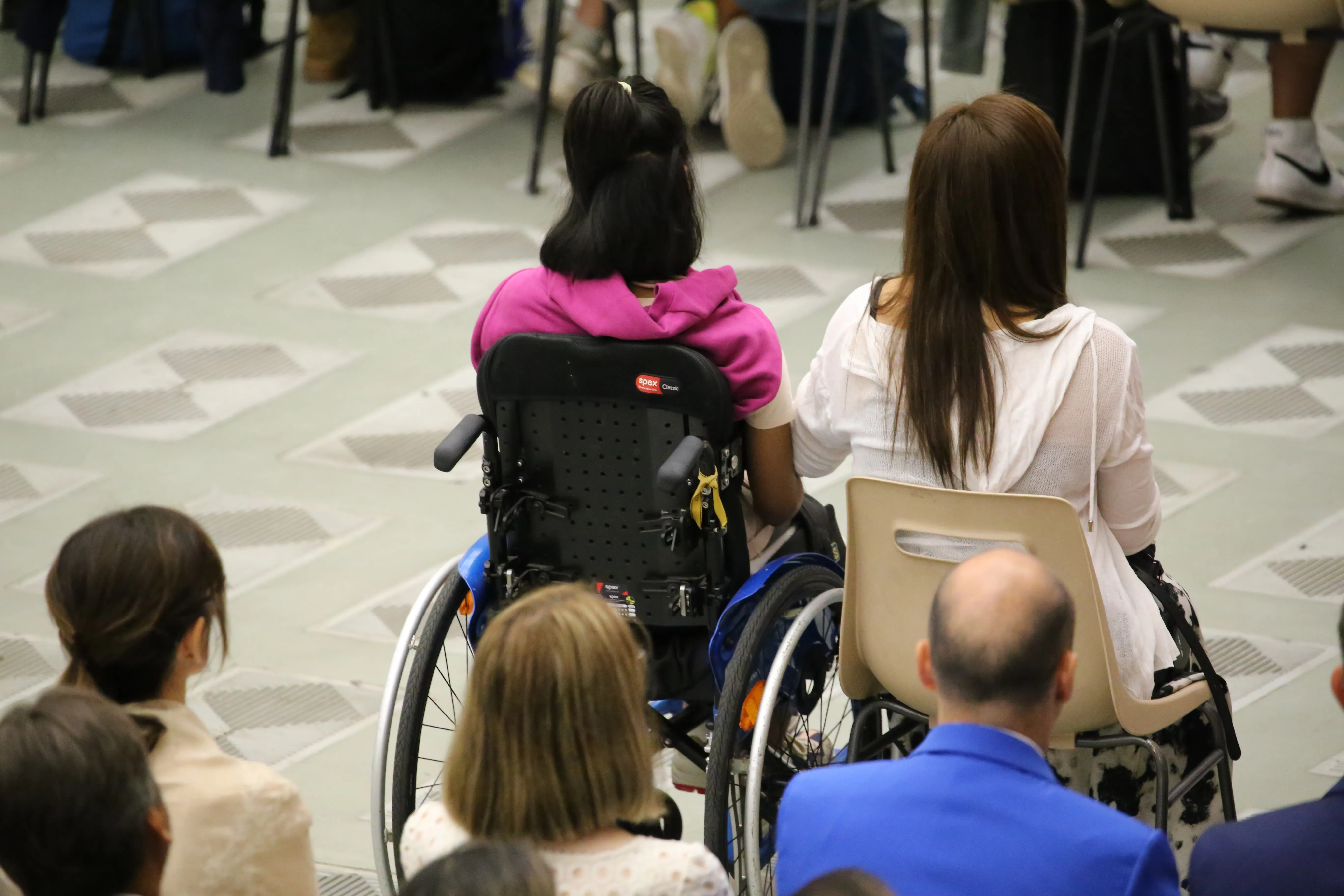
Antonietta Pantone, 31, a Rome resident who uses a wheelchair, told journalists it was clear to her from the pope’s message that he considers it important that people with disabilities be part of the Church and not leave the Church.
She shared her personal journey of faith, which included finding a community in the Christian disability group Fede e Luce.
Pope Francis meets with Foi et Lumière members on Oct. 2, 2021. Vatican Media/CNA
Fede e Luce is the Italian branch of the French association Foi et Lumière (known as Faith and Light in the English-speaking world), which began 50 years ago with a pilgrimage for people with disabilities to the Sanctuary of Our Lady of Lourdes in France. The movement has now expanded to five continents.
“I always say: In the eyes of God, we are all equal,” Pantone said, noting that in her journey of faith, friendship has been fundamental.
Friendship with others “demonstrates the closeness of God,” she said.
Pantone also explained how losing physical contact with friends because of the COVID-19 pandemic has been very hard for her and other disabled people, especially her friends who live in residences and not with family.
In his message, Pope Francis addressed the difficulty of the coronavirus outbreak for the disabled.
“I think, for example, of your being forced to stay at home for long periods of time; the difficulty experienced by many students with disabilities in accessing aids to distance learning; the lengthy interruption of social care services in a good number of countries; and many other hardships that you have had to face,” he wrote.
He mentioned in particular those who live in residential facilities, separated from loved ones. “In those places, the virus hit hard and, despite the dedication of caretakers, it has taken all too many lives,” he said.
He also emphasized the importance of confronting these challenges by finding consolation in prayer and friendship with Jesus.
“I would like to speak personally to each of you, and I ask that, if necessary, your family members or those closest to you read my words to you, or convey my appeal,” he said. “I ask you to pray. The Lord listens attentively to the prayers of those who trust in him.”
“Prayer is a mission, a mission accessible to everyone, and I would like to entrust that mission in a particular way to you. There is no one so frail that he or she cannot pray, worship the Lord, give glory to his holy Name, and intercede for the salvation of the world. In the sight of the Almighty, we come to realize that we are all equal,” he stressed.
Pope Francis also noted the continued presence of discrimination, ignorance, and prejudice at all levels of society, assuring people with disabilities that through baptism they are “a full-fledged member of the Church community, so that all of us, without exclusion or discrimination, can say: “I am Church!’”
“The Church is truly your home!” he said.
At a Nov. 25 press conference, Fr. Alexandre Awi Mello said that the Vatican’s Dicastery for Laity, Family, and Life is trying to do more to improve pastoral care for those with disabilities.
“This message, in recognizing that people with disabilities have their place in the holy faithful People of God, is a great invitation, for us in the dicastery, but above all for parish, diocesan and associative realities to take new paths with pastoral creativity,” Awi Mello said.
Fr. Alexandre Awi Mello, secretary of the Dicastery for Laity, Family, and Life, speaks at a Vatican press conference, May 18, 2021. Gianluca Teseo/CNA.
“It is a door that opens to think of pastoral care no longer for, but with…”
On Dec. 6, the dicastery will launch a video campaign with the hashtag #IamChurch. In five videos, Catholics with disabilities from different parts of the world will share about their experiences in the Church.
Pantone, who participated in one of the Vatican’s videos, told CNA that she would like to see the Catholic Church do more to develop courses that allow people with all kinds of disabilities to participate in parish life, such as formation courses to become a catechism teacher.
“I still had some ways to study [to become a catechist],” she said, “but it depends on the type of disability, so if another disabled person wants to be a catechist, the Church should give him all the appropriate tools.”
Pantone said that the Church can do a lot for the disabled, but the recently begun Synodal Journey “is already a step forward which the world of disability sees positively.”
Pope Francis said in his message that “having Jesus as a friend is an immense consolation. It can turn each of us into a grateful and joyful disciple, one capable of showing that our frailties are no obstacle to living and proclaiming the Gospel.”
“In fact, a trusting and personal friendship with Jesus can serve as the spiritual key to accepting the limitations that all of us have, and thus to be at peace with them,” he said.
Deacon Ronnie Lastovica, right, and Bishop Joe Vasquez of the Diocese of Austin celebrate Mass in the Mountain View Unit prison in Gatesville, Texas, which houses the state’s female death row, on Dec. 1, 2023. / Credit: Catholic Prison Ministries Coalition/TDCJ Communications
Vatican City, Jan 20, 2025 / 08:00 am (CNA).
In an important move for the Catholic Church in Texas on Monday, Pope Francis named Austin Bishop Joe Vásquez to replace 75-year-old Cardinal Daniel DiNardo as head of the Archdiocese of Galveston-Houston.
DiNardo, who was made a cardinal in 2007 and who led the U.S. bishops’ conference as president from 2016-2019, turned 75 — the standard retirement age for Catholic bishops — in May of 2024.
The 67-year-old Vásquez is returning to the Archdiocese of Galveston-Houston, where he served as an auxiliary bishop from 2002-2010. The bishop is coming back to the archdiocese almost exactly 15 years after moving 160 miles to the northwest to lead the Diocese of Austin.
The Mexican-American bishop also served as apostolic administrator of the Diocese of Tyler from November of 2023 to December of 2024, after Pope Francis removed Bishop Joseph Strickland.
The Metropolitan Archdiocese of Galveston-Houston serves 1.7 million Catholics in 146 parishes across 10 counties in southeastern Texas. Houston is the fourth-largest city in the U.S.
According to the archdiocese, the local Church is multicultural, with members coming from every continent. Liturgies are held in 14 different languages.
Vásquez, whose seminary education included five years in Rome studying at the Pontifical Gregorian University, was ordained a priest for the Diocese of San Angelo in 1984.
He grew up the oldest of six children in the small town of Stamford, in west-central Texas.
Vásquez has served as a consultant to the U.S. bishops’ conference committee on pro-life activities and as lead bishop for Region X for the V National Encounter for Hispanic/Latino Ministry (V Encuentro).
Leave a Reply