


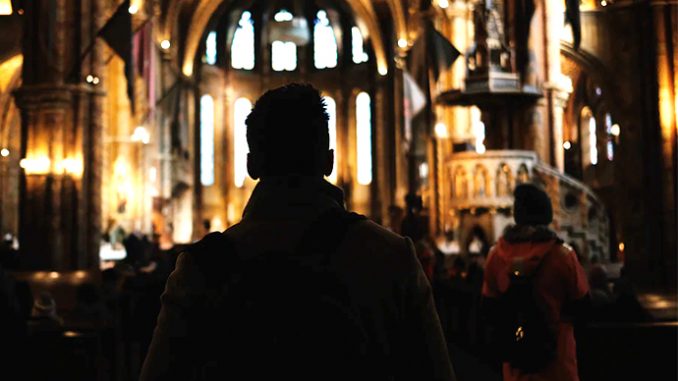
Where do we find Christ in the world? We tend to think immediately of words and personal witness, of course, but there are growing signs that beauty can play a key role in the New Evangelization, if the Church embraces the devotional power of images.
Young people are identifying as religious in greater numbers, and the Church is seeing an uptick in converts. The news isn’t all rosy, however, as young adults still don’t attend church at higher levels than other generations, and it’s estimated that the Catholic Church loses eight practicing members for every convert.
These findings were presented to the USCCB last week by Aaron Weldon, director of New Wineskins at the Catholic University of America. He identified beauty as one significant factor bringing young adults to the Church, as summarized by the National Catholic Register: “Among young Catholics who consider themselves to have become more religious, 82% said that the experience of ‘encountering beauty’ in religious spaces or rituals was behind the increase in their faith.”
In addition, Weldon has been studying the impact of beauty on the lives of adults in both the U.S. and the U.K. as part of a larger research project titled “Can Beauty Save the World?” The project recently released a study, “The Beauty and Belief Survey: Aesthetics and Spirituality in Modern Life,” which highlighted the greater impact of beauty on Americans in religious settings:
U.S. adults are 29 percentage points more likely than U.K. adults to report encountering beauty in spiritual or sacred moments. This gap in spiritual or sacred moments is expected, as a greater percentage of U.S. adults consider religion an important part of daily life (49%) compared with U.K. adults (30%). This difference appears despite the large drop in U.S. religiosity observed in 2025.
Given the importance of beauty in conversion, these findings point to an opportunity for evangelization. For this to happen, however, there needs to be a movement from a general spiritual experience to a specific encounter with Christ. As the study also points out, people are more likely to look for spiritual beauty outside of religion:
Spirituality, more than religious identity, is associated with valuing beauty. Adults who describe themselves as spiritual, whether they are also religious or not, are most likely to say beauty is important to living a meaningful life. On finding beauty specifically in spiritual or sacred moments, however, religious identity matters more, and religious adults who report a recent religious or spiritual change are the most likely to say beauty in religious spaces or rituals was important for that change.
Beauty offers an opportunity to engage those who are seeking, but we also have to think about how to make use of the possibilities presented by the great artistic and architectural heritage of the Church.
Church buildings offer public witness to the beauty of faith, as their steeples lead eyes upward against a skyline full of horizontal lines. A beautiful church offers an invitation, and once entered, it must lead into the presence it manifests. Its interior art can complete the movement from public witness to personal encounter, but to do so, it needs to go beyond being a beautiful decoration or pedagogical tool. Sacred images, like spoken words, communicate and make present the realities they represent and become a means of coming into contact with Christ, Our Lady and the saints.
This is why the Second Council of Nicaea taught in 787 AD that “the honor paid to an image traverses it, reaching the model, and he who venerates the image, venerates the person represented in that image.” Further, “people are drawn to honor these images with the offering of incense and lights, as was piously established by ancient custom.”
Pope Benedict XVI made a shocking claim, writing while still a cardinal in The Spirit of the Liturgy, that the Church of the West still has not embraced the teaching and practice of the Council: “But she must achieve a real reception of the Seventh Ecumenical Council, Nicaea II, which affirmed the fundamental importance and theological status of the image in the Church.” At this pivotal moment, when interest in the Church is rising, we would do well to attend to the power of sacred images to bring people into contact with Christ.
In support of Benedict’s contention, I have found that many newer and renovated older churches treat images as decorations, putting statues in inaccessible niches, sometimes moved into the narthex, while paintings, when they are present at all, are not geared toward devotion. The beauty of churches and sacred art needs to converge on the face of Christ, with images of the Savior and the key actions of salvation directly engaging those who enter the church. Jesus is the image or icon of the invisible God (Colossians 1:15), and God gives “the light of the knowledge of the glory of God in the face of Christ” (2 Corinthians 4:6).
When the curious, the seekers, come into our churches, their hearts can be pierced by the gaze of the one who is beauty itself. He teaches us what beauty really is and what it is for — the attraction of love that leads us to give of ourselves. In order to facilitate this encounter and implement the teachings of Nicaea II, we need to treat sacred images as more than artistic objects, making them a means of contemplation through which our thoughts and prayers pass from the image to the One they represent.
This requires devotional images closer to eye level, with the faces of Christ and the saints clearly visible and means of venerating them with candles and physical gestures. Decorations help create a mood for prayer, giving nobility and grandeur to the space. Devotional images, however, draw us into prayer and become a means of relating directly to Christ.
Art will not lead to conversion on its own, in the context of a museum or as mere lines on a wall. Walking into a beautiful church, however, has served as a means of conversion, of walking into another world. Because in the church we can encounter Christ. As Pope Benedict XVI also related in “The Feeling of Things, the Contemplation of Beauty,” a talk while still a cardinal: “Nothing can bring us into close contact with the beauty of Christ himself other than the world of beauty created by faith and light that shines out from the faces of the saints, through whom his own light becomes visible.”
Sacred art can teach us to see, to recognize in the face of Christ a light that pierces the heart and transforms us from within. In our efforts of evangelization, we must prioritize this sacred beauty, which manifests the presence of Christ and his saving love for us.
If you value the news and views Catholic World Report provides, please consider donating to support our efforts. Your contribution will help us continue to make CWR available to all readers worldwide for free, without a subscription. Thank you for your generosity!
Click here for more information on donating to CWR. Click here to sign up for our newsletter.



Leave a Reply