Vatican City, Apr 10, 2017 / 04:46 am (CNA/EWTN News).- On Monday the latest Pope Francis-inspired initiative for the poor opened up in Rome – a new laundromat, with washing, drying and ironing services for those without a home or a fixed living situation.
"The Pope's Laundry,” as it is being called, is organized in partnership with the Community of Sant'Egidio and will be run by volunteers who will wash, dry and iron the clothes and blankets of those who otherwise can’t clean their belongings.
The initiative was born out of an invitation from Pope Francis in his apostolic letter Misericordia et misera, “to give a ‘concrete’ experience of the grace of the Jubilee Year of Mercy,” an April 10 communique from the Vatican stated.
As Francis wrote at the end of the Year of Mercy, the announcement said, “To want to be close to Christ demands to be near to our brothers, because nothing is more pleasing to the Father than a concrete sign of mercy. By its very nature, mercy is made visible and tangible in concrete and dynamic action.”
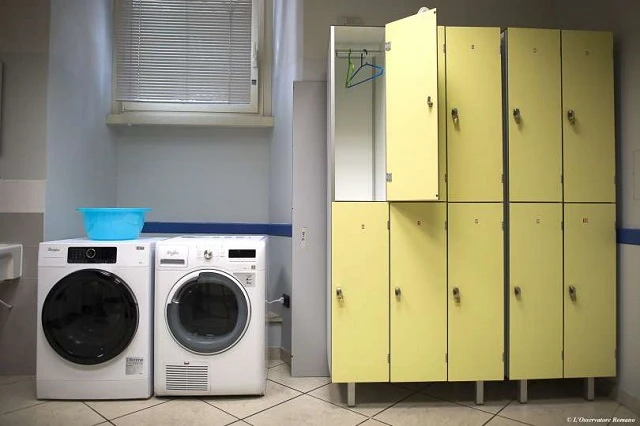
The service, located in an old hospital in Rome's Trastevere neighborhood, now called the “People of Peace Center,” includes six brand-new washers and dryers, donated by Whirlpool. Irons, detergent and other products needed for the service have also been donated.
The laundromat joins services to welcome and assist the poor already in place at the location for more than 10 years.
In the next few months, they plan to also add a barber, free clothing, medical clinics, and the distribution of necessities to the Center.
The laundry service follows a string of special initiatives by Pope Francis to serve the homeless in Rome.
In 2015, Francis established showers, bathrooms and a barber shop inside the Vatican to serve the homeless population.
Later in the same year, he opened up a new homeless shelter for men, just around the corner form the Vatican in Via dei Penitenzieri, furnished by the Papal Office of Charities and donations, and run by sisters from Mother Teresa’s Missionaries of Charity.
With enough space to house 34 men, the shelter brought the Vatican’s total capacity for housing the homeless up to 84.
Throughout his pontificate, Pope Francis has also invited homeless men and women to the Vatican, whether to see the Sistine Chapel, to dine with him, or for special events, showing his continued commitment to put into practice his charge to the Church to go out to the “peripheries.”
If you value the news and views Catholic World Report provides, please consider donating to support our efforts. Your contribution will help us continue to make CWR available to all readers worldwide for free, without a subscription. Thank you for your generosity!
Click here for more information on donating to CWR. Click here to sign up for our newsletter.
Pope Francis addresses international diplomats to the Holy See on Jan. 9, 2023, in the Vatican’s Blessing Hall. / Vatican Media
Rome Newsroom, Jan 9, 2023 / 06:28 am (CNA).
The global community is engaged in a “third world war” marked by heightened fear, conflict, and risk of nuclear violence, but a recommitment to “truth, justice, solidarity and freedom” can provide a pathway to peace, Pope Francis told international diplomats Monday.
Citing the ongoing war in Ukraine, but also drawing on conflicts in places such as Syria, West Africa, Ethiopia, Israel, Myanmar, and the Korean Peninsula, the Holy Father said this global struggle is being “fought piecemeal,” but is nonetheless interconnected.
“Today the third world war is taking place in a globalized world where conflicts involve only certain areas of the planet direct, but in fact involve them all,” said Pope Francis, speaking in the Vatican’s apostolic palace.
The pope made these remarks as part of his annual address to the diplomatic corps accredited to the Holy See. Pope Francis characterized this speech as “a call for peace in a world that is witnessing heightened divisions and war.”
Pope Francis addresses diplomats to the Holy See in the Blessing Hall at the Vatican on Jan. 9, 2023. Vatican Media
As part of this heightening of tensions, the Pope warned about the increased threat of nuclear warfare, drawing particular concern to the stall in negotiations for the Iran nuclear deal. He told the gathered diplomats that the possession of nuclear weapons is “immoral” and called for an end to a mentality that pursues conflict deterrence through the development of ever-more lethal means of warfare.
“There is a need to change this way of thinking and move toward an integral disarmament, since no peace is possible when instruments of death are proliferating,” the pope said.
In proposing a path towards global peace, the Holy Father drew heavily from Pacem in Terris (“Peace on Earth”), the papal encyclical promulgated by St. John XXIII in 1962. Pope Francis said the conditions which prompted the “good Pope” to issue Pacem in Terris 60 years ago bear a striking similarity to the state of the world today.
In particular, the Holy Father drew from what John XXIII described as the “four fundamental goods” necessary for peace: truth, justice, solidarity, and freedom, values that “serve as the pillars that regulate relationships between individuals and political communities alike.”
Regarding “peace in truth,” the Holy Father underscored the “primary duty” of governments to protect the right to life at every stage of human life.
“Peace requires before all else the defense of life, a good that today is jeopardized not only by conflicts, hunger, and diseases, but all too often in the mother’s womb, through promotion of an alleged ‘right to abortion,’” said Pope Francis, also calling for an end to the death penalty and violence against women.
Speaking of the necessity of religious freedom for peace, the Holy Father noted widespread religious persecution against Christian minorities, but also discrimination in countries where Christianity is a majority religion.
“Religious freedom is also endangered wherever believers see their ability to express their convictions in the life of society restricted in the name of a misguided understanding of inclusiveness,” he said.
Regarding justice, the Holy Father called for a “profound rethinking” of multilateral systems such as the United Nations to make them more effective at responding to conflicts like the war in Ukraine. But he also criticized international bodies for “imposing forms of ideological colonization, especially on poorer countries” and warned of the growing risk of “ideological totalitarianism” that promotes intolerance towards those who dissent from certain positions claimed to represent ‘progress.’”
Pope Francis visits with international diplomats accredited to the Holy See on Jan. 9, 2023, at the Vatican. Vatican Media
The Holy Father also spoke of the need to deepen a sense of global solidarity, citing four areas of interconnectedness: immigration, the economy and work, and care for creation,
“The paths of peace are paths of solidarity, for no one can be saved alone. We live in a world interconnected that, in the end, the actions of each have consequences for all.”
Finally, regarding “peace in freedom,” Pope Francis warned of the “weakening of democracy” in many parts of the world, and an increase in political polarization. He said peace is only possible if “in every single community, there does not prevail that culture of oppression and aggression in which our neighbor is regarded as an enemy to attack, rather than a brother or sister to welcome and embrace.”
The Holy Father’s address to the diplomatic corps, which includes representatives of the 91 countries and entities with an embassy chancellery accredited to the Holy See, also served as an opportunity to review diplomatic highlights of the past year and expectations for the year to come.
Milestones included the signing of new bilateral accords with both the Democratic Republic of São Tomé and Príncipe and with the Republic of Kazakhstan. The Holy Father also briefly mentioned the provisional agreement between the Holy See and the People’s Republic of China, first agreed to in 2018 and renewed in 2022 for an additional two years.
“It is my hope that this collaborative relationship can increase, for the benefit of the life of the Catholic Church and that of the Chinese people.”
The next significant marker on the pope’s diplomatic docket: His trip to the Democratic Republic of Congo at the end of the month as a “pilgrim of peace,” followed by a joint visit to South Sudan with the Archbishop of Canterbury and the head of the Presbyterian Church of Scotland.
Vatican City, Sep 2, 2019 / 07:13 am (CNA).- Euthanasia is a way of treating the human person as an object; while it may appear to give freedom, it is really a rejection of hope, Pope Francis told an oncology association Sept. 2.
“The practice of euthanasia, which has already been legalized in several countries, only apparently aims to encourage personal freedom,” he said Sept. 2.
“In reality,” he continued, “it is based on a utilitarian view of the person, who becomes useless or can be equated to a cost, if from the medical point of view, he has no hope of improvement or can no longer avoid pain.”
“If one chooses death, the problems are solved in a sense; but how much bitterness behind this reasoning, and what rejection of hope involves the choice of giving up everything and breaking all ties!” he declared.
Pope Francis stated that medical technology is not being used for its right purpose, the service of the human person, when it “reduces him to a thing,” or makes distinctions between who is not deserving of treatment because of supposedly being “a burden” or “a waste.”
The contrary approach is a commitment to accompany a patient and his loved ones at all stages, trying to alleviate suffering through palliative care, or the family environment of hospice, he argued. This “contributes to creating a culture and practice more attentive to the value of each person.”
The countries with legal euthanasia are the Netherlands, Belgium, Colombia, Luxembourg, and Canada. Assisted suicide is legal in the Netherlands, Switzerland and Germany, and in the U.S. states of Washington, Oregon, Colorado, Hawaii, Vermont, Montana, Washington, D.C., New Jersey, California, and Maine (starting January 1, 2020).
Pope Francis spoke about euthanasia Sept. 2, to a group of about 150 members of the Italian Association of Medical Oncology, in an audience at the Vatican.
He encouraged the medical personnel to “never lose heart for the misunderstanding you might encounter, or before the insistent proposal of more radical and hasty roads,” adding that their work includes raising awareness in a society “which is not very aware and is sometimes distracted.”
Francis described a sort of “Pandora’s box,” in which everything is explained except hope. “And we have to go look for this,” he said. “How to explain hope, indeed, how to give it in the most limited cases.”
In the audience, the pope praised the association’s focus on providing the best care for each individual patient, according to his or her unique biology, calling it “an oncology of mercy,” because personalizing care puts one’s attention on the individual, not only the illness, he argued.
He encouraged the medical workers to take Jesus as their example, also stressing the importance of Christ for those who are sick. Jesus, he said, “helps them to find the strength not to interrupt the bonds of love, to offer their suffering for brothers, to keep friendship with God.”
“Inspire everyone to be close to those who suffer, to the little ones above all, and to put the weak in the first place, so that they can grow a more human society and relationships marked by gratuitousness, rather than opportunity,” he urged.
Leave a Reply