

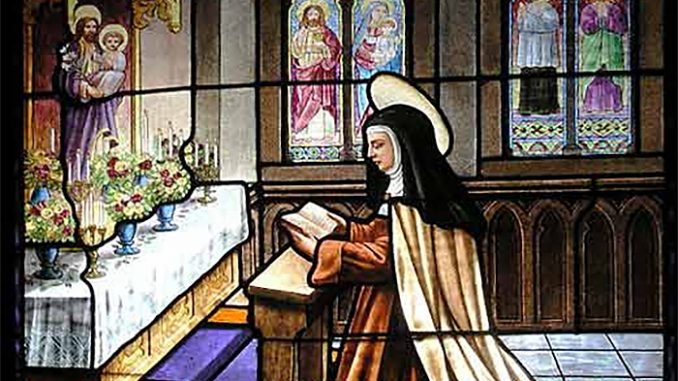
She would have laughed if she had been told that she would someday be named a Doctor of the Church. Teresa de Ahumada y Cepeda (1515-1582), better known as Saint Teresa of Ávila, received the sort of education given to a sixteenth-century housewife. Nevertheless, a famous contemporary theologian and preacher declared that “he would rather argue with all the theologians in Spain than with this nun who knew no Latin.”1
Most Catholics know that Saint Teresa was born in Spain, decided to become a Carmelite nun, and lived a faithful but mediocre life for almost two decades. After experiencing a deep conversion, she spent the rest of her life establishing a reformed order, now known as the Order of Discalced Carmelites.
She was also a spiritual giant. Her writings were published several years after her death, and on the basis of her spiritual works, her letters, and the testimony of witnesses, she was declared a saint.
Despite her reputation as a great mystic, witnesses attested that Teresa was a charming, levelheaded, and affectionate woman. Perhaps that’s why she has been such a popular spiritual guide for more than four centuries. She used down-to-earth proverbs and ordinary speech to express her ideas, not pedantic language. She was a paradoxical woman who wanted to disappear into a convent but who spent decades traveling all over Spain. She sought a life of silence but was forced to placate aristocrats, interview postulants, beg for money, and write letters to people both inside and outside her order.
She was named a Doctor of the Church in 1970 because of the depths of her writings. However, one doesn’t need to have a degree in theology to learn about the spiritual life from Teresa. Demonstrating that fact, here are eight lessons from her life, which are still applicable to Catholics today.
Rule 1: Admit your faults
Unlike the authors of so many modern autobiographies, Teresa freely pointed out the mistakes she had made in her autobiography, The Book of Her Life. She drew attention to the devotion of her pious, wealthy parents and lamented her failure to follow their example, also admitting to a teenage preoccupation with reading novels. Did Teresa’s father send his fifteen-year-old daughter away to be educated by Augustinian nuns because her mother had died, because she had a crush on a cousin, or because he was afraid that she would become a shallow chatterbox? Perhaps it was a combination of all three.
Young Teresa was fascinated by the nuns who taught her, so she impulsively decided to become one herself. She ran away from home at the age of twenty to enter the Carmelite convent of the Incarnation in Ávila, taking the name in religious life of Sister Teresa of Jesus.
For almost twenty years, she lived a seemingly unobjectionable life as a nun. She was chaste, obedient, and apparently happy. She dutifully participated in her community’s life of prayer and worship. However, in modern language, she was simply “going through the motions.” She was more devoted to her friendships and to chatting with visitors in the convent parlor than to talking to the Lord.
Teresa’s autobiography reveals what it looks like to be comfortably stuck in venial sin. Decades passed before she was able to face up to her faults.
Rule 2: Know Christ, and you will know yourself
Soon after Teresa had been professed as a nun, she became seriously ill and almost died. During her slow recovery, she began to pray more earnestly. But when you are surrounded by 180 nuns, all living more like boarders in a hotel than like vowed religious, it’s easy to give up praying. Her father and a Dominican priest confronted her about the frivolous way she was living her faith, but she ignored them.
One day in 1553, she passed a devotional statue of Jesus Christ that depicted Him covered with wounds. This time, the sight of His pain and His blood moved her to repentance. Perhaps more accurately, a near-death experience, the fraternal correction of others, two decades of failed attempts to improve her life, and a unique movement of grace finally broke open her heart. She fell in love with Jesus Christ.
She shocked the other nuns when she began to take prayer seriously. In time, she realized that God was calling her to establish a small community of nuns which would more closely follow the original Carmelite Rule.
Note that Teresa was only able to recognize that the community in which she was living, which was too large, too lax, and poorly led, was impeding her spiritual growth when she fixed her eyes on Christ.
Rule 3: Know when to speak and when to keep your mouth shut
In Teresa’s writings, she vividly describes her experiences in prayer. Although she bemoaned the years that she had spent chatting with visitors in the convent parlor instead of praying, all that talking had turned her into an excellent conversationalist and an insightful writer about the complex subject of prayer.
She did not decide to write about her spiritual experiences on her own. She only did so when her superior ordered her. Of course, she subtly retaliated against him by adding little comments in her writing about how she thought her writing was a waste of time. She thought her time would be better spent spinning wool so that her nuns would have clothing to wear.
On another occasion, she showed a priest a notebook containing a writing she had titled Thoughts on the Love of God. When he said it was a waste of energy and told her to throw it in the fire, she did so immediately. (Faithful Catholics can hope that this priest has completed his time in purgatory for depriving future generations of this writing.)
When Teresa came to her senses after a spiritual ecstasy and learned from her nuns that she had been levitating during prayer, she was humiliated. She worried that they would think she was holy when she was quite sure that she was not.
Teresa’s gift of gab was useful for her as a religious foundress. She often needed diplomatic skills to beg for donations to support her nuns or to gain permission to found a new community. In her letters, she was both polite and shrewd as she diplomatically handled complicated situations involving bishops, rich nobles, local leaders, and even the king of Spain.
Rule 4: Be not afraid of suffering
Teresa grew up in a comfortable home and was indulged by her father and adored by her younger brothers. She could have become a spoiled brat. Fortunately, her Christlike acceptance of suffering saved her from that fate.
Soon after entering the convent, Teresa became seriously ill, and her suffering was exacerbated by poor medical treatment. She almost died, and her family had already dug her grave. Afterward, she was partially paralyzed for three years.
After her recovery from that illness and her conversion, she began receiving visions of Jesus Christ. Her confessors refused to believe her, and they said she was receiving demonic visions instead. Some of the nuns at her convent agreed with the priests. Teresa wondered if they were right.
Later, when she began to establish Carmelite communities in different cities in Spain, residents of those cities would sometimes become violent. They were faithful Catholics, but they were afraid that it would be too expensive for them to support a new community of nuns. Teresa figured out a way to trick them: she and her nuns would sneak into the city in the middle of the night, set up the house, and simply ring the community’s bell in the morning. As a fait accompli, the citizens usually did not riot. Usually.
Having recognized the danger of comfortable surroundings in the Incarnation convent, Teresa insisted that her nuns should live in poverty. During her lifetime, that was generally not a problem. Instead, she and her nuns were often penniless and starving. Teresa did insist that their houses remain clean and were arranged in a practical way, but she did not allow any extra comforts.
Each time Teresa of Jesus faced opposition about her new order, she seemed to be energized, not discouraged. After all, she believed all her work was God’s work. However, in one bitter moment late in her life, when the enemies of her order seemed to be about to destroy the Discalced Carmelites, she was overcome by grief. She wept, worrying that her nuns and priests were about to be expelled or imprisoned. At that critical moment, our Lord appeared to her. He told her that He saw her sufferings, and He encouraged her to take heart. Teresa’s hope returned, and she told her sisters to keep praying. While she and her nuns prayed, a sympathetic priest in the court of Spain convinced the king to intervene. This saved the Discalced Carmelite order from destruction.
Rule 5: Love your friends and family, but do not be blind to their weaknesses
Teresa of Jesus may have become a nun, but that did not change the fact that she had brothers, sisters, nieces, nephews, and other extended family. Sometimes they needed her help; sometimes she needed theirs. Teresa loved her family, and that meant that she was frequently involved in charitably resolving messy family matters.
As the foundress, it was initially Teresa who decided which nuns and priests should be accepted into the new order. As the Discalced Carmelites spread, she relied on her leaders to make important decisions. Some of her early leaders became saints, such as the mystics Saint John of the Cross and Blessed Anne of Saint Bartholomew. One holy priest, Father Jerome Gracián, lived an extraordinary life, as is described in his autobiography. However, as much as Teresa of Jesus respected and loved Fr. Gracián, he could be impulsive and caused her many problems. Sadly, not all the other early Discalced Carmelite leaders became saints, and a few of them even betrayed her.
Teresa loved her family and the members of her order like a true mother. That meant that she forgave them their mistakes and sins. But she was not afraid to correct them, often in a witty way, which softened the blow.
Rule 6: Live for eternity
When Teresa and her favorite brother, Lorenzo, were children, they liked to talk about God with one another. One concept that intrigued them was the idea of eternity. What does it mean to say, “Forever”? They discussed this for hours.
Lorenzo was the brother whom Teresa convinced to run away from home with her. Their plan was to go find some Muslims and be killed so that they could go straight to heaven as martyrs. Fortunately, a relative found them wandering in the countryside and brought them home.
One could argue that all of Teresa of Jesus’ life can be explained by that childhood desire to understand eternity and her willingness to die for it.
Rule 7: Complain to God like a lover
During one of Teresa’s many journeys to establish new communities, she narrowly escaped drowning in a raging river. Tired and hurt, she complained to Jesus, saying “Lord, amid so many ills this comes on top of all the rest!” He replied to her, “Teresa, this is how I treat my friends.” Teresa of Jesus famously said to the Lord of the Universe, “Ah my God! That is why you have so few of them!”2
There is no sign that our Lord found her words offensive. Rather, He knew that she loved Him, no matter where He led her.
Rule 8: Pray every day
There is one thing that the young Teresa of Jesus failed to do and which kept her stuck in a life of mediocrity for decades: she failed to pray every day.
What Teresa called mental prayer is easy to summarize. Place yourself in God’s presence. Talk to Him. Listen to Him. Believe that He is as close to you as your own breath, because, of course, He is.
If that seems too hard, pick up a copy of The Way of Perfection, Interior Castle, or The Book of Her Life, and learn from a mystical master. Teresa’s humility, simplicity, and sense of humor demystify the seemingly complicated subject of mysticism. After all, that’s why Saint Teresa of Ávila is called the “Doctor of Prayer.”
Endnotes:
1 Marcelle Auclair, trans. Kathleen Pond, Saint Teresa of Avila (Petersham: St. Bede Publications, 1988), 394.
2 Ibid. 391.
If you value the news and views Catholic World Report provides, please consider donating to support our efforts. Your contribution will help us continue to make CWR available to all readers worldwide for free, without a subscription. Thank you for your generosity!
Click here for more information on donating to CWR. Click here to sign up for our newsletter.


Leave a Reply