

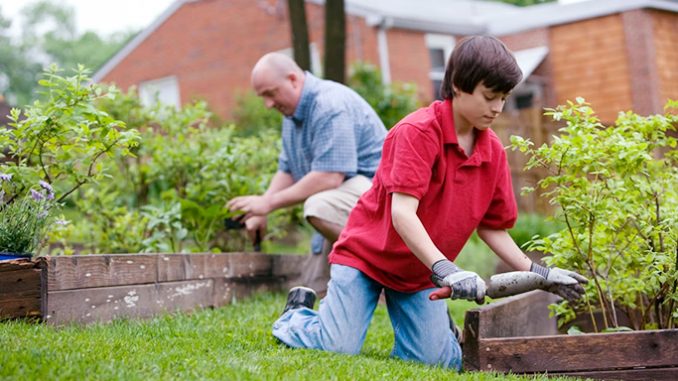
I know better than to declare victory before the summer is over, but this has been the first year in quite a while that our pumpkin, watermelon, and cantaloupe vines have all made it through August alive. Just last night, we harvested our first pumpkin of the year, and, God willing, we will be enjoying more from those vines before long. Meanwhile, there are still a few blackberries and raspberries ripening that the kids have been bringing to me. Still, it’s clear that berry season is winding down as melons, apples, and pears are now taking over at the Ramage family’s little homestead.
Enjoying these fruits of the earth is one of my favorite parts of this time of year. But one of the things I love about this seasonal transition is watching the annual procession of insects arrive as one crop gives way to another in our yard. At last, the Japanese beetles seem to have left for the year, though not before leaving plenty of carnage in their wake. In their place, we have grasshoppers and katydids climbing our house, and we get to fight squash bugs bent on wiping out the small pumpkin patch.
And then there’s my unassuming little nemesis—the crickets that keep invading the garage and interrupting my sleep with their endless chirping. This time of year, it’s not unusual to find me out of bed after midnight with a flashlight, hunting these bugs—including ones that have taken up residence too close to my window.
Like me, you may find these creatures unpleasant. No one enjoys being kept awake by creatures making a racket, and for sure nobody wants a summer’s work in the garden undone just as the harvest arrives—whether by tomato worms or by raccoons, opossums, and deer helping themselves before we can enjoy the literal fruits of our labor.
But St. Augustine would remind us that if we find something about the natural world repulsive, the problem lies less in the creature in question than in the condition of our own souls. God’s handiwork is beautiful and edifying, but it’s also sometimes strange, prickly, loud, and inconvenient. Even so, the Catholic tradition is overwhelmingly clear that every single creature glorifies God in its own way and occupies an important place within the providential order of the cosmos.
I may not enjoy crickets, but God does. And that’s a significant enough fact to pause over—which is precisely what I want to do right now.
An opportune time to rediscover creation
The more time marches on, the more I find wisdom in John Paul II’s teaching that real personal restoration can come through contact with nature and by attending to ordinary things like its various cycles—even the approaching season when things begin to wither and fade. On September 1st, the Catholic Church appropriately celebrates the 11th annual World Day of Prayer for the Care of Creation. The name may be a mouthful, but it’s nonetheless deeply traditional to religiously observe the turning of the seasons—and it would be nice if we brought back Ember Days to do that, too. Pope Leo XIV has continued Francis’s practice of issuing a message for the occasion.
While I greatly appreciate his effort and was edified by last year’s message, this year’s gave me less to reflect on. Still, the ecumenical Season of Creation, which we commemorate alongside Orthodox Christians among others, offers a fitting occasion to reflect on creation and our care for it (which must always include, first and foremost, care for the most vulnerable humans among us). And, providentially, this year’s observance arrives as my new book, Cosmic Covenant: A Catholic Theology of Creation, has just been published with Word on Fire.
While that larger text explores this theme in much greater depth, for the rest of what follows, I want to tease out the implications of one point Leo makes that has its roots in the pontificate of Pope Benedict XVI.
The deserts around us and within us
Pope Leo’s recent message begins by acknowledging the sobering fact that profound human suffering and the accelerating disruption of creation’s harmony are advancing in lockstep across the world today. In keeping with Catholic teaching on integral ecology, he insists that these aren’t unrelated crises. They’re “a single plea for healing and peace arising from a wounded world.”
In this particular instance, our present pontiff is concerned most with how war and environmental degradation often turn into “a vicious cycle.” Armed conflict can destroy ecosystems and contaminate air and water. In this way, what begins as violence against one’s neighbor becomes violence against the wider creaturely world. In turn, however, this damage endangers food security, exacerbates poverty, and fuels further social tensions as people compete over increasingly limited natural resources.
Yet the pope thankfully doesn’t leave the matter at the level of geopolitics, and in any event, I have no interest here in weighing in on such matters—whether generally or with respect to the present-day armed conflicts he may have in mind. The problem, he says, is fundamentally moral and spiritual. What I especially want to focus on is Leo, in making this appeal, references Pope Benedict XVI’s unforgettable warning at the inauguration of his pontificate: “The external deserts in the world are growing, because the internal deserts have become so vast.”
As the Bavarian pontiff poignantly articulated in this context, there are many kinds of ‘desert’ in our world, but the most damaging of all are “the desert of poverty, the desert of hunger and thirst, the desert of abandonment, of loneliness, of destroyed love…the desert of God’s darkness, the emptiness of souls no longer aware of their dignity or the goal of human life.”
Precisely because these wastelands are expanding so rapidly, he explained, “the earth’s treasures no longer serve to build God’s garden for all to live in, but they have been made to serve the powers of exploitation and destruction.”
Conversion beyond the abstract
This is a hard saying, but it’s an indispensable one. A world stripped of beauty, stability, and peace isn’t healed merely by better policies, even as these aren’t irrelevant. Nor are ecological problems solved—as so many people seem to think they can—simply by purchasing a few carbon credits and thinking kindly about “the planet” in the abstract while continuing to live as we always have. And, certainly, the Catholic approach to creation rejects both romantic escapism from human problems and anti-human forms of environmentalism.
According to the Church, the deeper task before us is conversion: learning again to receive the world as a gift and to see other creatures (including people) as fellow covenantal partners rather than as obstacles to our desires or raw material to be manipulated at will—a mindset at the heart of what Pope Francis calls today’s pervasive “throwaway culture.”
This is a point made by every pope since John Paul II, who taught in one of his Theology of the Body catecheses, “Man appears in creation as the one who received the world as a gift, and it can also be said that the world received man as a gift.” Francis, however, articulates the Polish pontiff’s teaching on creation’s “sacramentality” and the human vocation it entails especially well:
Only in the human being, the microcosm that condenses the universe into itself, but that lives by the breath that the personal God has directly blown on his face, can the world correspond to its secret nature as sacrament—that is, be seen as a gift…It is the human being’s task to freely and creatively decipher the revelation of this gift. And it is also his task to grasp the world in his communion with God.
Christian stewardship, then, is not a flight from reality but an immersion into it: a way of receiving the world God has actually placed before us and learning to love it well.
Learning again to read creation
The logic of this vision echoes a principle Scripture teaches about our fellow human beings. It’s easy to profess love for “humanity” in the abstract while failing to love the actual people God has placed before us. As St. John teaches, “he who does not love his brother whom he has seen, cannot love God whom he has not seen” (1 Jn 4:20). Something analogous holds true for creation: we can’t claim to love “the environment” in general while neglecting the specific creatures and places entrusted to our care.
In his important work articulating a vision of “Green Thomism,” Christopher Thompson ups the ante. “Ignorance of creation is ignorance of the Creator,” he writes, adding that our growing failure to read what the Fathers lovingly called “the book of nature” undermines our capacity to live a life in grace and effectively proclaim the gospel of Jesus Christ. Pope Leo himself would later say as much, putting it bluntly: “We cannot love God, whom we cannot see, while despising his creatures.” But if these words from the past decade are too recent, consider these words from the great apologist Frank Sheed, in his 1946 book Theology and Sanity , on the importance of reading God’s “first book”:
It is no compliment to God’s omnipotence to treat what he has made of nothing as if it were little better than nothing. It is no compliment to a poet to be always seeking him and resolutely refusing to read his poetry. God is communicating with us, telling us something, by way of his universe. There is something verging on the monstrous about knowing God and not being interested in the things he has made, the things in which his infinite power is energizing. The logical development of so strange an attitude would be to love God so exclusively that we could not love men—an exclusiveness which he has forbidden.
Care begins close to home
But attentive love of the book of creation has to be lived out concretely somewhere. If you’re a Catholic and believe in the principle of subsidiarity, it means that work begins close to home and not by going out and performing grand deeds only in faraway lands. As Wendell Berry has put it, “properly speaking, global thinking is not possible.” While our responsibilities can certainly extend beyond the places nearest to us, we can only love and serve the world concretely from somewhere. In the words of Berry, we can only “make good ecological good sense locally”—and even then only when the affection, knowledge, scale, tools, and skills are right. Lord knows, we need people designing clean-water systems and making basic medical care available in developing nations. But it’s easy to sentimentally profess concern for forests, oceans, or endangered species halfway around the globe while neglecting the people and creatures the Lord has entrusted to us where we actually dwell.
Christian stewardship, by contrast, is incarnational, and it implies a way of life centered on the dignity of the ordinary and the local. It asks us to love particular persons and places, even when they’re difficult to love. For instance, I didn’t find it easy to love Kansas when we moved here in 2009. Now I sincerely do—even if it’s still not my favorite parcel of God’s good earth. Thanks in no small part to my wife, I’ve learned that the familiar prairie, river, and field can disclose beauties most miss because we’re always looking elsewhere for something more exotic.
Most of the time, this incarnational way of inhabiting creation won’t look any more dramatic than Christ’s ordinary life in Nazareth would’ve appeared to those around him. It involves things like learning to repair things with our hands rather than always replacing them, picking up litter from a local creek or park knowing that it will go unnoticed, curbing needless online expenditures, or growing some of our own food, even though it’s not the most efficient (or necessarily cost-effective) thing we can do.
These small acts of love—which Pope Francis proposed as works of mercy—won’t by themselves put an end to wars or fix major ecological problems. But they’re great ways to cultivate an oasis amid the inner desert we help create whenever we give in to the illusion that the world exists simply for our consumption, convenience, and control.
Learning the names of the birds and plants in our own backyard and neighborhood may not initially seem to accomplish anything tangible, but it is a great place to start. We can only truly love what we know, and, personally, I find that this practice almost without fail has an immediate effect. Not only does it make me care more about the many goods that God has placed in my life, but it increases my capacity for self-restraint and my ability to be present to the real world instead of to my phone. As our culture grows more alienated from the natural world, this kind of attention is one small but real way we can push back against the nature-deficit disorder so widespread among us.
Conclusion: Tending the fields we know
Our efforts to live this way may not affect millions of people, but that’s precisely the liberating thing: it doesn’t need to. Nor do we need to see every fruit of our efforts. Christian stewardship includes what Benedict XVI called responsibility toward “future generations,” or “intergenerational solidarity”: receiving and tending our share of creation so that those who come after us may enjoy its goods in turn. “The environment is God’s gift to everyone,” he wrote, “and in our use of it we have a responsibility towards the poor, towards future generations, and towards humanity as a whole.” For his part, Pope Leo in his encyclical Magnifica Humanitas makes this point delightfully and refreshingly through a citation of J. R. R. Tolkien’s Gandalf, “It is not our part to master all the tides of the world, but to do what is in us for the succour of those years wherein we are set, uprooting the evil in the fields that we know, so that those who live after may have clean earth to till.”
As the seasons turn, my backyard pumpkin patch may yet fail. It often does. The watermelons may not ripen, and little mammals may devour all my cantaloupe. But for now, their growth—and the chirping, buzzing life around them—calls me to pay attention. This is where care for creation and the work of peace must begin: with the conversion of heart that enables us to receive the people and creatures God has entrusted to us as gifts, to make something of that gift through grateful and faithful care, and finally to offer it all back to God in love.
If you value the news and views Catholic World Report provides, please consider donating to support our efforts. Your contribution will help us continue to make CWR available to all readers worldwide for free, without a subscription. Thank you for your generosity!
Click here for more information on donating to CWR. Click here to sign up for our newsletter.

Leave a Reply