


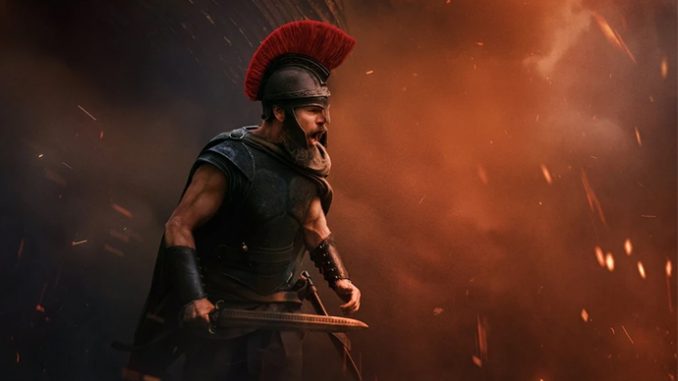
Christopher Nolan’s The Odyssey is proving quite controversial, in part because it admits of so many different interpretations.
Is it a nefarious piece of woke propaganda? A parable about PTSD? Or an “apologia for Christian morality,” as Ben Shapiro of The Daily Wire insists? The internet cannot decide.
On one level, this very confusion is a mark of Nolan’s success. Bad art is easy to see through; only good art contains murky depths.
Even so, The Odyssey is hardly unfathomable, and I think a close viewing suggests Shapiro is not far from the mark. On this interpretation, the movie is fundamentally a meditation on how, due to the alienation resulting from sin, man’s only hope of homecoming lies in exile.
Consider how Nolan’s The Odyssey differs from Homer’s original.
The latter is all about man’s need for a home in this world and concludes with its hero, the Trojan War veteran Odysseus, reclaiming his native kingdom of Ithaca. In Nolan’s version, such an end is impossible—Odysseus’s destruction of Troy has unleashed a global wave of violence that dooms Ithaca, and the hero must sail on indefinitely.
This recalls the fate of the titular scientist in Nolan’s previous film, Oppenheimer, who enables the bombing of Hiroshima and Nagasaki to win World War II, only to find that those acts of mass murder have undermined the very civilization he set out to save. Both he and Odysseus, argues Fr. Mike Johns in Evangelization & Culture, are stand-ins for modern man in general, who has “invented the sure means of his own annihilation” and thus “forever put his home out of reach.”
But The Odyssey is not just a commentary on modernity. As indicated by its mythical setting, the movie’s message is meant to be universal. Moreover, Odysseus’s great offense, unlike Oppenheimer’s, is not characterized as technological or merely moral—it is explicitly spiritual.
Yes, the sacking of Troy, like the deployment of nuclear weapons against civilians, is abominable in its own right. But in a confessional monologue to his wife, Penelope, Odysseus makes clear that his chief regret is not the destruction of the enemy city per se. It is his concoction of the impious Trojan Horse ruse, whose abuse of the Trojans’ religiosity constitutes a profound betrayal of the gods.
That betrayal harkens back to original sin, and its effects are the same.
In the theology of Pope St. John Paul II, sin alienates “the sinner from himself, from God, and from the community.” In The Odyssey, it condemns Odysseus to wander for ten years in the wilderness, where he is stripped first of broader society, then of his comrades, and finally, albeit temporarily, of his memories.
All the while, Odysseus is also bereft of a direct word from the gods. Only Athena appears to him, and she turns out to be something akin to a figment of his guilty imagination. It seems that when Odysseus lost his spiritual innocence, he, like Adam, also lost the comfort of easy friendship with the divine.
There is hope, however, for man and the hero. As John Paul loved to repeat, the one can rediscover his true self “through a sincere gift of himself,” and the other can achieve a spiritual, if not a permanent physical, homecoming by going into exile to atone for his sin.
For Odysseus, this means relinquishing his desire to be “master of [his] fate,” as one character puts it, by abandoning himself to the gods—literally allowing the wind and sea to blow him where they will. Then, after he has returned to Ithaca and purged it of the stain of his sin, represented by the villainous suitors, he must leave home again, sailing beyond the known world to make a sacrifice on behalf of the dead.
This leaves Odysseus simultaneously “perpetually adrift,” in Fr. Johns’s words, and restored to a kind of personal integrity. Like the Christian, he is dead to the world. But the world of The Odyssey, like our own, is already dying as a result of the evil man has unleashed upon it. To seek restoration outside it is the only path forward.
What of those who remain?
Nolan ends his movie with an image of the Trojan Horse to warn them that they live under its shadow. And, by extension, under the shadow of the Tree of the Knowledge of Good and Evil. Neither Odysseus’s cleverness nor Oppenheimer’s scientific ingenuity could deliver them from that, and neither, suggests Nolan, can our own civilization save itself.
In this, the epic filmmaker and the epic poet have more in common than they first appear to. While Homer allows Odysseus to stay in Ithaca, he also allows the kingdom to descend into a blood feud with no end in sight when the suitors’ families stake their claims for revenge. Ultimately, only the gods can put a stop to the madness.
“Call a halt to the great leveler, War,” demands Athena in Robert Fagles’s translation of The Odyssey.
Nolan’s adaptation makes a similar appeal, but both works acknowledge that their audiences cannot comply without help. Now, as in the time of the ancients, this world’s salvation must come from Another.
If you value the news and views Catholic World Report provides, please consider donating to support our efforts. Your contribution will help us continue to make CWR available to all readers worldwide for free, without a subscription. Thank you for your generosity!
Click here for more information on donating to CWR. Click here to sign up for our newsletter.

If, in fact, this is the message Nolan wishes to convey, he should have chosen a different vehicle. Bastardizing The Odyssey just obscures it.
Having seen (and owning) all Nolan’s movies (from Memento through Oppenheimer) and enjoying every one of them (multiple times in fact), I was excited to hear that Nolan was taking on the Odyssey. However, over time, there was all the major issues that have been brought forth (I will not state them here as it appears everyone knows already).
I still went to see this movie with my wife (primarily for her birthday wishes); I’m not a film critic, but I’d have to say that despite the beautiful way of coming at the story, I will not go to see this again nor think of owning it.
Possible spoilers — I handled the race baiting of a black Helen of Troy fairly well (if you noticed, the ship’s crew seemed very “diverse” and I’m not absolutely sure the ancient Greeks didn’t have slaves of other races with them). She didn’t seem as integral to the story and she could’ve been cut out.
I even enjoyed the way they portrayed the creatures and sorcerers and such (especially Circe turning the men to pigs; while disturbing to watch, it was an excellent take on that portion)
My two biggest issues (which were more like toxicity to a meal rather than grizzle on a good steak dinner that can simply be cut out) were the dialogue (way too modern; it sounded like childish middle school banter at times) and Ellen Page (it’s bad enough in real life that she pretends to be a man, it’s even worse that her character in this movie seems instrumental to the Trojan Horse plot; after all, she takes the place of Robert Patterson’s character who later on wants to marry Penelope played by Anne Hathaway).
When the reveal came out of who Ellen Page’s character was, it actually soured the remaining portions of the movie (despite them being done decently).
I sincerely believe that the only reasons this movie has done, is doing, and will do well is because of the name of Christopher Nolan; he’s making a name for himself and that’s the reason people want to see what he directs.
Obviously this whole thing is just my opinion on it.
If you have already seen it, I hope you have some of the same issues and will consider not viewing it again. If you haven’t seen it, while it’s up to you, I recommend not wasting your time primarily because of the issues I mentioned.
God Bless.
When it’s streamed somewhere online for free I might take a look. But in the meantime I think I’ll search for the vintage Kirk Douglas version of the story.
🙂
To each his (or her) own, but the 1950s Kirk Douglas version is a really mediocre movie.
I actually found the 1954 Kirk Douglas version for free on YouTube. No ads either but it was dubbed in Portuguese. 🙂
Portuguese isn’t too different from Spanish so I turned on the Portuguese subtitles and could kind of sort of put the dialogue together.
Homer is vastly superior to all his pitiful imitators. And to the clown who took the title of one of his great works for a ridiculous movie. Don’t waste your time on them. Read Homer.
Homer is unreadable. His poetry was supposed to be an oral tale and it suffers terribly upon writing it down. Much like another unreadable tale, Ulysses by James Joyce, it is fit only for school assignments.
Let’s face it, very few people have actually read Homer’s Odyssey. A truly faithful film would have to be five hours long, if not longer.
I’m no Christopher Nolan fanboy. Some of his movies have been disappointing. “Interstellar,” for example, began promisingly, only to becoming so increasingly ridiculous that I thought my eyes were going to roll out of my head. So I approached “The Odyssey” with a bit of trepidation. But I have to say, he really knocked this one out of the park, and I’m not going to fault him for taking a three year hiatus from filmmaking, as he says he plans to do. Sure, he could have stuck very strictly to the source material, including a lot more gore not to mention Odysseus’ year-long sexual romp with Circe. But that would have made for a MUCH longer and unmarketable film. Like Peter Jackson and his “Lord of the Rings” movies, Nolan made some hard choices in order to craft a convincing epic tale. It’s already grossed over $727.9 million globally after just 12 days in theaters. Again, this is an R-rated movie based on a Greek epic and it’s close to three hours long. Only Nolan could have made this into a box office guarantee. I thought it was absolutely magnificent.
And BTW, the Chinese Communist Party is promoting this movie in China lavishly. Hmmm. Could it be because this movie is one more weapon in the CCP relentless undermining of the traditions and values of the West? Nah. It must be because of the great quality of the movie. And if is so good for the CCP it must be good for us too.
• “The phrase “CCP promotes” gains weight because Chinese state media outlets (which are mouthpieces of the Party) are covering the red carpet event and the release extensively. In China, positive coverage by state media of a foreign film is often interpreted as a political signal of approval, effectively serving as state-sanctioned promotion.
• The “Red Carpet” Precedent: The upcoming July 30 event at the China National Film Museum is described by IMAX China’s CEO as the first time an American film has been permitted such a ceremony in Beijing. This exception to the norm suggests a deliberate decision by authorities to highlight this specific film, likely due to Nolan’s prestige and the film’s thematic alignment with anti-war sentiments that resonate with current state narratives.”
So, you are going to reject a movie based solely upon people liking it?
Since we’re into spoilers, the handling of the Trojan Horse is brilliant in channeling how, in “The Planet of the Apes” (1968), the relic Statue of Liberty is discovered half buried in a sandy beach. Well done!
Good review. I really liked it (not every scene!), for as a veteran of the war in Afghanistan, I could relate deeply to Odysseus as retold by C Nolan. Those who detracted often have not seen it. The vast majority never bothered to raise their right hands to volunteer much less serve in combat arms in a theater of war despite decades of opportunity. To speak against the potential PTSD, aka PTS, as a man who never served a day is a gross revelation of a man’s cowardice. Now certainly that’s not all that is in the film, but to care about the color of Helen’s skin when Homer himself as far as we know never reveals her tone is to reveal far more about the inside of a filthy heart than to make a credible dent in Nolan’s character and ability as a film maker and storyteller. The film speaks to our day’s audience, as it should. To fail to see how this is nothing new in storytelling is to betray your ignorance of Virgil, Dante, Shakespeare, et alia. The haters gonna hate. Meanwhile, meaningful analysis is lacking. Bitterness can be bittersweet. Moving on, finding healing, and trying to see the good in others and everything is most sweet.
A good thing about this movie’s screening is that it has motivated many young and old people to read Homer. The translation of the Odyssey by Robert Fagles is excellent and available also in audio.
https://www.amazon.com/The-Odyssey-audiobook/dp/B000OYDLE4/ref=sr_1_10?s=books&sr=1-10
Another good one is by Daniel Mendelsohn with audio available at amazon
—Homeric texts was how young Greeks in Classical Greece learned. Young Greeks in classical Greece learned to read by engaging with Homer, as his works served as the primary educational text. The Iliad and Odyssey were central to early intellectual exercise, often taught through memorization and oral recitation before formal literacy was fully developed.
—It was the basis of character formation.
—These were the Greeks who defeated the huge invading army of the Persians at Marathon. And yes, this battle gave origin to the practice of the marathon race today. Look it up.
—These were the Greeks who created the Olympic Games….
—And the ones who stopped the Persians at Thermopylae, and told the Persian despot who asked them to give up their weapons “come and get them!” ( molon labe!).
—Homer is still part of the education of young Greeks. It is still part of the classics major in American universities. It is a foundational work in Western civilization. I read the Odyssey as a child and could not put it down. As Jorge Luis Borges wrote, Western civilization comes from two places, Athens and Jerusalem.
. ΜΟΛΩΝ ΛΑΒΕ!
And the tough modern Greeks, also readers of Homer in school, adopted during their War of Independence (1821-1830) from the centuries of domination by the Muslim Ottoman Turks the motto LIBERTY OR DEATH!, Eleftheria i thanatos (Greek: Ελευθερία ή θάνατος!
The phrase is now part of the Greek flag symbolized by the nine horizontal stripes corresponding to the nine syllables of the phrase.
For the history and significance of all this see
https://talkpal.ai/culture/why-is-the-phrase-eleftheria-i-thanatos-linguistically-powerful/
and
https://grokipedia.com/page/Eleftheria_i_thanatos
—Nolan’s Odysseus is a replica of today’s wimpy American man, psychologically penetrated and corrupted by left wing ideas and misunderstood Christian teachings alien to the great Christian heroes of the past, and bombarded by them in school, college, university, the media, work and politics. And movies like Nolan’s “Odyssey.”
—These are the virtues that Greek children learned at school, taught by Homer, and that allowed the Greeks to beat the invading armies of the despotic Persia (today’s Iran) and fight for liberty or death at Marathon and Platea and stop them at Thermopylae and tell the Persian despot who demanded that they surrender their weapons, “Come get them” (Molon Labe!). And create a civilization that is absolutely fundamental for Western civilization. And that allowed even Greek Orthodox priests to fight and die and kill during the Greek War of Independence against the Muslim Turks oppressors AND WIN.
CORE HOMERIC VIRTUES
• Arete (ἀρετή): Often translated as “excellence” or “virtue,” this is the foundational concept of fulfilling one’s specific potential. For a warrior, arete meant unmatched martial prowess, courage, and skill. In the film, Odysseus’s arete is portrayed not as a source of pride but as a burden linked to guilt, contrasting with the Homeric ideal where expressing arete was the only path to human flourishing (eudaimonia).
• Kleos (κλέος): Meaning “glory” or “fame” that lives on after death, kleos was the primary motivation for Greek heroes, who sought “imperishable glory” through great deeds. Nolan’s Odysseus appears indifferent to or weary of kleos, viewing his legendary deeds (like the Trojan Horse) as moral failures rather than sources of eternal renown.
• Timē (τιμή): This refers to honor, social worth, and public respect received during one’s lifetime, often manifested through prizes and status. The film’s focus on internal guilt overrides the external pursuit of timē; the character is driven by a modern “guilt culture” rather than the ancient “shame culture” where public reputation was paramount.
This column by Greek journalist John Kass (formerly of the Chicago Tribune) is excellent:
Beware of Geeks Bearing Grifts: Nolan’s Cowardly Betrayal of The Odyssey and the Greek People
By John Kass
https://johnkassnews.com/beware-of-geeks-bearing-grifts-nolans-craven-betrayal-of-the-odessey-and-the-greeks/
Self reflection and growth are not “wimpy”. Sad that you see it so.
Slowey makes brilliant insights that I never saw watching the movie. My favorite is:
“On this interpretation, the movie is fundamentally a meditation on how, due to the alienation resulting from sin, man’s only hope of homecoming lies in exile.”
Where are the great Christian heroes of the past, now that we need them?
—Godfrey of Bouillon, Skanderbeg, King Saint Louis IX of France, King Saint Ferdinand III of Castile, El Cid, Don John of Austria and his fellow soldiers at Lepanto, King Richard the Lionhearted of England, John Hunyadi, Vlad Tepes, the monk Knights Hospitaller, the monk Knights Templar, and so many other Christian heroes who still had THE ANCIENT GREEK VIRTUE OF ARETE (EXCELLENCE, VIRTUE, AS WARRIORS IN THEIR CASE) and who through these virtues of courageous war-making effectiveness—Arete—BY DEFENDING CHRISTIANITY ACHIEVED THE ANCIENT GREEK VIRTUE OF KLEOS—RENOWN, GLORY—AND TIME—RESPECT, SOCIAL WORTH–BECAUSE WE STILL REMEMBER THEM AND HONOR THEM AS GREAT CHRISTIAN HEROES—WHO SHOWED THAT FOLLOWING CHRIST DOES NOT MEAN BECOMING A DOORMAT AND A WIMP AND LETTING ENEMIES TRAMPLE AND WORSE ON ONE’S WIVES, CHILDREN, FAMILY, CHURCHES, NATION, NEIGHBORS, FRIENDS, RELIGION AND CULTURE.
—For King Saint Ferdinand III of Castile see
SAINT FERDINAND III OF CASTILE: WARRIOR KING AND CATHOLIC SAINT
https://www.tfp.org/king-saint-ferdinand-iii-and-his-conquests-for-christ/
—For the famous Don John of Austria and the other famous heroes of Lepanto read G.K. CHESTERTON’S FAMOUS AND GLORIOUS POEM LEPANTO
https://www.poetryfoundation.org/poems/47917/lepanto
—For many others famous and glorious Christian heroes READ THIS BOOK WHICH HAS ACHIEVED FAME—KLEOS– as a No. 1 Best Seller at amazon
DEFENDERS OF THE WEST: THE CHRISTIAN HEROES WHO STOOD AGAINST ISLAM
https://www.amazon.com/Defenders-West-Christian-Heroes-Against/dp/1642938203#averageCustomerReviewsAnchor