


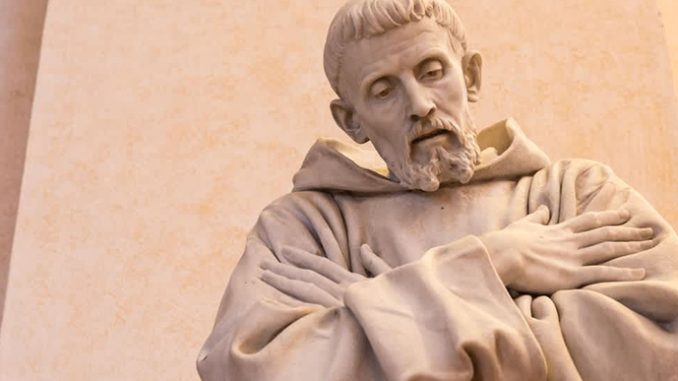
It only took 653 days. Pope Gregory IX declared Giovanni di Pietro di Bernardone to be a saint on July 16, 1228, even though “Il Poverello”, the little poor man of Assisi, had only been dead for a year, nine months, and fourteen days. This was a blistering speed for a canonization by any measure in any century in the history of the Catholic Church.
But one could hardly blame the pope for wanting to recognize what everyone in the thirteenth century already knew: Francis of Assisi was a saint.
Eight hundred years have passed since the death of Saint Francis on October 3, 1226, and Catholics and non-Catholics alike continue to be fascinated by his life story.
Fortunately for us, Pope Gregory wanted a trustworthy biography to be written about Francis around the time of the 1228 canonization. He asked a Franciscan friar named Thomas of Celano, a nobleman’s son who had joined the Franciscan order in 1215, to write one.
According to the first biography Thomas wrote,1 Francis was a rich man’s son living in Assisi, Italy. He was known for his wit and practical jokes, his extravagance with money, and his many friends. But even a rich kid can get sick. Francis was twenty-five years old when he contracted a serious illness. When he had recovered, he sometimes went for walks through the countryside. But he was surprised to find that the beauty of nature did not lift his spirits as it always had before.
For that reason, when he heard that a nobleman in Assisi was undertaking a military campaign against another city, Francis leapt at the opportunity to “enrich himself in money or distinction.”2 The night before the soldiers were about to leave, Francis had a vision of his own home, which he saw filled with military equipment. This seemed the perfect sign of future success—but once again, Francis was not filled with excitement at the prospect of going into battle. Surprising everyone, including himself, he refused to go.
Instead, he sought out a faithful friend and confided in this friend that he had found a treasure. The treasure, of course, was God, and Francis began to seek Him in a nearby cave. Without revealing this profound change of heart to others, Francis spent more and more time praying in the solitude of that cave. He wept for his sins and mourned his past acts of selfishness. And the beauty of his new love—Lady Poverty—stole his heart.
Here is the moment when every parent is tempted to side with Francis’ father and against Francis himself. Francis was sent to the city of Foligno to sell some of his father’s expensive cloth, as he had done many times before. But this time the money Francis received from the sale felt like a great burden. He impulsively decided to abandon his horse and give away the money. He first tried to give it to a priest at the rundown church of San Damiano, but the priest refused to accept it. He was afraid the money was stolen. Francis threw the money out the window.
And then he hid. For a month, Francis hid in a pit. Filled with fear about how his father would react, he prayed. Finally, he felt God’s presence again and walked back home. Of course, everyone now thought he was a thief. When Francis’ father learned that he had returned, he dragged his recalcitrant son home, beat him, bound him like a criminal, and kept him locked up in his room.
However, his father eventually had to leave the house, and his mother released him from his imprisonment. Thus followed the famous scene in which Francis’ father brought Francis before the bishop, accused him of stealing, and demanded his money back. Francis replied that he didn’t have the money, so he gave his remaining worldly possessions—the clothes off his back—to his father. Covered with only the bishop’s mantle, Francis walked away, leaving everything behind out of love for God.
The rest of his life seemed to follow, naturally and supernaturally, from that one pivotal moment. He was mistreated by bandits and cared for lepers. He rebuilt falling-down churches and traveled the countryside on foot to preach the Gospel. He attracted disciples and trained them, met the pope and founded a religious order, healed the sick and drove out demons, showed his love for the poor and sang his love for God’s Creation.
How would you describe Saint Francis? In the Life written by Thomas of Celano, he called Francis a “soldier of Christ.”3 Saint Bonaventure, a Doctor of the Church and the seventh Minister General of the Franciscan order, described Francis in this way: “Humility, / the guardian and the ornament / of all the virtues, / had filled the man of God in copious abundance. / In his own estimation / he was nothing but a sinner, / although in truth he was / a resplendent mirror of all holiness.”4
Before his conversion, this “resplendent mirror of all holiness” had loved the lyric poetry of the medieval troubadours. After he gave his life to Christ, his sensitive nature and love of poetry were still visible in his writings, such as his famous hymn, “Canticle of Brother Sun.” Some of his biographers followed his example and included poetry in their biographies about Francis. For example, Henri d’Avranches’ Versified Life of Saint Francis (1232-1239) turned Thomas of Celano’s prose into a poetic biography, making it more popular with the sophisticated readers of his day. D’Avranches calls Francis a “godly captain,”5 a holy man leading his followers in the army of Jesus Christ.6 When Dante Alighieri wrote his famous Divine Comedy a century later, he included Saint Francis as one of the holy characters enjoying heavenly bliss.7
Today, statues of Saint Francis typically depict him with birds fluttering around him. Do the owners of those statues know why he is shown with birds? As Thomas of Celano describes an important incident, while Francis was travelling through a valley, he and his companion entered a field filled with birds. Francis greeted the birds in the same way he greeted people. “The Lord give you peace,” he said. Then he began preaching to the birds about how to love God. (It is not reported whether Francis’ companion initially wondered if Francis had lost his mind.) “My brother birds,” Francis said, “you should greatly praise your Creator, and love him always. He gave you feathers to wear, wings to fly, and whatever you need. God made you noble among His creatures and gave you a home in the purity of the air, so that, though you neither sow nor reap, He nevertheless protects and governs you without your least care.”8
Of course, Francis spent much more time preaching about the love of God to men and women than to birds. However, Thomas of Celano also wrote: “When [Francis] could not think of anything [to say when preaching to people], he would give a blessing and send the people away with this act alone as a very good sermon.”9
Francis was not a theologian or a voluminous writer. However, he did leave behind some writings to encourage his disciples. For example, Francis wrote twenty-eight directives in a work now called The Admonitions, a work which contains simple spiritual advice applicable for any Christian:
XI, 1. Nothing should upset the servant of God except sin. And no matter how another person may sin, if the servant of God lets himself become angry and disturbed because of this, [and] not because of love, he stores up the guilt for himself (cf. Rm 2:5). That servant of God who does not become angry or upset at anything lives justly and without anything of his own.
XIII, 1. …The servant of God cannot know how much patience and humility he has within himself as long as everything goes well with him. But when the time comes in which those who should do him justice do quite the opposite to him, he has only as much patience and humility as he has on that occasion and no more.
XXI, 1. Blessed is the servant who, when he speaks, does not reveal everything about himself in the hope of receiving a reward, and who is not quick to speak (cf. Prov 29:20), but wisely weighs what he should say and how he should reply.10
Francis did not simply renounce his father’s comfortable home when he walked away from Assisi around the year 1203. He embraced complete poverty and all its related inconveniences, such as not having enough food to eat, a bed to sleep in, a roof over his head, and all those other worldly possessions we take for granted. He did this joyfully, without resentment. His poverty was not primarily about self-discipline or self-abnegation; it was about showing his Heavenly Father that he, Francis, had complete trust in God’s providential care for him.
Captivated by his example, a few men began to follow Francis almost from the beginning. Francis’ order grew rapidly. The Order of Friars Minor, also called the Franciscan order, has given birth to daughter orders and has been reformed many times over the centuries. The Franciscan order has also produced more saints than any other religious order in the history of the Church by a large margin.11 Five hundred and forty-two members of a Franciscan order have been canonized or beatified, and 331 of them have died as martyrs.
A century after Francis’ death, a Franciscan friar named Ugolino Boniscambi compiled a collection of stories about Francis and his early companions which he called The Deeds of Blessed Francis and His Companions. This work was translated and edited anonymously sometime after 1337 to become the more famous work, The Little Flowers of Saint Francis and His Companions. Every devotee of Saint Francis knows the story of Francis telling his traveling companion, Brother Leo, that perfect joy is not to be found in giving a holy example to others, performing miraculous cures, or possessing surpassing wisdom. Instead, Francis tells Leo that perfect joy is found in this:
Above all the graces and gifts of the Holy Spirit, which Christ grants to His friends, is that of conquering our own selves and gladly, for the love of Christ, to endure sufferings, injuries and insults and difficulties, because we cannot glory in all the other gifts of God, since they are not ours but God’s.12
In the year 1219, during the middle of the Fifth Crusade, Francis decided to convert the Sultan of Egypt, Al-Kamil, or die trying. Taking only one companion (who, not being a saint, must have been a bit nervous about imminent martyrdom), Francis traveled to Egypt. While he did not win the sultan’s soul for Christ, Francis did win the sultan’s respect. The fact that the Franciscan order has been granted custody of Christian sites in the Holy Land for many centuries is a testimony to Francis’ holiness.
Francis became so popular that mobs of people constantly sought him out, offering him little time to be alone with God. Fortunately, he had been given—of all things—a mountain by a wealthy count. Francis would sometimes take a few companions with him and pray in solitude on that mountain, called La Verna.
In 1224, Francis, who was now blind, was praying at La Verna when he was filled with joy during a spiritual ecstasy. Soon afterward, on September 17, 1224, he experienced a vision of God and saw “a man, having six wings like a Seraph, standing over him, arms extended and feet joined, affixed to a cross.”13 This vision also filled him with joy and awe, but as he was pondering its meaning, his hands, feet, and side were inflamed with pain. Although Francis tried to hide the marks of the stigmata,14 his companions soon discovered that his hands and feet “seemed to be pierced through the middle by nails, with the heads of the nails appearing on the inner part of his hands and on the upper part of his feet, and their points protruding on opposite sides. …His right side was marked with an oblong scar, as if pierced with a lance, and this often dripped blood.”15
Of course, there are many more stories about Saint Francis, not all of them found in the oldest biographies. However, Catholics and non-Catholics have been trying to make sense of the extraordinary events that occurred in the life of Francis ever since the thirteenth century.
In his biography of Francis, the English writer and Catholic apologist G. K. Chesterton described him as “one of the strongest and strangest and most original personalities that human history has known.”16 Chesterton also wrote that although Francis was only a mere creature in comparison to our Savior,
St. Francis is the mirror of Christ, rather as the moon is the mirror of the sun. The moon is much smaller than the sun, but it is also much nearer to us; and being less vivid it is more visible. Exactly in the same sense St. Francis is nearer to us, and being a mere man like ourselves is in that sense more imaginable.17
Sometime during the year 2026, when the Franciscan order is privileged to offer an indulgence through the intercession of their famous founder, visit a Franciscan church. And pray to become a mirror of Jesus Christ just like Saint Francis of Assisi.
Endnotes:
1 Thomas of Celano wrote his first biography of Francis in 1228-1229, a second life (titled Remembrance of the Desire of a Soul) in 1245-1247, and a treatise on Francis’ miracles in 1250-1252.
2 Francis of Assisi: Early Documents, volume I, ed. Regis J. Armstrong, J. Wayne Hellman, William J. Short (St. Bonaventure: Franciscan Institute of St. Bonaventure University, 2001), 185.
3 Ibid, 189.
4 Bonaventure: The Soul’s Journey Into God, The Tree of Life, The Life of St. Francis, trans. Ewert Cousins, (Mahwah: Paulist Press, 1978), 228.
5 Francis of Assisi: Early Documents, volume I, 428.
6 Like Thomas of Celano, Henri d’Avranches expanded on his Versified Life of Saint Francis later in his life (sometime after 1283).
7 See Paradiso, Cantos XI and XII.
8 Francis of Assisi: Early Documents, volume I, 234.
9 Francis of Assisi: Early Documents, volume I, 245.
10 Francis and Clare: The Complete Works, trans. Regis J. Armstrong, O.F.M. Cap., and Ignatius C. Brady, O.F.M. (New York: Paulist Press, 1982), 31, 33, 34.
11 The Dominican order comes in second place with 282 saints and blesseds.
12 Francis of Assisi: Early Documents, volume III, ed. Regis J. Armstrong, J. A. Wayne Hellman, William J. Short (St. Bonaventure: Franciscan Institute of St. Bonaventure University, 2001), 581.
13 Francis of Assisi: Early Documents, volume I, 263.
14 Francis is generally accepted as being the first person to receive the stigmata. There are some who argue that Saint Paul may have received the stigmata (see Gal 6:17), as well as an obscure eighth century saint, but those cases cannot be verified.
15 Francis of Assisi: Early Documents, volume I, 264.
16 G. K. Chesterton, Collected Works: Volume II (San Francisco: Ignatius Press, 1986), 79.
17 Ibid, 104.
If you value the news and views Catholic World Report provides, please consider donating to support our efforts. Your contribution will help us continue to make CWR available to all readers worldwide for free, without a subscription. Thank you for your generosity!
Click here for more information on donating to CWR. Click here to sign up for our newsletter.

Than you for this moving and learned reminder, Miss Dawn. Yes, he was a soldier of God, and in fact he had been part of the military for a short while. Chesterton surely loved him. Please read Chesterton’s great poem Lepanto, honoring the great Christian heroes who prayed the Rosary for divine help to beat the enemies of Christianity and got the help and beat the enemies. I will go now pray at the statue of San Francesco in my yard. God bless you.
“My brother birds,” Francis said, “you should greatly praise your Creator, and love him always. He gave you feathers to wear, wings to fly…”
St. Francis is also the Patron Saint of Ecology, such that each precious bird is also sustained within an ecology that involves food chains and webs of predation. St. Francis, today, would have us see the connection between the flapping of a butterfly wing and the whole blue-green planet earth, as photographed above the bleak lunar landscape by the astronauts of Apollo 8 in December 1968.
As the great Miss Carpenter asked in the song, “Why do birds, suddenly appear, everytime, you are near!?”
I never understood the Muskrat Love lyrics until I watched a pair of muskrats playing in a pond.
I think the Captain and Tennille sang that in the White House once? Forgot about that one, even though it was on the radio a lot.
Many animals frisk about, kick up their heals etc… espc farm animals when they’re young and full of milk.
My little grandson loved watching the muskrats play. He still talks about it.
I don’t remember if it was sung in the White House. Perhaps so.
The problem I have with Francis and other mendicants as role models is, “If everyone were to do as Francis did, who would they beg FROM?” It’s the classic economic problem stated so succinctly by Margaret Thatcher: “Eventually, you run out of other people’s money.”
just print it!
don’t worry about inflation effects
Thank you Dawn for reminding us of this wonderful saint.
Not every order has the same vocation description or charism.