

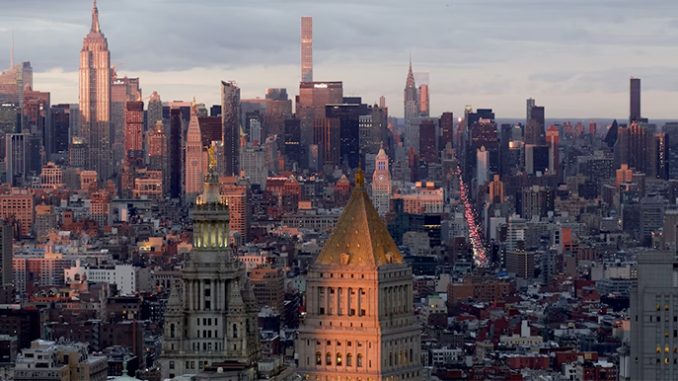
I found myself with a free morning in New York City and decided to do some reconnaissance work at Saint Joseph’s Church in Greenwich Village. St. Joseph’s has recently been highlighted as a lodestar of a trend which more than the usual outlets have reported on in recent months: the spike in people—largely under 40—becoming Catholic.
First: the walk from 45th Street down to the Village. It was a perfect spring day in New York, warm but without the oppressive humidity of July in the city. And the streets were what they always are in the arch-metropolis: bustling with life of a certain variety. I always feel the need to walk very quickly in New York, as if walking slowly would lead to being accosted by someone taking surveys or being tempted to purchase an eighteen-dollar smoothie. I feel the need to talk loudly as well, like children in a large family who feel they must raise their voices to be heard.
Midtown brought its usual array of professionals in business casual attire and AirPods. When I was in high school, one of the assistant principals would encourage us to look at the faces of people on their way to work. He said it would tell you a lot about whether they like their jobs or not. He said this to encourage us to choose a career that we really enjoyed, and that also benefited others. As I looked at the faces of the people on the Avenue of the Americas—many right around my age—I had to wonder if they had the gnawing sense that they had chosen incorrectly, as though it never dawned on them that working hard at elite schools and getting connected to the right people would lead inexorably to quiet desperation.
Walking past Bryant Park, I was reminded how certain activities, which are technically still federal crimes, are accepted with studied nonchalance. Near Broadway, a group of about 40 young people was engaged in a choreographed dance, facing—what else?—a camera. In a city full of performers of one kind or another, this performance seemed the least offensive of all.
The further downtown I walked, the happier I became. The forbidding skyscrapers of midtown—an entire city in the sky—gave way to the charming brownstones and colonials near NYU until I arrived at the West Village. Here is a real neighborhood, with human-style buildings and a sense of being in a community.
As I walked into the church, I was moved by its elegant simplicity. It is a neighborhood church in the colonial style, clearly built and maintained over the years by people who valued beauty but not ostentation. Those gathering for daily Mass came in reverently: an elderly couple, a few middle-aged Filipino ladies, and students or recent graduates living in the area. A bunch of them. Mind you, this was a daily Mass, and there were easily twenty people there from the ages of 18 to 25. One young woman had clearly come to Mass immediately after a run. Another young adult had the look of a future Dominican friar. A young couple knelt next to each other in prayer.
I found the New York Times’ recent article on this topic (“Roman Catholic Churches See a Surge of New Converts”) comprehensive and well-researched. It focused mainly on the unique paths that several people in very different places and states of life took to the Catholic Church amid this “surge.” The overarching narrative was that we live in a lonely and anxious age, and the Catholic Church provides an antidote of stability and community. This is undoubtedly true.
But I also like the Free Press’ look at this question from a year ago (“How Catholicism Got Cool”). The article begins with a scene from last year’s Easter Vigil at Saint Joseph’s:
The candlelit church in Greenwich Village was packed. After months of study and preparation, 19 adults sat at the front, dressed in white, nervously awaiting their turn at the baptismal font. One by one, they stepped forward. After anointing them with chrism (holy oil), the priest poured water over their heads, baptizing them into the Catholic Church in the name of the Father, the Son, and the Holy Spirit.
“It was almost as if the veil between heaven and earth had been lifted,” said Jane, one of the adults baptized into the Church that day. She left feeling “more receptive to the supernatural.”
In the end, while human desires for community and meaning—not to mention viral videos of engaging heralds of the Gospel—can provide part of the explanation for why those young people were at Saint Joseph’s for daily Mass, it’s still only a part. Ultimately, the real source lies beyond human nature. The veil has to be lifted.
******
This is a neighborhood known for its counterculture, the place that epitomizes perhaps more than any other the shift away from the Puritan moral codes of pre-Elvis America to a rebellious, transgressive, and libertine set of values. And yet, almost sixty years after Stonewall, a transposition has taken place. The counterculture has wandered up Madison Avenue and, from there, out to every suburban cul-de-sac to become the prevailing ethos of our country, the very air we breathe. Just look at the ads produced in those big office buildings, ads which would have been considered pornographic in 1969. Listen to the professionals—women and men—casually walking down Fifth Avenue using obscenities previously considered inappropriate in public and private, not to mention the words used in what passes for discourse in Washington D.C.
In a world awash with this darkness, suddenly the Village seemed normal, even a tad quaint. Here, and in many places like it across the city and the world, a different kind of counterculture has sprung up: a creative minority gathered around the altar of the Lord to worship the Father, the Son, and the Holy Spirit. As I watched several young people light candles after Mass, perhaps in anticipation of a big exam or an interview or a date, and then gather with a few young Dominican friars on the church steps, I thought of the dry bones of Ezekiel 37. Amid that grotesque vision of death and decadence comes a haunting question, “Son of man, can these bones come to life?”
In other words, the prophet must decide whether the God who speaks to him is capable of bringing life out of death, just as Abraham was asked to trust in God’s power and his goodness as he accompanied his son Isaac up the mountain. Such a decision—which ultimately is placed before each one of us—has been summed up in the theological concept of Credere in Deum; that is, to believe not just that God exists or even the truths he has revealed in Christ, but to believe unto God, to surrender my life and all that I have to him.
In our time and place, this involves answering a few questions: Does he have a plan for me and for others? Do I believe that this plan, even with its sufferings, is better than any hopes or dreams I concoct on my own? Can God really bring about a renewal of faith here and now? God delights in carrying out his work in secret, in the hidden recesses, and in the most unlikely places—even a field of dry bones! It is the Holy Spirit, which hovered over the world at its foundations, the “Spirit of the one who raised Christ from the dead,” which prompts that invitation in our hearts and thus vivifies not just individuals but even entire civilizations. As the Lord God explained to Ezekiel:
“Son of man, these bones are the whole house of Israel. Behold, they say, ‘Our bones are dried up, and our hope is lost; we are clean cut off.’ Therefore prophesy, and say to them, Thus says the Lord God: Behold, I will open your graves, and raise you from your graves, O my people; and I will bring you home into the land of Israel. And you shall know that I am the Lord, when I open your graves, and raise you from your graves, O my people. And I will put my Spirit within you, and you shall live, and I will place you in your own land; then you shall know that I, the Lord, have spoken, and I have done it, says the Lord.”
Indeed, filled with the joy of the Resurrection, we can only arrive at one conclusion: that history belongs not to the performers and especially not to the peddlers of obscenity, but to those who emerge from the cave convinced of something more and assent to the true Light which shines amidst the darkness. What we need now more than ever is to embrace this Light, which pierces the darkness of our hearts, which once turned a creative minority into the culture that built Chartres Cathedral and gave us the Victimae Paschali Laudes. Faith in Christ assures us that such renewal is constantly at work within us, even tucked away amid the subways and farmers’ markets of a city that never sleeps.
(Editor’s note: This essay was first posted on the “What We Need Now” site and is published here with kind permission.)
If you value the news and views Catholic World Report provides, please consider donating to support our efforts. Your contribution will help us continue to make CWR available to all readers worldwide for free, without a subscription. Thank you for your generosity!
Click here for more information on donating to CWR. Click here to sign up for our newsletter.
I hope that the anecdotal stories of young people turning to the catholic church are true. Every year my New York suburban (mostly gray) parish has one, two or three converts. They appear to be mostly middle aged (40-ish) and younger. That IS A POSITIVE SIGN. What I also see is two or three people kneeling during Mass to receive communion (with no kneeler-tile floor) and a few young women with the head veils of my youth. I NEVER saw that 20 years ago. All of these folks are young people in their 20’s. . Both of these signs may indeed indicate a younger generation looking for stability, faith, and guidelines on how to negotiate life. Dare I say they may even be looking for some rules?
‘Do your own thing” in a world gone depraved and selfish is not the way everyone wants to live. Nor do many find the ability to act in a totally self-absorbed manner to be appealing and meaningful. I hope this is the positive fork in the road many have been praying for.
I think there are numbers available of how many young adults have entered the Church recently. I have a family member who just did that on Easter.
I agree. People are looking for meaning & direction in their lives.And a real foundation not built on shifting sand.
I was confirmed last Easter and out of our class of 30, quite a few were college students. This year, our confirmation was comprised of mainly college students and even a Baptist minister and his wife. There were 36 people in that class which was a record for my church! Glory be to the Father, Son and Holy Spirit!
Readers ought to treat themselves to a visit to St. John the Baptist church in Front Royal VA. There are four priests assigned to the parish. There are confessions heard twice a day six days a week and a church fully packed for DAILY Mass.
A very beautifully-written article, and I was delighted to find it was composed by a good and holy Priest. The part about the “dry bones” gave me literal chills as I recalled seeing the film of the tractor at Aushwitz shoveling into mass graves the thousands of corpses of Jewish martyrs. Yes, they will rise again, praise to Almighty God. Thank you, Father Banacker; I am going to research what else you may have written.
The Gates of Hell will not prevail against God’s Holy Church, but the effort to destroy her has been momentous. Thank God there are signs of renewal as people search for a solid foundation in a world where everything that can be shaken shall be, and is being, shaken.
Fr Banecker writes well describing the different faces of NYC and the wonderful evidence of the Holy Spirit drawing young adults out of the darkness into God’s wonderful light.
St Joseph’s a church I’m familiar with prior to the recent flowering of the faith. Then it was a spiritual refuge in Greenwich Village, the capitol of homosexual lifestyle.
Stonewall Inn alluded to by Banecker, a notorious gay bar where Pride began the movement to politicize homosexual rights. Having not been in Manhattan for decades, the change seems a miracle.