

 By
By CRS is partnering with Caritas medical centers across seven Catholic dioceses, along with the Democratic Republic of the Congo Ministry of Health and the World Health Organization.
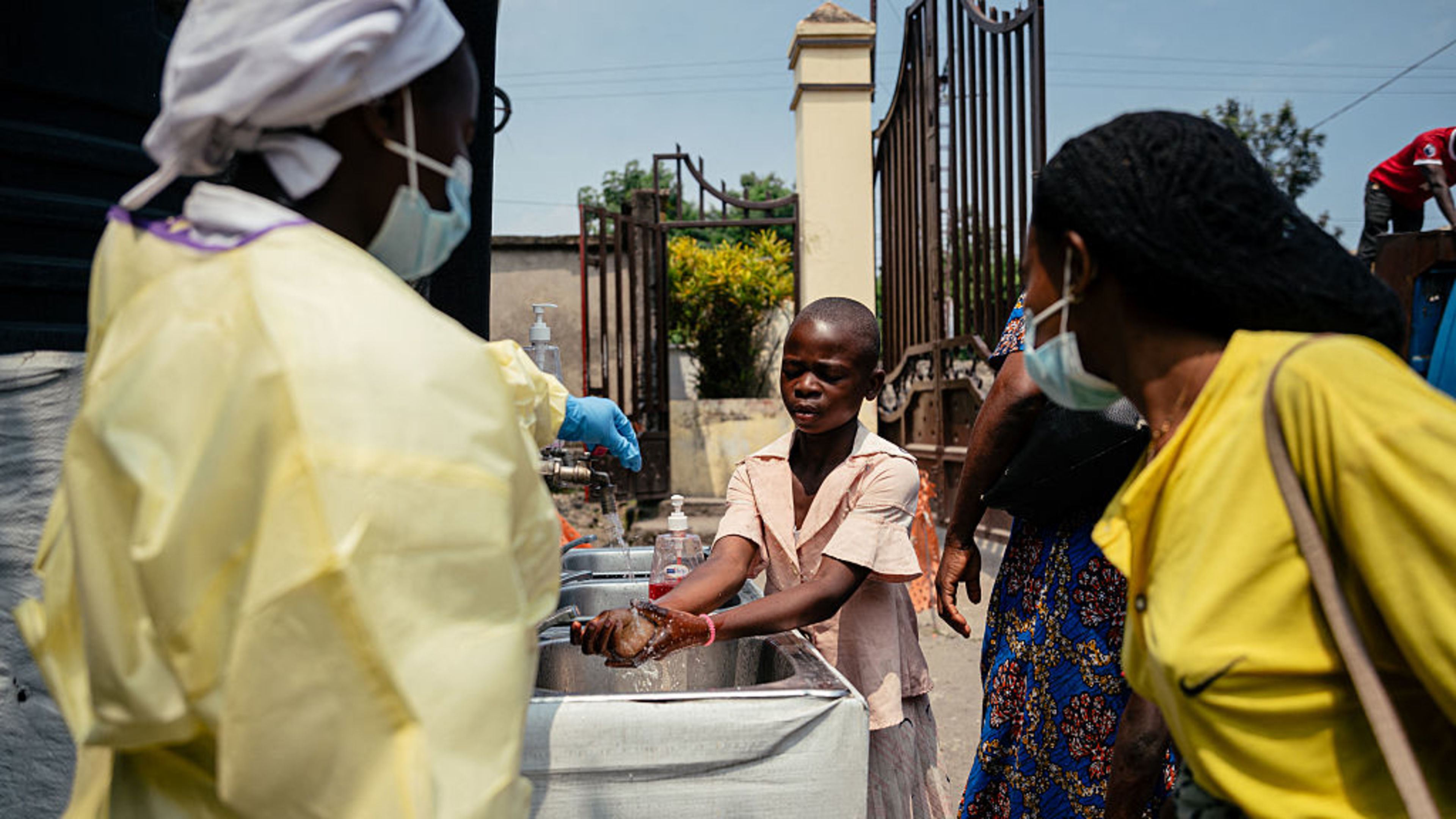
An Ebola outbreak in the Democratic Republic of Congo (DRC) and Uganda could take more than a year to contain due to scarce resources, regional conflict, and misinformation among local communities, according to Catholic Relief Services.
“It is a very big crisis,” Rafaramalala Volanarisoa, head of office for Catholic Relief Services in the DRC, told EWTN News. “Of course, Ebola, there’s no treatment, there’s no vaccines, so it’s very difficult to contain.”
Volanarisoa, who is based in the capital, Kinshasa, said CRS is partnering with Caritas medical centers across seven Catholic dioceses as well as the DRC Ministry of Health and the World Health Organization (WHO) to help combat the outbreak.
She said CRS is providing funding to health centers for medical and hygiene supplies and distributing educational materials to help prevent transmission and counter misinformation.
“We have sent money to them to purchase those different supplies to protect the health center staff but also to protect those who are doing education in the community,” she said. “There are really big needs, so in many aspects, it’s reaching the community, doing proper education, and also supporting health center staff so they are protected.”
In addition to a lack of medical and sanitation supplies, Volanarisoa said population movement driven by armed groups and multiple warring factions is complicating response efforts. She also noted resistance among some local communities to accepting CRS-led public health education.
Volanarisoa said stigma and disbelief have fueled misinformation that Ebola is “fake” or intended to undermine local traditions, including burial practices. She said that while there is a high risk of transmission from bodies of those who have died from the disease, some communities remain resistant to changing burial practices.
“It’s very difficult for the population to do it in their proper ways, so there is misinformation that this is something brought to change the way we live here,” she said.
She noted that CRS does not operate directly on the front lines due to “cultural norms,” language barriers, and long-standing relationships between the Church and local communities.
Although she said the scope of the outbreak remains difficult to determine, she estimated the total cost to stop the spread of the virus at around $3 million and said past assessments suggest that if cases surpass 500, containment could take more than a year.
According to Volanarisoa, there are 33 confirmed Ebola cases in the DRC. There are also 516 suspected cases in the DRC, 131 deaths among suspected cases, and 541 people identified as contacts of confirmed cases or symptomatic deaths.
Two lab-confirmed cases have been reported in Kampala, Uganda, including one death, among two unrelated individuals who traveled into the country from the DRC, according to WHO.
If you value the news and views Catholic World Report provides, please consider donating to support our efforts. Your contribution will help us continue to make CWR available to all readers worldwide for free, without a subscription. Thank you for your generosity!
Click here for more information on donating to CWR. Click here to sign up for our newsletter.

All one needs to know about CRS is the annual salary of its CEO.
Google says this about the annual salary of the CEO of Catholic Relief Services:
“As of early 2026, based on 2024–2025 financial data, the total compensation for Sean Callahan, the President and CEO of Catholic Relief Services (CRS), is approximately $640,000 to $648,000 per year”
Bishop Baron’s enterprise, Word on Fire Ministries, takes in $26 million annually.
What is the relevance?
Charities often have well paid leadership.
And?
I live in Pennsylvania. The salary of the Governor of a Commonwealth with millions of people and an operating budget measured in the tens of billions is $253,870 as of 1/1/2026.
Why do charities need to pay more than twice that amount?
Here’s the ugly little secret about “non-profits”. A lot of people become quite wealthy working at them.
A bishop’s salary is not the same as the revenue of his ministry.
Revenue is all the money taken in. Expenses are subtracted. What is left is the net income which does not necessarily go to the bishop. Citing how much money Word on Fire takes in annually is not the issue. CRS takes in over a billion each year.
Suzanne: you’re posting irrelevancies…as usual.
Just about as relevant as any charity CEO salary I guess. BTW, what are you paid?
I once earned $40/day as a juror. How tall are you?
Suzanne: I am retired. However, I did spend some years in my career as the Director of my Diocese’s Catholic Charities. I won’t but if I did tell you what my annual salary was you, along with most here, would be shocked. You might be interested, however, to know that I considered it part of my diaconal ministry in the Church.
“Bishop Baron’s enterprise, Word on Fire Ministries, takes in $26 million annually.”
You are comparing one organizations revenue to another’s executive personnel costs?
Since WOF files a 990, I went to look. Their highest paid exec for the most recently available year (fiscal year 2023, filed in 2024) was $218K.
Less than 1/3 of what the CEO of CC made.
Whew! Thought you were going to say 700,000.
While we’re at it, there’s this on Google:
As of 2026, Kerry Alys Robinson is the President and CEO of Catholic Charities USA (CCUSA).Specific, updated 2026 salary figures for the CEO of the national office (Catholic Charities USA) are not explicitly detailed in the search results, though one source indicates an estimated total salary range for the position between $102,000 and $163,000.It is important to distinguish between local agencies and the national office:Local CEO Salaries: Average salaries for CEOs at various local “Catholic Charities Agencies” across the U.S. are higher, with some estimated averages from $339,085 to over $800,000, depending on the agency size and location.
Catholic charity’s (small c intentional) lavish executive compensation first became a matter of donor and public concern during Carolyn Woo’s time at CRS.
“The gospel message is so very clear and nonnegotiable: Serve the most vulnerable people.”
—Carolyn Woo
Subtext- also make good bank doing it. Now what was that quote from Pope Francis about “professional Catholics”. Forget the fact that the Gospel is about saving souls.