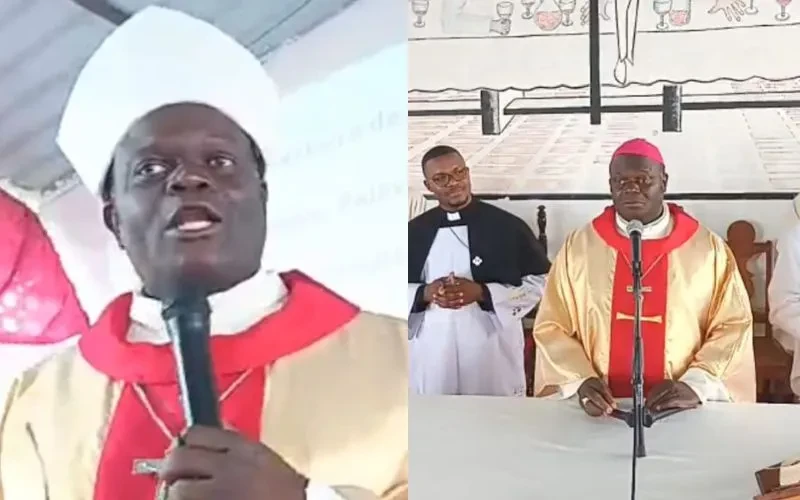
In a Aug. 31 homily at Holy Trinity Parish in the Diocese of São Tomé e Príncipe, Bishop João de Ceita Nazaré lamented that many couples have forgotten the value of their marriage vows. / Courtesy of the Diocese of São Tomé and Príncipe
ACI Africa, Sep 3, 2025 / 11:45 am (CNA).
Bishop João de Ceita Nazaré of the Diocese of São Tomé e Príncipe has expressed concern over the growing crisis of family life, warning that widespread marital infidelity in male spouses is leaving painful scars on women, children, and the very fabric of society.
São Tomé e Príncipe is the second-smallest and second-least populous African sovereign state after Seychelles. It is located in the Gulf of Guinea, off the west coast of Africa.
In a Aug. 31 homily at the diocese’s Holy Trinity Parish, Nazaré, lamented that many couples have forgotten the value of their marriage vows.
“Marriage is not a game. It is a sacred mission,” he said. “Our families are wounded, destroyed, deceived, and left adrift because many have already forgotten the value of the word given at the altar.”
He continued: “The family crisis is today one of the greatest spiritual and social challenges of the Santomean community, and marital betrayal has left deep scars on women, children, and the very social structure.”
“Our married women are dying. They die inside; they die of abandonment; they die because they gave everything of themselves and were left with nothing,” Nazaré bemoaned. “Fidelity in marriage is not only a Christian virtue but an essential condition for the stability of society.”
The bishop said “many of the wounds we see in families today stem from the emotional and spiritual disorganization of couples.”
For him, “the wives who cry today did everything to keep their homes: They carried rice, sold fish, washed clothes, helped build the house, and today they are abandoned.”
“This suffering is real. We hear mothers say they no longer know what they are worth; children who tell their mothers to their faces: ‘You are good for nothing.’ This is not only ingratitude. It is the result of a broken family structure,” the bishop said.
He denounced marital infidelity, describing it as a “silent social wound that slowly disintegrates the family and spiritual fabric.”
“We have families built on lies. The husband has two women, and neither of them knows she is being betrayed. Or she knows but endures it because she fears being alone. And the children? They grow up in confusion. They grow up without an example,” Nazaré lamented.
“How can we want a strong youth if the model we give them is one of lies, abandonment, and wounds?” he said.
The 51-year-old bishop also spoke of the role of women in the family and in the Church, referring to Mary, the Mother of Jesus, as a model of humility, service, and dedication.
“Mary did not disappear. She ran to serve. She carried the Son of God in her womb, but she never exalted herself. So too are our mothers. When they are faithful, they uphold the world. But today, many have been betrayed, wounded, forgotten. We need to once again recognize the value of women, of wives, of mothers. They are not replaceable,” he said.
On the responsibility of men — especially fathers, husbands, and godfathers — he noted that “to be a real man is not to collect relationships but to keep your heart in one place: with your wife and children.”
He denounced the behaviour of those who, he said, “lie, cheat, and then show up in church with the face of saints.”
For Nazaré, “the true Christian is the one who lives his faith at home, at work, and in marriage. You cannot be a Christian on Sunday and unfaithful on Monday.”
He appealed for the reconstruction of the family as the foundation of society and of Christian faith, warning that “if we want to change this country, we must start at home. Start by being faithful, truthful, and honest.”
“The Church can preach a thousand sermons, but if couples are not faithful, the children will continue to grow up wounded. Let us not allow betrayal, lies, and selfishness to destroy what God has united in love,” Nazaré said in his homily.
If you value the news and views Catholic World Report provides, please consider donating to support our efforts. Your contribution will help us continue to make CWR available to all readers worldwide for free, without a subscription. Thank you for your generosity!
Click here for more information on donating to CWR. Click here to sign up for our newsletter.
Father Jude Nwachukwu (left) and Father Kenneth Kanwa were kidnapped from their parish rectory in the Diocese of Pankshin in Nigeria on Feb. 1, 2024. / Credit: Ahiara Diocese
ACI Africa, Feb 6, 2024 / 11:00 am (CNA).
A religious missionary orde… […]
Bangui, Central African Republic, Feb 6, 2019 / 05:53 pm (CNA).- The Central African Republic government has signed a peace deal with more than a dozen armed groups this week.
The deal was announced by the African Union Saturday, according to Reuters, but details were not publicly released.
Several previous peace deals in the last five years have failed.
The latest deal, between government forces and 14 rebel groups, comes after two weeks of discussions. Both sides are hopeful that the deal will last, Reuters reported.
The Central African Republic has suffered violence since December 2012, when several bands of mainly Muslim rebel groups formed an alliance, taking the name Seleka, and seized power.
In reaction to the Seleka’s attacks, some Central Africans formed self-defense groups called anti-balaka. Some of these groups, mainly composed of Christians, began attacking Muslims out of revenge, and the conflict took on a sectarian character.
Many Catholic churches in the country have offered refuge to Muslims and Christians alike fleeing violence, included churches in the Diocese of Bangassou, some 140 miles to the east of Alindao, where several Catholic institutions took in displaced Muslims facing violence at the hand of anti-balaka.
The country held a general election in 2015-16 which installed a new government, but militant groups continued to terrorize local populations. Thousands of people have been killed in the violence, and at least a million have been displaced. At least half of Central Africans depend on humanitarian aid, the U.N. reported last year.
The U.N. humanitarian chief for CAR, Najat Rochdi, has warned that the country will see a famine within a few years “if the situation is remaining the same and people are not going back to work their fields.”
The CAR bishops have repeatedly issued pleas for peace. They declared December 1 last year as a day of mourning and prayer for victims of violence. The day is normally celebrated as the anniversary of the nation’s establishment as a republic after French colonial rule.
Alfred Magero, Matthew Njogu, and Edward Chaleh Nkamanyi are three Catholic fathers from Africa who recently shared insights about being a present dad, protecting their families amid threats to the African family, and being a model of family values for their children with ACI Africa, CNA’s news partner in Africa. / Credit: Photos courtesy of ACI Africa
ACI Africa, Jun 17, 2024 / 12:37 pm (CNA).
On the occasion of Father’s Day 2024, a day focused on the celebration of fatherhood, four Catholic men from different African countries recently shared their experiences of impacting the lives of their children.
The Catholic fathers — who hail from Cameroon, Kenya, and Nigeria — talk about the importance of “being present,” of protecting their families amid threats to the African family, and of being a model of family values for their children, who they believe someday will become parents as well.
Tony Nnachetta, 68: Fatherhood is a full-time enterprise
Tony Nnachetta shares a moment with Pope Francis. The married father of four is a parishioner in the Catholic Archdiocese of Onitsha. Credit: Photo courtesy of ACI Africa
Tony Nnachetta is a married father of four who attends the Church of the Assumption Parish in Nigeria’s Archdiocese of Lagos. Nnachettahas been a parishioner there for 40 years, and he was wed there 38 years ago. A member of the Grand Knights of St. Mulumba, he originally hails from the Archdiocese of Onitsha.
I got married to my friend after we dated for four years. I was looking forward to fatherhood and I was mentally prepared for it. Here are the lessons I have learned along my fatherhood journey.
First, being a father means you watch your children grow and become independent. You watch them get to a point in their lives where they can engage in a debate with you and even disagree with you.
Fatherhood is a long process. You would be fortunate to go through the entire process and maybe see your children’s children. I have seen mine achieve excellence in school and even leave home and go across the world as they sought to become independent.
Wherever your children go, what is important for them is what they take away from home — what they take from mommy and daddy. I have always told mine to “remember the child of who you are.” This means that they are not allowed to break the Christian values in our family.
I taught them to always stand for the truth and never to flow with the tide. We have encouraged them to always say what they mean. These days, they have jokingly turned around the statement and they tell me, “Remember the dad of who you are,” and we laugh about it.
You can’t always be there to take the bullet for them, but you can support them through prayers. Our family relies a lot on the intercession of the saints. We call ourselves a family of Jesuits because the school my children went to is under the patronage of St. Ignatius of Loyola.
Fatherhood is a full-time engagement. It is not like you can be a father in the morning and take a break in the evening. You worry about your children even when they are grown and have left your home. They preoccupy you everywhere. You wonder whether they are warm and if they have had their meal. But all this brings a father immense joy.
Young fathers in Africa are overburdened by poverty. Because of poverty they don’t have a way to help their families. Others are scared to enter the marriage institution. Poverty has made young men weak and helpless. Some are leaving their young families and going to faraway places outside the continent to make a living.
Poverty is eroding family values because some fathers do what they do, including stealing, for their children to survive. In doing so, they are setting a bad example for their children …
It is important for our leaders to confront this situation. They must accept that they have let us down.
Matthew Njogu, 75: Tips on being a present dad
Matthew Njogu is the moderator of the Catholic Men Association at St. Austin’s Msongari Parish of Kenya’s Archdiocese of Nairobi. His children are now adults. Credit: Photo courtesy of ACI Africa
Fathers need to be present in the lives of their children. For a long time, it was assumed that it was the mother’s responsibility to take care of the young children; fathers kept off. But being absent in the lives of your children hurts your relationship with them. They end up growing up without you having any impact on their lives.
Unfortunately, some fathers assume that fatherhood ends at providing material things… They don’t pay attention to their children’s growth milestones. And when they eventually try to establish a connection, they find that the children are already all grown without knowing anything about their fathers.
Simple things like dropping your children off at school help you connect with them. While stuck in traffic on the way to school, you can talk about things that will help you understand your child and for him to know you.
Always try as much as possible to have dinner with your children and help them with schoolwork. And always try to make up for the time you don’t spend with them.
Edward Chaleh Nkamanyi, 53: Raising a Christ-like family
Edward Chaleh Nkamanyia runs a medical college in Doula, Cameroon. He is a father of two, though he tells ACI Africa that he is “a father of many” as he takes care of several orphans and other vulnerable children. Credit: Photo courtesy of ACI Africa
Nkamanyi runs a medical college in Doula, Cameroon. He is a father of two children ages 16 and 20. He tells ACI Africa that he is “a father of many,” as he takes care of several orphans and other vulnerable children. Here are his insights into nurturing a Christ-like family.
It is the joy of every responsible young man to be called “daddy” or “papa.” Having a Christ-like family is the greatest gift for a father; a family like that of Joseph, Mary, and Jesus.
My appeal for Catholic fathers is to hold their families firmly, to provide for them, and to protect them from all dangers in the contemporary society, where values are being eroded.
I don’t believe that being a father is a challenging task. God already gave us the innate potential to be fathers. I believe that God can’t give you a role that you can’t perform.
It is unfortunate that many young men are choosing to be absentee fathers. From what I have seen, many children raised by a single parent end up adopting wayward behaviors.
Alfred Magero, 48: Being a present dad in a low-income setting
Alfred Magero belongs to the Catholic Men’s Association group of St. Joseph the Worker Kangemi Catholic Parish of in the Nairobi Archdiocese. The father of three has been married for 29 years. Credit: Photo courtesy of ACI Africa
Magero belongs to the Catholic Men’s Association group of St. Joseph the Worker Kangemi Parish of the Archdiocese of Nairobi. The father of three has been married for 29 years and shares his experience and that of other Catholic dads raising their children in a low-income neighborhood.
I am raising my children to become God-fearing adults. This is not an easy task in the community in which we live, where there is a lot of poverty, drunkenness, and other characteristics typical of a low-income [neighborhood].
Many fathers rarely interact with their children since their main focus is to provide for their families. They leave for work before their children wake up and come back at night when the children have already gone to bed.
The young men and boys we are raising are experiencing a different environment from ours when we were growing up. With the whole world brought to them on the palm of their hand by a simple tap on the phone, this generation is dangerously exposed. They need us, their fathers, to constantly give them direction. They need us to be their role models.
They need us to constantly remind them that they are in Africa and that they should not adopt alien cultures, especially those bound to destroy the family.
As fathers, we must remind our young ones to uphold African values that kept the family unit and the society glued together. Africans knew the importance of loving and caring for each other. Unfortunately, this value is being eroded, and in its place, now we have individualism. Older men in families would educate young men to be responsible adults. Unfortunately, we no longer have this kind of education.
We read that Nazaré bemoaned: “Fidelity in marriage is not only a Christian virtue but an essential condition for the stability of society.”
Meanwhile, the kissing car[di]nal Fernandez opines on Vatican letterhead that the most obvious symptom of abusive and absentee fathers (etc.) and of lost stability—such as homosexuality—can be fixed by ignoring these personal histories and multiple outcomes, such that even male insemination of male colons can now be blessed by ordained priests, so long as the mutant blessing is “non-liturgical, spontaneous, and informal” (Fiducia Supplicans).
But, not to be patronized and dismissed as an African “special case,” the Western Catholic sociologist/historian sides with the dissident African cardinals (to Fiducia Supplicans) with this non-amnesiac and prescient perspective on families and all societies:
“Late marriages and small families became the rule, and men satisfied their sexual instincts by homosexuality or by relations with slaves and prostitutes. This aversion to marriage and the deliberate restriction of the family by the practice of infanticide and abortion was undoubtedly the main cause of the decline of ancient Greece, as Polybius pointed out in the second century B.C. And the same factors were equally powerful in the society of the Empire. . . .” (Christopher Dawson, “The Patriarchal Family in History,” The Dynamics of World History, 1962).







We read that Nazaré bemoaned: “Fidelity in marriage is not only a Christian virtue but an essential condition for the stability of society.”
Meanwhile, the kissing car[di]nal Fernandez opines on Vatican letterhead that the most obvious symptom of abusive and absentee fathers (etc.) and of lost stability—such as homosexuality—can be fixed by ignoring these personal histories and multiple outcomes, such that even male insemination of male colons can now be blessed by ordained priests, so long as the mutant blessing is “non-liturgical, spontaneous, and informal” (Fiducia Supplicans).
But, not to be patronized and dismissed as an African “special case,” the Western Catholic sociologist/historian sides with the dissident African cardinals (to Fiducia Supplicans) with this non-amnesiac and prescient perspective on families and all societies:
“Late marriages and small families became the rule, and men satisfied their sexual instincts by homosexuality or by relations with slaves and prostitutes. This aversion to marriage and the deliberate restriction of the family by the practice of infanticide and abortion was undoubtedly the main cause of the decline of ancient Greece, as Polybius pointed out in the second century B.C. And the same factors were equally powerful in the society of the Empire. . . .” (Christopher Dawson, “The Patriarchal Family in History,” The Dynamics of World History, 1962).