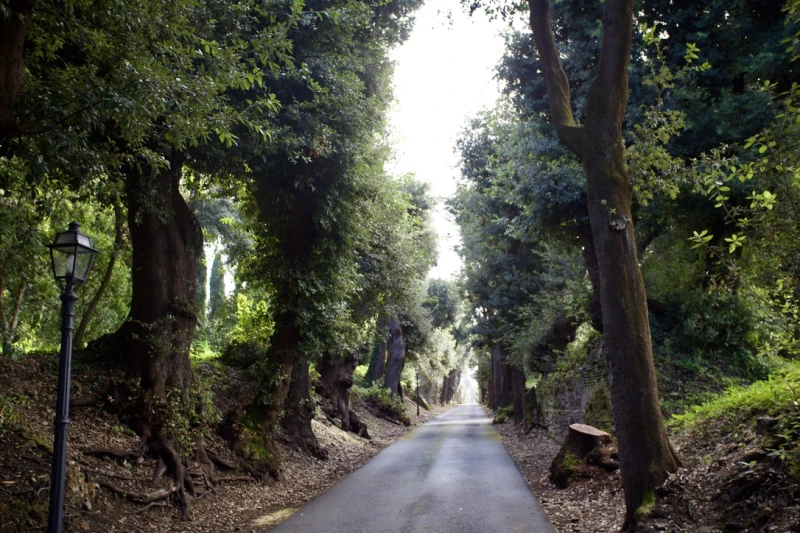
The Vatican Gardens at Castel Gandolfo in Italy. / Credit: Courtney Mares/CNA
Vatican City, Jul 2, 2025 / 12:35 pm (CNA).
Pope Leo XIV declared that nature should not be a “bargaining chip” in his message announcing the theme “Seeds of Peace and Hope” for the 10th World Day of Prayer for the Care of Creation, set for Sept. 1.
Drawing inspiration from Pope Francis’ encyclical Laudato Si’, released 10 years ago, the Holy Father said the “Bible provides no justification for us to exercise ‘tyranny over creation’” and should therefore not be exploited.
“Nature itself is reduced at times to a bargaining chip, a commodity to be bartered for economic or political gain,” Leo said. “As a result, God’s creation turns into a battleground for the control of vital resources.”
The pope said poor nations, marginalized societies, and Indigenous communities are destabilized and penalized as a result of conflicts over water and natural resources as well as the destruction of forests and agricultural areas.
“These various wounds are the effect of sin,” he added. “This is surely not what God had in mind when he entrusted the earth to the men and women whom he created in his image.”
In his July 2 message, the pope said three things are necessary for genuine environmental justice: prayer, determination, and concrete actions.
Leo invited Catholics to prayerfully consider the significance of seeds as a metaphor of coming of the kingdom of God in Scripture, saying: “Jesus often used the image of the seed.”
“In Christ, we too are seeds, and indeed, ‘seeds of peace and hope,’” he said. “The prophet Isaiah tells us that the Spirit of God can make an arid and parched desert into a garden, a place of rest and serenity.”
Insisting that environmental justice is not an “abstract concept” or a “distant goal,” the Holy Father said “now is the time to follow words with deeds” in his message dedicated to the care of creation.
“By working with love and perseverance, we can sow many seeds of justice and thus contribute to the growth of peace and the renewal of hope,” he said.
This year, Pope Leo has twice visited sites linked to the Holy See’s integral ecology projects outside of Rome. In addition to visiting the Borgo Laudato Si’ project at Castel Gandolfo in May, he toured the proposed Vatican solar energy project site in Santa Maria di Galeria in June.
The Holy Father praised these initiatives, which serve as examples of “how people can live, work, and build community by applying the principles of the encyclical Laudato Si’.”
“I pray that Almighty God will send us in abundance his ‘Spirit from on high,’ so that these seeds, and others like them, may bring forth an abundant harvest of peace and hope,” the pope said.
If you value the news and views Catholic World Report provides, please consider donating to support our efforts. Your contribution will help us continue to make CWR available to all readers worldwide for free, without a subscription. Thank you for your generosity!
Click here for more information on donating to CWR. Click here to sign up for our newsletter.
Bangkok, Thailand, Nov 21, 2019 / 02:30 am (CNA).- The dignity of the human person can be recognized and affirmed through loving medical care to the sick and injured, Pope Francis told the staff of St. Louis Catholic Hospital in Bangkok Thursday.
When Pope Pius IX declared the doctrine of the Immaculate Conception of the Virgin Mary on December 8, 1854, he had a golden crown added to the mosaic of Mary, Virgin Immaculate, in the Chapel of the Choir in St. Peter’s Basilica. / Daniel Ibañez/CNA
Vatican City, May 29, 2023 / 10:30 am (CNA).
To honor the Blessed Virgin Mary, the Vatican offers a special Marian pilgrimage within St. Peter’s Basilica each Saturday afternoon during the month of May.
The Marian itinerary brings pilgrims from Michelangelo’s marble sculpture of the Pieta to Our Lady of Perpetual Help, a 12th-century painting brought into the basilica in 1578 in a solemn procession.
For those unable to travel to the Eternal City, CNA is providing the following “virtual tour” with photos by Daniel Ibañez of eight beautiful images of Our Lady in St. Peter’s Basilica for the feast of Mary, Mother of the Church.
In St. Peter’s Basilica’s Chapel of the Choir, a large mosaic based on painting by Italian artist Pietro Bianchi depicts Mary, Virgin Immaculate, in the glory of heaven being venerated by St. John Chrysostom (left) and other saints. Daniel Ibañez/CNA
Virgin Immaculate
In the basilica’s Chapel of the Choir, a large altarpiece reveals Mary, Virgin Immaculate, in the glory of heaven above angels and saints. The mosaic based on an 18th-century painting by Italian artist Pietro Bianchi depicts St. John Chrysostom St. Francis of Assisi, and St. Anthony of Padua venerating the Blessed Virgin Mary.
The chapel is located on the left side of the basilica behind an iron gate designed by Gian Lorenzo Bernini. St. John Chrysostom is buried beneath the altar, which also contains relics of St. Francis and St. Anthony.
When Pope Pius IX declared the doctrine of the Immaculate Conception of the Virgin Mary on December 8, 1854, he had a golden crown added to the mosaic of Mary. Pope Pius X later added a larger diamond crown to mark the 50th anniversary of the declaration in 1904.
The original painting by Bianchi can be found in Rome’s Basilica di Santa Maria degli Angeli e dei Martiri.
Mother of the Church
St. Peter’s Basilica contains an icon of the Virgin Mary titled “Mater Ecclesiae,” which means “Mother of the Church.”. Daniel Ibañez/CNA
The basilica contains an icon of the Virgin Mary titled “Mater Ecclesiae,” which means “Mother of the Church.”
The original image of the Virgin Mary and the Christ Child was painted on a column in old St. Peter’s Basilica, built by Emperor Constantine in the fourth century. It was later transferred to the 16th-century St. Peter’s Basilica. Paul VI honored the icon with the title “Mater Ecclesiae” after the Second Vatican Council.
A mosaic of the Virgin Mary overlooking St. Peter’s Square was inspired by the original Mater Ecclesiae image. The mosaic was installed after the assassination attempt against St. John Paul II in 1981.
When he blessed the mosaic, John Paul II prayed “that all those who will come to this St. Peter’s Square will lift up their gaze towards you [Mary], to direct, with feelings of filial trust, their greetings and their prayers.”
In 2018, Pope Francis added the memorial of “Mary, Mother of the Church” to the liturgical calendar for the Monday after Pentecost.
Mother of Pilgrims
A restored 16th-century painting of Our Lady holding her Son can be found in St. Peter’s Basilica above the sarcophagus of Pope Gregory XIV under the title “Mother of Pilgrims.”. Daniel Ibañez/CNA
A restored 16th-century painting of Our Lady holding her son can be found in St. Peter’s Basilica above the sarcophagus of Pope Gregory XIV.
The image is titled “Mater Peregrinorum” or Mother of Pilgrims. The original artist is not known, but Italians also refer to the painting as the “Madonna di Scossacavalli” because it came from Rome’s Church of San Giacomo Scossacavalli, which was demolished in 1937 to create the current Via della Conciliazione leading to St. Peter’s Basilica.
Our Lady of Perpetual Help
A 12th-century painting on wood titled Our Lady of Perpetual Help in the Gregorian Chapel of St. Peter’s Basilica. Daniel Ibañez/CNA
A 12th-century painting on wood titled Our Lady of Perpetual Help, also known as Our Lady of Succor, was transferred to an altar in St. Peter’s Gregorian Chapel on February 12, 1578 with a solemn procession.
The painting was the first artistic restoration completed under Pope Francis’ pontificate during the Year of Faith, according to a book published by the Knights of Columbus.
The remains of the Doctor of the Church St. Gregory of Nazianzus (d. 390) are preserved in an urn beneath the Altar of Our Lady of Succor in the Gregorian Chapel, found on the right side of the basilica.
Ark of the Covenant
A mosaic altarpiece of the Presentation of the Virgin Mary in the Temple can be found above the tomb of Pope St. Pius X near the left-front entrance of the basilica. Daniel Ibañez/CNA
A colorful mosaic altarpiece of the Presentation of the Virgin Mary in the Temple brightens the wall above the tomb of Pope St. Pius X (d. 1914) in the Presentation Chapel near the left-front entrance of the basilica.
A young Mary is depicted on the steps of the Temple with her parents, Sts. Anne and Joachim, the grandparents of Jesus.
The mosaic completed by Pietro Paolo Cristofari in 1728 is based on a painting by 17th-century artist Giovanni Francesco Romaneli, the original of which can be found in Rome’s Basilica di Santa Maria degli Angeli e dei Martiri.
Gate of Heaven
According to Father Agnello Stoia, the pastor of the parish of St. Peter’s Basilica, the 15th-century image of Mary on the oldest door of St. Peter’s Basilica is a reminder of Mary’s title, “Gate of Heaven.”. Daniel Ibañez/CNA
The central door leading to basilica was retained from the old St. Peter’s Basilica and is known as the Filarete Door. Created by a Florentine artist in 1455, the door depicts Christ, the Virgin Mary, and the apostles Sts. Peter and Paul.
According to Father Agnello Stoia, the pastor of the parish of St. Peter’s Basilica, the 15th-century image of Mary on the door is a reminder of Mary’s title, “Gate of Heaven.”
Queen Assumed into Heaven
The mosaics decorating the interior dome of St. Peter’s Basilica depict the Blessed Virgin Mary next to Christ the Redeemer and the Apostles. Daniel Ibañez/CNA
Looking up at the soaring cupola, or dome, of St. Peter’s Basilica, one sees mosaics depicting the Blessed Virgin Mary next to Christ the Redeemer, along with St. John the Baptist and the apostles.
The mosaic of the Virgin Mary on the Great Dome, completed in 1610 by Orazio Gentileschi, is based on drawings by Italian Mannerist painter Giuseppe Cesari.
Mother of the Redeemer
Michelangelo’s Pieta conveys the faith and emotion of the Blessed Virgin Mary as she cradles in her arms the dead body of her only son after witnessing him crucified. Daniel Ibañez/CNA
Michelangelo Buonarroti carved the Pieta from a single slab of Carrara marble when he was 24-years old. The sculpture was unveiled in St. Peter’s Basilica for the Jubilee of 1500.
The moving sculpture conveys the faith and emotion of the Blessed Virgin Mary as she cradles in her arms the dead body of her only son after witnessing him crucified.
The sculpture sits above a side-altar near the front entrance of St. Peter’s Basilica, where Mass was sometimes offered before recent restrictions. Visitors to the basilica can only see the Pieta behind bulletproof glass after a man attacked the sculpture with a hammer in May 1972.
The Pieta was the only work of art that Michelangelo ever signed.
Pope Leo: first get the theology right before trying to tackle so-called environmental issues.
Planet Earth is thirsting for tender care, love, and respect.