


ACI MENA, May 27, 2025 / 17:18 pm (CNA).
To mark the World Day of Eastern Christians, held every year on the sixth Sunday of Easter and organized by the association L’Œuvre d’Orient, Cardinal Louis Raphaël Sako, patriarch of the Chaldean Catholic Church, presided over the Divine Liturgy in the Chaldean rite at Notre-Dame Cathedral in Paris on Sunday, May 25.
The celebration brought together bishops and faithful from various backgrounds. According to Vatican News, the World Day of Eastern Christians is for prayer, encounter, and communion between Eastern and Latin Christians.

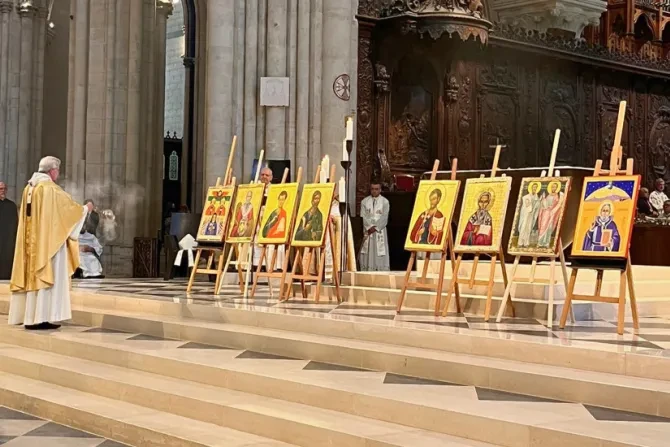
This year’s liturgy was distinguished by the blessing of eight icons painted by both French and Middle Eastern artists depicting the first saints from the early centuries of Christianity.
These icons were anointed with chrism and will be placed on Wednesday in the newly dedicated St. George Chapel — a space within the cathedral set aside for Eastern Christians.
In his opening remarks, Archbishop Laurent Ulrich of Paris described icons in the Eastern tradition as “true windows into eternity, a faithful witness to the faith of the entire Church. They are not mere pictures but an entryway into God’s holiness. To pray before them is a profound spiritual act.”
Ulrich expressed his hope that many Eastern Christians would come to St. George Chapel to pray, noting that the diocese had decided to consecrate it upon the cathedral’s reopening.
Expressing his deep admiration for the cathedral’s restoration, Sako said that the East “formed the roots of Christianity, while the West, through its missionaries, became its beating heart.”
He added: “The dedication of this chapel for Eastern Christians is of great significance, as it reveals the Church’s universality and unity. It is a source of pride for us. We are deeply grateful to the Church in France, which stood with us during the horrors we endured under ISIS.”

Speaking to ACI MENA, CNA’s Arabic-language news partner, Syrian artist Neemat Badwi explained that the eight icons portray early Eastern saints according to the Churches and regions they are associated with. These include Andrew of Constantinople, James of Jerusalem, Mark of Alexandria, Gregory the Illuminator of Armenia, Thomas of India, Addai and Mari of Seleucia-Ctesiphon in Iraq, Frumentius of Ethiopia, and Ignatius of Antioch. It was the icon of Ignatius that L’Œuvre d’Orient commissioned Badwi to create.

Badwi mentioned that he did not copy the icon from an earlier model but created an entirely new design. The work took him nearly three months to complete. He delivered the icons last month after arriving in Paris from Aleppo, accompanied by his brother, artist Bashir Badwi. Both were in the city to attend the conference titled “In Flesh and Gold” at the Louvre’s Michelangelo Gallery, which focused on the art and restoration of sacred icons.
This story was first published by ACI MENA, CNA’s Arabic-language news partner, and has been translated for and adapted by CNA.
If you value the news and views Catholic World Report provides, please consider donating to support our efforts. Your contribution will help us continue to make CWR available to all readers worldwide for free, without a subscription. Thank you for your generosity!
Click here for more information on donating to CWR. Click here to sign up for our newsletter.


In my opinion (of an Eastern Orthodox iconographer), that setting an “Eastern Orthodox chapel” in the body of Notre Dame de Paris is odd and superficial. They want it to be a sign of unity – they will achieve a superficial “unity” because they ignore the deep and true unity which is already there.
Eastern Orthodox pilgrims do come to Notre Dame de Paris and pray there, including before the Crown of Thorns. Furthermore, Notre Dame de Paris’s stained glasses are an equivalent of the Orthodox icons, such as a very fine carved wooden screen which depicts the life of Christ (I am not sure if it was returned after the fire). If you go to any museum of the Western Medieval art, you will see multitudes of Western icons – yes, icons. It is not the style that makes an icon but its faithfulness to an accepted iconographic scheme and rendition. Take the works of Duccio for example, or Fra Angelico, or others. They are your icons, the West, you do not need the extremely Eastern looking images to pray.
And so, we already have this unity in the variety of the holy images, both Western and Eastern. The core is one, the iconographic schemes are the same so there is nothing to state here; there is only to make use of what we have. Unfortunately, the West hugely lost an Eastern approach to icons and this is what needs to be recovered, not the stylistically different icons! This would be a step towards true unity, the unified treatment of the holy images (based on the Seventh Ecumenical Council).
About icons, “Take the works of Duccio for example, or Fra Angelico, or others.”
One key difference between eastern icons and Fra Angelico (more so, than Duccio) is the setting of his figures in space, rather than outside of time altogether. The early Renaissance in the West already is marked by a growing slant toward life within space and time, as perfected later in the art of linear perspective—from the eye of the beholder. Even the linear/basilica Church form—as at Notre Dame—is quite different from the symmetrical and domed Greek Cross form of Eastern churches. The Latin form offers an experienced cadence through time and even history—as one moves through the sequence of bays from the baptistry toward the altar at the far end in the liturgical East. While in the East, one remains surrounded by eternity.
To place the form of Eastern icons within the basilican form is a sort of expression of Church unity (which, yes, already exists). But, recalling the time when the five original patriarchates (Alexandria, Jerusalem, Antioch, Constantinople, and Rome) had not yet differentiated into the Latin and Eastern forms, as between a stylistic focus more on experience within time and the alternative focus more on transcendent eternity beyond time.
The first eventually becomes the eyes of the beholder, the latter remains beheld by the eyes “written” (not merely painted) within the icon.
On a related matter, did cooler heads finally prevail? A couple years into the restoration of Notre Dame there was a flap as to whether the interior should be adulterated to replace (?) side chapels with light shows more in tune with the times. Surely the Eastern icons are a better display of perennial Church unity than such transitory trivialization.
“The first eventually becomes the eyes of the beholder, the latter remains beheld by the eyes “written” (not merely painted) within the icon.”
You mention my “favorite” pseudo-esoteric term “writing” applied to icons. It is a result of a poor translation to English and a desire to make icons and the work of an iconographer very special to the Western viewers. Whoever (most probably Russian immigrants in the US) invented that application, they claimed that icons are “written” because Gospels were “written”; the work “to paint” was too low for icons, etc.
However, the truth is that in Russian language the word “pisAt” (to write) is applied both to “wring the book/letters” and “painting” – painting WHATEVER: a still-life, a portrait, a battle scene, a nude – or an icon. So, the word “pisat” makes no distinction between secular and sacred art. I never use the English word “writing” applied to icons because it is odd and superficial; there is no reason for me to say “I wrote an icon” if I say “someone painted a portrait”.
There is more in the phenomenon of “writing”, unfortunately: some iconographers deliberately use those words and stress the “esoteric” aspect of icon painting when they advertise their “icons writing workshops”. They seduce naïve Westerners into a belief that they can become iconographers after doing, let’s say, 20 hours of learning how to “write” (to copy one icon) and to guild. This “writing” together with nonsense like “real icons must have guided” is nothing else but a profanation of the true sacred art – and a true attitude to it.
To make a total: icons are painted. It is their subject and a proper attitude that makes them sacred, not some odd wording.
You may be interested to read a short piece ‘Icons are not “written”, by “Dr. John Yiannias, Professor Emeritus of Art History at the University of Virginia. Dr. Yiannias holds a Ph.D. in Early Christian and Byzantine Art from the University of Pittsburgh, and is a leading expert on Orthodox iconography”
https://www.orthodoxhistory.org/2010/06/08/icons-are-not-written/