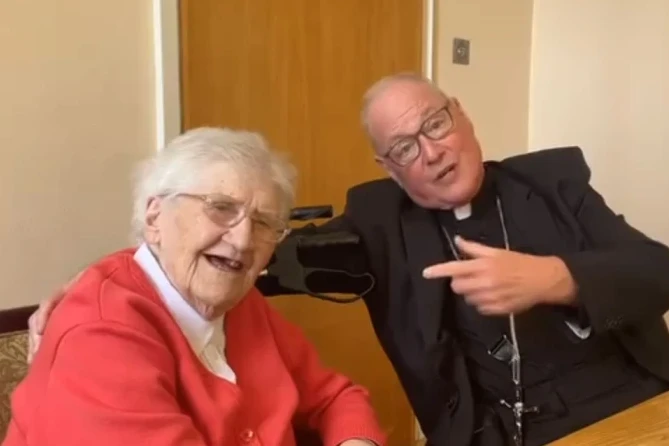
Cardinal Timothy Dolan, archbishop of New York, with Sister Mary Bosco of the Sisters of Mercy, a 100-year-old Irish nun who taught him to “love and serve the Lord.” / Credit: Photo courtesy of Cardinal Dolan
ACI Prensa Staff, May 15, 2025 / 17:03 pm (CNA).
Cardinal Timothy Dolan, archbishop of New York, shared a video on May 14 in which he appears with Sister Mary Bosco of the Sisters of Mercy, a 100-year-old Irish nun who taught him to “love and serve the Lord.”
“I’m in Tullamore, Ireland, with my beloved Sister Mary Bosco! She’s 100 years old and she taught me when I was just a little boy,” the cardinal explained in a video posted on X after being in Rome participating in the conclave in which Pope Leo XIV was elected.
“Choosing is always important for God — he chooses us! I thank God for Sister Bosco’s vocation, the call of Pope Leo, for St. Matthias [whose feast day is May 14], and for my parents, who chose to get married today in 1949,” he added.
“That’s choice in action! Thank God for calling us,” he concluded.
I’m in Tullamore, Ireland with my beloved Sister Mary Bosco! She’s 100 years old and she taught me when I was just a little boy. Choosing is always important for God – He chooses us! I thank God for Sister Bosco’s vocation, the call of Pope Leo, for St. Matthias, and for my… pic.twitter.com/RrKUk1hEOT
On Jan. 4, Dolan congratulated Sister Mary Bosco in a video message on her 100th birthday, noting that she “played a crucial role in my life,” as she was his teacher in second, fourth, and fifth grade.
“She taught me wisdom, she taught me knowledge, she taught me to put Jesus first. She taught me to know, love, and serve the Lord, she taught me to love the Church, to desire to receive the Lord in holy Communion and to strive to do my best to live the commandments and the beatitudes,” he recounted in January.
“I don’t know where I would be without her,” he shared at the time.
This story was first published by ACI Prensa, CNA’s Spanish-language news partner. It has been translated and adapted by CNA.
If you value the news and views Catholic World Report provides, please consider donating to support our efforts. Your contribution will help us continue to make CWR available to all readers worldwide for free, without a subscription. Thank you for your generosity!
Click here for more information on donating to CWR. Click here to sign up for our newsletter.
Washington D.C., Mar 14, 2020 / 12:00 pm (CNA).- The Museum of the Bible announced Friday that its entire collection of “Dead Sea Scroll” fragments have been proven to be forgeries, according to tests conducted at its request.
An Easter Vigil procession at St. Dominic Parish in San Francisco. / Credit: St. Dominic Parish/Lorelei Low
CNA Staff, Mar 15, 2025 / 06:00 am (CNA).
Five years ago this week, public health orders issued amid the uncertainty of the novel coronavirus turned Mass schedules across the country and the world upside down.
In those early days following the WHO’s March 11, 2020, declaration of COVID-19 as a pandemic, the bishops of every U.S. diocese issued some form of dispensation, suspending the obligation that Catholics must attend Sunday Mass in person.
Thousands of parishes and ministries scrambled to develop plans to offer livestreamed Masses, deliver the sacraments in a “socially distanced” manner, and live out the Church’s life as best they could under extraordinary circumstances. Public Masses at most parishes were suspended entirely for a time, and those that were able to reopen were subject, in many areas, to distancing requirements and numerical or percentage-based attendance caps.
As Catholics nationwide adapted to the changes — not knowing how long this new reality might last — observers feared that many Catholics, barred from their parishes for so long and now accustomed to attending from the comfort of home, might not return after the parish doors reopened.
A study from the Pew Research Center found that most Catholics continued participating in Mass throughout the pandemic — but many were only able to do so virtually. In November 2022, when the survey was done, only about 4 in 10 U.S. Catholics said they attended Mass in person as often as they did before the pandemic.
Indeed, from the start of the COVID pandemic lockdowns in the U.S. to the declared end of the pandemic in May 2023, in-person Mass attendance averaged just 15% — a dismal figure, but not markedly lower than the 24% it was before. (The Catholic Church teaches that Catholics are obligated to attend Mass in person every Sunday, except for a serious reason such as illness or if they’ve been dispensed from their obligation by their pastor or bishop.)
Some bishops lifted the dispensations they had issued as early as late 2020, while a few held out until 2022. In lifting the dispensations they issued amid the lockdowns, many U.S. bishops implored Catholics to return to Mass in person.
While Mass attendance today among Catholics in the U.S. remains much lower than among Catholics in other countries, recent data has suggested that U.S. in-person Mass attendance levels have quietly returned to where they were in 2019 after years of uncertainty over whether they would ever rebound.
For some thriving parishes in the U.S., the lockdowns — while challenging — presented an opportunity to continue sharing the faith in a creative manner and come out even stronger than they were before.
Father John Mosimann, pastor at St. Mary of the Immaculate Conception Parish in Fredericksburg, Virginia, told CNA that the parish has seen its numbers grow since the pandemic.
On a typical weekend, Mosimann and his four parochial vicars celebrate 11 total Masses in English, plus another in Spanish at a different parish where they are kick-starting a Spanish Mass ministry.
All told, roughly 3,800 people attended St. Mary’s weekend Masses on a typical week in 2019. According to headcounts, the parish had already exceeded its pre-pandemic levels by 2023, with around 4,300 attendees on average. The parish, which is about 55 miles south of Washington, D.C., has 6,700 registered families and nearly 100 active ministries.
Father John Mosimann poses with altar servers and Bishop Michael Burbidge of Arlington, Virginia. Credit: Photo courtesy of Father John Mosimann
During the pandemic, St. Mary’s added extra Masses — since for a time, Masses were limited to a smaller-than-usual number of attendees — and continued hosting adoration. Like so many other parishes, the parish had to quickly adapt to a livestreaming paradigm in order to stay connected with the community.
“I was in the office and I was looking at Facebook and I said, ‘What if I hit this button and go live, what would happen?’” Mosimann remembers thinking as the lockdowns began.
“And so I started streaming on Facebook Live and everybody started jumping in … ’What’s going on, Father? What’s going to happen?’ And I didn’t have answers, because I wasn’t that great a prophet. But we did immediately start streaming.”
He said parishioners were grateful for the effort the priests made to stay in touch, despite the occasional technical challenge — a problem far from unique to St. Mary’s.
“If you want perfect sound and you want a studio, go to EWTN. They’ve got professional equipment. If you want to see your priests, come talk to us,” Mosimann said he told his parishioners.
“We’re not going to be anxious over having studio quality, because what’s important is for us to be connected to you. People responded to that. People were very grateful for that. It was very frequently cited by parishioners, how grateful they were for our staying in touch with them during that difficult moment.”
Father John Mosimann baptizes a child at his parish, St. Mary of the Immaculate Conception in Fredericksburg, Virginia. Credit: Ginny Foreman
The last of Virginia’s capacity-restricting public health orders on venues was lifted in late May 2021, and Bishop Michael Burbidge of the local Diocese of Arlington in the following month lifted the dispensation he had issued, inviting Catholics to return to Mass throughout the diocese. So far, as in most U.S. dioceses, Mass attendance overall in Arlington has risen significantly but has not quite returned to pre-pandemic levels.
Since the pandemic’s end, Mosimann said his focus has been on encouraging parishioners to use their time and talents generously to help rebuild and grow the parish community.
For Mosimann, the pandemic experience was proof that by remaining faithful even through troubling and difficult times, God can and does bring good out of bad situations through his grace.
“[We] did everything we could to provide the sacraments to God’s people and to make it available as much as possible with all the restrictions. That should be the goal of every parish, every day, whether there’s a pandemic or not,” Mosimann said.
‘We are proud to be who we are’
Father Michael Hurley, OP, pastor of St. Dominic Parish in San Francisco, said his parish, which offers what he believes is the largest young adult presence in the entire archdiocese, regularly sees attendance numbers today that are similar to pre-pandemic levels.
The parish was able to safely provide the sacraments to those in need during the pandemic and had, providentially, already set up livestreaming for Masses shortly before the start of the pandemic. To this day the parish maintains a healthy online base of Dominican laypeople who tune in for Masses and prayer.
Father Michael Hurley, OP, (left) and his fellow priests from St. Dominic Parish in San Francisco cross the street in a homage to “Abbey Road.” Credit: St. Dominic Parish/Ivi Fandino
Hurley said he personally never worried during lockdown about people not returning to Mass, instead trusting that Catholics would return when they could. He said his main concern was keeping the church building open safely during the pandemic — in a state with some of the strictest lockdown measures in the country — to maintain sacramental support.
California finally lifted all capacity restrictions on religious gatherings in April 2021 after previously implementing a near-total ban on indoor services that was contested all the way to the U.S. Supreme Court.
The sanctuary of St. Dominic Parish in San Francisco. Credit: St. Dominic Parish/Alex Mizuno
Though the demographics of St. Dominic Parish has changed somewhat, in-person worshippers, many of whom work in the Bay Area’s high-tech sector, have returned in large numbers.
“The Lord is always searching for the strays, right? … All you have to do is open the doors and do what you’re doing, and people will come,” Hurley told CNA.
That said, Hurley said he believes St. Dominic’s beautiful church building, welcoming atmosphere, and a strong sense of identity — as a Dominican-led parish that aims to “radiate the joy of the Gospel in the heart of the city” — helps to make it an attractive place for Catholics, especially young adults. They also keep the church building open for personal prayer throughout the day, a rarity in a city that occasionally struggles with crime.
“We are proud to be who we are as Catholics, and for us as clergy, as Dominicans. And that makes a huge difference,” Hurley said.
Fr. Richard Cassidy, professor of Sacred Scripture at Sacred Heart Major Seminary, dresses in Roman prisoner garb as he holds a copy of his newest book, “A Roman Commentary on St. Paul’s Letter to the Philippians.” Fr. Cassidy’s eighth scholarly work, the book explores the subversive nature of St. Paul’s Letter to the Philippians, which the apostle wrote from behind bars in a Roman prison cell. / Valaurian Waller | Detroit Catholic
Detroit, Mich., Apr 30, 2022 / 08:00 am (CNA).
It was a tough decision for Rick Cassidy as he began graduate studies at the University of Michigan in mid-1960s. Would he take the course on Imperial Rome, because of his love of history, or the course History of Slavery, because of his deep concern for social justice?
The Dearborn native chose the course on slavery. The insights he acquired have helped to guide Fr. Richard Cassidy’s scholarly work for three decades, including his latest work, “A Roman Commentary on St. Paul’s Letter to the Philippians“ (Herder & Herder, 2020).
Paul’s letter, composed in chains and secreted out of his Roman jail cell, is intentionally “counter-slavery” argues Father Cassidy, professor of Sacred Scripture at Sacred Heart Major Seminary since 2004, as well as “counter-emperor.” At its core, Philippians is an underground epistle that subverts the Roman power structure and the “lordship pretensions of Nero.” Reviewers praise the “distinctive thesis” of Father’s groundbreaking work as “fresh and illuminating,” making for “fascinating reading.”
This is Father Cassidy’s seventh book that examines the influence of Roman rule on the writers of the New Testament, and his eighth book overall. He returned to Ann Arbor on a rainy afternoon in late June to discuss his newest work.
Dan Gallio: St. Paul’s Letter to the Philippians is most known for its soaring declaration of the divinity Christ, before whom one day “every knee must bend,” and “every tongue proclaim” his universal lordship (2:6-11).
Your new book presents a unique argument: Paul’s letter is primarily a “subversive” document of resistance against the Roman Empire—particularly against emperor worship and slavery. How did you arrive at this against-the-grain interpretation?
“A Roman Commentary on St. Paul’s Letter to the Philippians” (Herder & Herder, 2020) is Fr. Cassidy’s eighth book and a follow-up on his 2001 work, “Paul in Chains: Roman Imprisonment and the Letters of St. Paul”. Valaurian Waller | Detroit Catholic
Father Cassidy: These insights were the result of long hours with the text, spending a lot of prayer time for guidance, as to Paul’s situation.
The issue of slavery came into play strongly. I now saw that Jesus was executed as a violator of Roman sovereignty, condemned by Pilate, executed under Emperor Tiberius—and that this was the slave’s form of death. This is a crucial point.
In regards to the two topics you mention, I had the intuition that the Letter to the Philippians was “counter-emperor cult” and “counter-slavery.” First, the self emptying of Christ from on high—descending downward into human form, downward, downward to the point of the slave’s death on a Roman cross—and then you have St. Paul’s wonderful words in chapter 2, verses 9-11.
My insight was that there is going to be a redressing of what has happened. Because of the great faithfulness of Jesus Christ, the Father intervenes and begins the lifting up, the ascending of Christ, where the Father exalts Jesus and bestows upon him “the name above every other name.”
So I can now speak about this famous passage in terms of a kind of “drama”: four scenes that represent the descent of Jesus, and four scenes that represent his ascent, akin to a medieval passion play. The Father intervenes on Christ’s behalf, conferring upon him the name of “Lord.” Now all of creation, including the emperor, the governor, the imperial personnel, are all subject to Jesus. They have to prostrate themselves before the name of Jesus.
DG: So, essentially, Philippians is subversive because it makes a political statement as much as a theological one.
FC: Yes, but for some, it is a great privilege to genuflect at the name of Jesus. This includes slaves! Paul had integrated slaves into his community in Philippi. They were empowered now to proclaim the name of Jesus, standing alongside free men and women. They are standing alongside the Roman imperial power structure, all involved in the same process of bowing before Christ and proclaiming his name.
A security guard at Sacred Heart Major Seminary helps Fr. Cassidy don his “prisoner’s clothing” for a photo shoot promoting Fr. Cassidy’s latest book, “A Roman Commentary on St. Paul’s Letter to the Philippians,” which details Paul’s experience behind bars and the conditions under which he wrote his Letter to the Philippians. Valaurian Waller | Detroit Catholic
And that name is “Lord.” Jesus is being acclaimed as Lord, and not the emperor, to the glory of God the Father. This is the decisive element of Philippians 2:6-11, blended together in this one passage.
DG: You provide a forty-four-page introduction to the social situation of the Roman colony of Philippi. Why did you feel such an informative but lengthy introduction was necessary to support your thesis?
FC: I had to establish that conditions at Philippi mirror conditions at Rome. This is important. Philippi was like “Little Rome.” When Paul is speaking of conditions at Philippi, his is also experiencing the same oppressive conditions at Rome as a chained prisoner. I had to establish that emperor worship was everywhere, in Philippi’s renowned amphitheater, in the streets, in public artifacts. That is why I had to go into an extensive introduction to set the stage of what Paul is doing in his letter.
DG: Your appendices are extensive, too, like bookends to the introduction, driving the thesis home again using illustrations.
FC: There is one illustration of a monument where slaves are chained, and a slave trader is proclaiming his prowess as a slave trader. This monument to the degradation of slavery was at a city adjacent to Philippi. Paul almost certainly passed by it on his way to and from Philippi. It was discovered back in the 1930s and almost destroyed in the war by Nazi bombings.
DG: Paul is sometimes criticized by revisionist commentators for not rejecting the institution of slavery in his letters. Is your book an answer to these critics?
FC: Paul’s approach to slavery is complicated. There are some letters where he seems to envision the imminent return of Christ. Possibly he minimized the importance of slaves being freed in these letters. However, in Philippians, his final letter before his death, he addresses the issue definitively. It is very undermining of slavery.
I intended to de-establish the idea that Paul acquiesced to slavery. He did not acquiesce. The laudatory prepublication comments by scholars make me think the book will have a decisive role in re-imaging Paul.
Against a prevailing notion that St. Paul “acquiesced” to the idea of slavery in his writings, Fr. Cassidy’s book aims to counter the idea by showing how St. Paul’s Letter to the Philippians actually served a subversive purpose in a Roman empire dominated by emperor worship and tight controls. Valaurian Waller | Detroit Catholic
DG: Back to Philippians 2:6-11. Why do you maintain this passage is not a hymn or baptismal catechesis, as is customarily believed, but is an original composition of Paul? Is this position another example of your counter exegesis?
FC: This is not some other preexisting hymn. No! This is fresh imaging. Visceral imaging. This is intensity from identifying with Christ as the “slave crucified.” No one else could have composed this passage. And Paul could not have composed this passage until he was in Roman chains and could see the threat posed against Jesus by the counterfeit claims that Emperor Nero is Lord.
DG: It’s almost like the passage is “supra-inspired,” that he would get such an original insight while in such dreadful circumstances.
FC: Correct. And there is a real question as to how this letter could be transmitted from prison, with the security and censorship. In garments? In pottery? It is possible the original written letter was confiscated. So how is Paul is getting his subversive thoughts past the Roman guards?
I suggest in my book that Paul was drilling his associates, Timothy and Epaphroditus, to memorize his letter, given the role of memory in early Christian life.
DG: With your busy teaching and pastoral duties, where to you find the motivation and energy to produce such a thoroughly researched, and beautifully written, work of scholarship?
FC: It’s Spirit driven!
DG: Is the Spirit driving you to another book?
FC: I would say so. After a book comes to publication, there is always a kind of mellowing period. So right now I have not identified the next project. I am appreciating the graces I have received from this book, and trusting that the same Spirit who has shepherded me through this sequence will still stand by me, guiding me forward.
Leave a Reply
