Maltese priest Fabio Attard was elected rector major of the Salesians for the next six years. / Credit: Courtesy of Salesian Family
ACI Prensa Staff, Mar 26, 2025 / 13:05 pm (CNA).
Maltese priest Fabio Attard was elected as the new rector major of the Salesian congregation during its general chapter in Turin, Italy, becoming the 11th successor of St. John Bosco.
The new superior general of the order founded in 1859 succeeds Spanish Cardinal Ángel Fernández Artime, who became prefect of the Dicastery for Institutes of Consecrated Life and Societies of Apostolic Life in January.
According to the Salesians, the new rector major did not participate in the Salesian chapter meeting, so he was informed of his election by telephone, at which point he was asked for his required acceptance.
“His words were heard in the hall and, moved to tears, he thanked the brothers for their trust and especially for their trust in God in taking on this new task,” the Salesians said in a statement.
This is the first time that the new rector major is not among the members of the general chapter, “so the profession of faith upon accepting the office and the greeting from the chapter members and the mother general of the Salesians Daughters of Mary Help of Christians will take place throughout the day, when the new rector major can make it to Turin.”
Attard will now have six years to lead the Salesian family, which will begin with the work remaining at the general chapter, which will last until April 12.
The priest’s election came two days after his 66th birthday. Born in Gozo, Malta, he made his profession as a Salesian in September 1980 in Dublin, Ireland, where he completed his novitiate.
Both his diaconal and priestly ordinations took place in Rome in 1986 and 1987, respectively. After leading several Salesian apostolates in Malta, he founded the Institute for Pastoral Formation of the Archdiocese of Malta in 2005.
With a licentiate in moral theology from the Alphonsianum in Rome, Attard participated in the general chapter held in 2008 as delegate for the Irish province and was entrusted with youth ministry until April 2020, when Artime asked him to create a continuing formation project for Salesians in Europe.
Since 2018, he has been a consultant to the Dicastery for the Laity, Family, and Life, a position he continues to hold today.
This week, the other members of the general council will be elected: the vicar of the rector major, the four sector councilors (formation, youth ministry, social communications, and missions), the treasurer, and the nine regional councilors for each of the regions into which the congregation is divided.
This story was first published by ACI Prensa, CNA’s Spanish-language news partner. It has been translated and adapted by CNA.
If you value the news and views Catholic World Report provides, please consider donating to support our efforts. Your contribution will help us continue to make CWR available to all readers worldwide for free, without a subscription. Thank you for your generosity!
Click here for more information on donating to CWR. Click here to sign up for our newsletter.
The beatification Mass of Fr. Juan Elías Medina and 126 companions in the Mosque-Cathedral of Córdoba in Córdoba, Spain, Oct. 16, 2021. / Diocese of Córdoba.
Cordoba, Spain, Oct 25, 2021 / 17:06 pm (CNA).
Fr. Juan Elías Medina and 126 companions… […]
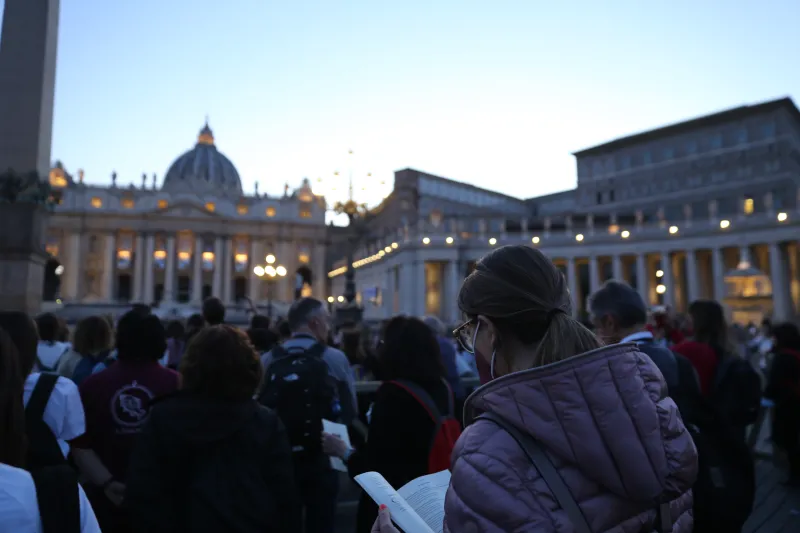
Pilgrims pray in front of St. Peter’s Basilica / Hannah Brockhaus/CNA
Rome, Italy, May 26, 2022 / 08:37 am (CNA).
When St. Philip Neri came to Rome from Florence in 1533, he encountered a city in upheaval. The Sack of Rome six years prior had left famine and plague in its wake. The Protestant Reformation was in full swing and the Church was rife with corruption.
The young Philip, who would spend around 16 years in Rome as a layman before becoming a priest, soon dedicated himself to caring for the city’s sick and poor.
The saint, whose feast day falls on May 26, also realized that Rome’s people were suffering from a spiritual sickness and tiredness as well, and so he set out to reinvigorate Catholics with the joy of the faith through song and dance — and jokes.
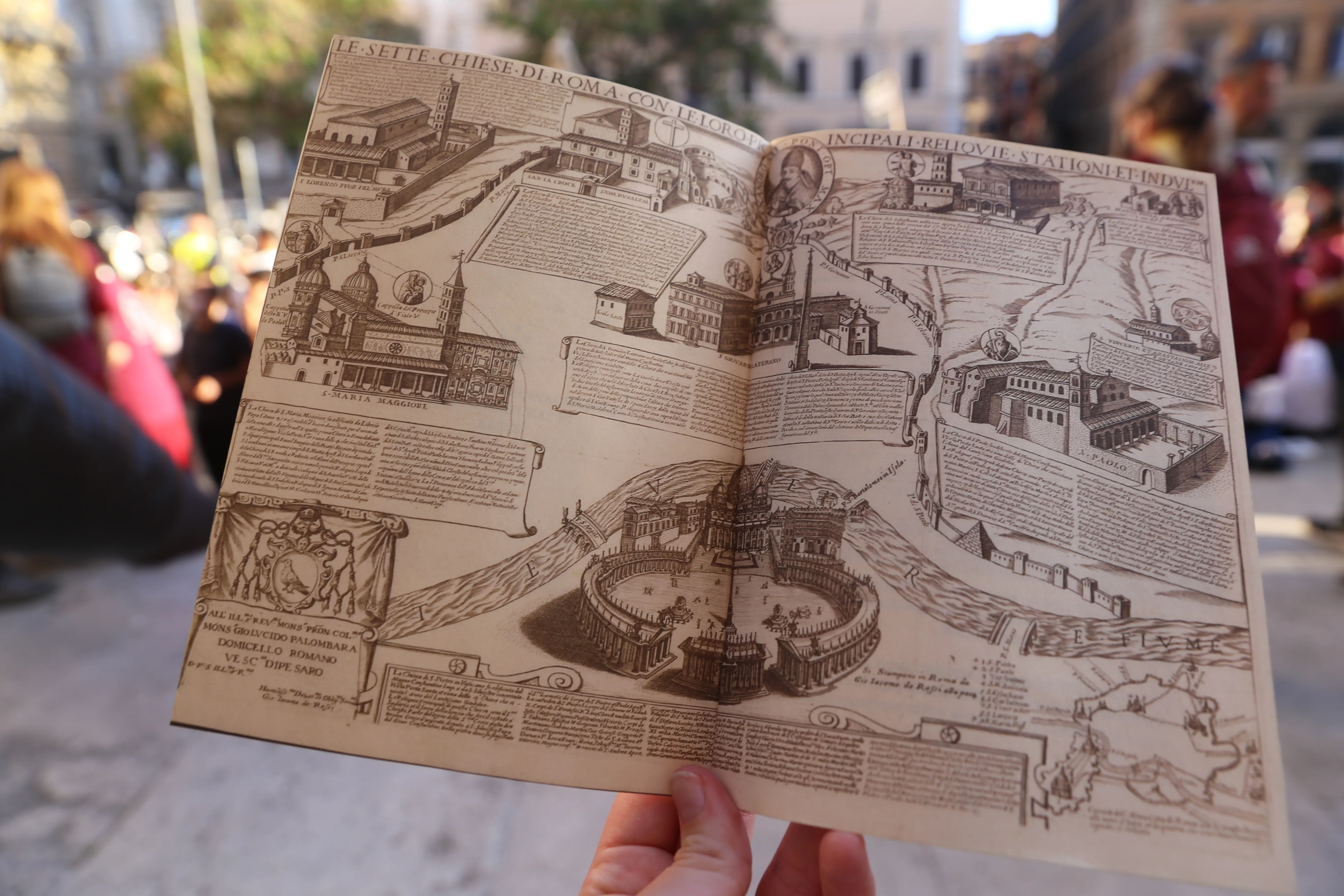
A historic illustration of the seven churches. Hannah Brockhaus/CNA
Part of St. Philip’s outreach was the revival of the Seven Churches visit. He may not be the originator of the idea of the pilgrimage to some of Rome’s most important churches, but he is credited with renewing its popularity.
After it fell out of use once again, St. Philip’s congregation of secular priests, the Oratory, revived it in the 1960s, including holding the walk one night each year, as close as possible to the way the saint would have done it.
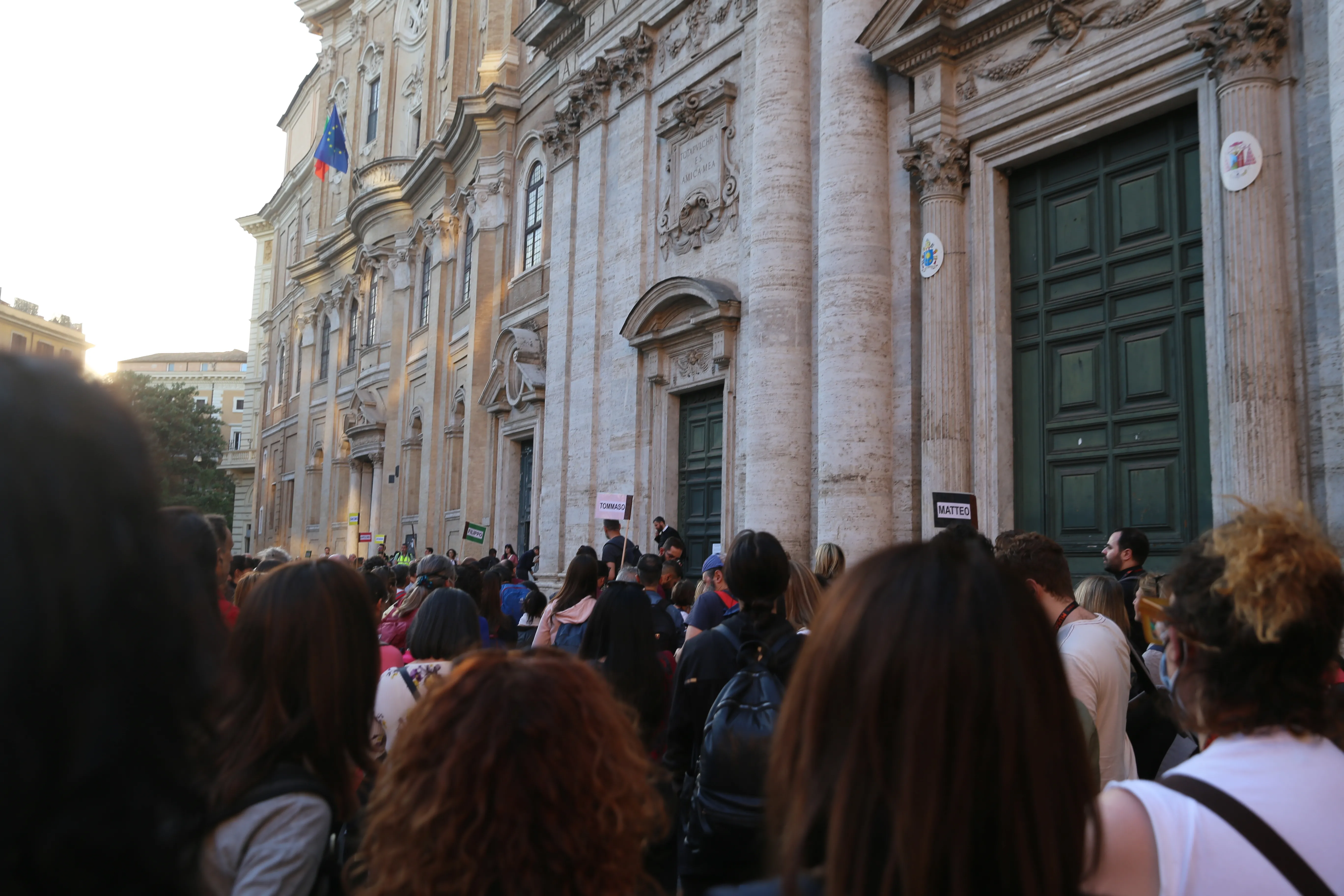
Fr. Maurizio Botta, who led the pilgrimage, speaks at the start in front of Chiesa Nuova. Hannah Brockhaus/CNA
After a two-year pause, on the evening of May 13 into the morning of May 14, around 800 people walked 15 and a half miles in the footsteps of the saint and his followers.
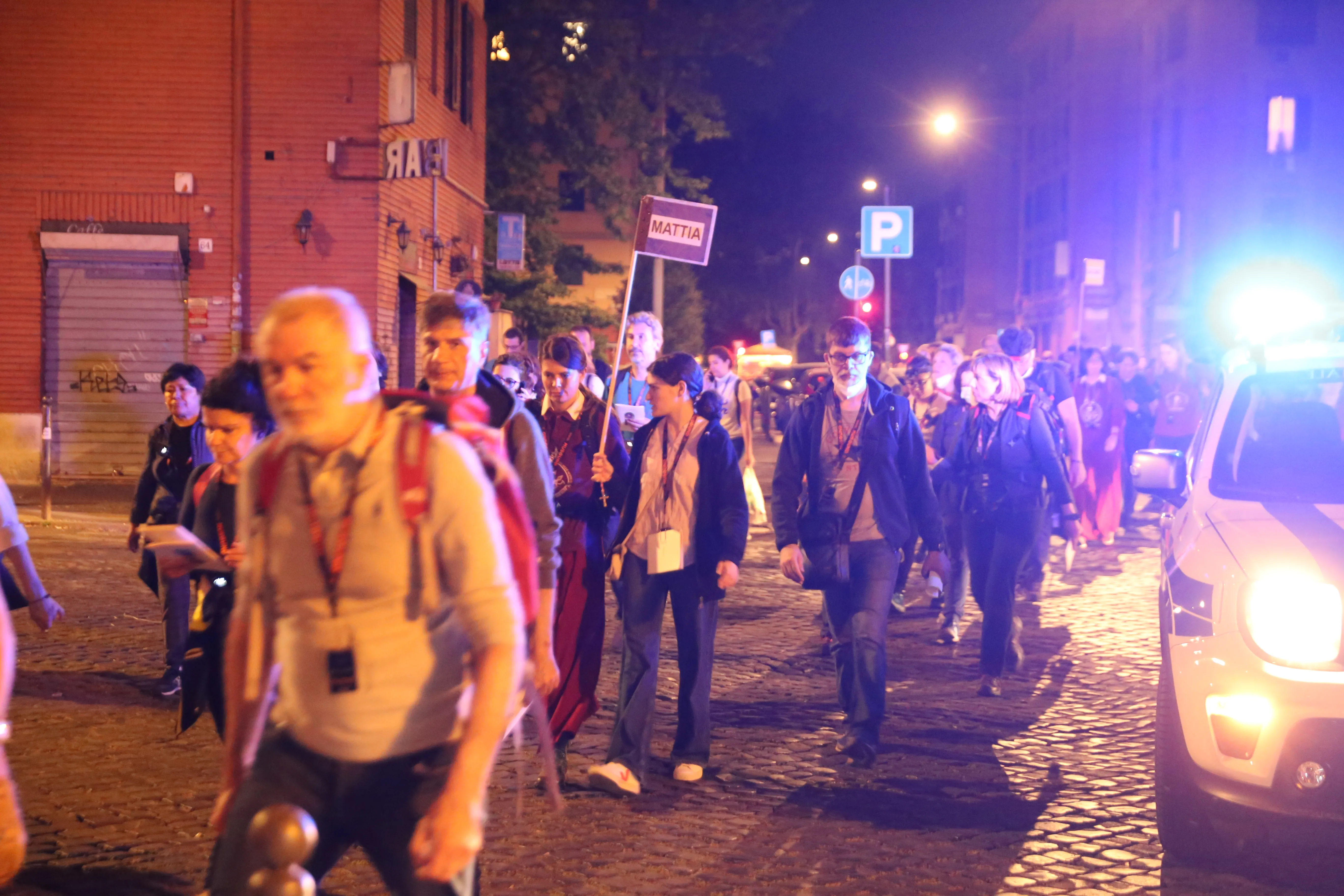
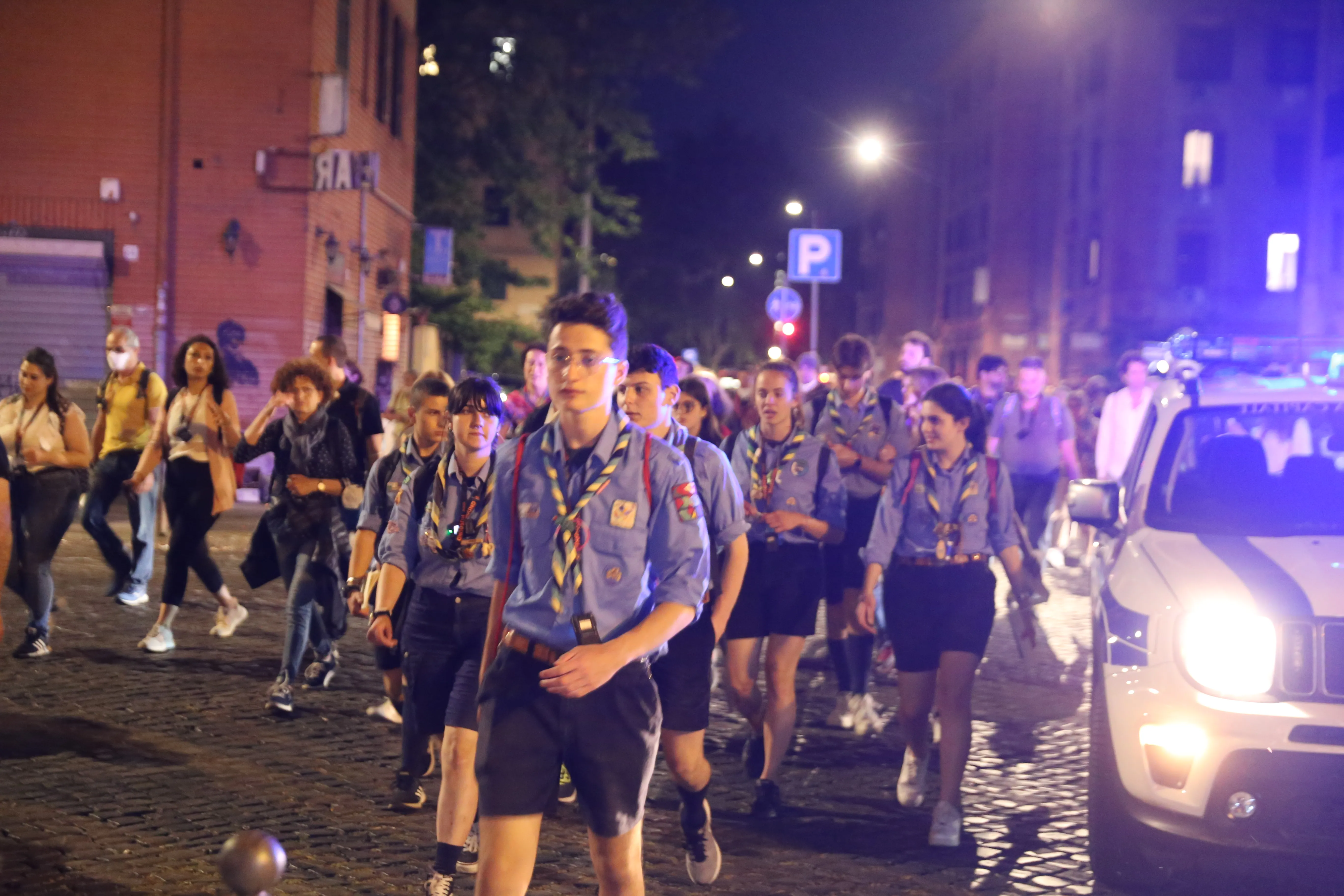
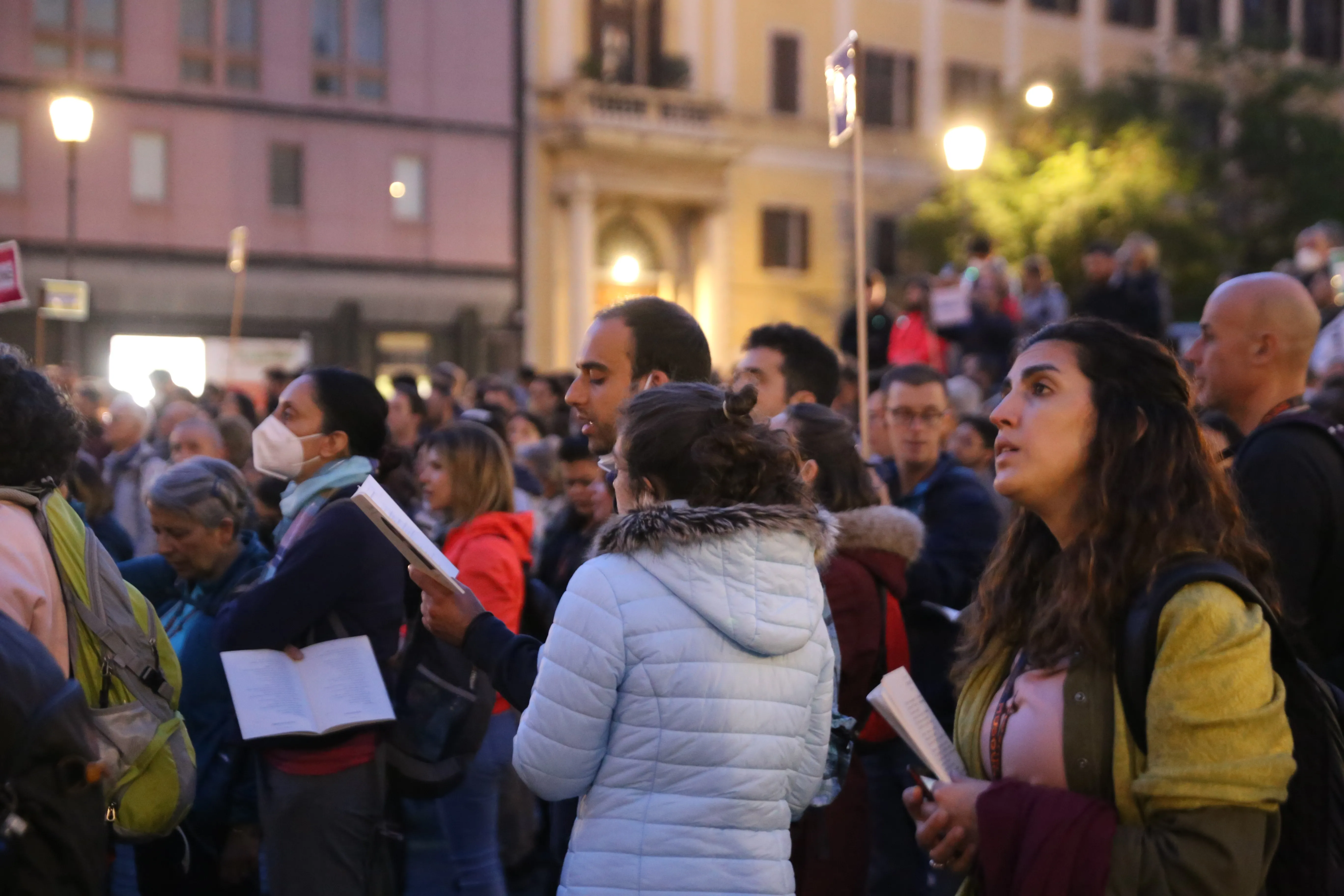
Police officers in cruisers drove ahead of the urban pilgrimage to block traffic as a sea of Catholics from around Italy crossed busy intersections and passed Friday night diners while praying the rosary in unison and singing the Taizé chant “Laudate Dominum,” whose words say in Latin, “Praise the Lord, all people, Alleluia.”
Pilgrims, including scouts, walk through Rome’s Ostiense neighborhood. Hannah Brockhaus/CNA
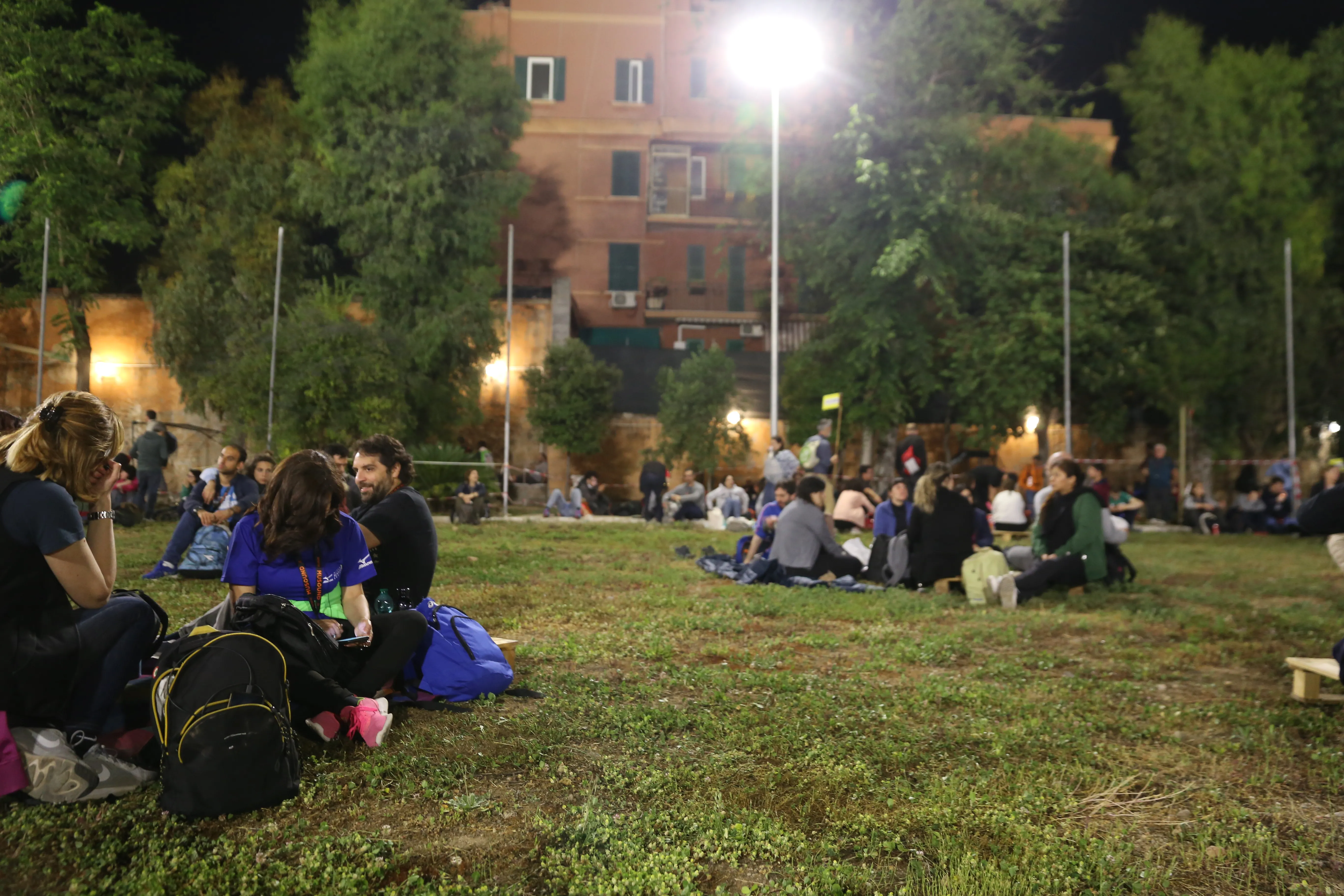
The rosary was prayed four times during the pilgrimage, which took almost 10 hours to complete, including stops for a sack dinner at midnight and short lessons on the virtues led by priests of the Oratory.
Pilgrims, including scouts, walk through Rome’s Ostiense neighborhood. Hannah Brockhaus
The seven basilicas were chosen by the saint for their importance to Christianity, and the walk on May 13-14 followed the path laid out in a 16th-century document almost certainly seen and used by St. Philip — and likely even written by him.
This document, recreated and printed into a booklet for use on the annual pilgrimage today, gives St. Philip’s guidance for those making the Seven Churches visit.
Eating a sack dinner in the courtyard of a church. Hannah Brockhaus/CNA
“Before setting out to make this holy Pilgrimage, each of the Brethren must lift up his mind to God, offering him the sincerity of his heart, with the purpose of desiring the sole glory of his divine Majesty in all actions, and especially in this one,” it says.
Those participating can also earn an indulgence under the usual conditions, and are asked to pray for specific intentions. These include praying for the penance of sins, the amendment of lukewarmness and negligence in the service of God, in thanksgiving for the forgiveness of sins, for the pope and the Church, for sinners still in the darkness of an evil life, for the conversion of heretics, schismatics, and infidels, and for the holy souls in purgatory.
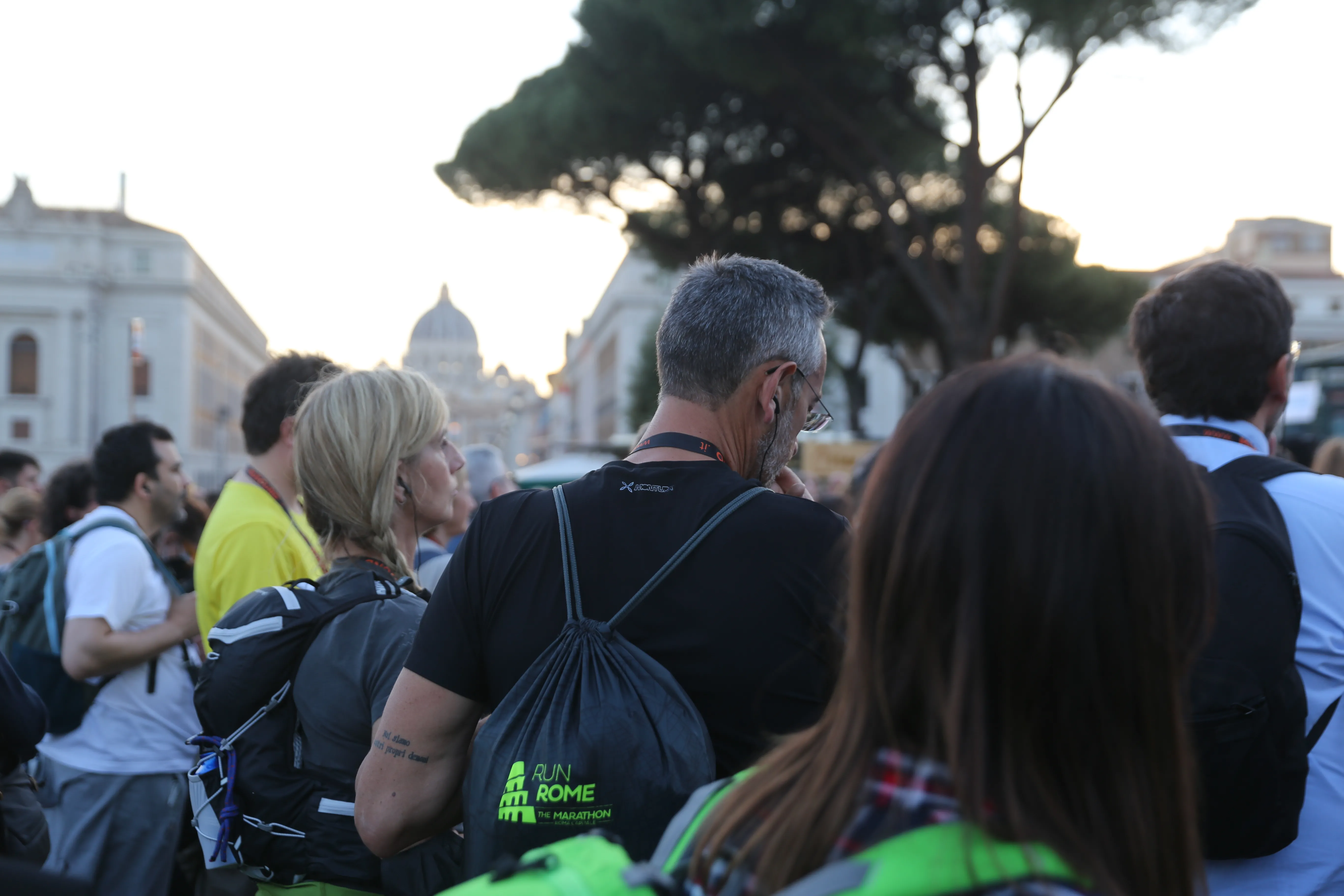
Pilgrims stop to pray on the way to St. Peter’s Basilica. Hannah Brockhaus/CNA
The pilgrimage began at Chiesa Nuova, the church built by St. Philip for the Oratory, and proceeded to St. Peter’s Basilica, reaching the site of St. Peter’s martyrdom at sunset.
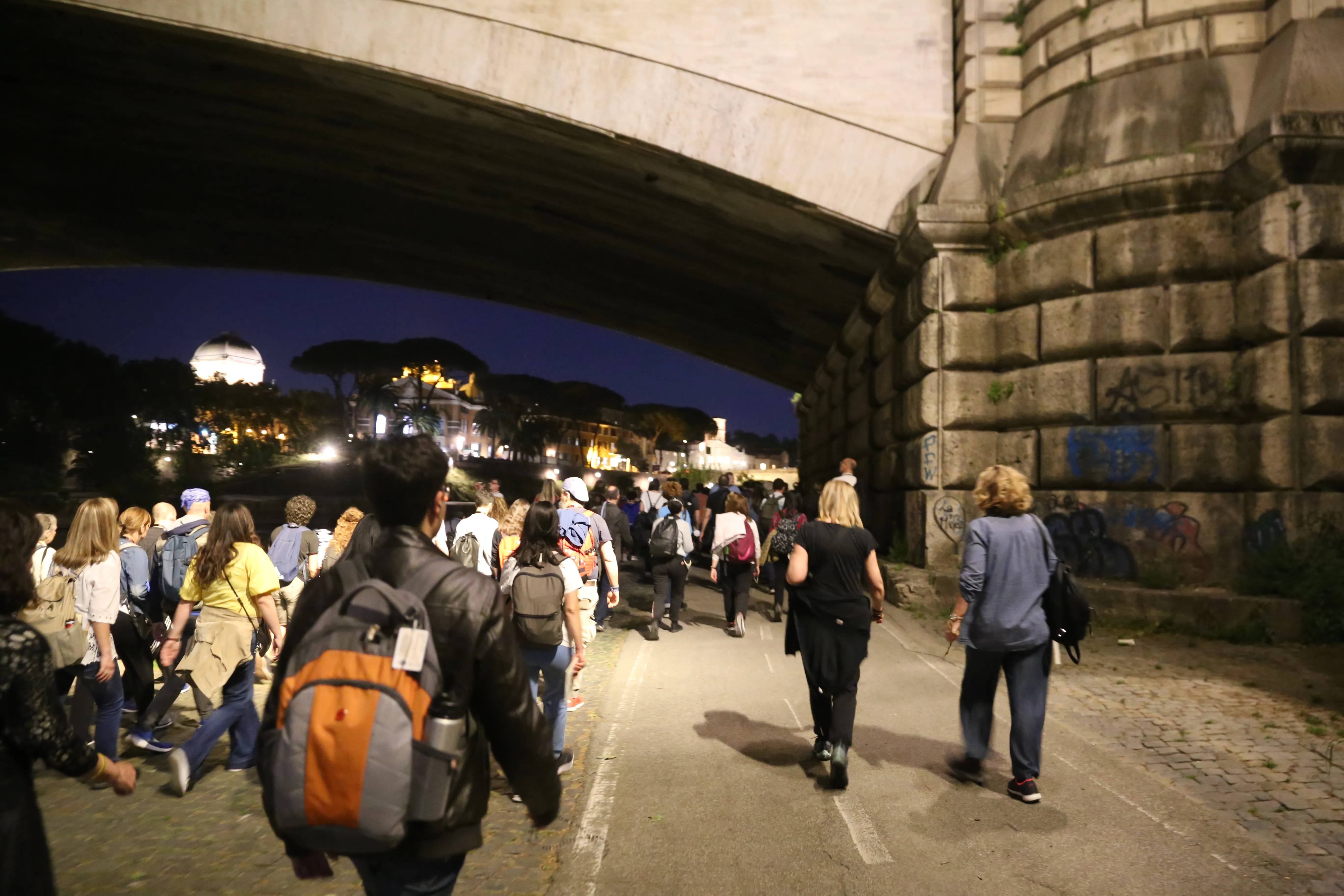
Pilgrims walk on a path next to the Tiber River. Hannah Brockhaus/CNA
Each of the seven churches is associated with a moment of Christ’s Passion and Crucifixion. At each stop, an Oratory priest preached on a virtue and its opposing vice, before everyone joined in a prayer for an increase in that virtue and for the gifts of the Holy Spirit.
The virtues and vices were abstinence against gluttony, patience against ire, chastity against lust, generosity against avarice, fervor of spirit against acedia, charity against envy, and humility against pride.
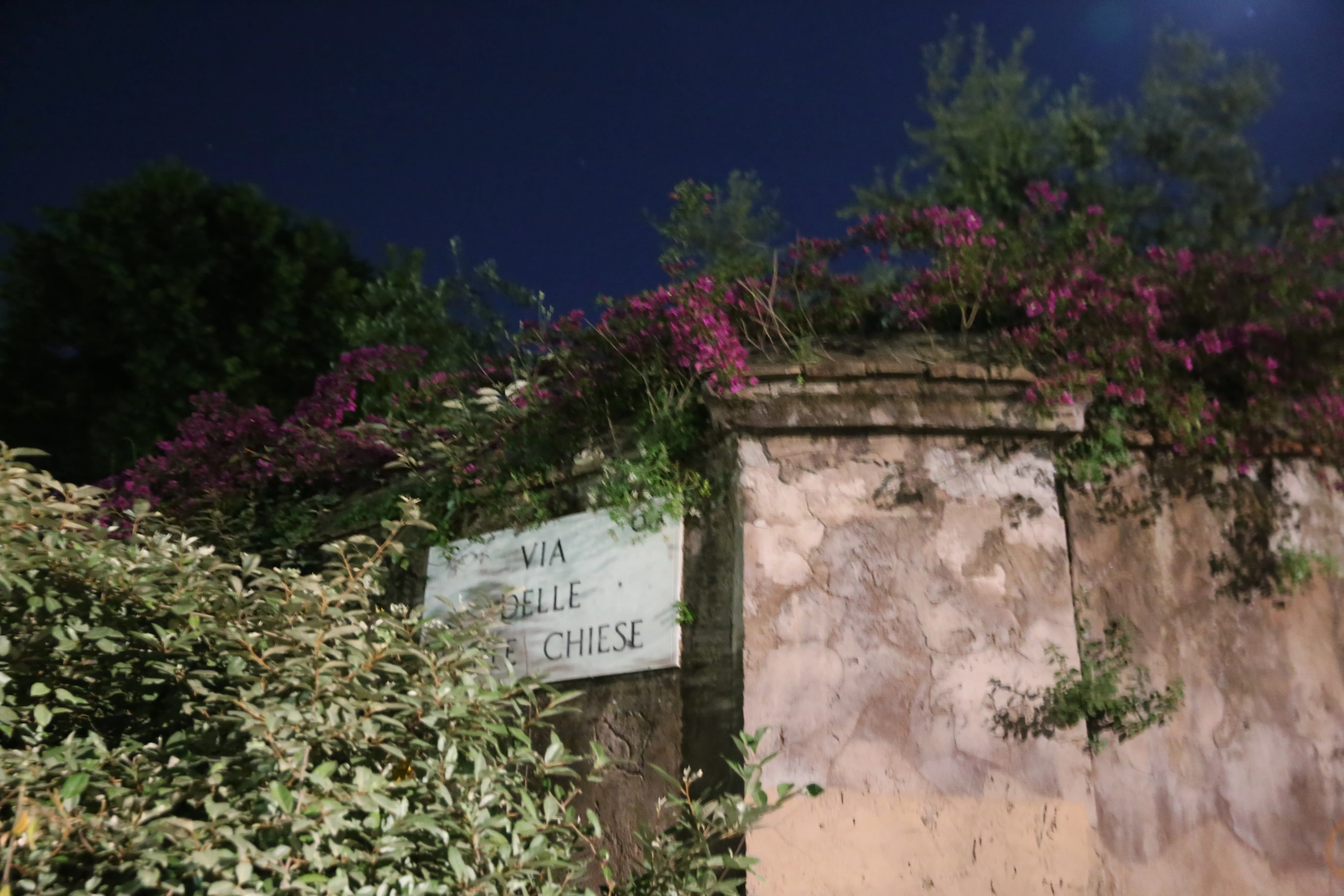
A street sign marking Seven Churches Way. Hannah Brockhaus/CNA
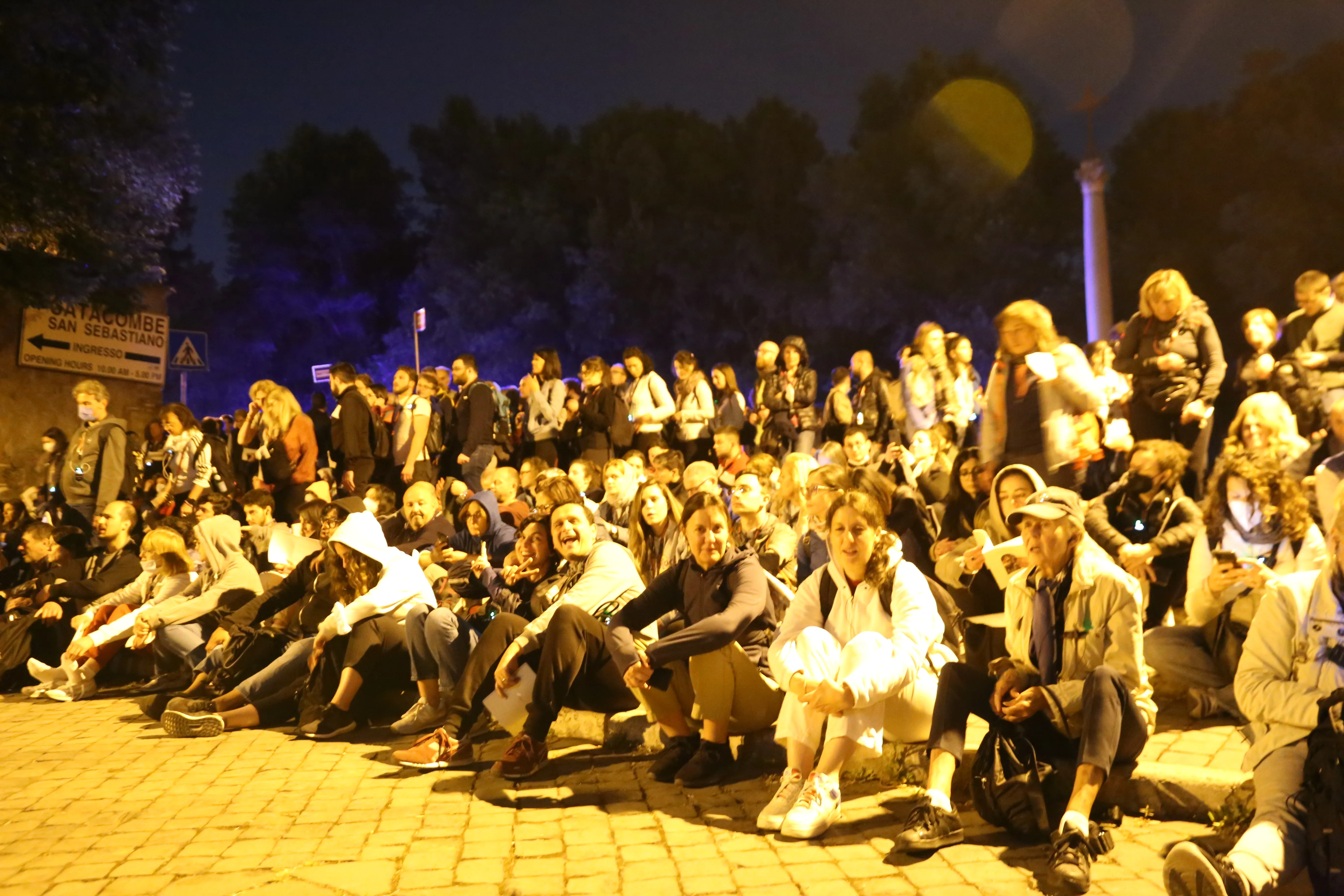
After the Basilica of St. Paul, the pilgrimage followed an ancient street still called Seven Churches Way to arrive at the catacombs and the Basilica of St. Sebastian, a third-century Christian martyr.
As a layman in Rome, St. Philip Neri used to visit the catacombs of St. Sebastian to pray. One night in the catacombs, about 10 years after moving to Rome, as he prayed, a mystical ball of fire entered his mouth and went down into his chest, exploding his ribs and doubling the size of his heart with love of God.
St. Philip was changed, both physically and spiritually, by this event, which he only revealed shortly before his death.
Pilgrims outside the catacombs of St. Sebastian. Hannah Brockhaus/CNA
Pilgrims next arrived at the Domine Quo Vadis Church after a silent, moonlit walk through the ancient Appian Way Park, flanked by the silhouettes of Italian cypress trees.
The small church of medieval origin marks the spot where, according to tradition, Jesus appeared to St. Peter as he was fleeing Rome to avoid martyrdom.
Peter asked Jesus, “Domine quo vadis?” (“Lord, where are you going?”), to which Christ said, “Venio Romam iterum crucifigi,” (“I am coming to Rome to be crucified again.”) This rebuke caused Peter to turn around and face his own martyrdom.
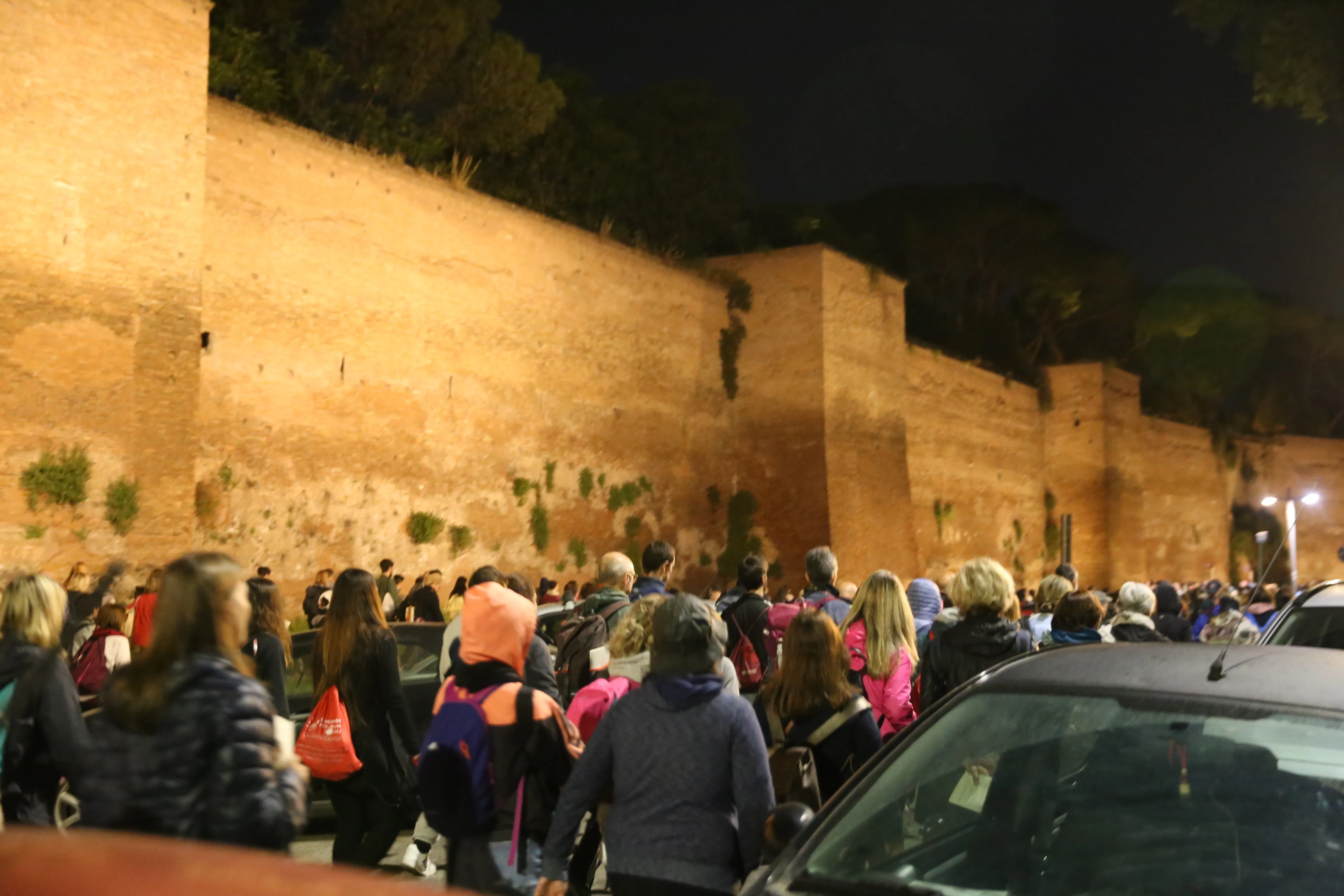
Pilgrims walk along the ancient Aurelian Wall on their way to the Basilica of St. John Lateran. Hannah Brockhaus/CNA
The Basilica of St. Lawrence Outside the Walls was the penultimate stop. The church, which has the tomb of St. Lawrence, is located next to Rome’s Verano Monumental Cemetery, and was included among the Seven Churches by St. Philip Neri, Father Botta said, as a reminder of mortality.
Almost 2 weeks ago I went on St. Philip Neri’s 7 Churches Walk in Rome.
800 people walked over 15 miles during the 10-hour night pilgrimage.
During the last stretch, at 5:15am, we passed through Termini train station, and Francesco caught this video of the moment. pic.twitter.com/C2SPHn5yoR
— Hannah Brockhaus (@HannahBrockhaus) May 26, 2022
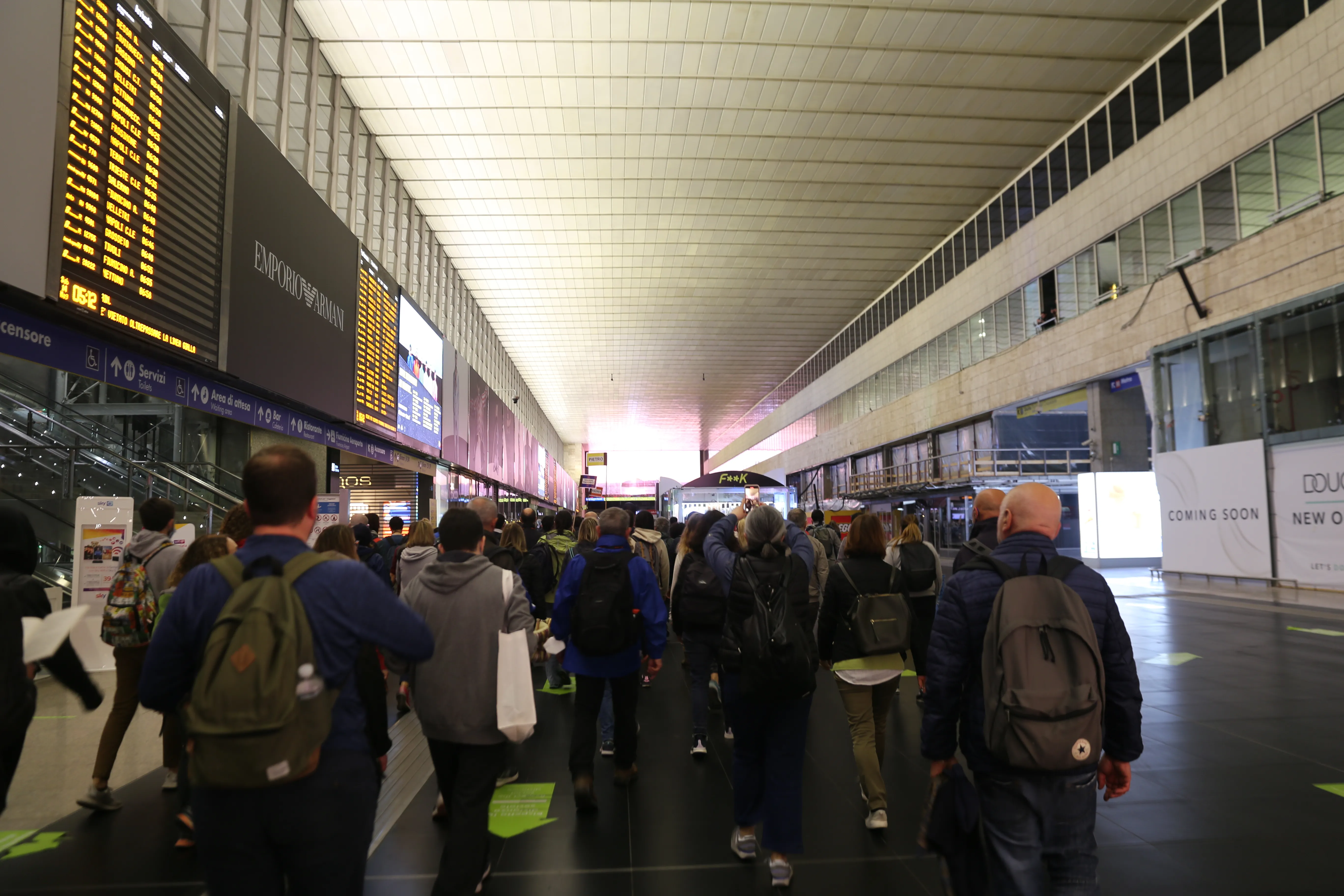
The final stretch of the walk passed through Rome’s main train station, Termini, where pilgrims sang the Marian antiphon “Salve Regina.”
Pilgrims walk through Termini train station singing the “Salve Regina”. Hannah Brockhaus/CNA
The pilgrimage finished shortly before 6:00 a.m. at the Basilica of St. Mary Major, the traditional end of the walk, where the “Salve Regina” hymn was sung again in honor of the Virgin Mary.
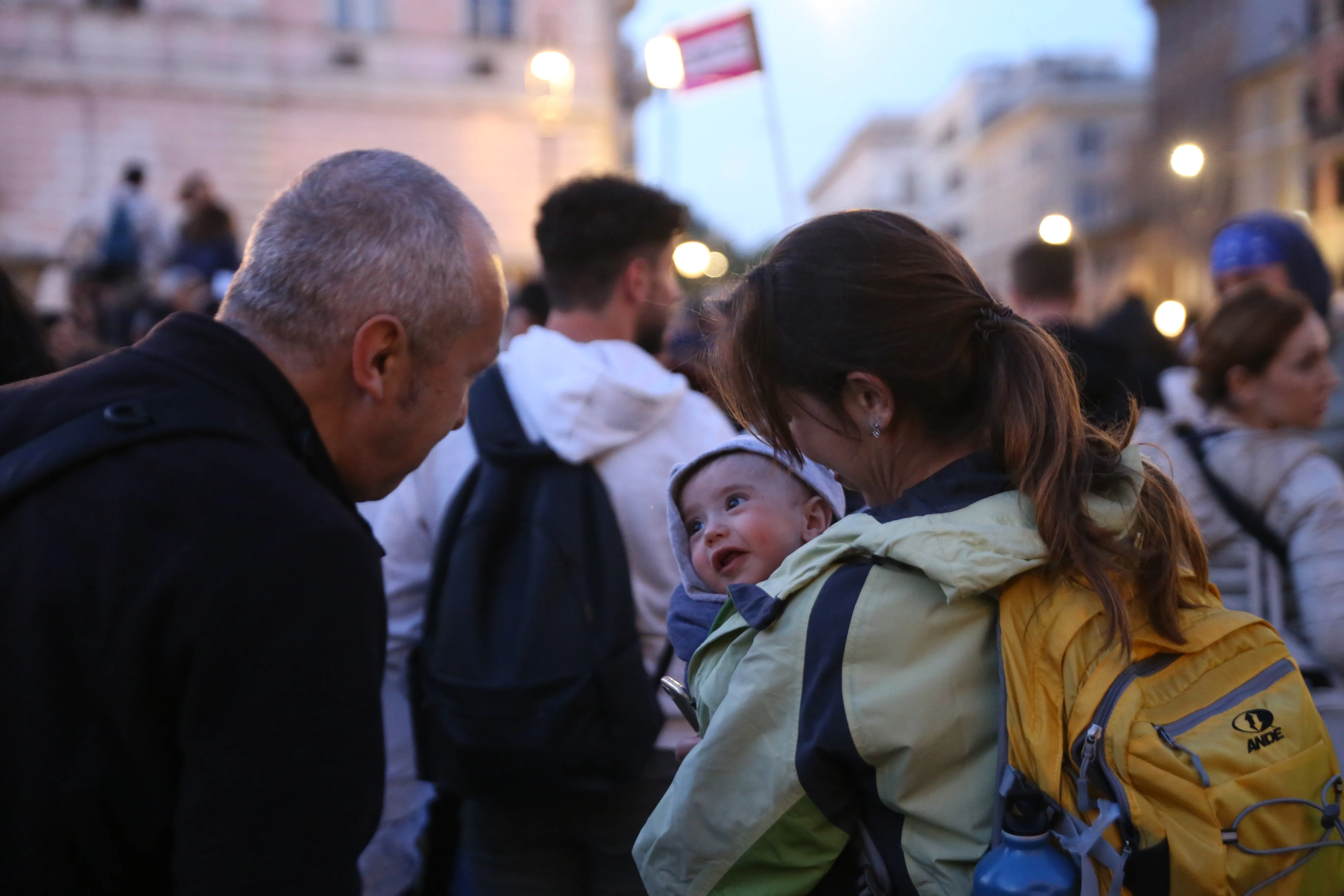
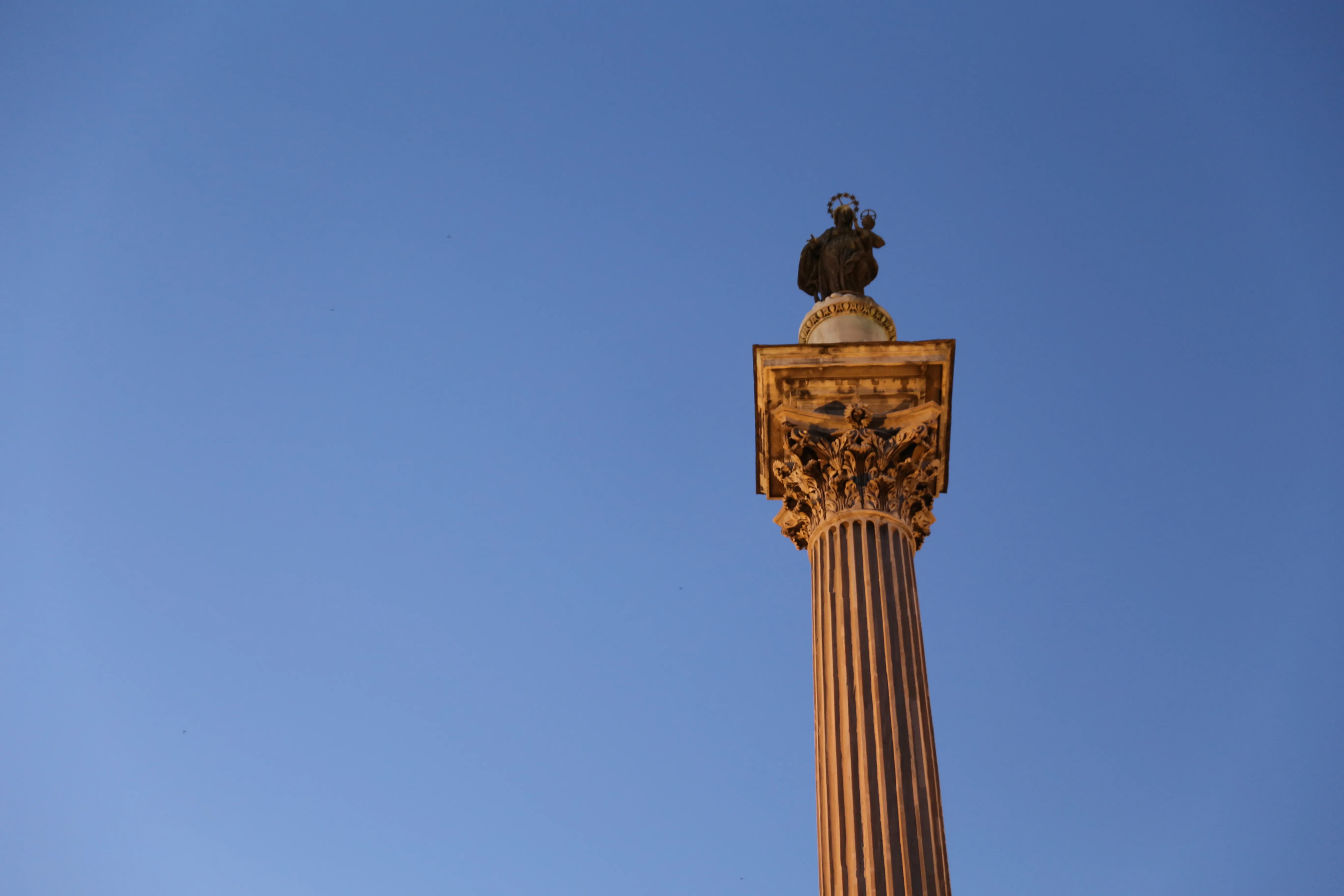
Pilgrims sing the “Salve Regina” outside the Basilica of St. Mary Major. Hannah Brockhaus/CNAA baby and his mom enjoy a moment with a new friend at the end of the pilgrimage. Hannah Brockhaus/CNAA statue of Mary on a column outside the Basilica of St. Mary Major. Hannah Brockhaus
Rome, Italy, Jan 20, 2017 / 10:33 am (CNA/EWTN News).- One year after Pope Francis visited the Great Synagogue in Rome, the Hebrew Choir of Rome “Ha-Kol,” and the Choir of the Diocese of Rome joined together to give a concert Jan. 19 on the theme: “Sing to the Lord a new song.”
The Pope’s attention to Jewish-Christian dialogue continues to be welcomed by the Jewish community in Rome, and events such as the concert is one way they can contribute to that dialogue, Richard Di Castro, president of the Ha-Kol Choir Association, told CNA.
“I believe that music can speed up the dialogue between all cultures and among all religions, and is a common thread that is understood in all latitudes and in all parts of the world,” Di Castro said.
“All the more so, the privileged nature of the dialogue that Jews and Christians have at this time, events like this where we can share our traditions, our musical culture, helps considerably in the dialogue.”
The concert, which consisted of musical interpretations of the Psalms in both the Jewish and Christian traditions, took place just a few days after the one year anniversary of Pope Francis’ visit to the synagogue on Jan. 17, 2016.
Pope Francis was the third-ever Roman Pontiff to visit the Great Synagogue, following the example of his two predecessors. St. John Paul II visited in 1986 and Benedict XVI in 2010.
Di Castro said that he considers Pope Francis’ visit, as well as the visits of the other two popes, very important.
“All this is definitely welcomed with much attention, very welcomed by our entire community. Furthermore, I believe that Pope Francis has always shown a lot of attention to the dialogue between Jews and Christians, and this clearly was always perceived very positively by our community,” he said.
The reason the songs in the concert focused on the Psalms, he said, is because the Psalms are “something that binds us together, something common to the two religious traditions.”
This isn’t the first time the two choirs have collaborated on events, Di Castro pointed out, saying “there is nothing better than the dialogue of music that unites cultures” and helps people to know and understand each other better, and eliminate prejudice.
Jesuit Fr. Philipp Renczes, Director of the Centre for Judaic Studies and Jewish-Christian relations at the Pontifical Gregorian University, agreed.
Getting to know one another is the “first major step” to unity, he told CNA. “Because as Augustine says…we can only love what we know.”
It is essential, Fr. Renczes said, that “Christianity, being rooted in Judaism,” be in dialogue with Judaism. “It is a way for Christianity to be in continuity with itself.”
During his 2016 visit, Pope Francis referred to St. John Paul II’s reference to the Jewish people as the “elder brothers” of Christians, and said that “we all belong to one family, the family of God, who accompanies and protects us as his people.”
“Together, as Jews and as Catholics,” he continued, “we are called to assume our responsibility for this city, making our contribution, first of all spiritual, and favoring the resolution of our diverse problems.”
“I hope that the closeness, mutual understanding, and respect between our two communities of faith always continue to increase.”





Hearty congratulations. Wishing the Reverend Fabio Attard divine blessings. God bless.