Florida Gov. Ron DeSantis speaks about a toll highway relief program during a press conference held at the Greater Miami Expressway Agency on April 1, 2024, in Miami. / Credit: Joe Raedle/Getty Images
CNA Newsroom, Mar 15, 2025 / 10:00 am (CNA).
The Catholic bishops of Florida are urging Gov. Ron DeSantis to commute the death sentence of Edward James, who is scheduled to be executed by the state next week for a 1993 double homicide.
James pleaded guilty in 1995 to the killings of Betty Dick and her eight-year-old granddaughter Toni Neuner in Casselberry, Florida. He had strangled and raped Toni prior to her death before stabbing Betty Dick. He was ultimately apprehended in California.
In a Friday press release, the Florida Conference of Catholic Bishops (FCCB) said it had “implored Gov. Ron DeSantis to stay the execution of Edward James and commute his sentence to life without parole.”
FCCB Executive Director Michael Sheedy in a letter to DeSantis noted that the murders were “heinous” and “tragic.”
“It is indeed a duty of the state to protect the lives and safety of its citizens and to impose appropriate punishment for crimes, and we recognize your responsibility in ensuring this duty is carried out,” Sheedy said.
But, he wrote, the “intrinsic dignity and unalienable rights of every human being are not annihilated by even gravely evil acts.”
“It is better for the people of Florida to punish severely without themselves acting to kill a human being,” Sheedy wrote, arguing that a life sentence without the possibility of parole “is still a severe punishment which also serves to protect society from further danger.”
The Church “teaches that all human life is sacred,” the FCCB said on Friday, writing: “Even people who have committed terrible acts and caused great harm possess a human dignity instilled by God, our Creator.”
The modern penal system has rendered executions “unnecessary,” the bishops said.
James is scheduled to be executed on Thursday. The Florida Supreme Court this week refused to block his execution, as did a federal appeals court.
The bishops’ conference said next week that prior to James’s execution Floridians “will gather across the state to pray for him and his victims, for DeSantis as he considers the request to stay the execution, and for an end to the death penalty and the cycle of violence in society.”
If you value the news and views Catholic World Report provides, please consider donating to support our efforts. Your contribution will help us continue to make CWR available to all readers worldwide for free, without a subscription. Thank you for your generosity!
Click here for more information on donating to CWR. Click here to sign up for our newsletter.
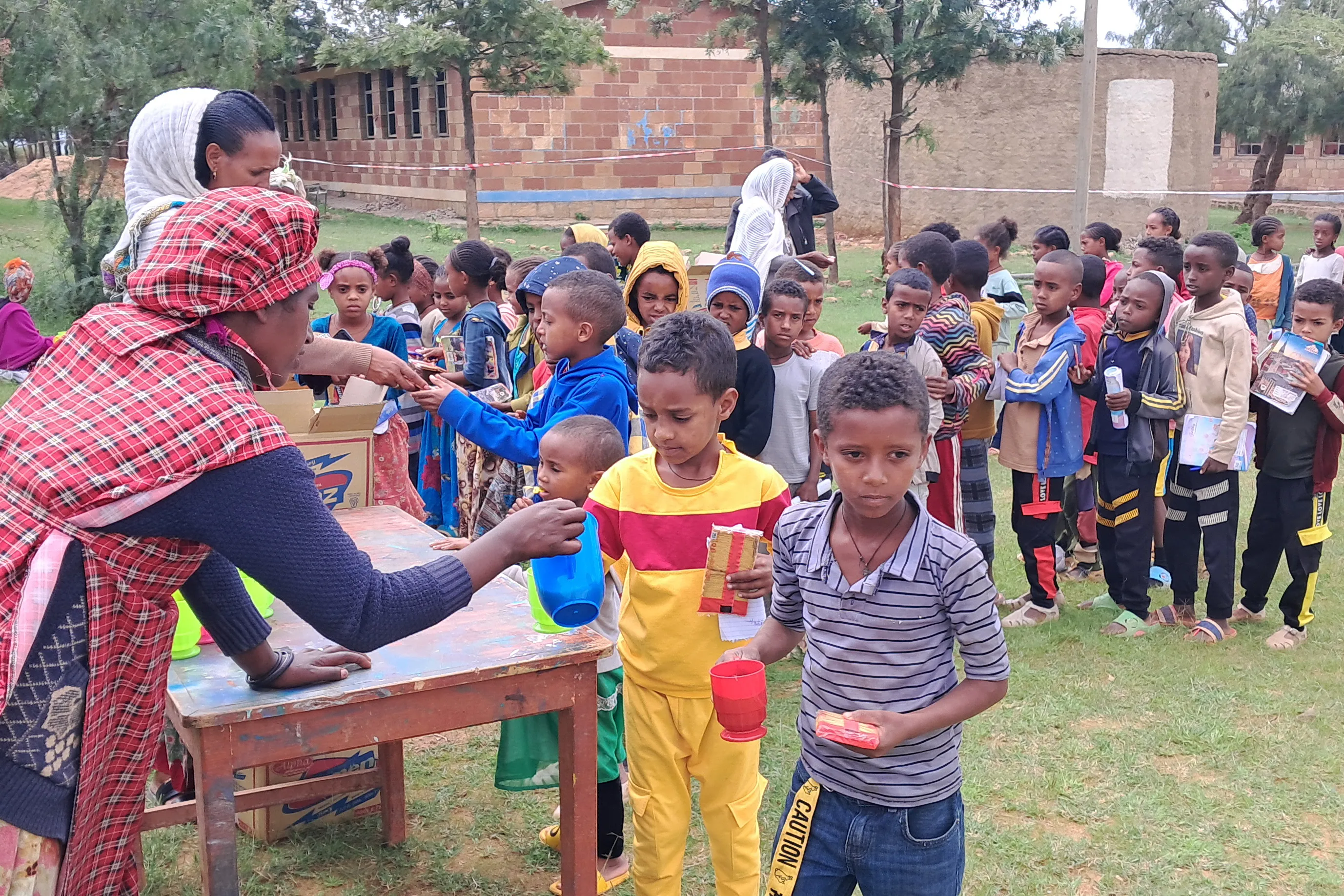
Schoolchildren in Tigray, Ethiopia, eat biscuits and tea provided by Mary’s Meals. / Copyright Mary’s Meals
St. Louis, Mo., Sep 3, 2023 / 05:00 am (CNA).
A Catholic charity providing thousands of free meals daily to schoolchildren in Tigray, northern Ethiopia, recently resumed operations after a brutal civil war precluded it from its mission for almost three years.
Since 2017, Mary’s Meals has worked with the Daughters of Charity in Tigray to bring food to schoolchildren there. Pre-2020 they fed an estimated 24,000 children a day, but the effects of the COVID-19 pandemic and the subsequent commencement of the country’s devastating civil war halted the program. Mary’s Meals had every intention of reopening in the fall of 2020 following COVID, but the start of the conflict precluded those plans.
“It was really heartbreaking to see that what we were expecting to be quite a joyous occasion in terms of the resumption of school feeding, children being welcomed back into schools and being able to return to what must have felt a bit more like normal life, suddenly being decimated by this terrible conflict,” Alex Keay, director of programs at Mary’s Meals International, told CNA.
Schoolchildren in Tigray, Ethiopia, eat biscuits and tea provided by Mary’s Meals. Copyright Mary’s Meals
Today, as of late August, Mary’s Meals is able to serve high-energy biscuits and hot tea to approximately 10,000 children in 14 schools. Over the next few months, the group says, its program and menu will be expanded as cooking facilities that were destroyed or looted in the fighting are replaced.
Keay called the resumption of the food distribution a “joyous occasion.”
“We’ve been able to restart school feeding just in the last couple of weeks. And more of those schools will be reopening and we will be able to get food to those schools, and we would like to be able to reach even more schools. We know the need is there,” Keay said, speaking from Mary’s Meals’ home country of Scotland.
“These school meals that we’re providing are a critical lifeline at this time, but also they are enabling the children to return to school after more than a three-year absence.”
A refugee camp in Tigray, Ethiopia. Copyright Mary’s Meals
Widespread starvation has been reported recently in Tigray, especially since U.N. and U.S. food aid has been disrupted in recent months due to revelations of corruption. Overall, more than 20 million people in Ethiopia rely on food assistance. A persistent drought has made food scarcity even worse. According to reports from the region, many mothers giving birth at local hospitals in Tigray have been unable to breastfeed due to their own hunger, and many malnourished children “near death” have been showing up at hospitals.
It is estimated that 600,000 people have died in the conflict and there are reports of ongoing violence in various parts of Tigray. Though Ethiopia is extremely diverse overall, the Tigray region is overwhelmingly Orthodox Christian, at about 96%.
Keay said Mary’s Meals is focused on providing nourishing meals for children in areas where access to education is limited. The logistics are challenging, and the on-the-ground help of the Daughters of Charity is vital, he said.
“They would sooner give away the food in their cupboard than have people come to their door hungry with nothing,” Keay said of the religious sisters.
“Our model is a low-cost model, but I think a very efficient model whereby the community is taking a strong ownership and a really strong part in making sure that those programs operate successfully,” he added. “So they’ll be the ones that manage the local preparation of the meals, they’ll organize the volunteer cooks to come every day to cook the food and to make sure that every child that comes to that school gets fed. And then our role is that we’ll provide the food, the training, the monitoring, and the support to those communities so that that food is in the right place at the right time and that the children will all be fed.”
Schoolchildren in Tigray, Ethiopia, eat biscuits and tea provided by Mary’s Meals. Copyright Mary’s Meals
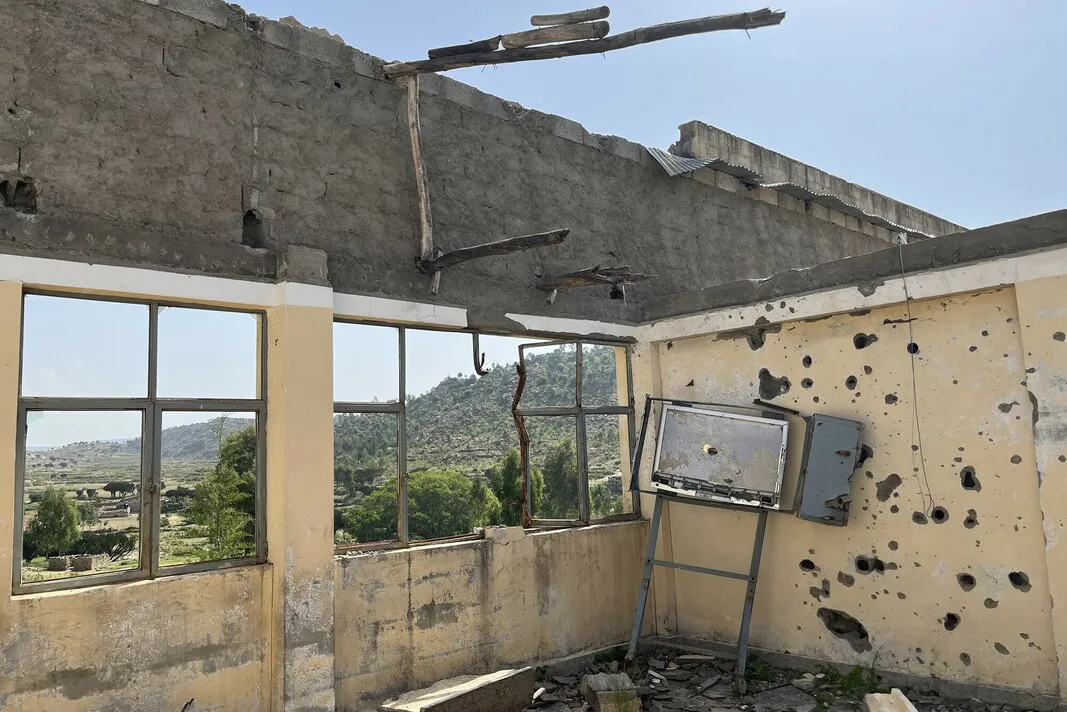
Schools provide a “beacon of hope” in an otherwise hope-starved country, and providing free meals at the schools helps to provide an incentive for students to get educated, he said. Major challenges remain, though, as many of the schools themselves have been shelled and looted amid the conflict.
“The children came with a lot of energy and a lot of passion for education, a lot of determination to really engage in their schools and to try and get the best from their education. And we certainly see that in terms of the … high attendance rates … once school feeding had started. That’s not uncommon for us to see that all of a sudden more children are encouraged to go to school,” Keay continued, drawing on his own experience visiting the country this year.
“The amazing thing is that the children were already coming back to those schools even though there was no furniture to sit on. Many of the teachers are still not back in their posts. A lot of the classrooms are actually damaged, the walls are damaged, or there’s holes in the ceiling. But the children are already coming back to those schools and are really, I guess, leading by example in their communities in terms of trying to get the schools back up and running.”
A destroyed school building in Tigray, Ethiopia. Copyright Mary’s Meals
The conflict in Tigray stemmed in part from the outsized role the Tigray People’s Liberation Front (TPLF), the primary political party representing the region, has played in recent decades in national politics in Ethiopia despite Tigrayans’ status as an ethnic minority. The political coalition that the TPLF led was dissolved in 2018 by Prime Minister Abiy Ahmed after he took office. The coalition’s ethnicity-based regional parties were merged into a single party, the Prosperity Party, which the TPLF refused to join. Tigrayan leaders have said they were unfairly targeted by political purges and allegations of corruption.
On Nov. 4, 2020, Abiy announced a military offensive in response to an alleged attack on a military base in Mekelle, the capital of Tigray. The conflict soon escalated into an all-out civil war in which mass atrocities have been reported. Eritrea, Ethiopia’s neighbor to the north and former adversary, joined the side of the Ethiopian government early in the conflict. Some have accused Abiy’s government of ethnic cleansing.
For much of the war, Tigray was under blockade by the Ethiopian government, which halted all humanitarian aid and forbade aid workers and media from entering the region. The Ethiopian government and the TPLF signed a peace deal brokered by the African Union (AU) in November 2022, bringing the war to an end on paper.
A damaged school building in Tigray, Ethiopia. Copyright Mary’s Meals
The needs in Tigray over the past few years have been largely overshadowed by other major world events, such as the war in Ukraine. Keay said it is important that people take notice of the “huge, devastating humanitarian situation” in Tigray.
“Tigray is a place that for the most part, people will be familiar with for probably quite negative reasons. There’s been terrible famines in that part of Africa, and a lot of those images, I think, have stuck in a lot of people’s minds. But it’s a very beautiful part of the world, with a real strong sense of identity and culture for the Tigrian people. They’re very distinctive in their culture, the way people dress. And there’s been a lot of work in that part of Ethiopia in recent years around development, and really a lot of progress has been made,” Keay said.
The brutal war, Keay said, has “really set back the development that’s been happening in Tigray.”
“From a state that was really blossoming and a lot of really positive things were happening in terms of sustainable food being grown for the communities … to a situation where the vast majority of Tigrayans are now dependent on food, hand out food aid to be able to survive. And it’s going to take a long time, I think, to repair that damage.”
Schoolchildren in Tigray, Ethiopia, eat biscuits and tea provided by Mary’s Meals. Copyright Mary’s Meals
The BBC reported earlier this month that at least 1,400 people have starved to death in Tigray since food assistance from the U.N.’s World Food Programme (WFP), the global humanitarian organization addressing food security, and the U.S. Agency for International Development (USAID) was suspended about four months ago. The suspension came about after it was revealed by Tigrayan authorities that nearly 500 people had been stealing the food, including government officials and nongovernmental organization staff.
Keay said that from an accountability standpoint, the Daughters of Charity have developed a very “transparent and accountable system that meant that the food was being put directly into [needy people’s] hands.”
“Other organizations were having to suspend their programs because of concerns about food not getting to those that it was intended to. But it was very clear when we were there and being on the ground, seeing the food being distributed, that it is really possible to be able to put the food directly into the hands of those that we’re trying to serve,” he noted.
Mary’s Meals now operates in 18 countries, after its founding in Malawi in 2002. Magnus MacFarlane-Barrow, a Catholic and founder and CEO of Mary’s Meals, was declared a “CNN Hero” in 2010 and has also been awarded the Order of the British Empire by Queen Elizabeth for his work. The organization says it feeds 2.4 million children every day throughout the 18 countries where it is present, with the largest share of those children in Malawi.
Pope Francis has repeatedly called for peace in Tigray. In 2021, after his weekly Angelus, the pope prayed a Hail Mary for the people of the Tigray region.
Washington D.C., Nov 28, 2018 / 04:40 pm (CNA/EWTN News).- Students for Life has urged U.S. President Donald Trump to defund Planned Parenthood, and encouraged pro-life advocates to ask the administration to do so.
Hey, you Florida bishops. I get that all life is precious.
But I would think you might want to say something every once in a while about the three thousand or so babies who are butchered and scalded and puréed every day of every week of every month of every year in this country.
As opposed to say, you know, a creep who raped an innocent little girl and then murdered both her and her mother.
Now, once all the babies are safe and sound, then, yes, say something about the vilely heinous murderers.
But, until then, I think you ought to speak up about this most horrific holocaust humanity has ever witnessed, abortion.
Unfortunately, usually all we get is crickets from most of you in the Catholic hierarchy.
Please go back and read your quotes about the value and dignity of all life, and then think about those thousands of little babies being killed by their mothers.
And then ask the Holy Spirit what He wants you to say.
One benefit of the death penalty is the stark choice of final conversation and this has been the advocacy of classical Catholic mor theology. I hope this soul, even at this late stage, sees that!!
“James pleaded guilty in 1995 to the killings of Betty Dick and her eight-year-old granddaughter Toni Neuner in Casselberry, Florida. He had strangled and raped Toni prior to her death before stabbing Betty Dick. He was ultimately apprehended in California.”
And why, bishops, would you assume here that the death penalty is not the necessary and appropriate consequence of this heinous crime? Why should criminals who murder children receive mercy?








Hey, you Florida bishops. I get that all life is precious.
But I would think you might want to say something every once in a while about the three thousand or so babies who are butchered and scalded and puréed every day of every week of every month of every year in this country.
As opposed to say, you know, a creep who raped an innocent little girl and then murdered both her and her mother.
Now, once all the babies are safe and sound, then, yes, say something about the vilely heinous murderers.
But, until then, I think you ought to speak up about this most horrific holocaust humanity has ever witnessed, abortion.
Unfortunately, usually all we get is crickets from most of you in the Catholic hierarchy.
Please go back and read your quotes about the value and dignity of all life, and then think about those thousands of little babies being killed by their mothers.
And then ask the Holy Spirit what He wants you to say.
One benefit of the death penalty is the stark choice of final conversation and this has been the advocacy of classical Catholic mor theology. I hope this soul, even at this late stage, sees that!!
“James pleaded guilty in 1995 to the killings of Betty Dick and her eight-year-old granddaughter Toni Neuner in Casselberry, Florida. He had strangled and raped Toni prior to her death before stabbing Betty Dick. He was ultimately apprehended in California.”
And why, bishops, would you assume here that the death penalty is not the necessary and appropriate consequence of this heinous crime? Why should criminals who murder children receive mercy?
I propose that instead of their telescopic sympathy, a Bishop gets to be a “celly” of this individual for a month or so.