Pope Francis meets with members of the Italian Union of Blind and Partially Sighted People on Jan. 3, 2025, in Clementine Hall at the Vatican. / Credit: Vatican Media
ACI Prensa Staff, Jan 3, 2025 / 15:20 pm (CNA).
Pope Francis on Friday welcomed a group of children and young people from the Italian Union of Blind and Partially Sighted People in the Vatican’s Clementine Hall, encouraging them to be pilgrims of hope during the 2025 Jubilee Year.
At the beginning of his Jan. 3 audience, the Holy Father encouraged those present to repeat the “Pilgrims of Hope” theme of the 2025 Jubilee, getting louder and louder each time until he was satisfied with their enthusiastic response and congratulated them with a “bravo!”
Pope Francis then encouraged them to be “people on the journey” who always have the desire to continue, “never stopping, never arriving, always with the desire to move forward.”
In his talk, the pontiff recalled that a pilgrim is more than a traveler, because he has a particular goal: “A holy place, which draws him, which motivates him, which sustains him in his fatigue.”
In the case of the ordinary Jubilee of 2025, he said, the goal is a Holy Door “that allows us to enter into new life, free from the slavery of sin, free to love and serve God and neighbor.”
The pilgrim is also distinguished from the traveller, the pope said, because he is eager “to encounter Jesus, to know him, to listen to his word, which gives meaning to life, which fills it with a distinct joy, a joy that does not remain ‘outside,’ on the surface, but fills the heart and warms it, a joy that is peace, goodness, tenderness.”
Pope Francis then proposed examples of saints who show that “only Jesus can give this joy,” citing Blessed Pier Giorgio Frassati, who is scheduled to be canonized this year; St. Francis and St. Clare of Assisi; and St. Thérèse of the Child Jesus.
The pontiff concluded by saying that pilgrims of hope are “children and young people who have encountered the Lord Jesus and have journeyed with him, and he is the hope for every man, for every woman, and also for the world.”
By following this path, Pope Francis added, “we too will become small signs of hope for those we meet.”
This story was first published by ACI Prensa, CNA’s Spanish-language news partner. It has been translated and adapted by CNA.
If you value the news and views Catholic World Report provides, please consider donating to support our efforts. Your contribution will help us continue to make CWR available to all readers worldwide for free, without a subscription. Thank you for your generosity!
Click here for more information on donating to CWR. Click here to sign up for our newsletter.
Vatican City, Oct 1, 2017 / 03:34 am (CNA/EWTN News).- On Sunday Pope Francis said that we can’t improve our political landscape by observing and judging from afar, but that it involves personal involvement, which should always be done in a spirit of charity and helpfulness.
“Try to act personally instead of just looking and criticizing the work of others from the balcony,” the Pope said Oct. 1.
But make your advice constructive, he continued. “If the politician is wrong, go tell him, there are so many ways to say, ‘But I think that would be better like so, like so…’ Through the press, the radio… But say it constructively.”
“And do not look out from the balcony, look at her from the balcony waiting for her to fail.”
Pope Francis spoke to people in the Italian town of Cesena during a day trip to Cesena and Bologna Oct. 1. In Cesena he met with citizens of the town and with priests, religious and lay people at the city’s cathedral.
In the 18th and 19th centuries, Cesena was the birthplace of Pope Pius VI and Pope Pius VII. Also in the 19th century Francesco Xaverio Castiglione (the future Pope Pius VIII) was bishop of Cesena, thus giving the city its nickname of the “city of the three popes.”
In Bologna the Pope’s schedule included meetings with migrants and refugees, clergy and religious, academics and students, and workers and the unemployed.
“The authentic face of politics and its reason for being,” Francis said, is “an invaluable service to the good of the whole community. And that is why the Church’s social doctrine regards it as a noble form of charity.”
In order to re-establish the independence and the ability of politics to serve the public good, he continued, we must “act in such a way as to diminish inequalities, to promote the welfare of families with concrete measures, to provide a solid framework of rights-duties – balance both – and make them effective for everyone.”
Therefore, the Pope said, from the centrality of the “piazza” – the square – goes out the message that it is “essential to work together for the common good.”
“I invite you to consider the nobility of political action in the name and favor of the people,” he said. In recent years, the true aim of politics has appeared to retreat in the face of aggression and financial power.
Thus, we must “rediscover the value” of this essential part of society and give our contribution – recognizing the need for political ideas to be held up to reality and reshaped as necessary.
We shouldn’t claim an impossible perfection from those in public life, he stated, but we should still “demand” from politicians “the coherence of commitment, preparation, moral rectitude, initiative, forbearance, patience and strength of spirit in addressing today’s challenges.”
This won’t fix everything quickly or easily, of course, he continued. “The magic wand doesn’t work in politics.” But if a politician does wrong: constructively tell them, he encouraged.
We all make mistakes, Francis said. And when we do, we should apologize, return to a right path and go on.
Concluding, he said that it is the right of everyone to have a voice in politics, but especially we should listen to “the young and the elderly.” To young people because they are the ones with the energy to do things, and to the elderly because they have the wisdom and authority of life.
The people expect from good politics the defense and “harmonious development” of their heritage and its best potential, he said.
“Let us pray to the Lord for the raising of good politicians who really care for society, the people and the good of the poor.”
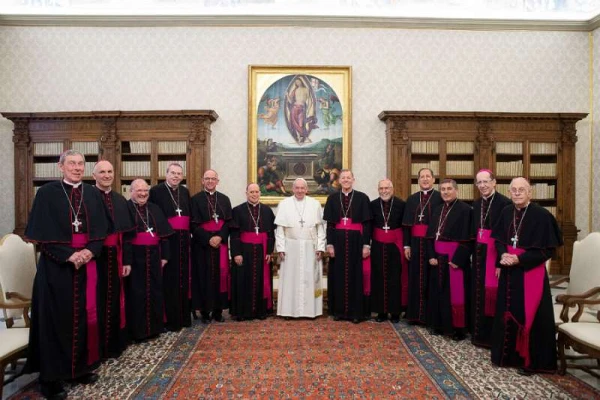
Vatican City, Feb 21, 2020 / 04:06 pm (CNA).- Archbishop John Wester of Santa Fe has offered his recollections of a meeting between Pope Francis and the American Southwest, especially as regards a discussion during the meeting of Fr. James Martin, SJ.
CNA reported Feb. 20 that Martin was discussed during a Feb. 10 meeting between the pope and bishops of the USCCB’s Region XIII, who were with the pope as part of their ad limina visit.
Martin, an American Jesuit, is well known for his writing and speaking on LGBT issues and the Church. His work has been a subject of controversy; it is criticized by some bishops and praised by others.
The Santa Fe archbishop, who was appointed to his post in 2015, is one of seven U.S. bishops to have endorsed “Building a Bridge,” Martin’s 2017 book on the Church and homosexuality.
“This courageous work is necessary reading for all who wish to build up the Christian community and to give witness to the Gospel message of inclusion,” Wester wrote of Martin’s book.
In his Feb. 21 commentary, the archbishop indicated that a broader discussion of Martin had taken place than was previously reported. Wester said bishops raised to the pope questions about a recent speech Martin delivered to the presidents of Catholic universities, “and his work in general with the LGBT community.”
The pope’s visit with Martin “was only mentioned in passing and was not the main point of the questions” bishops raised to the pope about Martin, Wester wrote.
The archbishop did not indicate what he saw as the “main point” of the bishops’ questions, nor did he indicate the response of Pope Francis to questions raised about the issues he mentioned.
While it would be “difficult for anyone to remember with precision anything that was said” in such a lengthy meeting, Wester said that he did not recall “the pope saying or implying that he was unhappy with Father Martin or his ministry.”
Regarding the pope’s visit with Martin, one bishop told CNA Feb. 20 that Pope Francis “made his displeasure clear” about the way the meeting was interpreted, and framed by some journalists.
Wester’s commentary confirmed that report. The archbishop added that from his viewpoint, “it was not Father Martin the Pope was talking about, but the way others tried to use that encounter, one way or the other.”
The Archbishop of Santa Fe did take issue with a bishop who told CNA that “the Holy Father’s disposition was very clear, he was most displeased about the whole subject of Fr. Martin and how their encounter had been used. He was very expressive, both his words and his face – his anger was very clear, he felt he’d been used.”
Speaking of that bishop’s description, Wester said “the language subtlety, yet incorrectly, leads the reader to believe that Father Martin was the issue while in fact, it was how others used their meeting that was in play.” Wester said he did not think the pope had been “angry, upset or annoyed.”
In his commentary, Wester disagreed with reports from other bishops that the pope said Martin had received some correction about the way the Sept. 30 visit was framed.
According to Wester, the pope did not say that Martin was given a correction.
“I vaguely remember some mention of people in leadership trying to clarify any misunderstandings about his ministry,” the archbishop wrote, but said he thought that reference had to do with an article written by Martin in America Magazine that, the archbishop said, “detailed the ways in which his ministry was not contrary to Church teaching but in keeping with the Church’s mission and Gospel mandate.”
Martin himself, after Wester’s commentary was published, tweeted that he has “never heard anything negative from Jesuit superiors, nor was I ever given a ‘talking to.’”
The archbishop said he could not recall other aspects of reports about the meeting.
“I believe that I have an obligation to offer my perspective on those matters contained in the CNA article about Father James Martin, SJ, since my understanding of the facts differs from what was reported anonymously,” Wester concluded.
The bishops who spoke with CNA reported that Martin’s work in regards to the LGBT community was also discussed with the heads of numerous Vatican congregations, and that some officials expressed concern about aspects of the priest’s work. Wester did not comment on those reports.
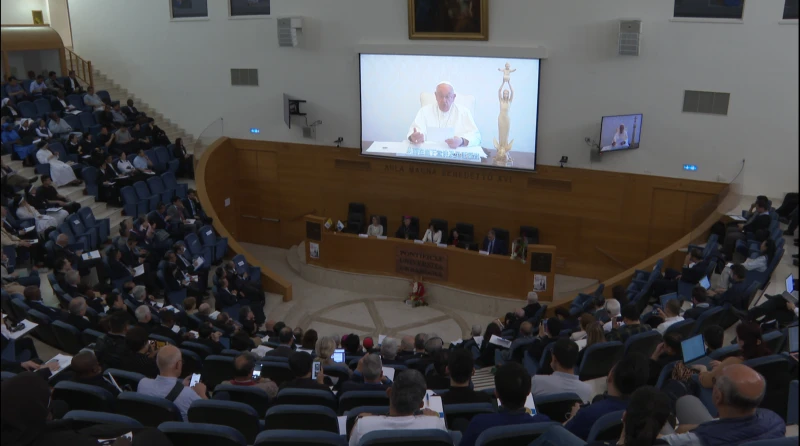
Pope Francis delivers a video message to the conference “100 Years Since the ‘Concilium Sinense’” at the Pontifical Urban University in Rome on Tuesday, May 21, 2024. / Credit: Fabio Gonnella/EWTN
Rome Newsroom, May 21, 2024 / 13:57 pm (CNA).
Pope Francis has praised the Catholic Church’s first council in China 100 years ago as “an authentic synodal journey” that opened the way for the Church in China “to increasingly have a Chinese face.”
In a video message to a conference in Rome on the Catholic Church in China, the pope noted that Chinese Catholics have endured “times of patience and trial” in the past century.
“The Lord in China has safeguarded the faith of the people of God along the way. And the faith of God’s people has been the compass that has shown the way throughout this time,” Pope Francis said in the May 21 address.
Pope Francis delivers a video message to the conference “100 Years Since the ‘Concilium Sinense’” at the Pontifical Urban University in Rome on Tuesday, May 21, 2024. Credit: Fabio Gonnella/EWTN
The pope pointed to a Church council that took place in Shanghai 25 years before the Chinese Communist Revolution as an example of a moment when “the communion between the Holy See and the Church in China manifested its fruits, fruits of good for all the Chinese people.”
The 1924 council, called the Primum Concilium Sinense, brought together 105 Catholic missionaries, bishops, and Chinese Catholics to establish a framework for a native Chinese hierarchy.
“The Fathers gathered in the Concilium Sinense lived an authentically synodal experience and made important decisions together,” Pope Francis said.
“Remembering the Council of Shanghai can also suggest today new paths to the entire Church and open paths to be undertaken with boldness to proclaim and bear witness to the Gospel in the present,” he added.
Among the crowd listening to the pope’s video message were representatives from the People’s Republic of China, including Bishop Shen Bin of Shanghai, who was unilaterally installed by Chinese authorities as bishop of Shanghai in April 2023 without a papal mandate, thereby breaking the terms of the Vatican-China deal. Pope Francis confirmed his appointment in July 2023.
The Holy See first entered into a provisional two-year agreement with Beijing on the appointment of bishops in 2018, which has since been renewed twice and is again up for renewal this fall.
Pope Francis opted not to speak of the Vatican’s diplomatic efforts with Beijing or religious freedom in China in his message but said that Chinese Catholics today “bear witness to their faith through works of mercy and charity, and in their witness they give a real contribution to the harmony of social coexistence.”
A large statue of Our Lady of Sheshan stood on the pope’s desk as he spoke. The pope noted that during the month of May many Chinese Catholics usually go on pilgrimage to the Marian Shrine of Sheshan, located near Shanghai.
“I too ideally climb the hill of Sheshan, and let us all together entrust to Mary, Help of Christians, our brothers and sisters in the faith who are in China, all the Chinese people, and all our poor world, asking for her intercession, so that peace may always win everywhere,” Pope Francis said.
Following the pope’s message, Shen Bin delivered a 15-minute speech in Chinese to the packed auditorium of the Pontifical Urban University on the Janiculum Hill overlooking St. Peter’s Basilica.
The Chinese bishop offered a different interpretation of the 1924 council from the pope in his speech, saying that “the Council of Shanghai did not lead to an immediate and radical change in the Church in China,” adding that by the 1949 Communist Revolution “only 29 of China’s 137 dioceses had Chinese bishops, and only three of 20 archbishops were Chinese.”
“The Catholic Church in China had not really freed itself from foreign powers to become a work led by Chinese Christians and had not yet managed to shed the label of ‘foreign religion,’” he said.
Shen Bin, who has held leadership positions in the Chinese Catholic Patriotic Association established by the Chinese Communist Party and under the control of the United Front Work Department, went on to defend Beijing’s religious freedom record and underlined the need for the Church in China to “follow a path of sinicization.”
“The policy of religious freedom implemented by the Chinese government has no interest in changing the Catholic faith but only hopes that the Catholic clergy and faithful will defend the interests of the Chinese people and free themselves from the control of foreign powers,” Shen Bin said in his speech.
“Today the Chinese people are carrying out the great rebirth of the Chinese nation in a global way with Chinese-style modernization, and the Catholic Church in China must move in the same direction, following a path of sinicization that is in line with Chinese society and culture today,” the Shanghai bishop added.
The conference, titled “100 Years Since the ‘Concilium Sinense’: Between History and the Present,” was held in Chinese and Italian in the Great Hall of the Pontifical Urban University. The Pastoral Commission for China and Agenzia Fides, the information service of the Pontifical Mission Societies, organized the conference, which featured Vatican Secretary of State Cardinal Pietro Parolin and Cardinal Luis Antonio Tagle as speakers.
Speaking to journalists on the sidelines of the conference, Parolin said the Holy See would like to increase and deepen its contacts in China.
“We have been hoping for a long time now to have a stable presence in China, even if initially it may not have the form of a papal representation of an apostolic nunciature,” Parolin said.






Leave a Reply