Archbishop Paul Gallagher, the Vatican secretary for relations with states. / Credit: Daniel Ibáñez/CNA
ACI Prensa Staff, Jun 7, 2024 / 11:47 am (CNA).
“More than 365 million Christians, approximately 1 in 7, face high levels of persecution for their faith,” Archbishop Paul Richard Gallagher, Vatican secretary for Relations with States and International Organizations, said at a conference on religious freedom held in Rome this week.
The conference, titled “Religious Freedom and Integral Human Development: A New Global Platform,” was jointly organized by the Sovereign Order of Malta, the Atlantic Council, and several universities, including the Pontifical Urban University of Rome and the University of Notre Dame.
In his speech, Gallagher said attacks on churches and Christian properties “increased significantly in 2023, with more Christians than ever before reporting violent attacks.”
The prelate went on to describe his concern that “according to some estimates, almost 4.9 billion people live in countries with serious or very serious violations of religious freedom.”
The Vatican diplomat underscored that religious freedom, “although not the only aspect of human rights, is probably the most fundamental,” adding that “the violation of the right to religious freedom has the effect of undermining not only one right but also the entire category of human rights,” he added.
“Religious freedom plays a decisive role in achieving integral human development,” Gallagher continued. For this reason, he added, “the state should exercise a detached neutrality and grant religious groups and all individuals an equal right to the public manifestation of their religious convictions.”
Gallagaher spoke as part of the conference’s opening panel analyzing the global crisis of religious freedom. The conference attracted participants from some 19 countries and included the participation of the Vatican’s secretary of state, Cardinal Pietro Parolin.
This story was first published by ACI Prensa, CNA’s Spanish-language news partner. It has been translated and adapted by CNA.
If you value the news and views Catholic World Report provides, please consider donating to support our efforts. Your contribution will help us continue to make CWR available to all readers worldwide for free, without a subscription. Thank you for your generosity!
Click here for more information on donating to CWR. Click here to sign up for our newsletter.
St. Peter’s Basilica / Simone Savoldi / Unsplash (CC0)
Rome Newsroom, Oct 2, 2022 / 03:00 am (CNA).
The world’s newest bishops gathered in Rome last month to learn more about what it means to be a Catholic bishop.
While the week’s presentations spanned a range of topics, three U.S. bishops who attended told CNA that synodality emerged as a key theme.
The Vatican’s annual formation course, sometimes known by the nickname “baby bishop school,” was canceled for two years because of the COVID-19 pandemic — making the 2022 edition the largest yet, with approximately 330 participating bishops across two sessions.
“People kind of picture baby bishop school as nuts and bolts, like ‘how to be a bishop.’ It’s not that at all,” Bishop Erik Pohlmeier of the Diocese of St. Augustine, Florida, told CNA at the end of the course.
“It’s kind of whatever the Church is talking about at that time, bringing that to the bishops that are coming on board,” he said. “The synodal process has been … a hallmark of conversation for the last couple of years, so now as we’re new bishops … the reflections revolved around that.”
The seminar’s first session was primarily attended by bishops consecrated in 2019 and 2020, while the second session was mostly those who joined the ranks in 2021 and the first part of 2022.
Thirty-nine U.S. bishops and auxiliary bishops attended, divided between the two weeks.
Pohlmeier was the freshest U.S. bishop to join. He was ordained a bishop on July 22 — just two days after his 51st birthday and seven weeks before arriving in Rome for the Sept. 12–19 course.
Speaking to CNA in Rome on Sept. 19, Pohlmeier said that as a new bishop, there are many things you do not know, but that’s where one’s fellow bishops come in.
“Every bishop knows other bishops,” he explained, like the bishop of the diocese where they served as a priest. “And they’re always, I mean to a person, helpful.”
Bishop Gregory Gordon, the first-ever auxiliary bishop of Las Vegas, Nevada, told CNA on Sept. 19 that the U.S. bishops’ conference also organizes meetings between bishops of the same ordination year, or “class,” as a way to build fraternity and create a network of support.
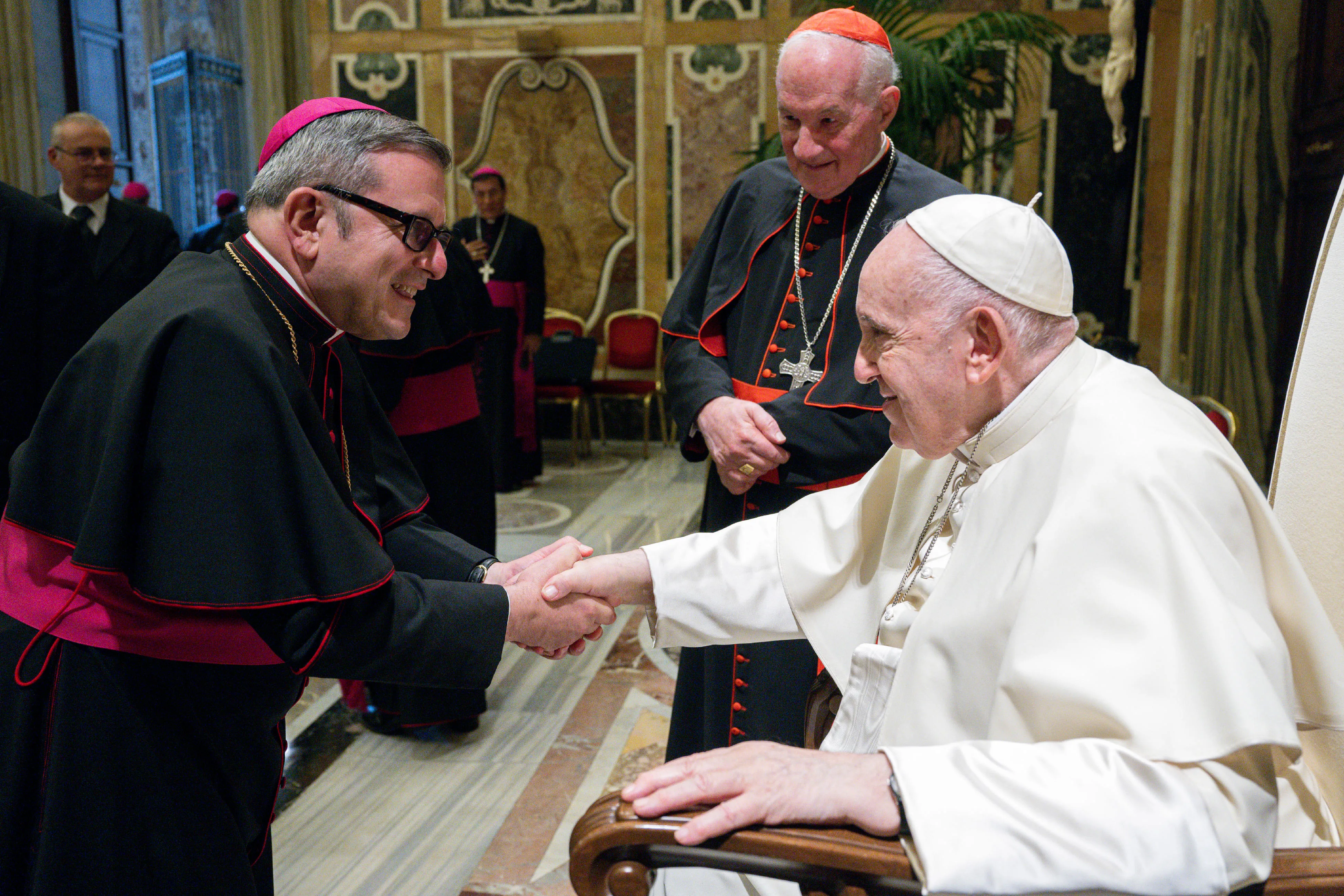
Bishop Gregory Gordon greets Pope Francis at the end of the course Sept. 19, 2022. Vatican Media
While the formal theme of this year’s seminar was how to announce the Gospel in changing times, Pohlmeier, Gordon, and Bishop Louis Tylka of Peoria, Illinois, said the unofficial topic of the week was synodality.
What they talked about
“We’re in the midst of the synod,” Tylka, who attended the seminar Sept. 1–8, told CNA by phone from his diocese. So the course, he added, focused on questions such as: “What does it mean to be a synodal Church? What is the ministry of the bishop in relation to that?”
Care for the planet and one’s neighbor, themes important to Pope Francis’ pontificate, were also a major part of the seminar, Tylka said.
The week’s presentations also covered child protection and the sexual abuse crisis.
“That’s one of those things that I think we will take home, saying we will be very, very careful not to neglect,” Gordon said.
Some talks, Pohlmeier noted, were directly about synodality and what it means. At the same time, those of a more practical nature, such as canon law for bishops, “would always include some comment on the synodal approach.”
“You’re going to get different articulations of what that means depending on who you talk to, but in general, my understanding is that it is more of a listening posture,” the St. Augustine bishop said.
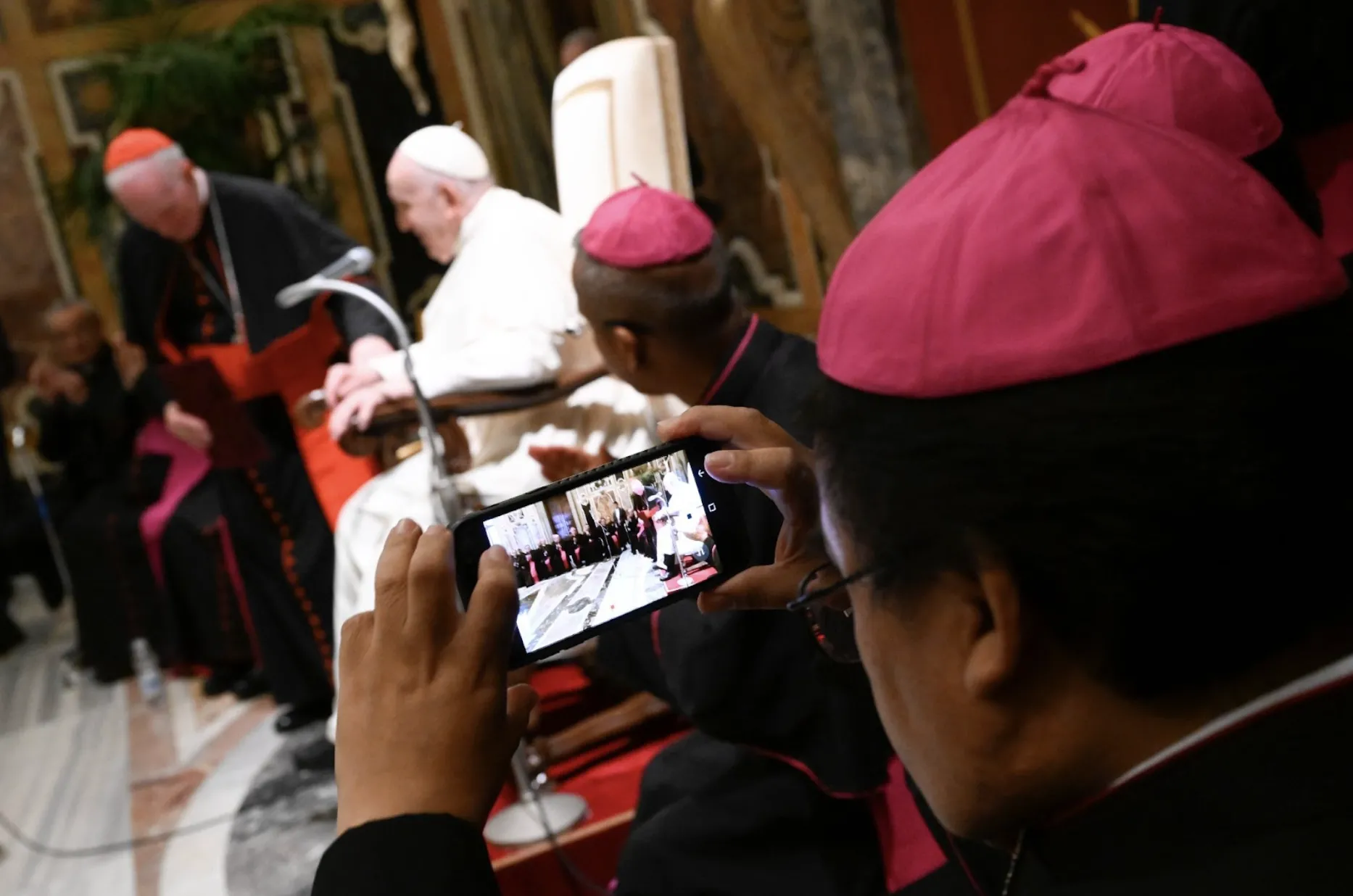
A bishop takes a photo of Pope Francis during their encounter on Sept. 19, 2022. Vatican Media
Bishop Gordon said Pope Francis himself modeled this listening attitude in their meeting with him on the final day of formation.
In the nearly two-hour meeting, he said most of the time was spent with the pope answering the bishops’ questions. “So you finished the course, [the pope] said. You’ve heard a lot already… Now I want to hear from you.”
This was Gordon’s big takeaway from the week: “It has to go back to the Holy Father’s words to us as he was answering our own questions, you know, asking us to exercise that episcopal closeness.”
The week also included time for communal prayer, Mass, adoration, and confession.
Bishop Tylka of Peoria said his personal opinion is that “a big part of synodality is the willingness and openness to create space for people to share their stories, to share their own encounters with Christ, to share their own experiences of how life is going.”
“So I think the role of the bishop clearly is to model that openness and that willingness to engage in dialogue,” he said.
This was my small group for discussion on Synodality! What an amazing group of bishops from around the world. Such a rich discussion on the Church! pic.twitter.com/fIOPLXwnfo
But there is also a lighter side to being a new bishop, as Pohlmeier evidenced with an amusing scene from the end of the week.
“Here we are, brand new and so … we got instructions on what we’re supposed to wear to meet the pope,” Pohlmeier said.
He explained that bishops in the Latin Church have two main styles of a full-length garment called a cassock. The new bishops were told to meet the pope. They should wear a black cassock with red trim, a purple fascia, and a purple zucchetto. (There is also a purple cassock with red trim for special liturgical events.)
Pohlmeier said it was funny to watch the bishops get ready for Mass in St. Peter’s Basilica and, afterward, the meeting with Pope Francis. Many of them were helping each other figure out where each piece of the complicated attire went — including the tall headpiece, called a mitre, which bishops wear to denote their office.
Today I joined the celebration in St Peter’s for the beatification of Blessed John Paul I. The rain did not dampen the joy of lifting up the ‘Smiling Pope.’ Humbled to be with the universal Church for such a celebration. pic.twitter.com/08AtzMUlMd
“Guys are literally opening up bags that haven’t been opened with miters from right there, from Euroclero,” Pohlmeier said, pointing over his shoulder in the direction of a clerical supply store next to St. Peter’s Square.
“You could see everybody that bought one this morning because they all matched,” he chuckled. “There were several people that were literally opening it up and pulling it out of the package and trying to get it on straight, and get things attached right, and not sure what clips go where and what’s right.”
“Those kinds of things are funny,” Pohlmeier said, “but nobody just tells you, ‘OK, buy this stuff, here’s what you need.’”
Msgr. Thomas Powers. / Screenshot from Bridgeport Diocese YouTube channel.
Rome, Italy, Mar 30, 2022 / 05:53 am (CNA).
The Vatican has appointed Connecticut priest Msgr. Thomas W. Powers as the next rector of the Pontifical North American Colle… […]
Davos-Klosters, Switzerland, Jan 21, 2020 / 04:56 am (CNA).- In a message to the global delegates of the 2020 World Economic Forum, Pope Francis stressed the duty of governments and businesses to place the good of the human person above power or profit… […]




Leave a Reply