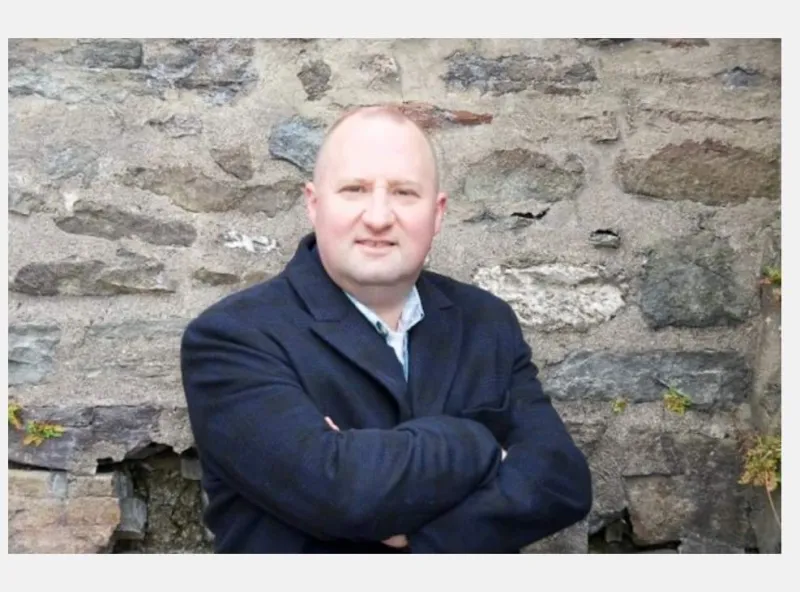
 Aaron Oliver thinks it’s possible to be pro-life and a loyal Democrat. But party leaders want him to resign. / Courtesy of Aaron Oliver
Washington, D.C. Newsroom, Jan 2, 2022 / 07:30 am (CNA).
His fellow Democrats call him a traitor (and worse) and the leaders of his party have pressured him to resign.
What has Aaron “A.J.” Oliver, the Democratic municipal chairman in his New Jersey hometown, done to deserve such scorn?
He’s pro-life.
Never mind that House Speaker Nancy Pelosi, U.S. Sen. Amy Klobuchar, and other prominent Democratic leaders have professed tolerance for pro-life Democrats.
Or that Oliver, an Episcopal priest and New Jersey Army National Guard chaplain, says he’s a faithful Democrat soldier in every other respect.
“I’m a loyal Democrat, a lifetime Democrat,” he told CNA. “Many of us think that there’s not an inconsistency with being pro-life and a Democrat. We think the party should be the open tent that it claims to be.”
The flaps of the tent appear to be drawn tight in New Jersey when it comes to abortion, however, Oliver has found, even though Pelosi and other Democratic leaders insist there’s no litmus test on abortion. Pelosi famously cited her own “devout Catholic family” in 2017 as the reason for her openness to Democrats who don’t share her staunch support of abortion rights.
“Most of those people — my family, extended family — are not pro-choice,” she said. “You think I’m kicking them out of the Democratic Party?”
Democratic leaders in the Garden State have taken a different approach with Oliver.
A party ‘betrayal’?
The 41-year-old Morristown resident was elected to a two-year term in June as chairman of the New Jersey suburb’s municipal Democratic committee, an unpaid position. The committee’s chief role is to recruit and support strong Democratic candidates, Oliver said.
Until very recently, party leaders saw Oliver as that kind of candidate, having initially supported his run in 2021 for the Morris County Board of Commissioners, a GOP stronghold for many years.
His ultimately unsuccessful bid ran into trouble after a video surfaced of him at an event sponsored by Democrats for Life of America (DFLA), an organization that opposes abortion and promotes pro-life Democratic candidates. A public interest group called NJ11th for Change swiftly retracted its endorsement less than a week before the Nov. 2 election.
“Given the revelation that Oliver’s position is far removed from what most of us would consider ‘pro-woman’ or ‘feminist,’ we feel strongly that continuing to endorse this candidate would be a betrayal of our members’ values, which are and have always been overwhelmingly pro-choice,” the group’s co-executive directors said at the time.
In December, the Morris County Democratic Committee called on Oliver to resign his municipal post. The county organization said it was its “duty to choose representatives and party leaders who will support, protect and expand equitable and quality access to reproductive rights in New Jersey and help make that a reality for every American.” More recently, the committee Oliver chairs issued a “no confidence” vote against him.
But Oliver is standing firm. He says party leaders were aware of his pro-life views prior to his run for commission and still thought he’d be good candidate, “especially since the county government doesn’t vote on legislation involving abortion,” he added. Yet know they want him out as Morristown chairman.
“I don’t think that’s a sufficient reason to resign, I really don’t,” he said.
“And to be honest with you, many of us are sick and tired of being bullied and marginalized for a matter of conscience like this, for defending a consistent life ethic … and we don’t want to take it anymore.”
Embracing a ‘Whole Life’ approach
Oliver’s story illustrates not only the hardened abortion stance of the Democratic Party but also the diversity of the pro-life movement.
Oliver, who is gay and a staunch Democrat, witnessed that heterogeneity himself when he attended a Democrats for Life rally outside the U.S. Supreme Court on Dec. 1 during oral arguments in the Dobbs v. Jackson Women’s Health Organization abortion case. Among those advocating for the unborn that day were secularists, atheists, feminists, and members of the LGBTQ community.
“It’s not just religious people that are pro-life,” Oliver said. “I think that the pro-life movement is growing. It’s diverse in a lot of ways, I mean ethnically, politically, as far as age, religion. I was happy to see that.”
Nor is the pro-life movement strictly focused on abortion, he added. Democrats for Life’s own “Whole Life” philosophy embraces a range of issues, he noted.
“We talk about issues like euthanasia, and capital punishment, and protecting women — providing real choice for them when it comes to pregnancy support (and) reducing the maternity mortality rate,” he said. “And our (DFLA) movement is actually led by women, so the false dichotomy, (that) it’s a men versus women thing, I think is kind of a false narrative.”
Extreme NJ bill a ‘turning point’
Faith and service have been running themes in Oliver’s life.
Raised in a Methodist family, he says his brother and several other relatives served in the military. In the wake of the 9/11 attacks, he enlisted in the New Jersey Army National Guard in 2003, joining an infantry unit. Meanwhile, his spiritual journey led him to join the Orthodox Church, and after discerning a vocation, he became an Orthodox priest and a U.S. Army chaplain.
The journey wasn’t over. He left the Orthodox Church and was accepted as an Episcopal priest in 2012. A couple of years later he went on active duty with the Army for five years, spending some of that time overseas. He rejoined the National Guard as a chaplain and captain in 2020.
He says his pro-life position evolved over time.
“I certainly haven’t reached this point overnight,” Oliver told CNA. “I’ve always had pro-life inklings … I’ve always wanted to look out for the vulnerable and the marginalized. And I started to see unborn children as being vulnerable and marginalized, and I started asking more questions, like, ‘Why aren’t we standing up for them and supporting them?’”
Those questions ultimately led him to Democrats for Life of America, which states on its website that “every human being is worthy of dignity and respect, from fertilization to natural death.”
But Oliver says the real turning point for him politically was Democratic Gov. Phil Murphy’s effort to pass the New Jersey Reproductive Freedom Act.
Crafted as a hedge against the possible decision in the Dobbs case that would overturn the Supreme Court’s 1973 Roe v. Wade decision that legalized abortion nationwide, the legislation would codify an unrestricted right to abortion up to the moment of birth, while removing the state’s longstanding conscience protection for medical professionals who object to abortion.
Additionally, the act authorizes non-physicians to perform certain abortions, and requires insurers to cover abortions with no out-of-pocked costs. It also mandates an annual allocation of state taxpayer funds to Planned Parenthood.
“Those provisions terrified me, honestly,” Oliver said. “I started talking to DFLA and we started a movement to protest it, which I think was pretty effective.” After enough Democrats were persuaded the legislation was too extreme, the legislation stalled in the state’s legislature last year, though Murphy, a Catholic, is pushing to get it passed in 2022.
Oliver said the extreme nature of the legislation “galvanized” his thinking on the abortion issue.
“At first I was kind of afraid to talk about it, because I don’t want to be accused of being anti-woman or not being sensitive to people who have to make that difficult decision,” he said. “But then I realized that … this is the civil rights issue of our time.”
Oliver says some of his fellow Democrats have privately told them that they share his pro-life views, but they’re too afraid to buck the party. At the same time, Oliver says it disturbs him to hear some abortion rights proponents talk about the issue in a way that “goes beyond pro-choice to pro-abortion” and equates abortion with routine health care.
“I’m even starting to hear people say, ‘Yes, the fetus is a (human) life, but abortion is still OK,’” he said.
Oliver and the DFLA have their work cut out for them staving off the abortion legislation in New Jersey indefinitely. In addition to pressing for the act to be passed, Murphy found a way around the legislature when political appointees sitting on the New Jersey Board of Medical Examiners agreed to allow nurses and midwives to perform first-trimester abortions, effective Dec. 6.
Kristen Day, DFLA’s executive director, calls Oliver a role model for pro-life Democrats, in the tradition of former Illinois congressman Dan Lipinski.
“I just have such respect for him, because when they went after him before, right before the election, he took the high road. He never called anybody names, he never got angry. He just laid out his case why he would be a good candidate, and all the things that he has done to support Democrats in New Jersey,” Day said of Oliver.
“So I think what they’re doing to him now is just really terrible. I mean, the names they’re calling him, the emails that they’re sending. It’s just not what the Democratic Party, (which) prides itself on diversity and inclusion, should be doing to someone who really cares about the party and wants to elect Democrats and who cares about feeding the poor, cares about … affordable health care and child care. I mean, he’s fighting for all of that. In addition, he wants to support pregnant moms and the right to parent,” Day said.
“New Jersey’s abortion numbers are an embarrassment,” Day added, referring to data from the Guttmacher Institute that place the state’s abortion rate among the highest in the U.S. “We should be doing more as a party to lower the abortion rate in New Jersey and provide women with real choice. And because he’s doing that, they’re trying to kick him out of the party.”
Oliver, who spent six weeks guarding the U.S. Capitol with his National Guard unit after the civil unrest on Jan. 6, isn’t sure what’s next for him, politically. Asked if he is considering switching to the Republican Party, Oliver said he would prefer to remain a Democrat, though his party isn’t making it easy for him.
In the meantime, he says his faith is helping him weather the adversity he faces now.
“My faith tells me that life begins at conception,” Oliver said. “So my Christian beliefs certainly inform my position on the issue. But they also allow me to hold firm on it, as well.
“They allow me to still advocate for life, even amidst all the criticism, and even hatred,” he said.
[…]



I wonder when we’ll be given any information on the assailant. That nothing has been revealed yet indicates that he is probably one of those fellows who came to Ireland “searching for a better life” and so beloved by Francis and the bishops.
I read that the attacker was an Algerian immigrant. This could be a terrorist attack, but too soon to know.
Ireland and other Western Nations need to do a better job screening immigrants. We don’t need terrorists. We may need to be more aggressive in screening and tougher in criteria of denying entry.
In the case in Dublin, both the attacker and the man who stopped the attack were immigrants.
Who stabbed the children? Who were the rioters fighting? Why the lack of information?
Do modern Catholic bishops ever have any other reaction than “distress?” (Laxatives are generally good for that). How about outrage at attacks on innocent victims? Or is that too strong an emotion for largely emasculated men?
The archbishop needs to get over his “utter disbelief” and clue in to what’s going on on his patch.
The verdict that the protesters are far-right ideologues is just a little suspect in its haste.