Teddy Howell, a Michigan third grader, dressed as a priest. / Stephani and Sean Howell
St. Louis, Mo., May 6, 2023 / 04:00 am (CNA).
When “The Bible in a Year” podcast hosted by Father Mike Schmitz shot to the top of the charts at the start of 2021, it inspired millions of people to dive more deeply into the Bible. One Michigan third grader was not content to merely listen, though — he wants to be a podcasting priest like Schmitz when he grows up. And he’s well on his way to making that dream a reality.
Teddy Howell, 9, is the creator — with the help of his parents, Stephani and Sean — of the “Kid’s Bible in a Year with Teddy” podcast, which launched on March 12. In each episode, released Sundays and Wednesdays, Teddy leads a prayer and then reads a passage from the Great Adventure Kids Catholic Bible Chronicles, a book from publisher Ascension that provides 70 Bible stories arranged in the same timeline order that the “Bible in a Year” podcast uses.
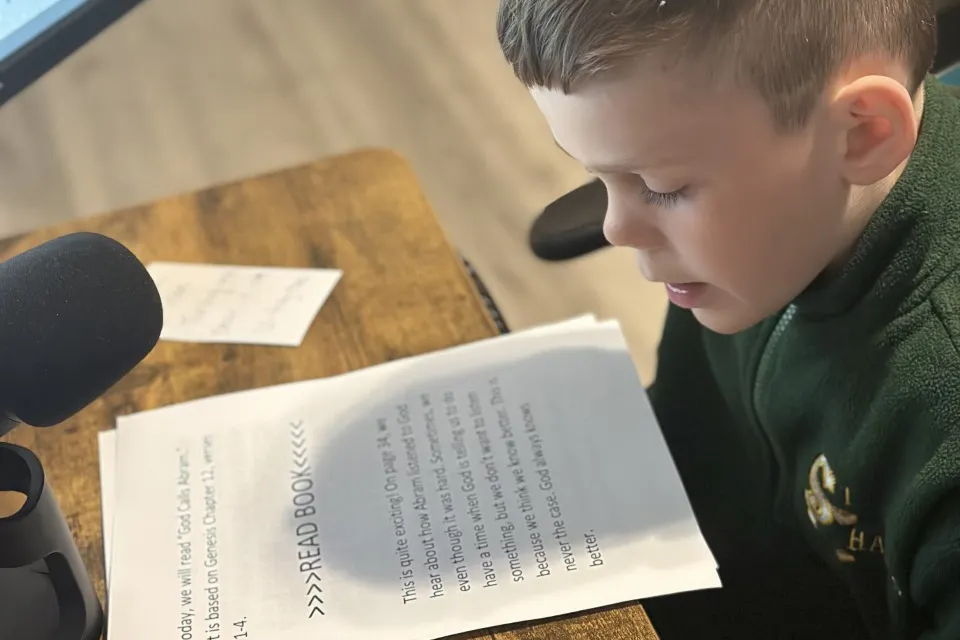
Teddy Howell recording an episode of the “Kid’s Bible in a Year with Teddy.” Stephani and Sean Howell
Teddy’s mom Stephani said her son, the oldest of six siblings, already loves learning about and sharing his Catholic faith with others. She said he often stays up at night reading the Bible under the covers with a headlamp and recently started serving at the altar at the family’s parish in southeast Michigan.
“He’s always had a love for the Church and the priesthood. Kind of of his own accord, he decided he wanted to go to daily Mass over the summer,” she said.
When asked directly what he wants to be when he grows up, Teddy didn’t hesitate — he wants to be a priest. He said his favorite part of the Mass is the Liturgy of Eucharist, though given his love for the Bible, the Liturgy of the Word also touches him deeply. He said his favorite parts of the Bible are the Gospel passages about the crucifixion and resurrection of Jesus.
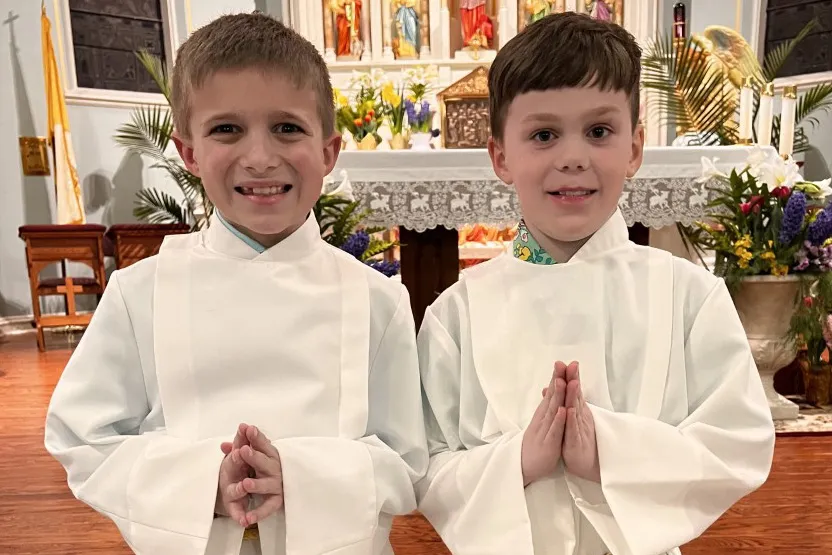
Teddy Howell, right, and a friend serving at the altar at their local parish. Stephani and Sean Howell
Teddy’s podcasting ambitions were sparked almost wholly by the example of Schmitz, the popular Minnesota priest who, in his podcast, reads through the entire Bible in 365 daily episodes, plus a prayer and reflection. Teddy’s parents would often put on “The Bible in a Year” for the family in the car, but turned it off if Schmitz issued any warnings about material unsuitable for children, as he occasionally does throughout the series. The interruptions perturbed Teddy, who craved a Bible podcast he could listen to in its entirety.
It was this desire, along with the prayers offered by Schmitz at the end of each “Bible in a Year” episode, that really inspired Teddy to want to create his own podcast.
He told his parents he wanted to give it a try, reading the Kids Catholic Bible Chronicles aloud. Stephani contacted the publisher of the book, Ascension, to see if they’d be willing to allow him to read the words from the book on-air. Ascension agreed (although Teddy always reads a disclaimer noting that Ascension doesn’t endorse or review the episodes).
Teddy begins each episode with a self-written prayer, then reads a passage from the book related to a Bible story, and then offers a reflection. He writes the scripts himself on his parents’ computer and then does the recording, editing, and posting of the episodes with their help. Teddy uses a microphone attached to his parents’ computer to get the job done.
The technical aspects of creating the podcast have been a learning experience for Teddy’s parents as well. Sean said he asked around among his friends about how to start a podcast, and his friends recommended the online platform Anchor, which allows listeners to subscribe and listen on just about any podcast app.
As of early May, Teddy has posted a dozen episodes, with no plans to slow down. His podcast has already garnered several thousand listens across several countries, with a growing number of five-star ratings. Ascension has even taken notice, sharing episodes from Teddy’s podcast on social media.
Beyond being a great learning experience for the budding young priest, Teddy has genuine hopes that his podcast will touch people’s lives.
“Hopefully a lot more people who are not Christian will become Christian by the end of this year by listening to my podcast,” he said.
If you value the news and views Catholic World Report provides, please consider donating to support our efforts. Your contribution will help us continue to make CWR available to all readers worldwide for free, without a subscription. Thank you for your generosity!
Click here for more information on donating to CWR. Click here to sign up for our newsletter.
Nativity School of Worcester, a Jesuit middle school in the diocese of Worcester is risking its Catholic status by refusing to remove a gay pride flag and a Black Lives Matter flag from its flag pole, per the request of the local ordinary, Bisho… […]
Last year, the Holy See appointed Father Valle as executor ad omnia of the Diocese of Estelí, allowing him to carry out all ordinary functions of pastoral governance, except those reserved to a bishop. / Credit: Diocese of Estelí, Nicaragua
A Chase bank building in Wilmington, Delaware. / Credit: Harrison Keely, CC BY 4.0, via Wikimedia Commons
CNA Staff, Mar 25, 2025 / 06:00 am (CNA).
Legislators in several states are moving to address the practice of “debanking” as part of an effort to stop what some critics say are anti-conservative measures employed by major U.S. financial institutions.
The Cambridge Dictionary defines debanking as “the act by a bank of closing someone’s account because they are regarded as a risk legally, financially, or to the bank’s reputation.” Critics have claimed that the practice is used by banks to antagonize certain groups, including conservatives and other political activists.
For example, the Trump Organization filed a lawsuit earlier this month against one of the largest banks in the United States. President Donald Trump claims he was a victim of debanking after Capital One allegedly closed hundreds of his organization’s accounts soon after his supporters’ Jan. 6, 2021, storming of the U.S. Capitol.
In her recently-released memoir, Melania Trump alleged that she and her son, Barron, were also debanked.
The Ruth Institute, a global coalition designed to equip Christians to defend the family, alleged it was debanked in 2017. Just two years ago, a Memphis-based Christian charity called the Indigenous Advance Ministries also claimed that it had been debanked by Bank of America.
In another high-profile case, in 2022 former U.S. senator and ambassador Sam Brownback announced that his nonprofit group the National Committee for Religious Freedom had been debanked.
Ambassador Sam Brownback speaks on Feb. 6, 2018. Credit: Jonah McKeown/ CNA
Over the past decade, other high-ranking individuals and grassroots organizations have reportedly faced debanking, including Nigel Farage, who led the Brexit effort in the United Kingdom; evangelist and motivational speaker Nick Vujicic; Moms for Liberty, a parental rights advocacy group; Christian author and preacher Lance Wallnau; and Timothy Two Project International, a Christian ministry.
U.S. bishops ‘monitoring’ debanking; legislators move to address
While it’s unclear to what extent debanking has affected U.S. Catholics, the U.S. Conference of Catholic Bishops acknowledged the phenomenon in its 2025 religious liberty report.
“In recent years, individuals have raised concerns that banks are discriminating on the basis of political and religious viewpoints,” the report read.
“In response to incidents like these, some states have begun passing laws intended to prevent politically motivated debanking,” the bishops noted. “However, the U.S. government argues that these laws hamstring banks, who need to be able to account for potential customers’ exposure to foreign actors. The lack of transparency, though, makes it difficult to ascertain why someone like Ambassador Brownback would be debanked.”
According to the report, the USCCB is “monitoring this issue but has not taken a position on it.”
Taking action against debanking
Some lawmakers are moving to address the controversy via legislation.
An anti-debanking bill in Idaho was sent to the state governor for signature last week.
The Transparency in Financial Services Act would prohibit “large financial institutions from discriminating against customers based on their political or religious views” and would give customers the right to request the reason for denial from an institution.
Montana’s Republican-sponsored Equality in Financial Services Act and South Carolina’s anti-debanking bill — similar to Idaho’s bill — have made some progress in the state Legislature, while Georgia’s Freedom of Speech and Belief Act failed to pass at the beginning of March.
Some see changes in bank policy, or even legal changes, as potential solutions to debanking.
Alliance Defending Freedom (ADF) — a legal group committed to protecting religious freedom and freedom of speech — worked with Indigenous Advance Ministries to file a consumer complaint following its alleged debanking in 2022.
“No American should ever fear losing access to their bank account due to their religious or political beliefs,” Lathan Watts, ADF’s vice president of public affairs, told CNA.
In its 2023 Viewpoint Diversity Score Index, ADF found that 7 out of 10 of the largest commercial banks — including Chase — have “hate speech” or “reputational risk” policies that contribute to debanking.
JPMorgan Chase, a top American bank, recently adjusted its policy, agreeing to protect clients against political and religious debanking in its code of conduct after 19 attorneys general petitioned the bank to cease its debanking practices in 2023.
“Chase’s policy change is a significant step by our nation’s largest bank to uphold financial access for all Americans,” Watts said. “This change provides necessary protections for customers like Ambassador Brownback, whose account at the National Committee for Religious Freedom was unexpectedly canceled in 2022.”
Watts shared his hope that other banks will take similar measures.
“Alliance Defending Freedom actively engaged with Chase in these negotiations, and we are hopeful that other banks will follow suit in safeguarding fundamental financial freedoms,” Watts said.
Jennifer Roback Morse, the founder and president of the Ruth Institute — an organization dedicated to combating the effects of the sexual revolution — recalled her own experience allegedly being debanked.
“In 2017, the Ruth Institute was one of the first organizations to be attacked in the banking arena,” Morse told CNA. “In our case, our credit card processor cut us off with no notification, or explanation, except to say that we ‘violated its standards.’”
Ruth Institute President Jennifer Roback Morse speaks on “The World Over with Raymond Arroyo” on June 13, 2019. Credit: “The World Over with Raymond Arroyo/EWTN News screenshot
While there was no clear explanation, Morse believes it was due to a leftist law center labeling the organization as a hate group.
“We surmised this was because we were listed on the Southern Poverty Law Center’s ‘Hate Map’ for our opposition to the redefinition of marriage and other LGBT-issues,” Morse said. “Thankfully, we were able to secure another credit card processor fairly quickly.”
Morse told CNA that banking “is a highly regulated, semi-monopolistic industry, comparable in some respects to public utilities such as electricity and water.”
“I am in favor of banks being legally required to be transparent and even-handed in their standards,” she said.
“Alternatively, if banks are permitted to engage in viewpoint discrimination,” she argued, “I would urge that bakers, florists, therapists, and other professionals also be permitted to refuse service to potential customers for any reason they choose.”
“A disappointed customer can find an alternative photographer a lot easier than they can find an alternative bank,” Morse noted. “And it is a lot easier to participate in the business world without a photographer or florist than to survive without banking services.”
‘A balanced approach’
While conservative legislators are pushing these anti-debanking bills, support for this legislation is not entirely united within the conservative movement.
A recent poll found that while a majority of conservatives are concerned about debanking, nearly three-quarters of conservatives expressed support for banks having the right to choose their own clients.
The poll by the Tyson Group found that conservatives “do not support broad government intervention that prevents financial institutions from making risk-based assessments when determining their customers.”
“When informed that legislation could force businesses to provide services to customers at odds with their values and the conservative movement, many expressed hesitations,” the study noted.
“As conservatives push for greater accountability from regulators, they also seek a balanced approach to debanking that avoids unintended consequences and protects the rights of both consumers and businesses.”
Some opponents of anti-debanking laws maintain that restrictions against debanking could have unintended consequences.
In South Carolina, for example, an anti-debanking bill under consideration, the Equality in Financial Services Act, would prevent financial institutions from discriminating when providing financial services.
But a Republican executive committeeman from Richland, South Carolina, is concerned that such an anti-debanking law could require pro-life banks to work with abortionists.
“Stopping abortion and protecting children requires winning hearts and minds but also cutting off the financial pipeline that enables these activities,” Eaddy Roe Willard, Richland GOP executive committeeman, told CNA. “Misguided legislation at the state level will only make it harder to do that.”
Leave a Reply
